We checked if it actually paid off to use Surfer. Our rules were: “No sugarcoating. If this study ends in tears, then so be it.”*
But no tears were shed. We came out victorious, and with these conclusions:
Pages optimized in Surfer's Content Editor were cited in almost twice as many AI answers as matched pages that weren't, 28 days after the edit.
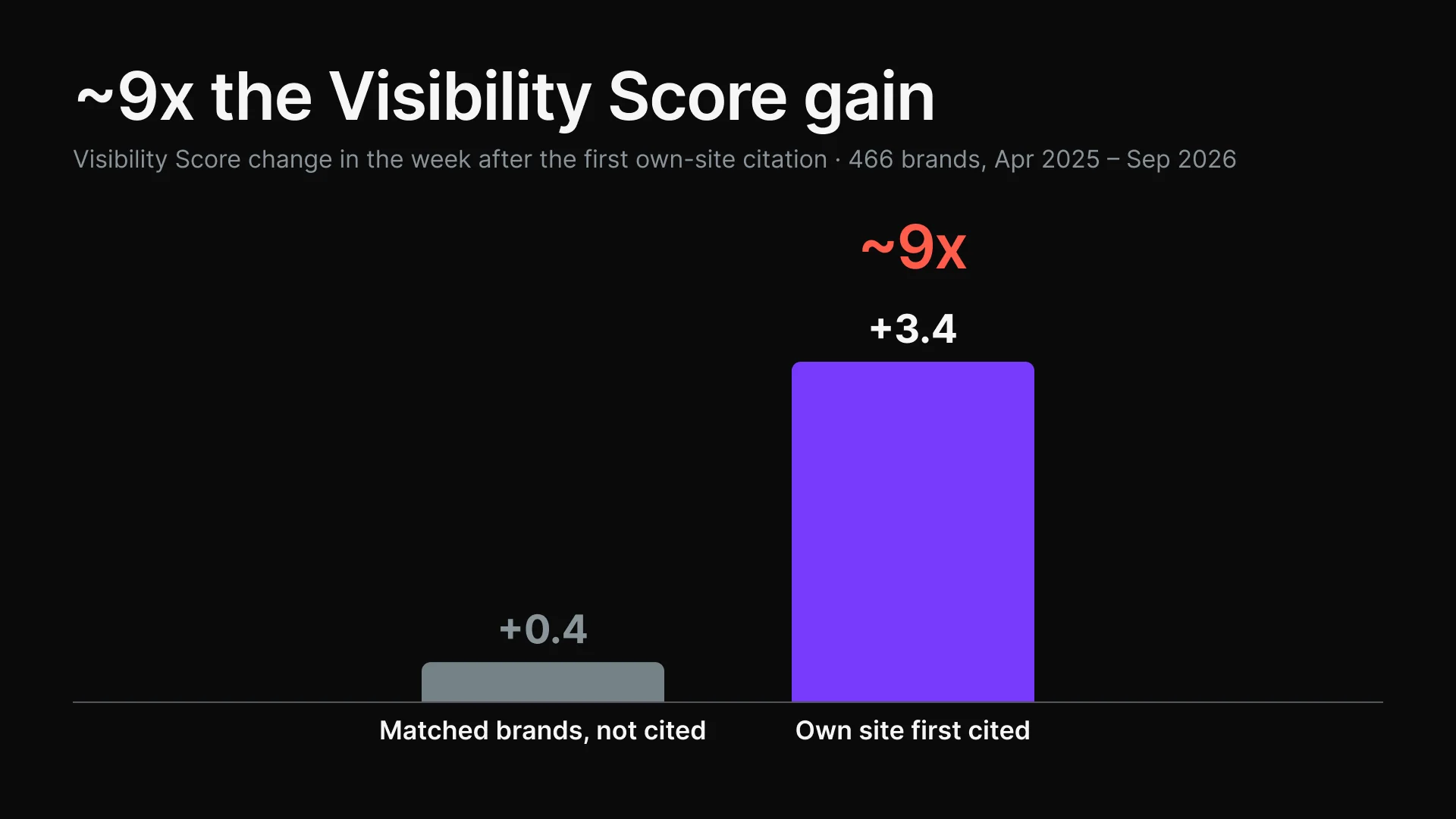
And when AI cites a brand’s own site for the first time, its Visibility Score grows about 9x as much in the following week as that of similar brands whose site wasn’t cited.
If you’ve been following us for a while, you know that at Surfer, we don’t like to just say things. We back all our claims and product decisions, including checking the actual ROI of Surfer.
So we looked into brands with AI Search Analytics projects to see what happens when AI starts citing their own sites, and when other pages start mentioning them. We also compared AI visibility results of Surfer-optimized pages vs. matched pages that weren't optimized.
Here’s what we found. And I also included tips on how to use Surfer to actually optimize for visibility.
*That’s not a direct quote from our data team, but they allowed me to exaggerate for dramatic purposes. That was the first and last exaggeration in this study. Below, just hard data.
Before we continue: a quick note on the data
Where the data comes from. AI Search Analytics collects answers from the real user interfaces (not from APIs—see why the distinction matters in our study on scraped LLM answers vs. API results) of ChatGPT, Perplexity, Gemini, AI Mode, and AI Overviews.
Which Surfer tools we investigated. We aimed to prove the return on investment for using AI Search Analytics, our tool that tracks mentions of your content and brand in LLM-generated responses, and Content Editor, our tool that helps you write and optimize articles to achieve higher search engine rankings for your topic. An active AI Search Analytics project means a fully set-up tracker for a given brand (added tracked topics and prompts). A Content Editor page means a document with Surfer’s optimization guidelines for the chosen keywords and locations.
What the metrics mean. Mention rate is the share of AI answers that name your brand. Visibility Score tracks and compares your visibility across tracked prompts and AI models: how often they mention you and how high up in the answer (two metrics from the top of the overview page). Share of voice is the percentage of brand mentions, citations, or recommendations your company receives compared to competitors across AI-generated answers.
Datasets and time frames. We collected 30M AI answers and 268M total citations, and tracked 130K prompts and 9,836 brands between February and October 2026. The own-site citation study covers a longer window: April 2025 to September 2026.
Getting your own site cited = 9x Visibility Score gain
First things first: we wanted to see how earning a citation affects AI visibility.
We followed 466 brands (April 2025 to September 2026) from the week before AI first cited a page on their site to the week after. We compared each with similar brands whose sites weren't cited. All the brands we tracked started with the same mention rate and the same number of prompts.
In the week after the citation, the Visibility Score rose 3.4 points, about 9x as much as the comparison brands (+0.4).
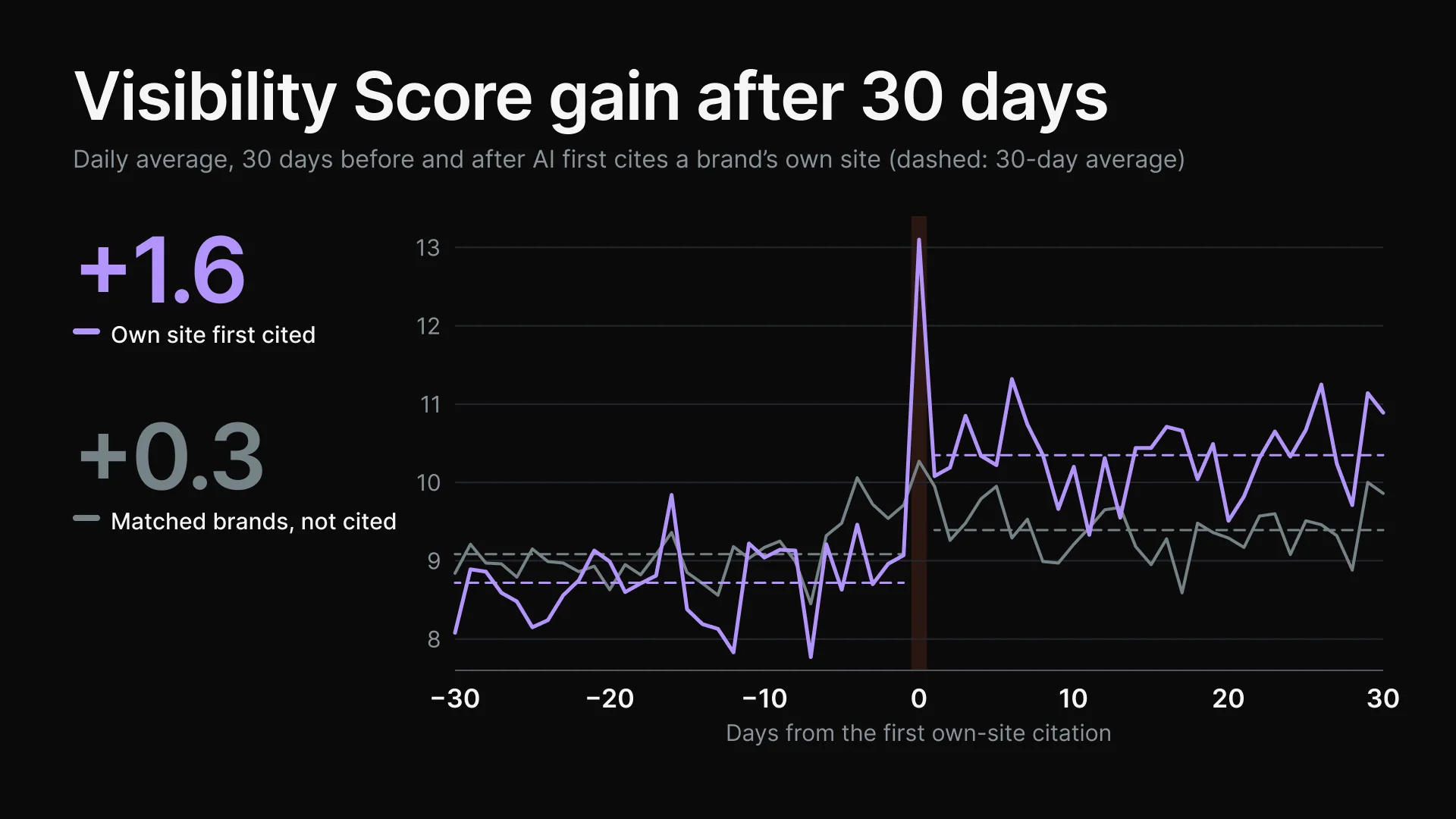
And before you start wondering: the positive impact lasted more than just that week.
A month later, these brands still had a higher Visibility Score than the comparison brands.
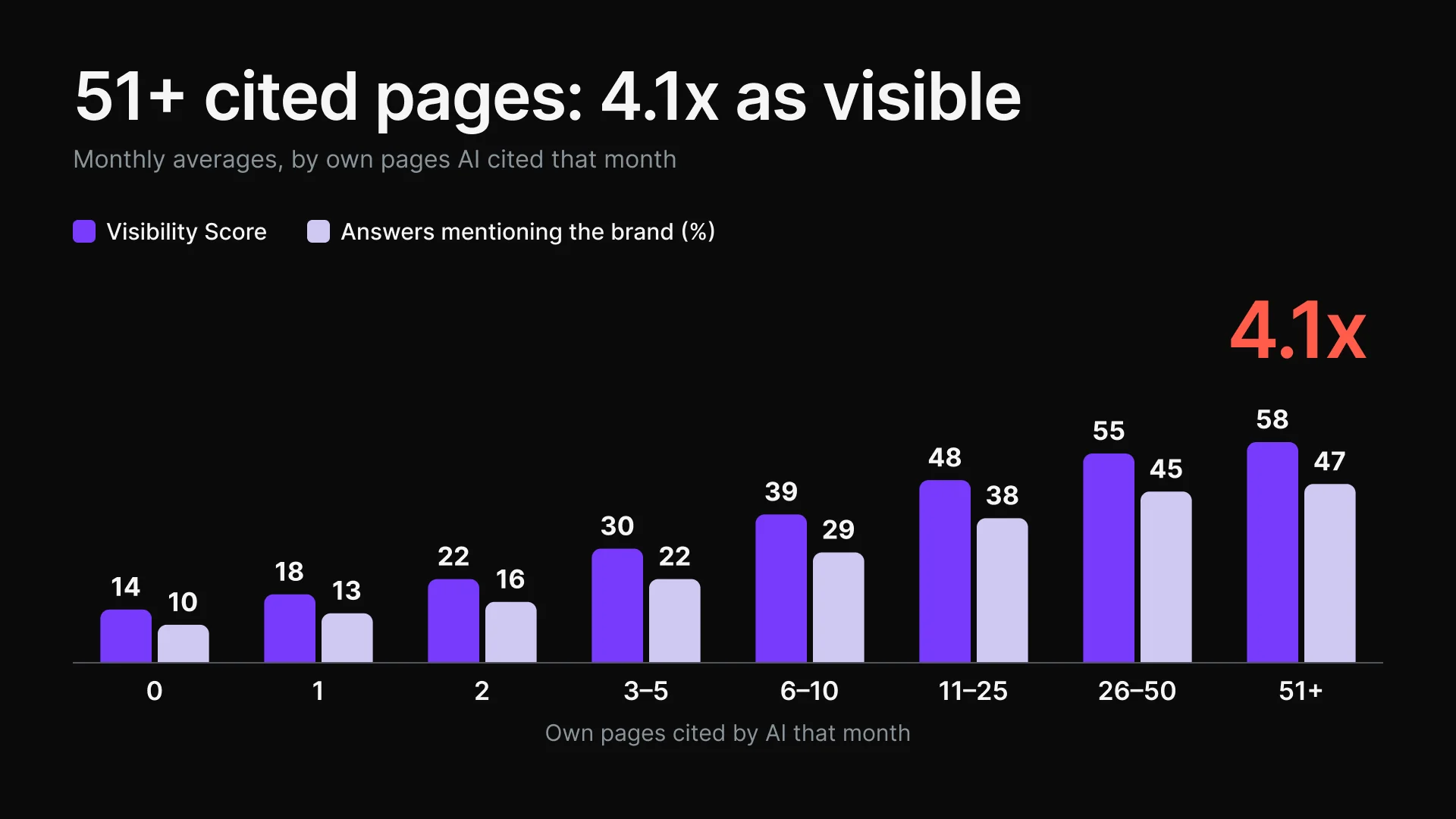
Let’s watch it stack: every new cited page adds visibility, and brands with 51+ cited pages are 4.1x as visible
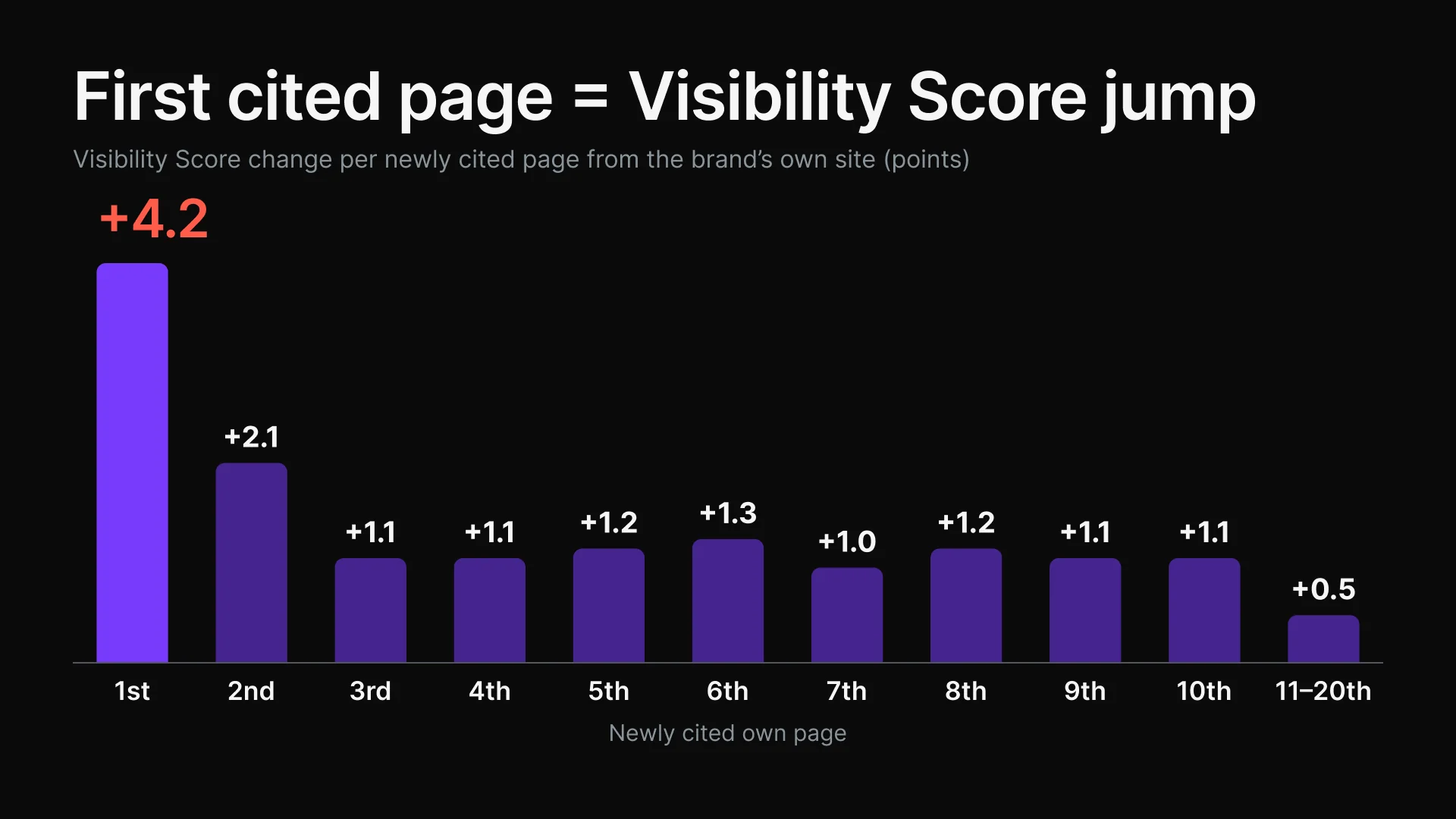
Of course, the numbers above are about the domain's first citation. It does bring the biggest lift, and each new cited page after that adds a little less.
But it’s like mastering a new skill—progress slows down after the start, but your efforts still compound. It’s all about perseverance.
Take a look at the chart below. The first cited page usually gives you the biggest jump in Visibility Score: +25% (4.2 points). Each subsequent page (up to 20) adds 9%, then 4% to 1%.
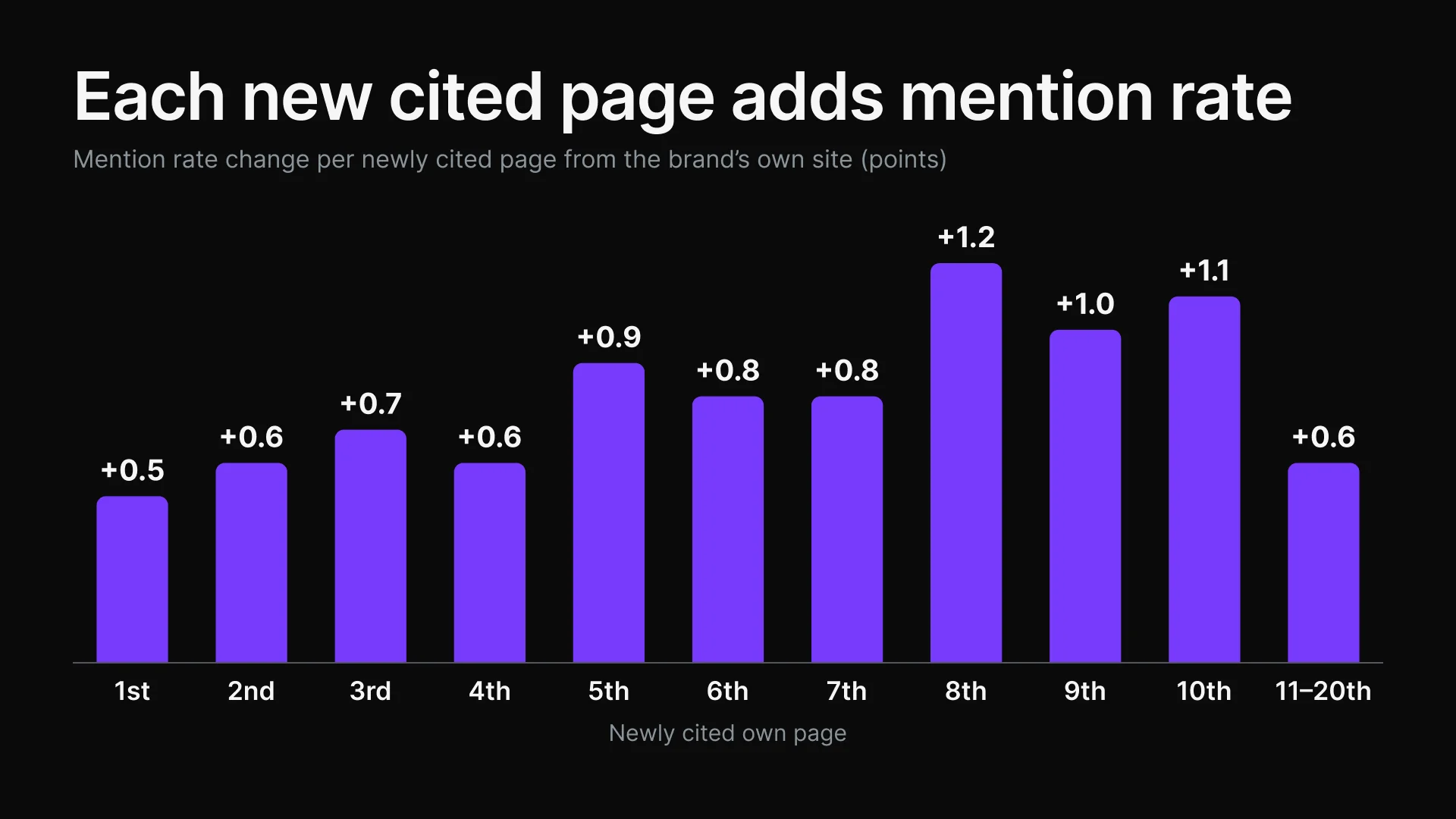
For mention rate, growth is steady: 7%—4% for the first 10 pages, then around 2% for pages 11 to 20.
And the gains stack up. We grouped brands by how many distinct pages from their own site AI cited in a month.
Brands with 51 or more cited pages had 4.1x the visibility and 6.0x the share of voice of brands with no cited pages.
| Own pages cited by AI in a month | Visibility Score | Answers mentioning the brand | Share of voice |
|---|---|---|---|
| 0 | 14 | 10% | 1.7% |
| 1 | 18 | 13% | 2.0% |
| 3 to 5 | 30 | 22% | 3.5% |
| 11 to 25 | 48 | 38% | 6.6% |
| 51+ | 58 | 47% | 10.3% |
AI is naming fewer brands over time, which makes getting noticed even harder
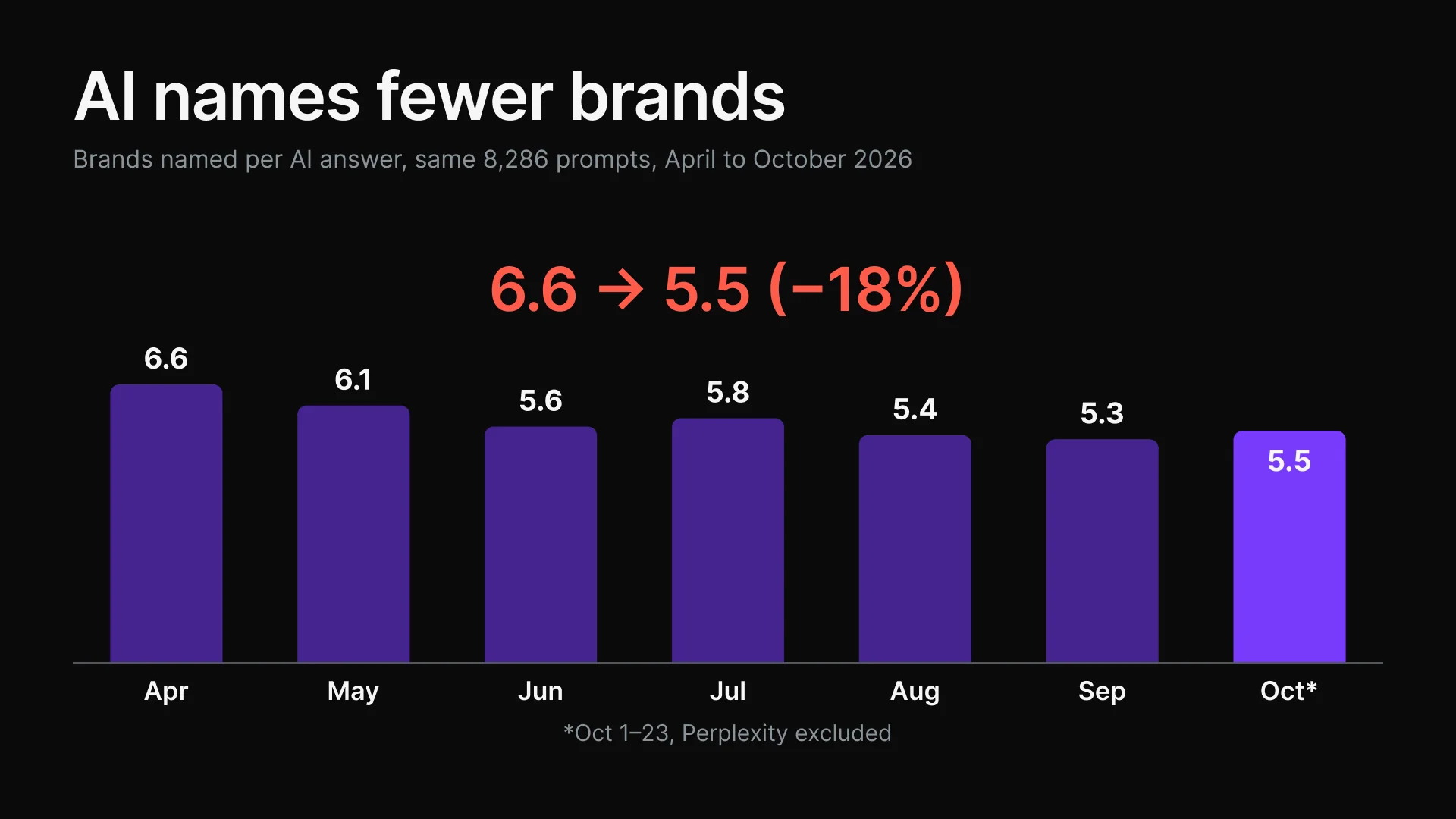
AI answers are getting more competitive. On average, they name fewer brands each month.
We tracked the same 8,286 prompts every month and found that over the past 6 months (April to October 2026), the average number of brands named dropped by around 18%, from 6.6 to 5.5.
So waiting for visibility to come to you not only slows you down, but also leaves you gambling on whether it comes at all. You need targeted actions, and getting your own pages cited is one of the fastest.
Okay, so now you know getting your own page cited pays off.
But how do we know Surfer is actually impacting your visibility? Let’s see.
Does Surfer get you cited more? Optimized pages get cited almost 2x as often (and your strongest pages gain 9x as much)
We measured how often 2,432 Surfer-optimized pages are cited in AI answers (ChatGPT, Perplexity, Gemini, AI Mode, and AI Overviews) in the 28 days before vs. after optimization, against 24,286 matched pages from across the web. We matched them on starting visibility and the same dates.
We discovered that Surfer-optimized pages get cited 1.71x as often. In most cases, they gained citations over time, while the control group lost them.
But these are just averages. For some pages, the share of AI answers grew even higher. If you optimize a page AI already cites a lot, the answer share you win (or keep) is 9x what you’d get from a brand-new page.
And if you keep optimizing your pages for high-quality prompts—which you can easily do with Surfer's recommendation system—just 25 optimized established pages can add 21,750 AI appearances a month.
But how did we arrive at these numbers? Let’s see.
A bit more detail on the methodology: a page counts as optimized if it was imported into Content Editor, edited within 7 days, and at least 5% of its content was changed. We matched each one with up to 10 random pages from across the web that started with the same share of AI answers in the same month. Then we compared the 28 days before the import with the 28 days after (import day excluded). Every page counts once, and drafts written by the Surfer team were removed.
The stronger you start, the stronger your citation odds (up to 9x advantage)
We split the pages into a few groups based on whether, and how heavily, they were cited before optimization.
Optimized pages won extra answer share over their matched pages in every tier, and the advantage grew roughly 9x from new pages to strong ones.
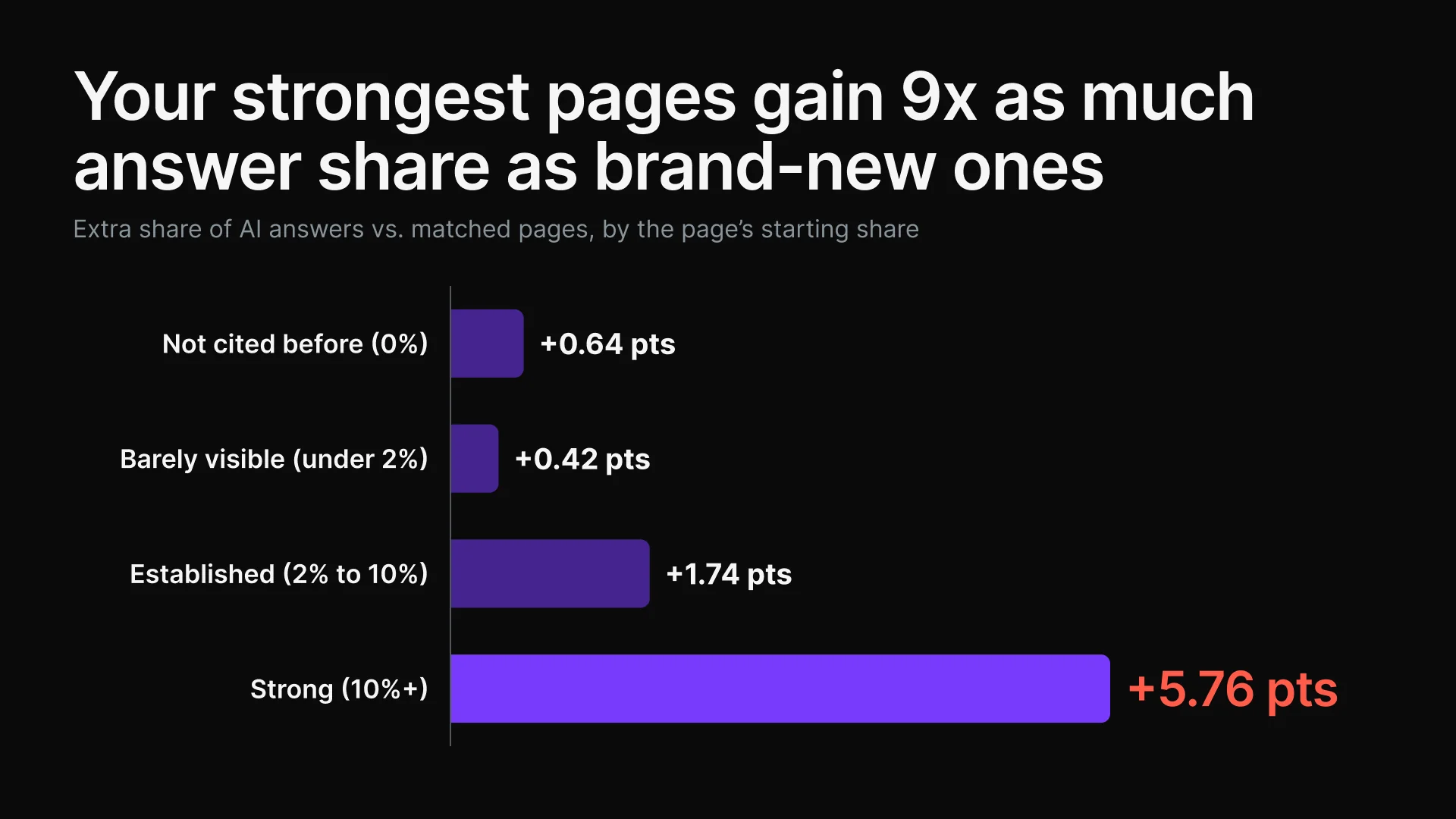
They also won on citation frequency. On average, Surfer-optimized pages turned out to be cited 1.71x as often (71% extra citations compared to the control group):
| Page's starting point (share of AI answers citing it) | Citation frequency, optimized, before → after | Citation frequency, not optimized, before → after | Optimized pages cited... | Advantage | Extra citations vs control |
|---|---|---|---|---|---|
| Not cited before (0%) | 0.00% → 1.20% | 0.00% → 0.56% | 2.13x as often | +0.64 pp | +113% |
| Barely visible (under 2%) | 0.75% → 1.03% | 0.75% → 0.61% | 1.67x as often | +0.42 pp | +67% |
| Established (2% to 10%) | 4.63% → 4.95% | 4.45% → 3.03% | 1.63x as often | +1.74 pp | +63% |
| Strong (≥10%) | 21.79% → 18.17% | 20.86% → 11.43% | 1.59x as often | +5.76 pp | +59% |
| All pages | 2.41% → 2.87% | 2.30% → 1.68% | 1.71x as often | +1.08 pp | +71% |
You may notice that strong pages fall regardless. The likely reason is that a high starting point means an unusually lucky month. And pages that start at the top have nowhere to go but down since AI rotates its citations constantly.
What’s important, though, is that they still fall much less than their unoptimized counterparts and show the biggest advantage of any group.
So what does this table show us?
- If you optimize your new pages, they double their odds of breaking through (2.13x).
- Pages that already show up not only win more citations (+1.74 pp advantage for established pages, and +5.76 pp for strong ones), but also don’t lose visibility or lose it to a much smaller extent.
- The biggest gains come from optimizing what’s already working. 9x more answer share for your strongest pages than for brand-new ones.
One optimized page can mean 17,400 extra AI appearances a month
And how do these visibility gains translate to views?
Take a question people ask AI and how often they ask it each month (understood as search volume). Multiply that by the advantage we presented above, and you get the extra monthly appearances in AI answers from optimizing a single page.
| Example keyword | Monthly asks | Extra appearances (established page, +1.74 pts) | Extra appearances (strong page, +5.76 pts) |
|---|---|---|---|
| suit | 1,000,000 | 17,400 | 57,600 |
| sun glasses | 400,000 | 6,960 | 23,040 |
| red dress | 200,000 | 3,480 | 11,520 |
| robot lawn mower | 50,000 | 870 | 2,880 |
The table only shows extra appearances for one keyword, though. But a page rarely answers just one question—there are always related ones.
And while you’re likely to hit a few of them anyway, Surfer’s Topical Map and Content Editor’s recommendations help you make sure you target all the most-searched questions and cover all the related topics you can.
Let’s scale it: 100 optimized pages add 87,000 AI appearances a month
Let's assume each page is an established one (already cited in 2% to 10% of answers) and competes for one question asked about 50,000 times a month.
(It’s a very safe assumption. As we established before, that’s pretty much never the case. A typical optimized page covers several questions.)
That means 10 optimized pages on your domain equal 8,700 more monthly appearances.
And 25 pages = 21,750 extra appearances.
These are pretty realistic numbers that most teams can sustain.
| Pages optimized on your domain | Extra appearances / month (established pages, +1.74 pts each) | Extra appearances / month (strong pages, +5.76 pts each) |
|---|---|---|
| 10 | 8,700 | 28,800 |
| 25 | 21,750 | 72,000 |
| 100 | 87,000 | 288,000 |
| 250 | 217,500 | 720,000 |
Visibility to revenue: about 44 to 130 extra conversions a month
Since I’m the kind of marketer who wouldn’t just serve you vanity metrics and assume you’re fine with it, let’s talk revenue.
We wanted to see how visibility translates into monetary gains. To calculate the approximate numbers, we followed these findings from outside sources:
- People click a source cited in an AI answer about 1% of the time (Pew Research).
- Visitors who click convert at 3x to 9x the rate of organic search traffic because the AI has already compared options for them (Microsoft Clarity cites 3x across 1,200+ sites; Seer Interactive saw ChatGPT visitors convert at 15.9% vs. 1.76% for organic).
So 100 established pages (87,000 extra appearances a month) mean about 870 highly qualified visits. At a 5% to 15% conversion rate, that's 44 to 130 extra conversions every month, from the clicks alone.
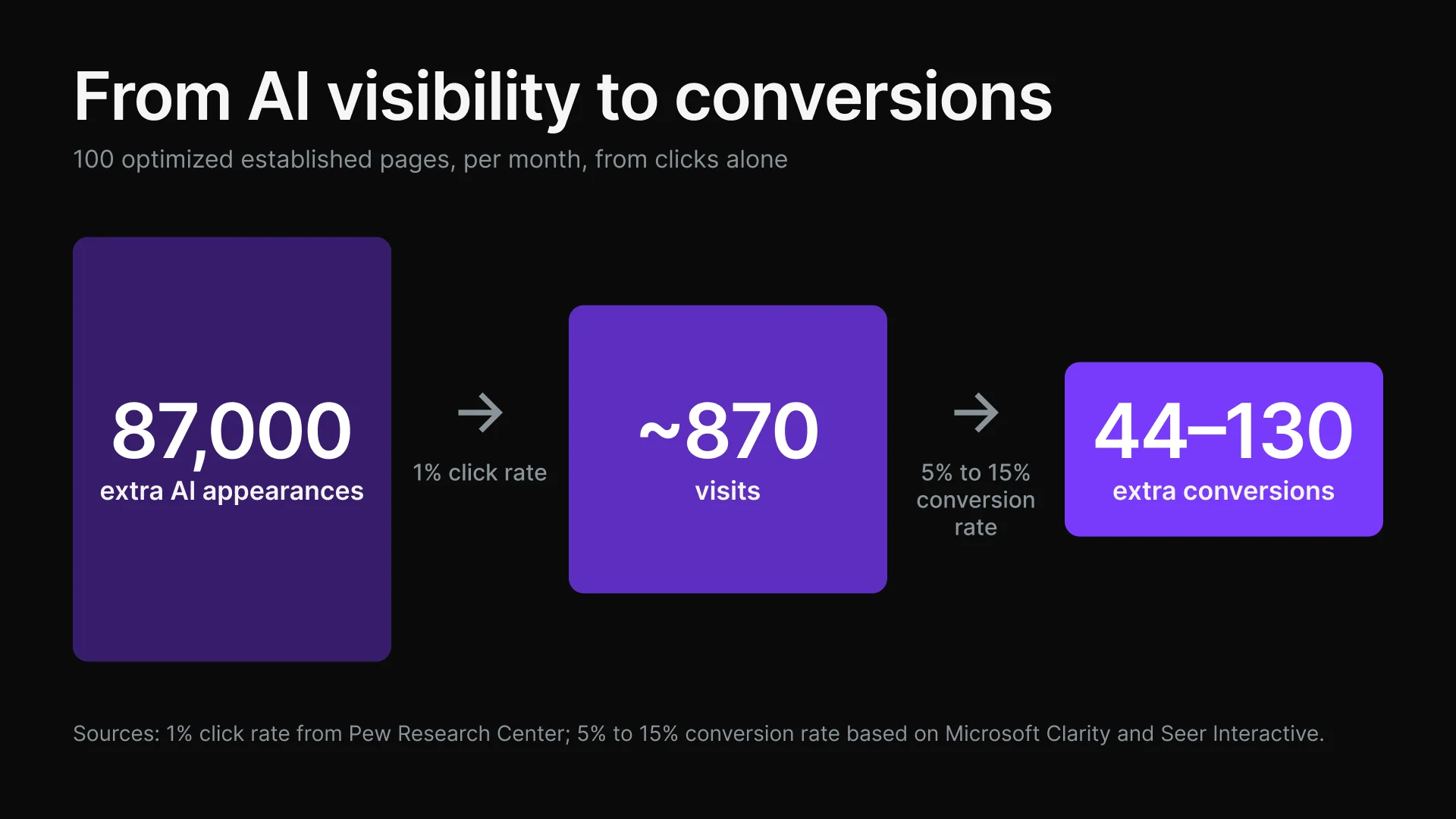
And this excludes the appearances where AI names your brand without a click. Those still drive branded searches and direct visits, just like word-of-mouth recommendations.
Measuring the ROI of tools that improve brand visibility should be the starting point. Today, it’s still the exception. As a data scientist, I’m interested in both reverse-engineering what drives visibility and measuring how well it works in practice.
Off-page findings: a mention on a top-cited page lifts mention rate by ~2 points (vs. 0.9 points on any page)
Above, I shared insights on how getting your own pages cited increases visibility, and how Surfer maximizes your chances of standing out.
But your domain is just half the picture. There are still mentions from other sources to account for.
We investigated what the first third-party mention means to a brand, and what collecting mentions adds up to, using a sample of 2,067 brands.
And here’s what we arrived at…
Brands with no cited pages of their own that weren't featured on any cited page were mentioned in just 3% of answers—vs. 44% for brands featured on at least one cited page.
So yes, mentions from other sites do matter. And they can give you an extra lift.
Let’s see how we arrived at these numbers.
The first third-party mention adds about 1 point of mention rate
We looked at brands in the 4 weeks before and after a page on another domain started mentioning them (say, by adding the brand to a comparison listicle).
The first new mention gave brands about 1 more percentage point of presence in answers (+0.9, from 33.9% to 34.8%) and +1.3 Visibility Score points (from 48.5 to 49.8).
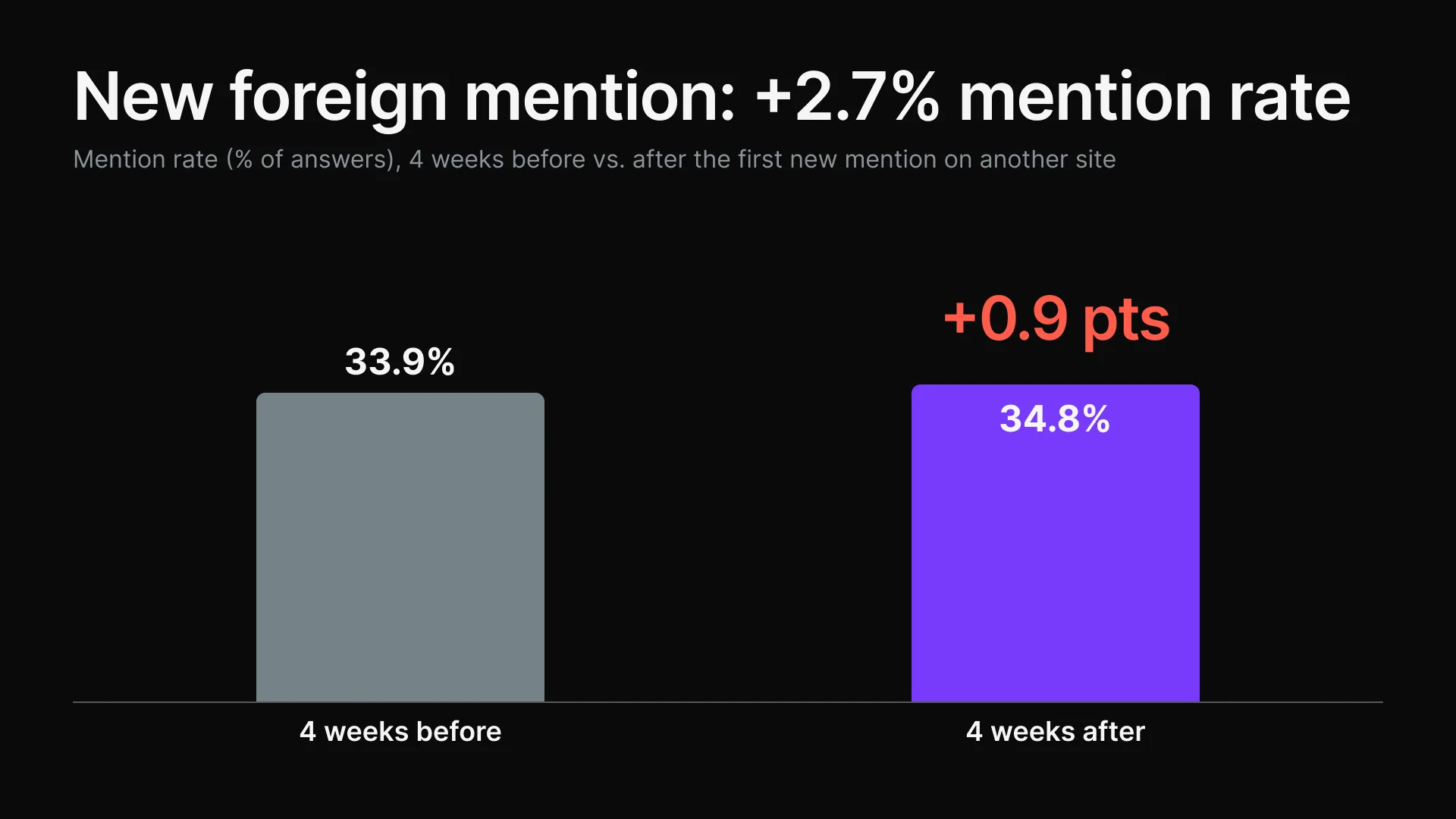
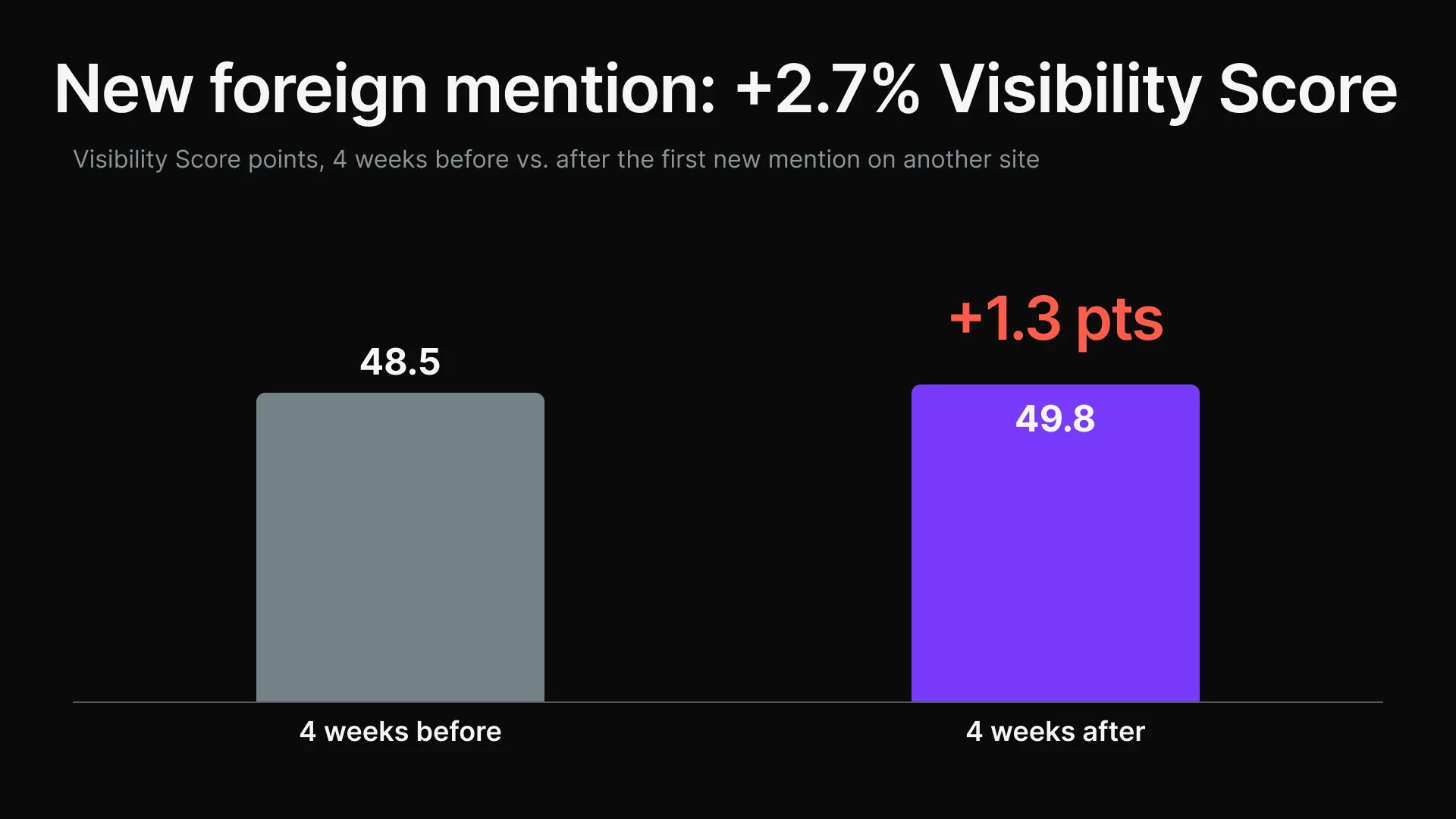
If you think, “But it’s just one lousy percentage point, what’s the fuss about?”—I get you. But AI answers are more volatile than, say, a local SERP. They are quite random from day to day, with slight adjustments depending on the specific prompt. So a steady gain of almost a point is really a lot.
And it's only the first mention. Brands are generally expected to collect more. (These are raw before-and-after numbers, so they include market-wide shifts and the brand's own momentum.)
Let’s compound: seven new mentions add about 6 Visibility Score points
The more pages on other domains mention you, the more visibility you gain. For example:
Mentions on 7 pages added 5.9 Visibility Score points and 4.0 points of mention rate.
Fewer brands got that far (2,067 brands had one new mention, 391 had seven). Still, the line keeps climbing.
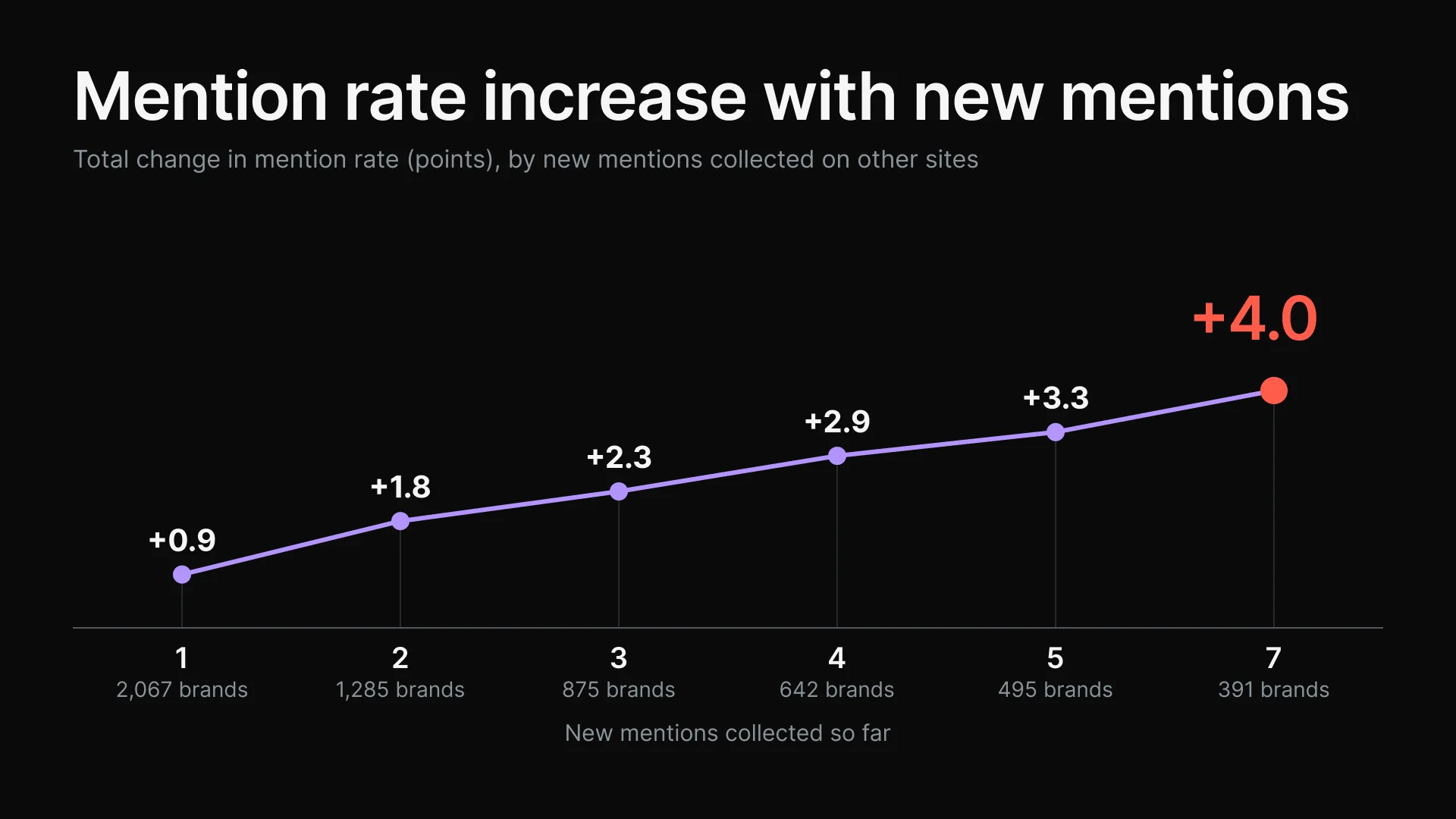
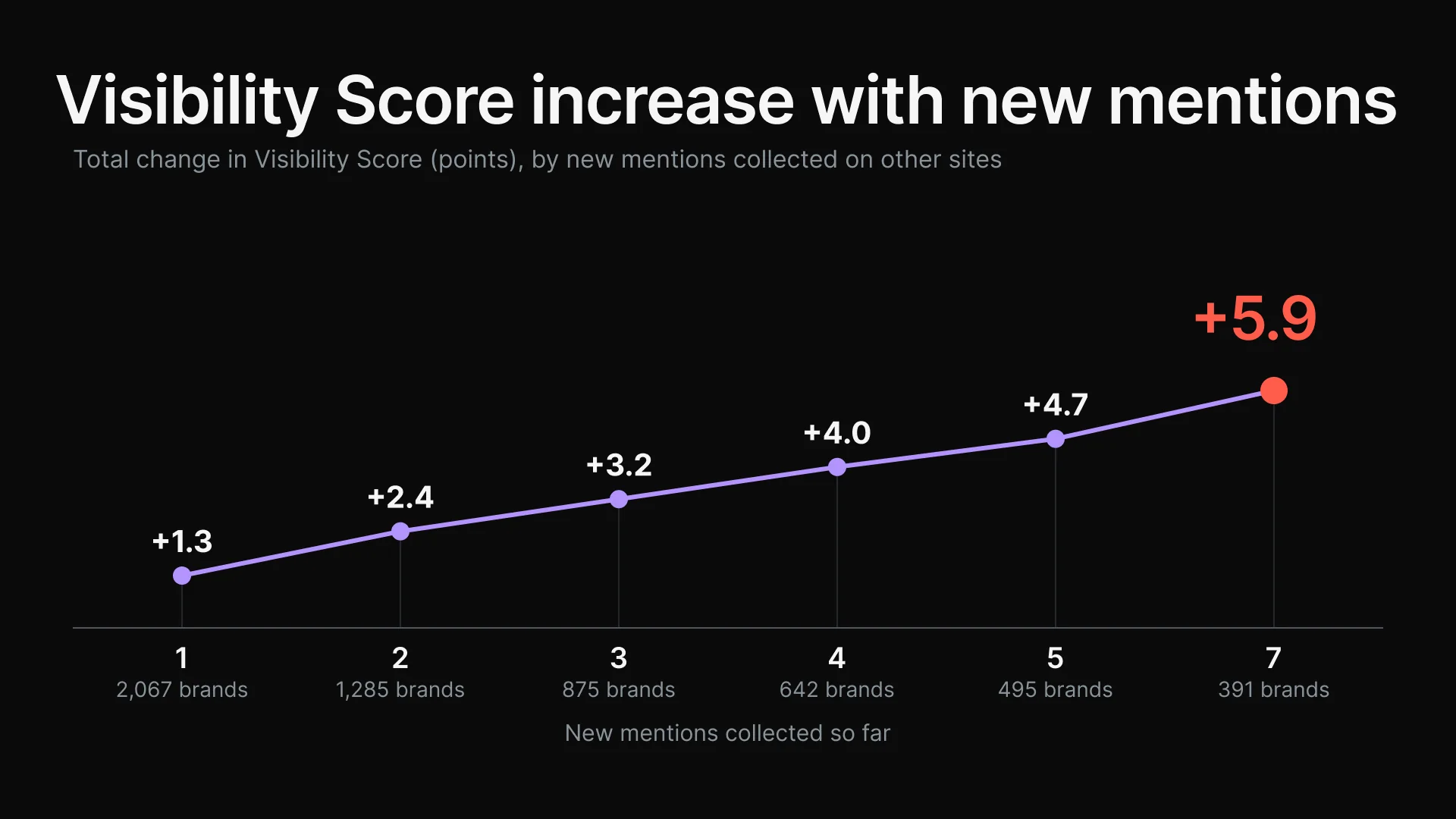
But is that the most you can get? No. What also matters is how visible the page that mentions you is.
Typically, a brand's AI answers cite about 1,000 different pages in four weeks. We ranked those pages by how often AI cited them, then checked where each brand's first new mention came from.
Only 13% of first mentions came from the 20 pages AI cites most. 56% came from pages ranked below the top 100.
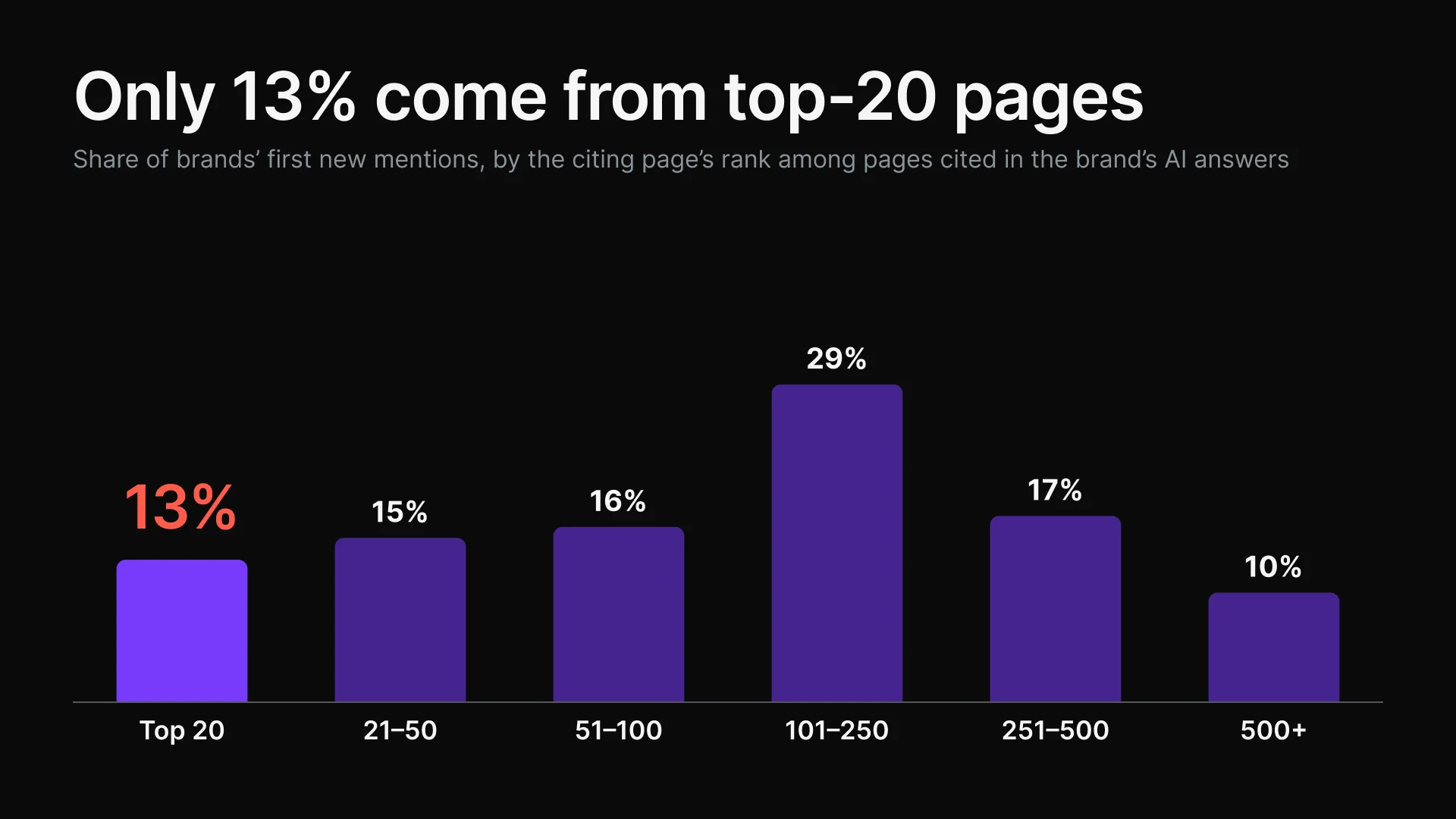
By citation share, it's the same story: 67% of first mentions came from pages cited in under 3% of the brand's AI answers.
But when the first mention came from one of the 20 pages AI cites most, it added 1.7 points to the mention rate, vs. 0.9 for a mention on any page.
| Where the first mention appeared | Mention rate change | Visibility Score change |
|---|---|---|
| Any page | +0.9 pts | +1.3 pts |
| Top 50 cited pages | +1.0 pts | +1.4 pts |
| Top 20 cited pages | +1.7 pts | +1.7 pts |
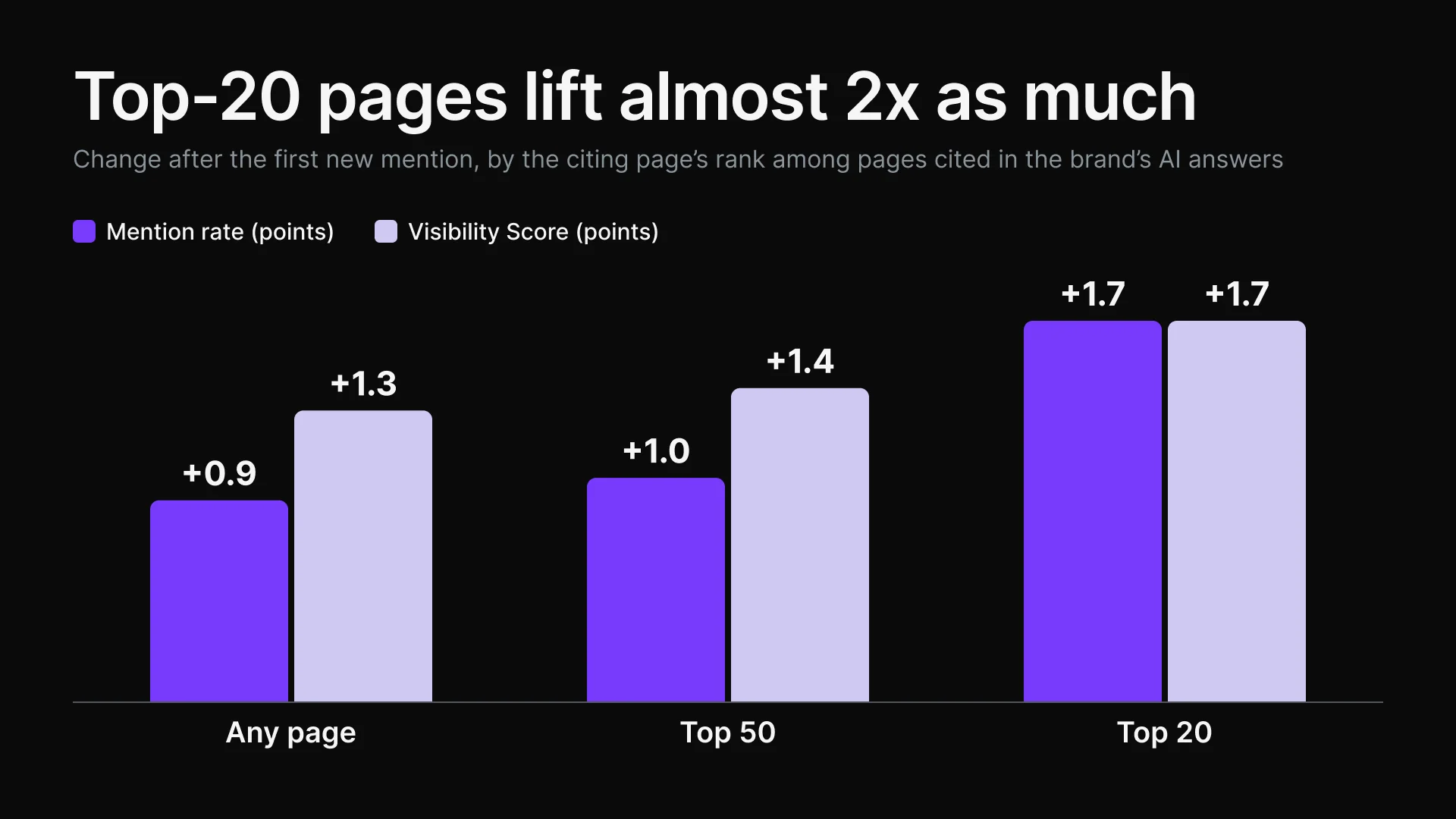
It pays off more if you focus on appearing on pages that already do well in your niche. And you need to do it at scale, because the gains stack up with every mention.
The “in your niche” part is crucial here. Sure, you can check the top-ranking pages for a given LLM and try to increase your visibility there.
But it may just as well be that, for your prompts, the top pages are outside that list. You need to check for your own use case every time.
Of course, Surfer can help you find them and scale your outreach efforts. More on that later.
Own content or third-party? Your own site lifts mentions by 22 points, but 73% of mentions come from third-party pages
Okay, so what should you focus on: optimizing your own content, or getting mentions from third-party sources?
Long story short: you need both.
And now for the actual long story:
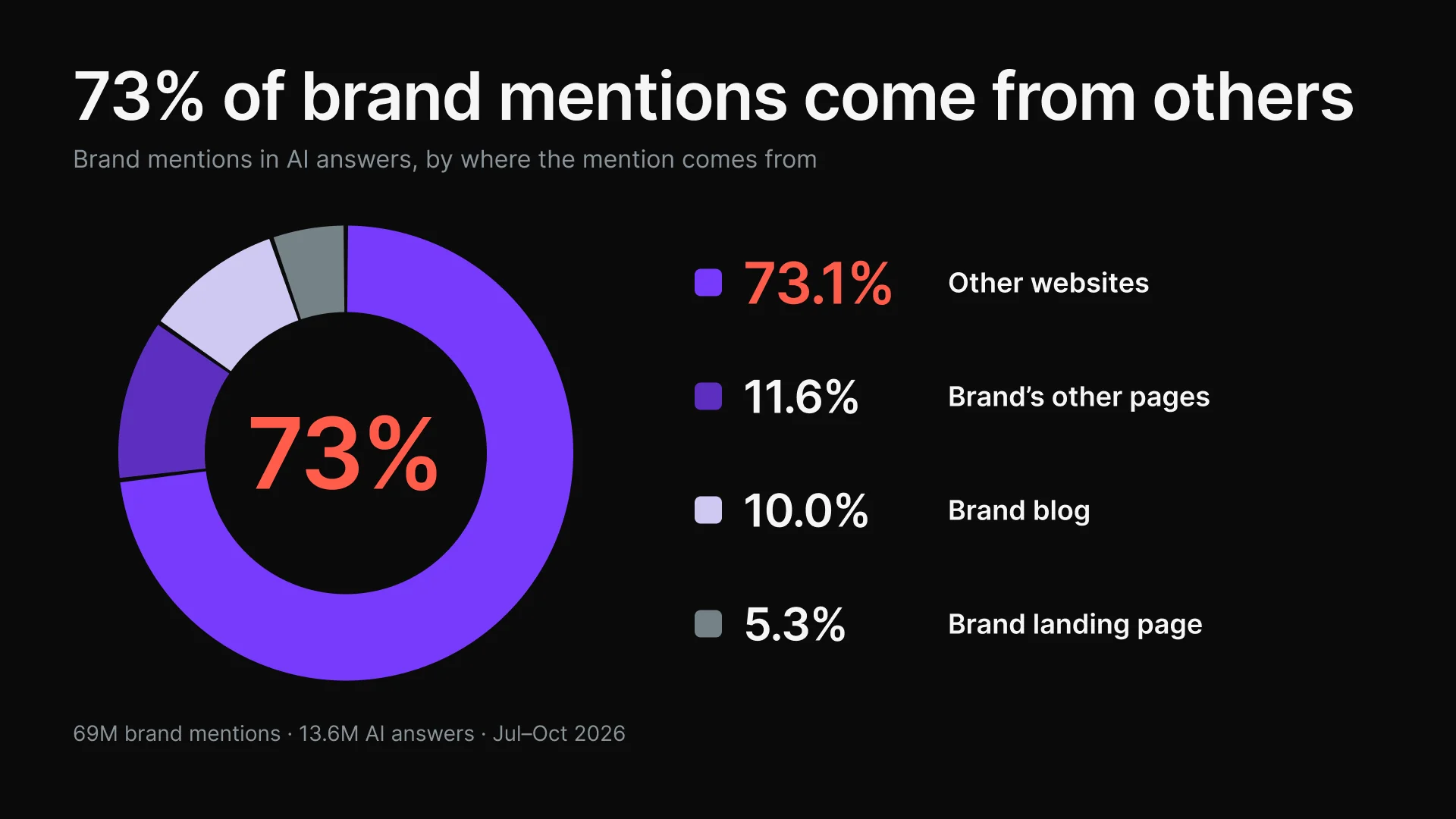
We collected 13,576,377 AI answers across 5,223 brands over 90 days, and checked what AI cited each time: the brand's own site, a third-party page that features the brand, or neither.
And what did we discover?
When AI cites your own site, it mentions you in 52% to 80% of related answers. When it cites only a third-party page that features you, that drops to 29% to 59%.
Gemini is the high end (80% vs. 59%). Perplexity is the outlier, with the lowest rates on both sides (52% vs. 29%). On the same prompt and model, an on-site citation beats a third-party feature by 22 points.
| Model | Mentioned when own site is cited | Mentioned when only a third-party page featuring the brand is cited |
|---|---|---|
| ChatGPT | 72% | 47% |
| Perplexity | 52% | 29% |
| Gemini | 80% | 59% |
| AI Mode | 74% | 51% |
| AI Overviews | 72% | 43% |
But here's the catch.
Brands that have no cited pages of their own AND aren’t mentioned by any cited third-party pages get mentioned in just 3% of answers.
But when a brand earns a third-party citation, the situation changes drastically—it starts appearing in 44% of answers.
In fact, across 69 million brand mentions in those 13.6 million answers, 73% came from third-party pages, not the brand's own site.
What does this mean for your strategy, beyond the simple “Both is good”?
If your own pages already get cited for a topic, optimizing them is the more direct win.
If AI rarely cites you and the answers lean on reviews, lists, and comparisons, that's where earning mentions pays more.
And either way, going for both tactics increases your chances of boosting your share of voice.
Summing up: So how does Surfer actually help?
AI visibility work pays off. It pays most when you target the most popular topics and prompts, and the top-cited sources.
Surfer can help you maximize your chances of getting noticed:
- Get your own site cited: In the week after AI first cited their own site, brands gained about 9x as much Visibility Score as similar brands. And brands with 51+ cited pages were 4.1x as visible as brands with no cited pages of their own.
- Optimize the right pages: 28 days after the edit, Surfer-optimized pages were cited in almost twice as many AI answers as matched pages that weren’t optimized. And the payoff grows with the prompt’s demand. The same gain on an established page means about 17,400 extra AI appearances a month for a question asked 1,000,000 times, vs. 870 for one asked 50,000 times. For new content, Surfer will help you discover the most frequently asked questions and help you cover as many as possible with one prompt. For existing content, it will help you choose the pages that can lift your visibility the most.
- Adding third-party mentions: A brand’s first new mention on another site added 0.9 points of mention rate, and seven added 4.0 points. A mention on one of the 20 pages AI cites most added 1.7 points, almost 2x the lift.
How to actually get the visibility lift? Lessons and tactics (based on the hard work of our data specialists)
We didn’t collect all this data just to make pretty charts.
Let’s use the insights above, plus data from some of our other studies, to give you a few best practices to follow.
(I don’t like the term “best practices” any more than the next guy. But these are all data-backed, and I promise to come back here and fix them if the numbers ever show otherwise.)
1. Optimize the pages AI already cites (established pages win 1.74 extra points of answer share, almost 3x what new pages get)
I already mentioned that above, but it’s worth repeating.
Optimizing your own pages that AI already cites a lot is, hands down, the most effective tactic (if we look at the individual gains of each method).
Established pages (cited in 2% to 10% of answers) won 1.74 extra points of answer share over their matched pages. That’s 4x the gain of barely visible pages and almost 3x the gain of brand-new pages.
They went from 4.63% of answers to 4.95% after optimization, while their matched pages slid from 4.45% to 3.03%, losing almost a third of their citations. That’s 1.63x as many citations after 28 days.
And strong pages won as much as 5.76 points of advantage, with optimization limiting citation drops.
Numbers aside, what that means for your content calendar is: if you’re unsure of your next move, go with optimizing the pages AI already cites most often to protect your winners from losing their crowns. Of course, with Surfer, you also get a list of Recommendations sorted by priority, so you don’t actually have to worry about this kind of decision-making.
2. Follow data-backed optimization rules (intent-aligned pages are cited 2x to 3.25x as often)
In April 2026, we checked 650k+ unique answers across 2k prompts per model to discover which factors make AI cite a page most often. Search intent alignment turned out to be the most vital across the board.
In fact, pages aligned with the prompt's intent were 2x to 3.25x as likely to be cited as misaligned ones (3.25x for blog posts).
Here are a few other rules to follow:
- Match the search intent. Name the topic in sentence one.
- Confirm and answer the question early. Early query confirmation and an early answer are the second and third most important factors. Give a short version of your conclusion early on.
- Cover the facts. Pages AI cites every time a question is asked cover 42% of a topic's key facts, vs. 23% for pages that aren't cited.
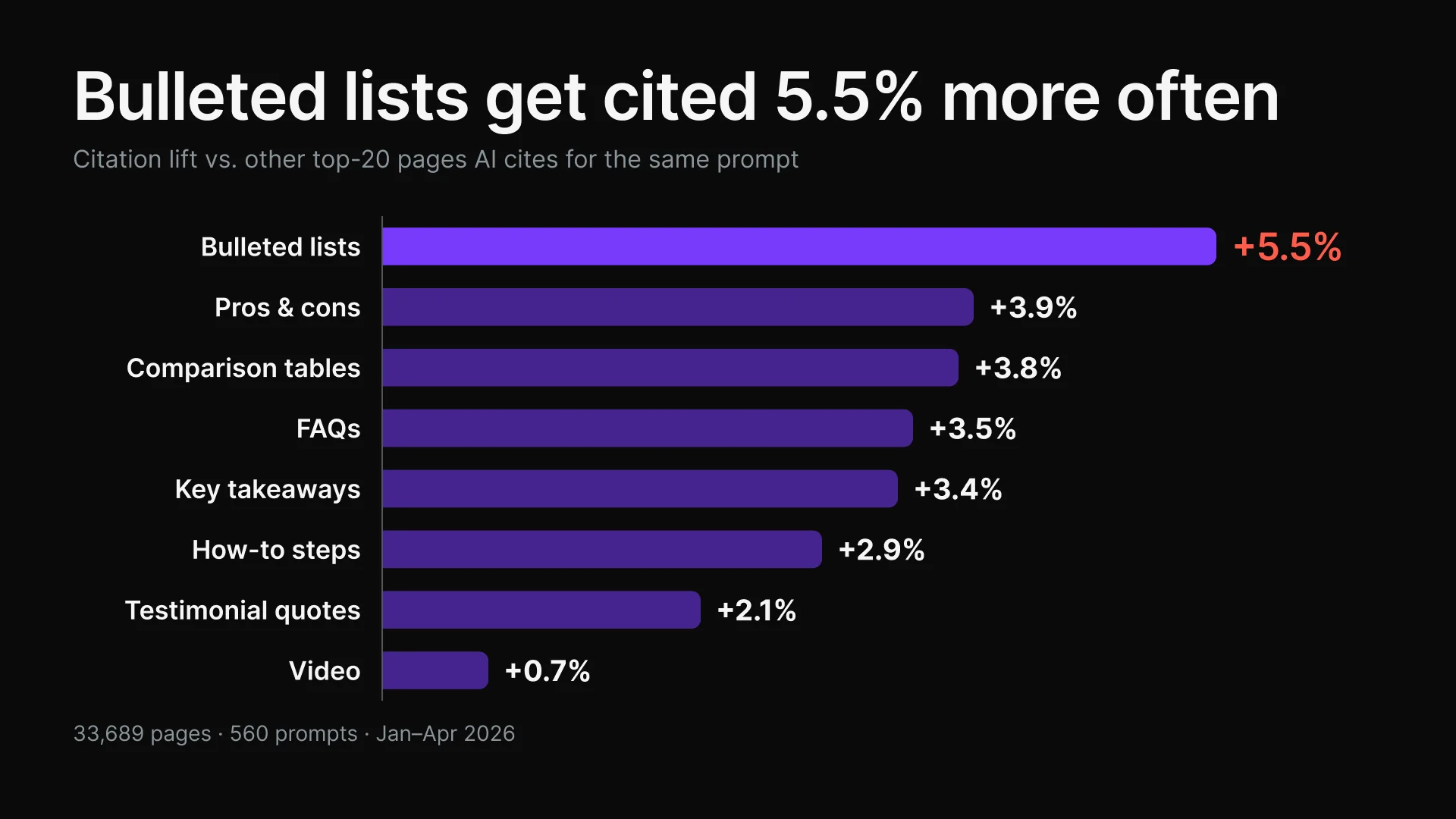
- Make it easy to pull from. Pages with bulleted lists are cited 5.5% more often, and pages with FAQs 3.5% more often.
Of course, the exact ranking factors differ from model to model.
But if you want the one optimization tactic that rules them all, it’s definitely: Don’t sleep on your intros.
And if you'd rather check the data yourself, a few of our previous studies break down what gets you cited in each model:
- How to rank in ChatGPT
- What gets you cited in Perplexity
- How to rank in Google AI Mode
- What gets you cited in AI Overviews
- Why almost 40% of AI citations come from your first 100 words
What that means for every page you edit: check the intent and the intro first. They're the two things AI reads before deciding whether your page is worth citing. If you use Surfer’s Content Editor, you don’t have to worry about all that. We measure how well-optimized your page is with the AI Search Score and give you all the guidelines—or you can Auto-Optimize with just one click.
3. Scale with AI if you want to (Google's spam update hit AI-written pages no harder: 48.6% vs. 49.0%)
Okay, fair, this one's mainly about Google rankings, not AI answers.
But the findings still matter for AI visibility: AI Overviews and AI Mode, two powerful engines your users definitely see, build their answers on Google's results.
We looked at Search Console data from 297,343 pages on 8,462 sites in the week after Google's August 18 to 21, 2026 spam update. Then we compared the 10% of pages that lost the most with the 10% that gained the most, against how those groups differ in an ordinary week.
Among the biggest losers, 48.6% of pages were flagged as AI-written. Among the biggest winners, 49.0%.
That 0.4-point gap is what an ordinary week looks like (0.7 points, give or take 2.9). The update didn't single out AI content. (However, do keep in mind that AI detection covers English pages only.)
What did lose? Generic advice written in long templates with tables of contents and lots of subheadings. The blog posts that gained were more often written in the first person and included a form or call to action, so there was a business and an author behind them.
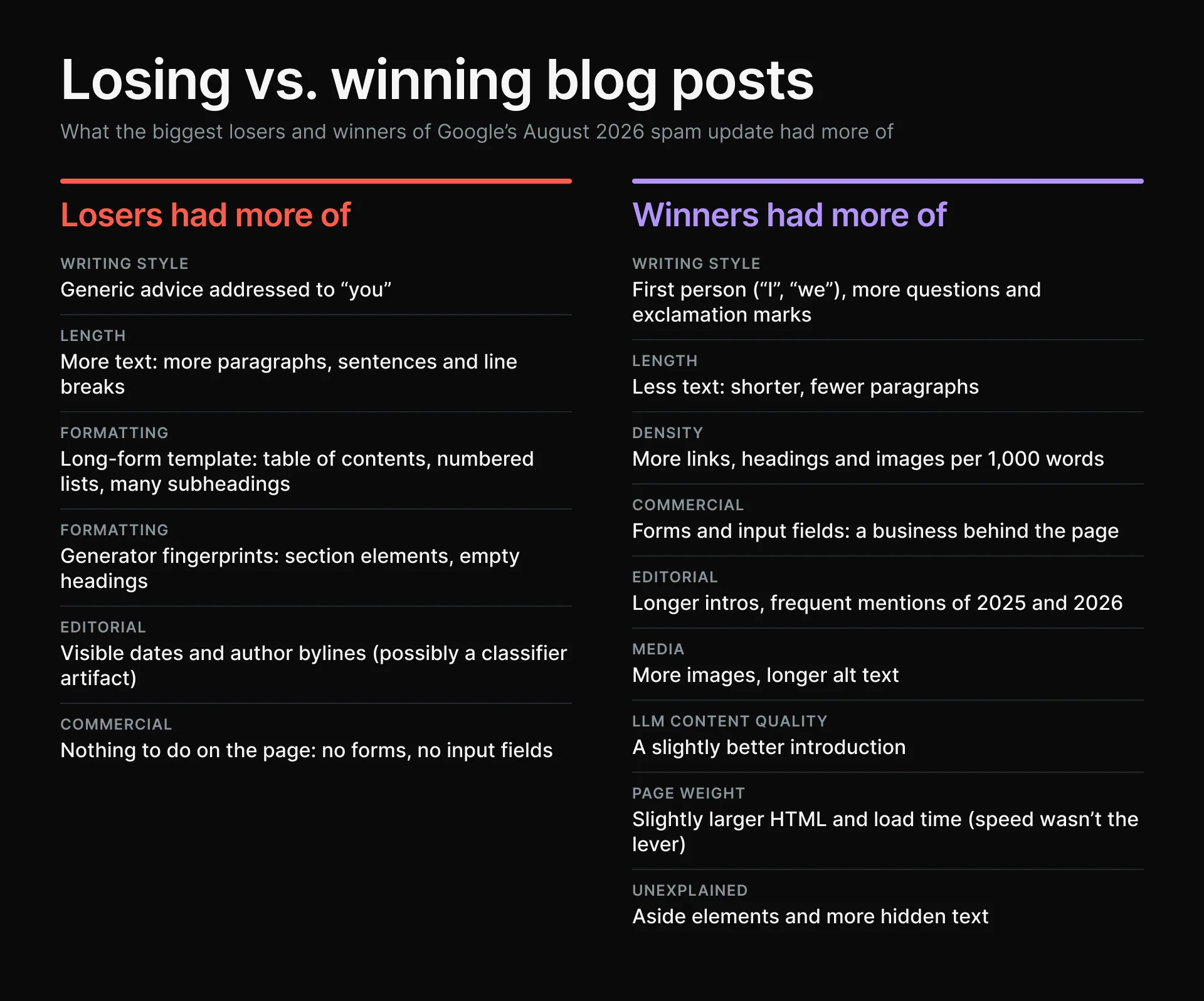
What that means for scaling your content: using AI to write is fine—as long as you have your own voice and opinions. Don’t be scared to use Surfer’s AI writing assistant or any other LLM. Just make sure to add a custom tone of voice and have ideas for your content beyond “we just need to ship whatever to cover this topic.”
4. Aim for the top-cited pages in YOUR niche (they lift mention rate almost 2x as much)
As the findings showed, most brands earn their first mentions on pages AI rarely reads, even though a mention on one of the 20 pages AI cites most lifts mention rate almost 2x as much (1.7 vs. 0.9 points).
But here's the thing: the pages that matter are specific to YOUR niche. Reddit is one of the most cited domains overall, but the sources AI cites for one brand's prompts look very different from another's.
What that means for your outreach: before you launch a Reddit campaign only to have your super insightful comments deleted by mods for being too marketing-y, find the pages AI cites most for your prompts, and aim to get mentioned by them. Surfer’s AI Search Analytics (specifically, the Sources tab—or you can just ask Surfer MCP, of course) can help you find the most cited sources for your niche.
Check out our guide on how to find your top sources and get the mentions:
5. Track each model separately
In August 2026, ChatGPT cut Reddit, YouTube, and social media sites from its sources. Reddit went from about 4% of ChatGPT’s citations in July to about 1% in late August, with most of the drop in the week of August 10. The share of ChatGPT answers citing any social site fell from 28% to 3%.
Some people started freaking out on social media—but that's only one model. AI Overviews and AI Mode didn’t follow. Reddit held steady there, and YouTube even grew.
What that means for your social and video teams: KEEP GOING. ChatGPT pulling back from socials and videos doesn't make these channels worthless for AI visibility. AI Overviews is huge, and there, Reddit held steady while YouTube grew. You always need to look at each model separately. Of course, Surfer tracks all five leading AI models and lets you filter all your data by model—as well as get separate recommendations for each.
AI visibility is a whole-company job
AI builds its picture of your brand from everything the web says about you. So the work can't sit with one team.
We compared different content types by how strongly they're linked to brand mentions in AI answers.
Brand blogs (0.35) and third-party blogs (0.24) correlate most strongly with mentions. But they’re followed by news (0.22) and brand websites (0.20), and reviews, videos, and social media sites are still on the list.
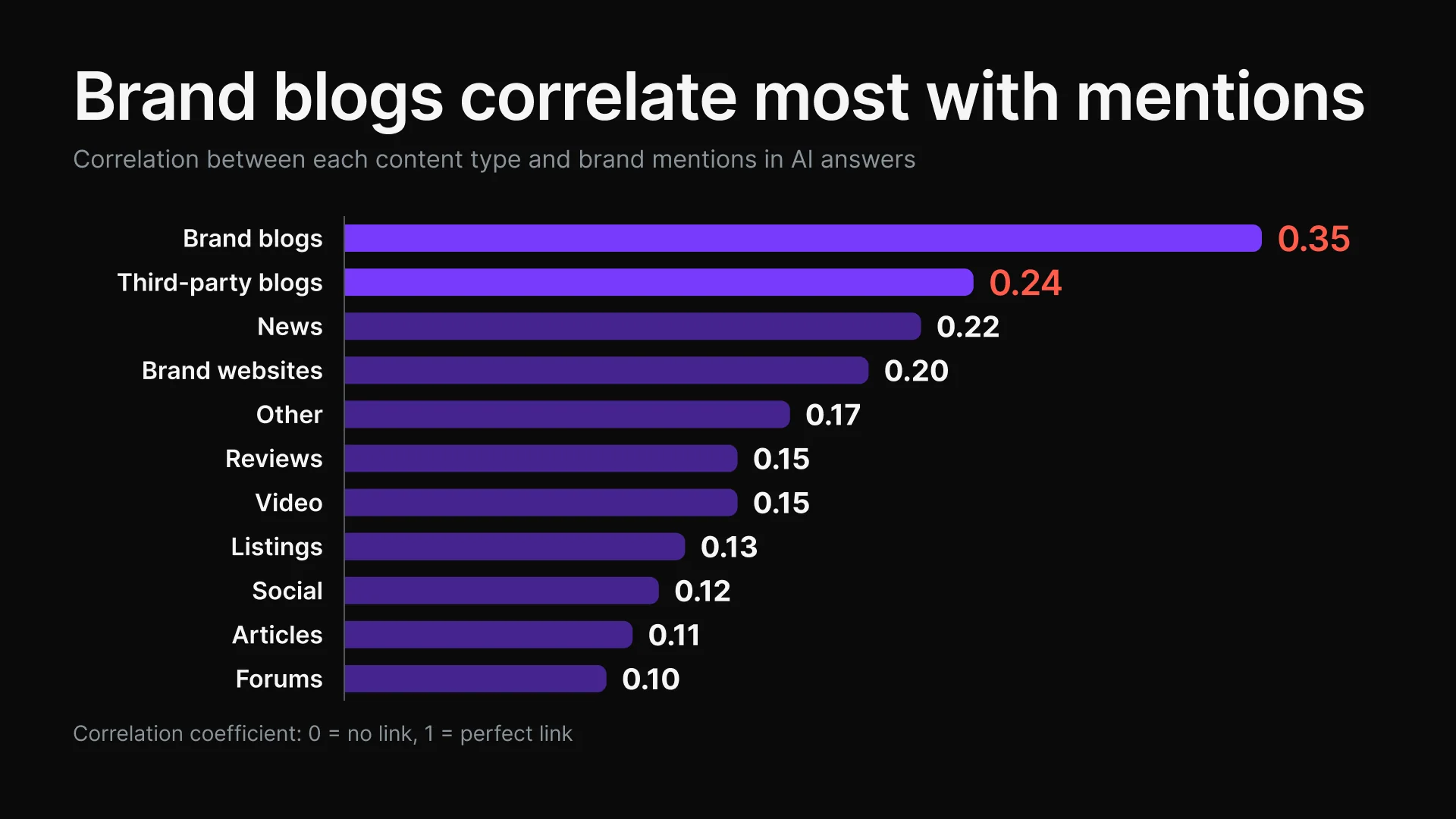
(For the stats buffs: these are correlation coefficients, where 0 means no link and 1 means a perfect one. 0.35 is a moderate link, and everything else on the list is weaker.)
And remember Google's August spam update? It also showed the importance of paying attention to content other than traditional blog posts to gain visibility. Landing pages and shop pages turned out to be the biggest winners.
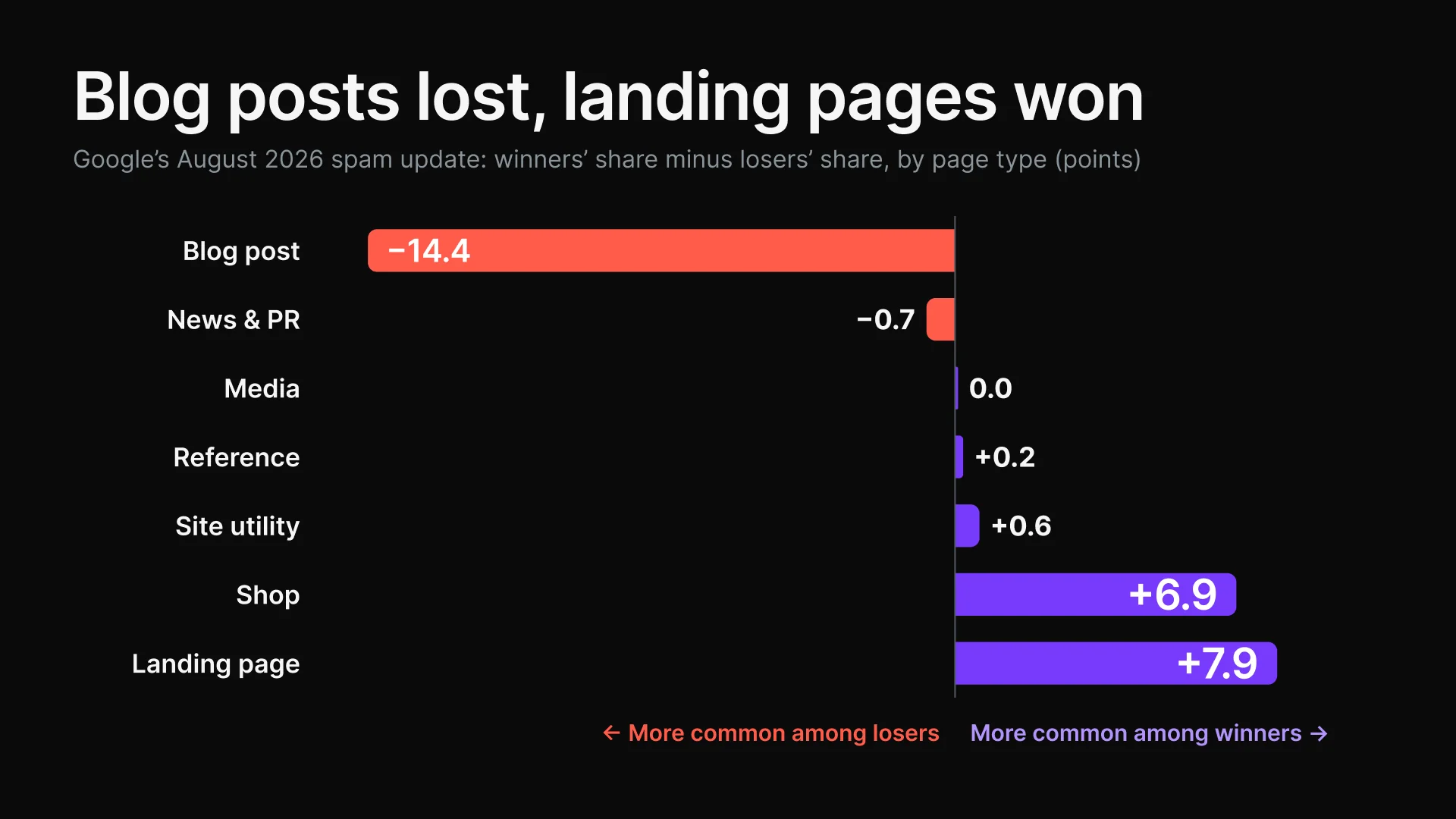
So the content and targeted actions that win AI visibility come from all over your company. Let’s see what each marketing team may own:
- Content and SEO: your brand blog, website, and guest posting, the two most relevant content types.
- PR and partnerships: news, plus outreach to top-cited pages in your niche.
- Product marketing: reviews and listings, and ensuring all content follows the up-to-date brand narrative.
- Social and video: video, social, and forums.
And they need to tell the same story. When AI cross-checks your site against third-party pages, mixed messages work against you.
What that means for your team: make AI visibility one shared KPI. Centralize your visibility strategy across all marketing teams to ensure consistent messaging and smart, targeted actions. With Surfer, you can set up a whole content headquarters to always know which content (or outreach) should target which topic. It’s especially easy with MCP—all your coworkers can access the same knowledge hub through their own AI assistant.
Track and grow your AI visibility with Surfer
Everything above comes down to two lists: the pages you should optimize or create, and the third-party pages AI cites most for your prompts. You can build both by hand, by running your prompts in each model and logging every cited URL. But across dozens of prompts and five models, that gets old fast.
You can do this with Surfer, either in the app or through the AI assistant you already use (Claude, ChatGPT, Cursor, and others) via Surfer MCP. Each step below shows both. Pick whichever fits how your team works, or mix them.
(Think of this as a starter workflow. Once it runs, you can tune it to your own process.)
Too often, I see people in SEO and brand visibility telling business owners what to do, without showing how much their platform actually improves visibility. Business owners want measurable results. Everyone’s trying to sell them something, but few can show what they’ll get in return.
Step zero: Setup
Start with Brand Knowledge for your workspace (or workspaces). Add your business description and goals, custom voices, and content templates. Surfer uses all of this to write content, make recommendations, and keep every team’s content consistent.
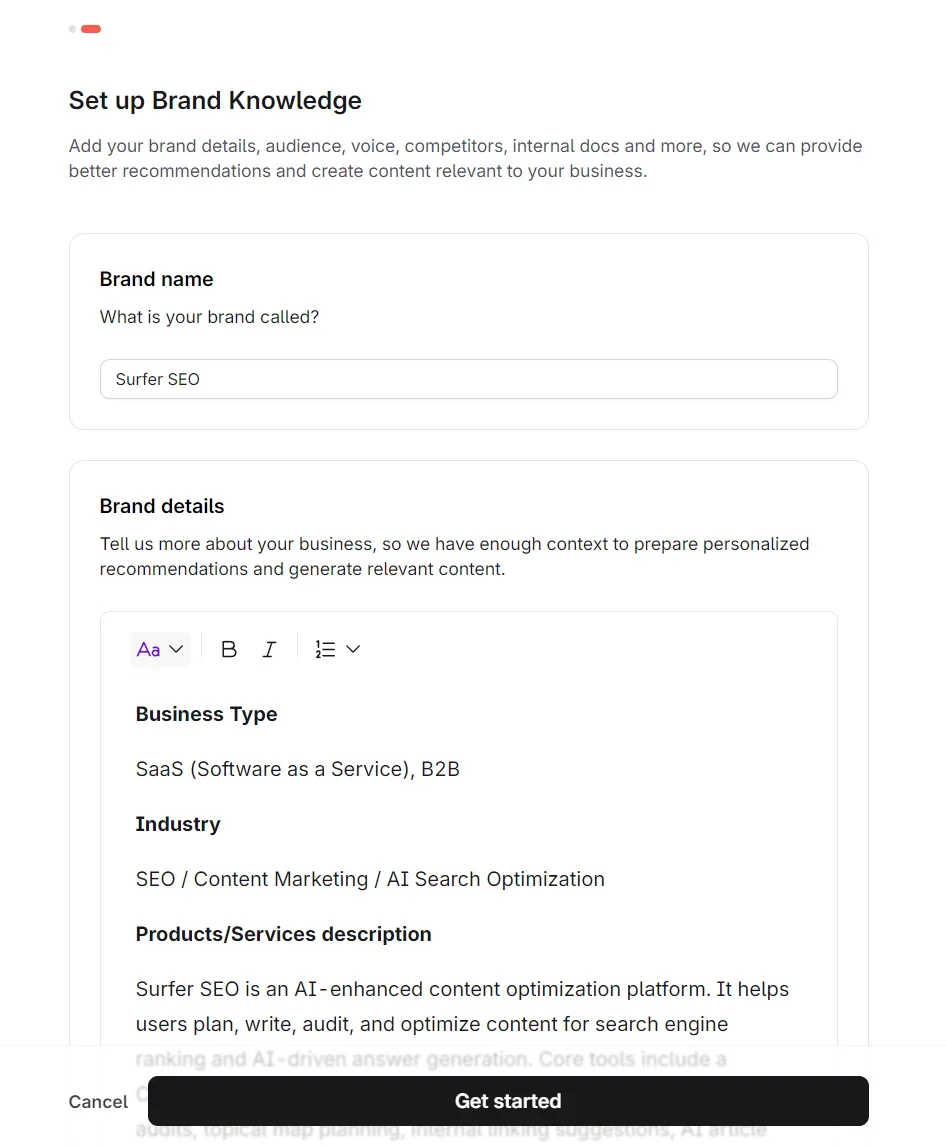
Once that’s done, create an AI Search Analytics project with your brand, your competitors, and the prompts your buyers ask. It tracks ChatGPT, Perplexity, Gemini, AI Mode, and AI Overviews, and refreshes daily on Pro, Peace of Mind, and Enterprise (weekly on Discovery and Standard).
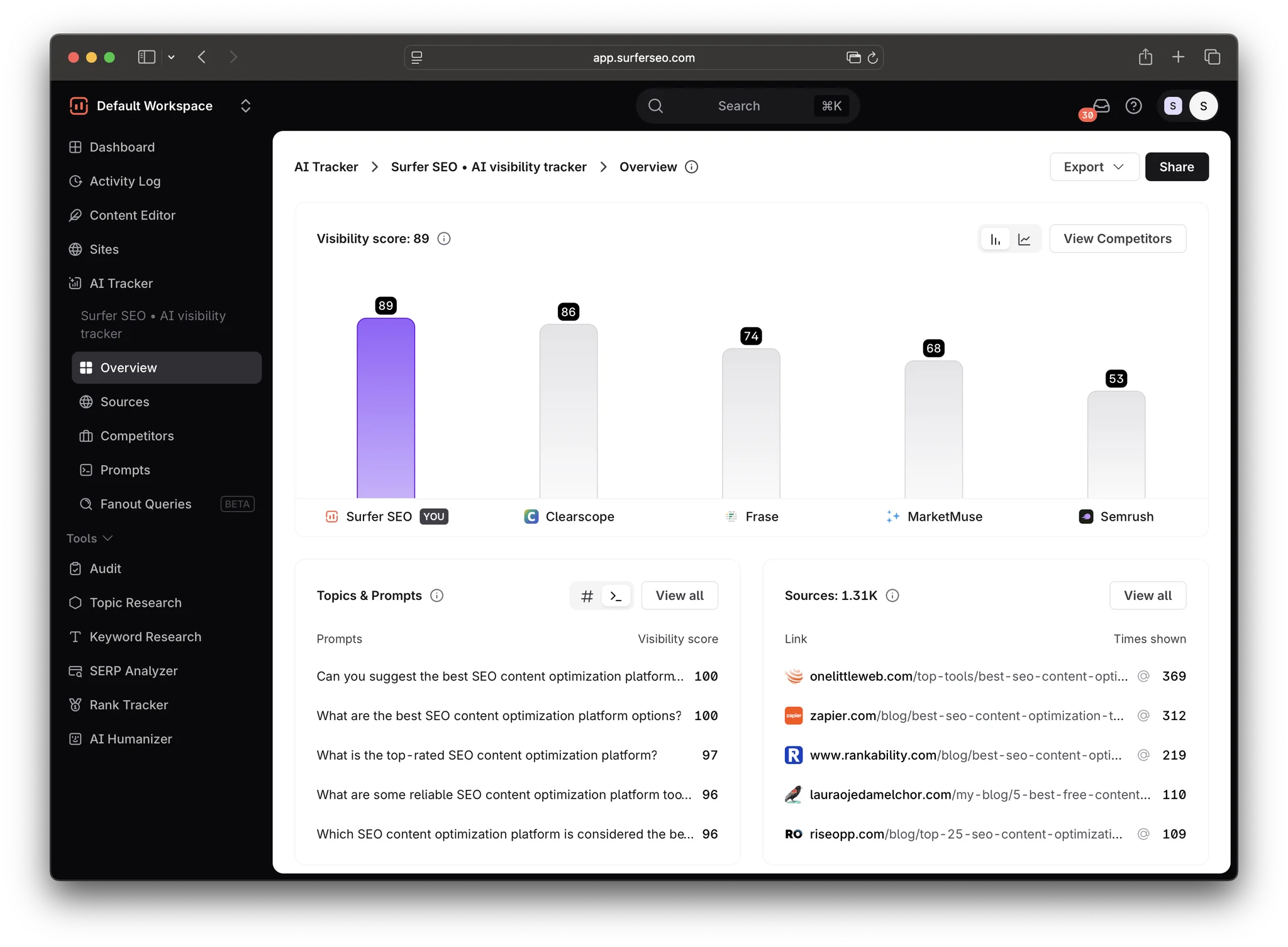
You can stop here, or connect Surfer MCP. Add https://mcp.surferseo.com/mcp as a connector in your AI assistant and sign in with your Surfer account. (MCP is included in the Pro, Peace of Mind, Enterprise, and AI Search Analytics plans.)
Step one: Find content opportunities that will lift your AI visibility
Open AI Search Analytics > Prompts to compare your prompt coverage with your competitors. Look for prompts where AI cites your competitors' own sites, but not yours.
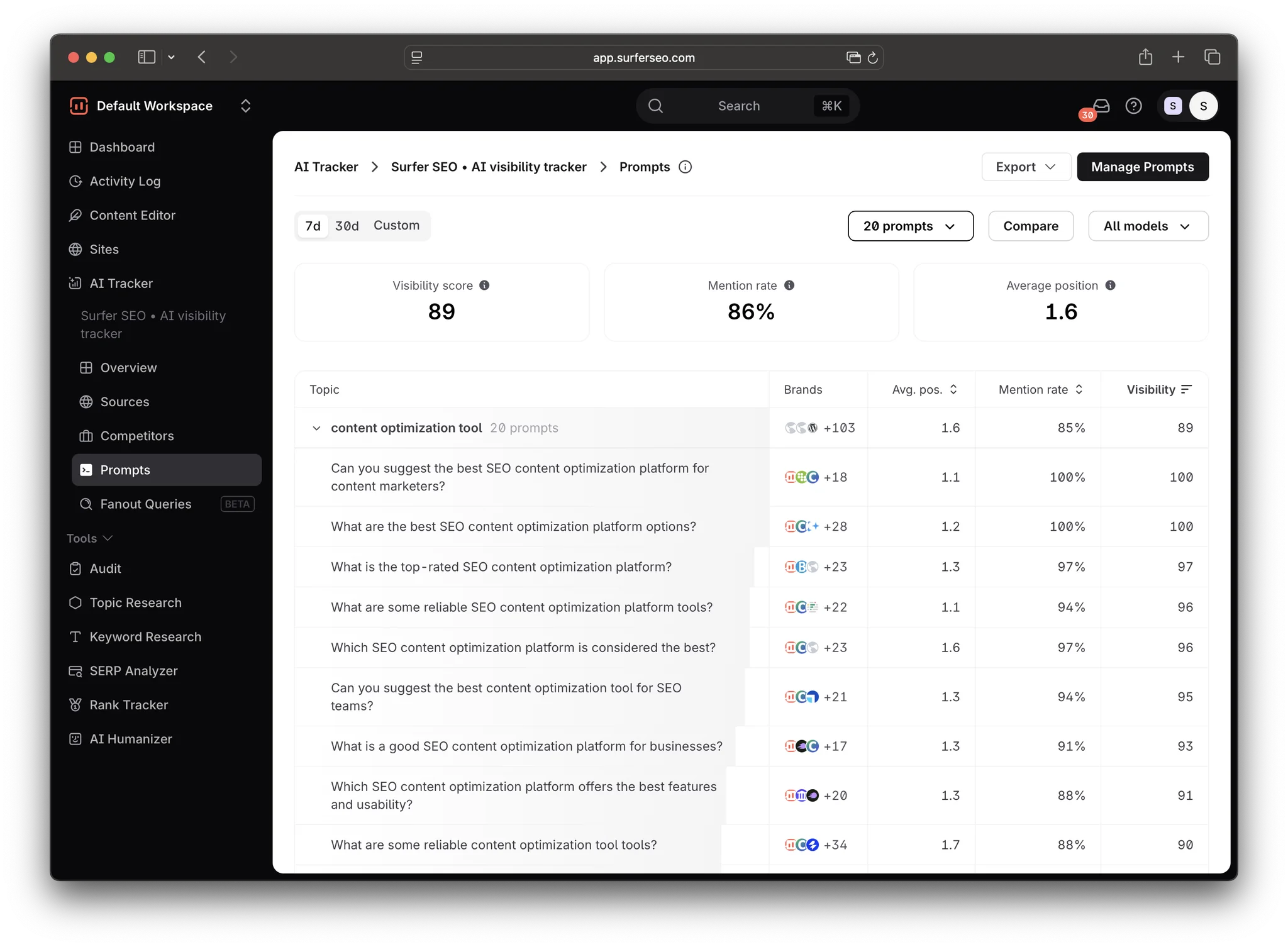
Now you can reverse-engineer where their mentions come from, and go write for those topics to reclaim some share of voice.
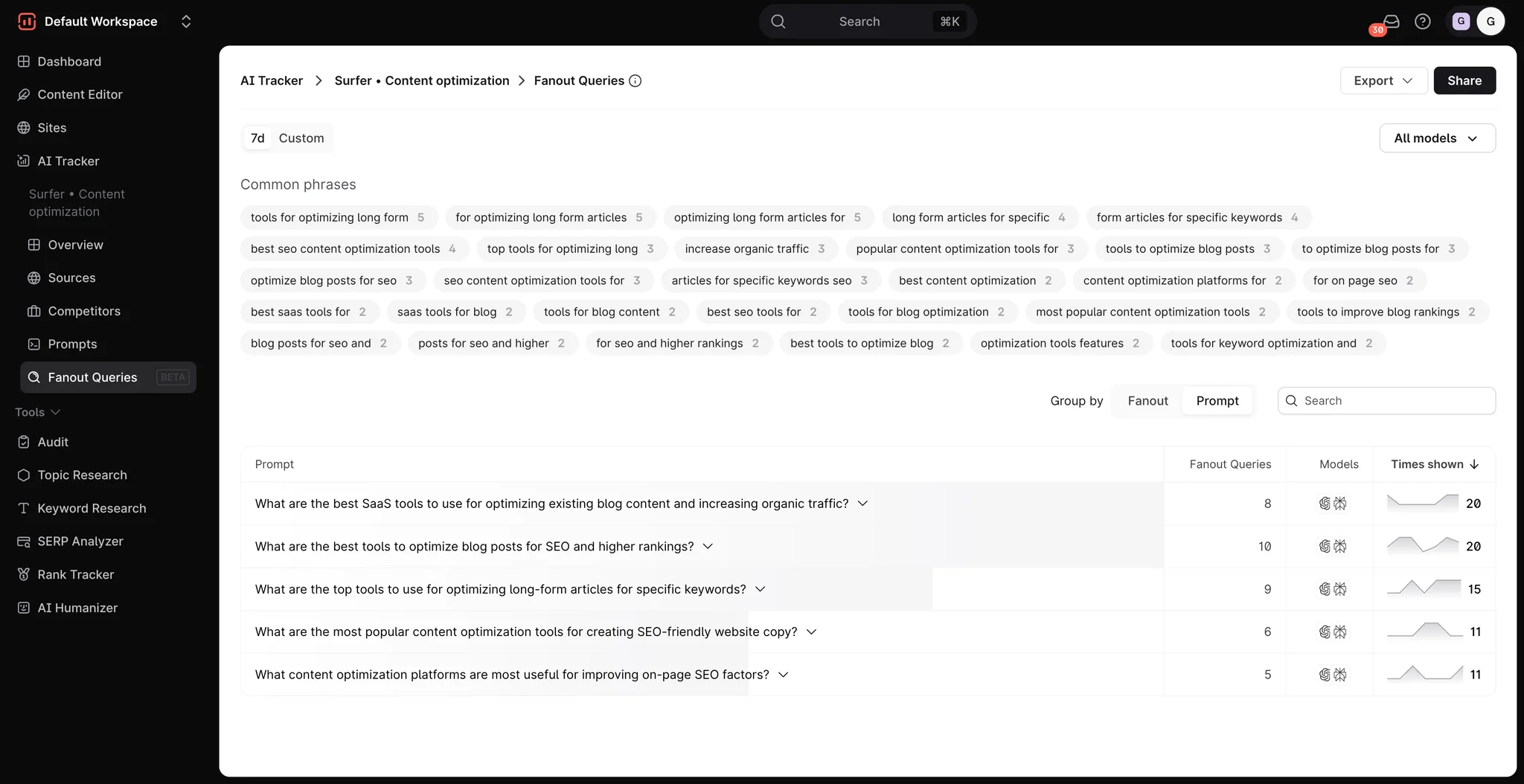
The Fanout Queries tab also helps you find related questions AI models care about, increasing your coverage.
If you want to find the best pages to optimize, look at the Prompts tab again and find the pages AI already shows for the prompts where you’re most visible. Since the biggest gains go to already strong pages, you can increase your chances.
But you can automate the decision-making process by just going straight to Recommendations. The list there is sorted by which actions will give you the biggest wins.
And to optimize even further, do it with MCP. Here’s an example prompt:
Analyze the top 100 cited sources for topics related to {{topic}}.

Find recommendations for writing new content and recommendations for optimizing existing content that might help us improve our visibility in {{model}}.

Find recommendations of type "write" and "optimize" for the {{workspace}} workspace. Each recommendation should improve visibility for prompts related to {{topic}}.

Present your findings as a table, sorted by the expected impact: recommendation | type (write or optimize) | prompt it serves | evidence in numbers.
Step two: Brief, draft, and optimize content
Now it’s time to act on the research you just did. Open a Content Editor for each topic you picked.
From there, you can generate an outline, write the whole draft with Surfer AI (“Write with AI”), or just write manually using the guidelines on the right (or share the editor with the writer). Either way, Surfer uses your Brand Knowledge, custom voice, and template. Keep an eye on the Content Score: it shows how well-optimized your content is for SEO and AI Search. AI Search Score checks your intent, your Facts coverage, and your intro: everything AI cares about most.
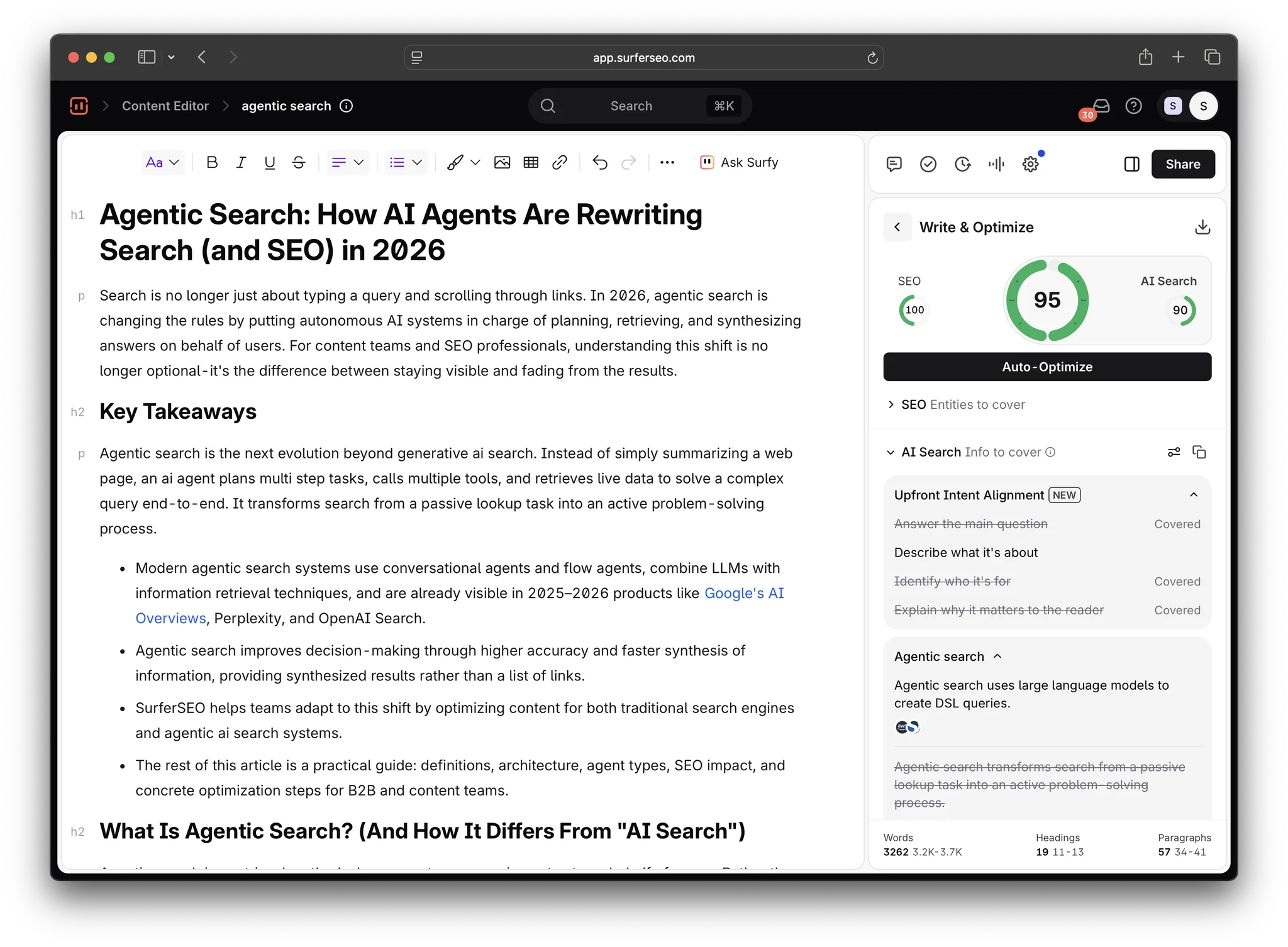
For your existing pages, Surfer will automatically load them in Content Editor. You can edit manually using the same guidelines, or click Auto-Optimize and watch the AI work.
You can also write and optimize with MCP. Here’s an example of a prompt for writing new content:
I pick: {{topic 1}}, {{topic 2}}.

For each topic:

1. Use surfer-create-content-brief to create a brief: outline, SEO guidelines, and AI Search facts with their sources. Open a Content Editor for the main keyword and give me the link.
2. Use surfer-create-outline to generate an outline and suggest a URL. Stop and wait for my approval. If I edit it, revise and stop again.
3. After I approve, use surfer-write-article to write the article with our Brand Knowledge and custom voice. Answer the main question in the first paragraph.
4. Give me the SEO Score, the AI Search Score, and the Content Score.
And here’s a prompt for optimization:
For the "optimize" pages I pick: {{URL 1}}, {{URL 2}}:

1. Pull the current content and title from {{your CMS, or a URL}} and save a copy of the body. Tell me you have.
2. Open the page's own Content Editor and give me the baseline SEO Score, AI Search Score, and Content Score.
3. Apply Auto-Optimize.
4. Show me one table: score | before | after | change.
5. After I approve, update the page at the same URL. Tell me when it's done.
Step three: Build your outreach list from Sources and Mention Gap
Open AI Search Analytics > Sources. These are the pages AI reads most for your prompts. Then check Mention Gap for the pages that mention your competitors but not you.
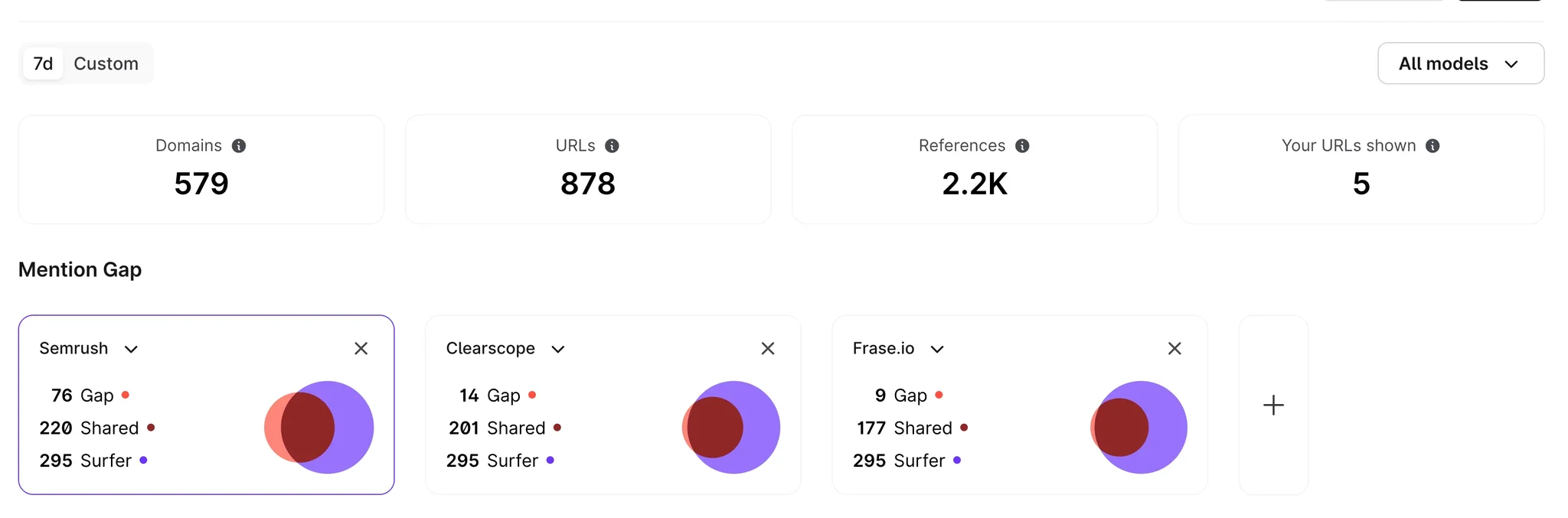
That's your outreach list. Start with the most-cited ones: in our data, a first mention on one of the 20 pages AI cites most added 1.7 points of mention rate, vs. 0.9 for a mention on any page. For some sources, you can buy a mention directly in the app.
Or use Surfer MCP for this:
Pull the AI Search Analytics sources for the last 30 days, all models, grouped by URL. Keep only pages that do not mention {{brand}}, sorted by citations.

Drop:
- user-generated platforms: Reddit, YouTube, Quora, Facebook, LinkedIn, Medium, TikTok, Wikipedia
- competitor-owned domains (use the competitor list in our Brand Knowledge)
- first-party documentation nobody can pitch, like developers.google.com, support.google.com, and university or government sites

From what is left, keep pages that name at least two competitors in the body text (ignore navigation, footers, and ads).

Give me two lists:
1. Top 3 to pay for: the most-cited pages that look like they sell placements (sponsored or partner labels, affiliate disclosures, listing fees). Table: URL | citations | competitors named | why it looks paid.
2. Top 10 to pitch: the most-cited pages where an editorial email makes more sense. Table: URL | citations | competitors named.

Then draft one short email per page in list 2. No template language, no flattery. Use our Brand Knowledge for context. Do not send anything.
Once a placement goes live, check whether AI actually cites it:
These are our placements: {{URL 1}}, {{URL 2}}, {{URL 3}}. Match them against the cited sources in our AI Search Analytics project over the last 30 days, by URL. Three buckets: cited and mentions us, cited but does not mention us, not cited at all.AI visibility pays off when you act on it
Tracking tells you where you stand. Acting on it is what moves the numbers.
- Almost 2x as many AI citations for optimized pages vs. matched pages
- 9x the Visibility Score gain in the week after AI first cites a brand’s own site, vs. similar brands whose site wasn’t cited
- 44% vs. 3% mention rate for brands featured on a cited page vs. brands that aren't
And the best long-term strategy hasn't changed: build a product worth talking about, and make sure the right places talk about it.
So, which pages is AI reading about you right now?
Run a free AI visibility audit to see where you stand.
And if you’re ready for more, try out Surfer for free.
Only need AI visibility tracking? The AI Search Analytics plan gives you 50 prompts refreshed daily for $82/month, billed yearly.
Considerations:
- Observational, not an A/B test. Optimized pages were compared with matched pages from across the web, not randomly assigned. Brands that optimize may also do other things that help.
- Some data show association only. The cited-pages-per-month results, the third-party presence results (3% vs. 44%), the own-site vs. third-party comparison (22 points, 73%), and the content-type correlations show links, not cause.
- Raw before-and-after for third-party mentions. These include market-wide shifts and each brand’s own momentum. The own-site results don’t: each brand was compared with similar brands over the same weeks.
- Own-site citation: matched, not randomized. The 466 brands were compared with brands that had the same starting mention rate and number of prompts. Brands whose site gets cited may still differ in other ways, for example by publishing more.
- The spam update data is about Google rankings. It covers 297,343 pages on 8,462 sites. AI detection covers English pages only. The comparison uses overlapping week-pairs, so it's a convention for spotting unusual changes, not a statistical test.
- Third-party comparison. Brands are pooled, and prompts that name the brand are excluded. "Featuring the brand" means AI Search Analytics' crawl of the cited page lists it.