The best AI visibility tools in 2026 are Surfer for tracking and improving AI visibility in one place, Profound for enterprise brands, Peec AI for flexible team tracking, Otterly.AI for a simple low-cost start, and Semrush or Ahrefs if you already use their SEO suites. AI visibility tools (also called AI search visibility tools, AI brand visibility tools, LLM tracking tools or GEO tools) show how often ChatGPT, Perplexity, Gemini, Google AI Overviews and AI Mode mention your brand, which sources they cite, and how you compare with competitors. Entry prices run from free to $295 per month.
This guide is for marketing teams, SEO teams and agencies choosing an AI visibility tracker. It compares 14 tools on price, AI engines, prompt limits and features, gives a verdict for each use case, and covers seven more tools worth knowing. Prices and features were checked on each vendor's own website on 25 October 2026.
Disclosure: Surfer is our own product and one of the tools on this list. We used Surfer, Amplitude, Rankscale, SE Ranking, Ahrefs Brand Radar and Semrush's AI Visibility Toolkit hands-on with the same sites and comparable prompts. For the other tools, the details come from each vendor's own pricing pages and documentation.
Which AI visibility tool is best for you?
The best AI visibility tool depends on what you'll do with the data. If you want to fix the content AI engines cite, pick a tracker with content optimization; if you report to a large brand, pick enterprise coverage; if you're testing the waters, start with a free checker or a low-cost plan. Our verdicts:
Not sure where to start? Answer three questions and see which AI visibility tools fit:
How do the best AI visibility tools compare?
The AI visibility tools that AI answers and buyers name most often differ most on price, engine coverage and what they help you do next. This table compares five of them side by side; the table after it covers all 14 tools.
All 14 tools at a glance. "Entry prompts" is how many prompts the cheapest paid plan tracks.
Which AI visibility tools do AI assistants recommend?
AI assistants recommend the same handful of tools again and again. We track 12 prompts about AI SEO, GEO and AEO tools in Surfer (for example "What are the best AI SEO tools?", "Best GEO tools" and "best AEO tools") across ChatGPT, Gemini, Perplexity, Google AI Overviews and AI Mode. Over 30 days (24 September to 23 October 2026), the answers cited 738 different URLs 10,779 times, and these brands were named most often:
Three patterns stand out:
- A few brands own the category. Semrush appears in 90% of answers; Ahrefs and Surfer each in 66%. Specialist AI visibility tools appear less often: Profound in 48% of answers, Peec AI in 28%.
- AI leans on video, vendor pages and roundups. The most cited domains were youtube.com (610 citations), semrush.com (515), onelittleweb.com (364), ahrefs.com (337) and reddit.com (302), followed by independent roundups on zapier.com and technologyadvice.com.
- Answers vary by engine and by run. Twelve prompts are a sample, not a census. Track your own prompts over weeks before drawing conclusions.
Prompts that ask specifically for AI visibility trackers, such as "What are the best AI visibility tools?" and "Best alternatives to Profound", surface a slightly different set. In the first runs of a second Surfer project with 26 such prompts (to 24 October 2026), the tools named most were Semrush, Profound, Otterly.AI, Ahrefs and Peec AI, followed by SE Ranking, Scrunch, AthenaHQ, ZipTie and Rankscale. Every one of them is reviewed below.
What do AI visibility tools track?
AI visibility tools track whether AI answers mention and cite your brand, and how that compares with competitors. Most report the same core metrics, under slightly different names:
- AI visibility score: a 0–100 index of how visible your brand is across tracked prompts and AI engines (see how a visibility score works).
- Mention rate: the share of AI answers that name your brand.
- Average position: where your brand appears in the answer, with 1 meaning first.
- Share of voice: your mentions compared with competitors' for the same prompts.
- Citations and sources: which of your pages AI links to, and which third-party sites it cites when it mentions you or your competitors. Your own most-cited pages show what's already working.
- Sentiment: whether AI describes your brand positively, neutrally or negatively.
- Prompt tracking: the questions you monitor, often grouped into topics, with results per prompt and per engine.
- Query fan-outs: the searches an AI engine runs behind the scenes to answer a prompt (Surfer and Otterly.AI show these).
- AI traffic and crawlers: visits from AI assistants and how AI bots crawl your site (for example Profound, Writesonic, Promptwatch and Similarweb).
Mentions without citations tell you AI knows your brand; citations tell you which pages earn it. Track both.
What features should an AI visibility tracker have?
A good AI visibility tracker covers the AI platforms your buyers use, reads real answers, shows citations as well as mentions, benchmarks competitors over time and points to what to fix. Use this checklist when you compare trackers:
A single score is the least useful part. Prompt-level detail, the sources behind each answer and a clear next step matter more, because they tell your content and digital PR teams what to do on Monday.
How did we choose the best AI visibility tools?
We ran the tools we tested with the same sites, similar prompts and comparable competitors, to see how consistent the visibility data was and how useful the insights were in practice. We also compared notes with SEO teams and content marketers who use these tools daily, and checked which tools AI answers and the top Google results recommend. Three criteria mattered most:
- Prompt control: can you see and edit the exact prompts being tracked?
- Explanations: does the tool show why a brand appears in AI responses, or doesn't, through the sources and citations behind each answer?
- Next steps: does the AI visibility data lead to concrete actions that improve your brand visibility?
We also weighed which AI engines each tool covers, how it collects answers, and the price per tracked prompt. Collection method matters: in Surfer's study of API results vs. scraped AI answers, roughly 75% of the brands named didn't overlap between the two methods. Tools that read the real interfaces people use (Surfer, Profound, Peec AI, SE Visible, Writesonic and Promptwatch say they do) are closer to what your buyers actually see.
1. Surfer
Best for: teams that want to track AI visibility and improve it in the same tool.
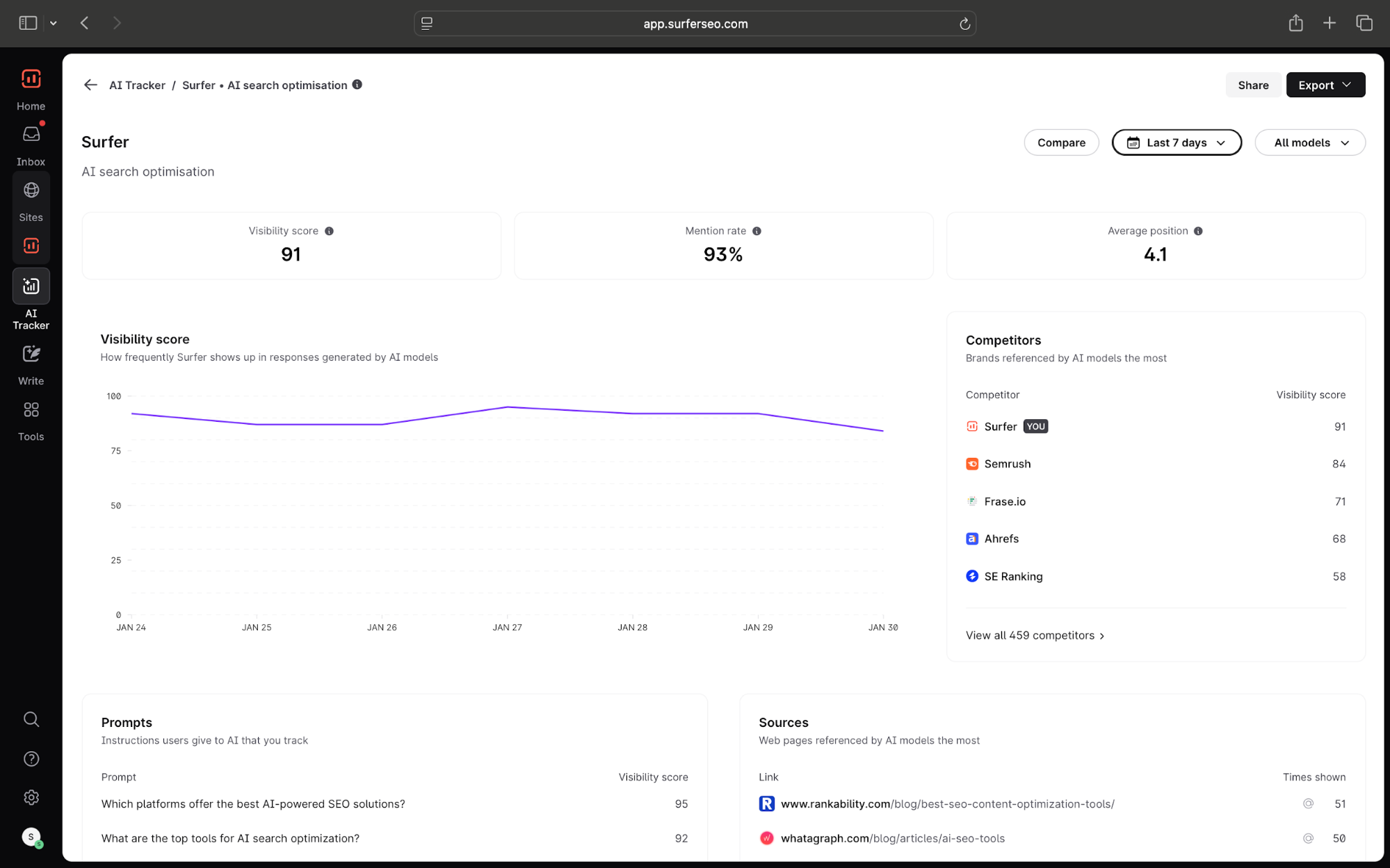
Surfer measures how often you show up in AI answers, which websites AI search engines cite, and, more importantly, helps you create content that's more likely to be mentioned by large language models. Its AI visibility tracking sits next to the Content Editor, so the data and the fix live in one place.
To get started, enter your site's domain and list your focus topics. Surfer generates prompts your ideal customers are likely to ask AI assistants, and you can add any prompts you want to track yourself. Surfer reads the answers in the same interfaces people use, not through an API, because API results and real AI answers often name different brands.
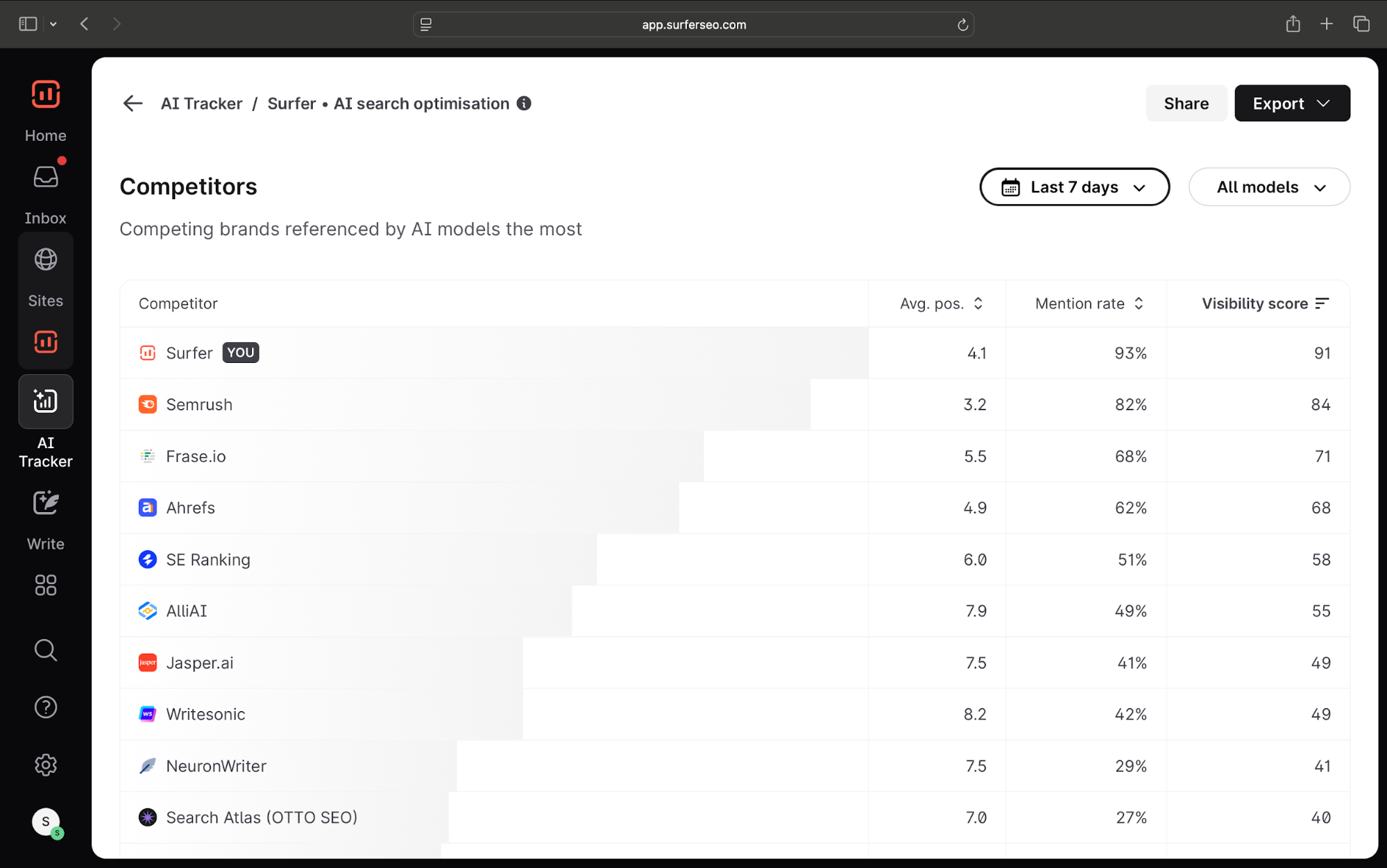
The Overview page shows your brand's AI visibility score, mention rate across AI models and average position in AI responses. You can benchmark competitor visibility on the same metrics and filter to the competitors you care about.
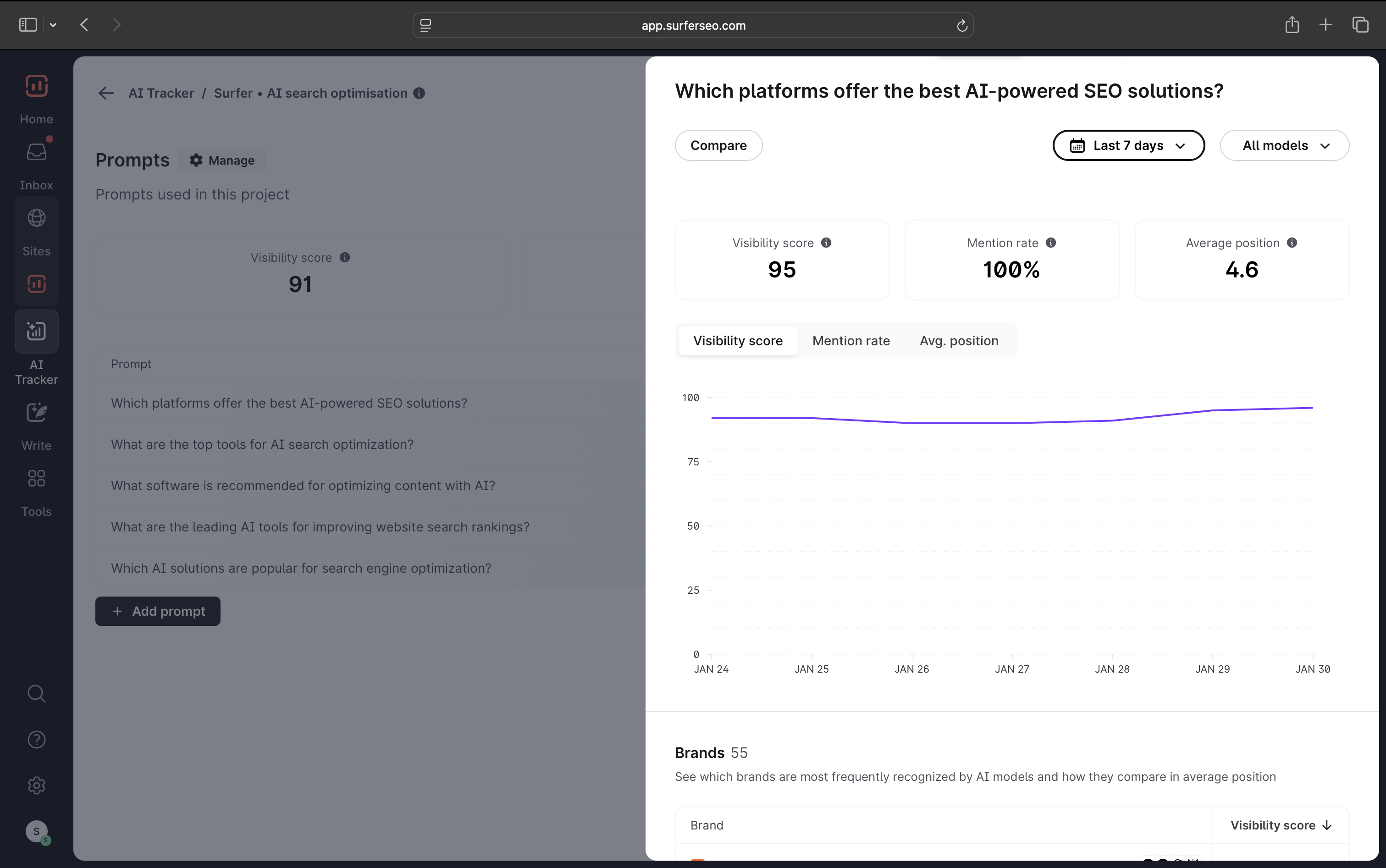
For each prompt, you can open the full detail: which brands were mentioned, which sources were cited and which fan-out queries the AI ran. The Mention Gap report lists sources that name your competitors but not you, which makes a ready-made outreach list. We use the fan-out queries to research outlines, so our content is optimized for both AI search and Google's blue links.
That covers AI search visibility tracking, and it's where most AI visibility tools stop. Surfer goes further with content optimization: the Content Editor shows the facts AI answers include for your topic, so you can cover them and give AI engines a reason to cite you. Surfer's research found that pages cited in AI Overviews covered 31% of a topic's key facts, versus 24% for pages that weren't cited.
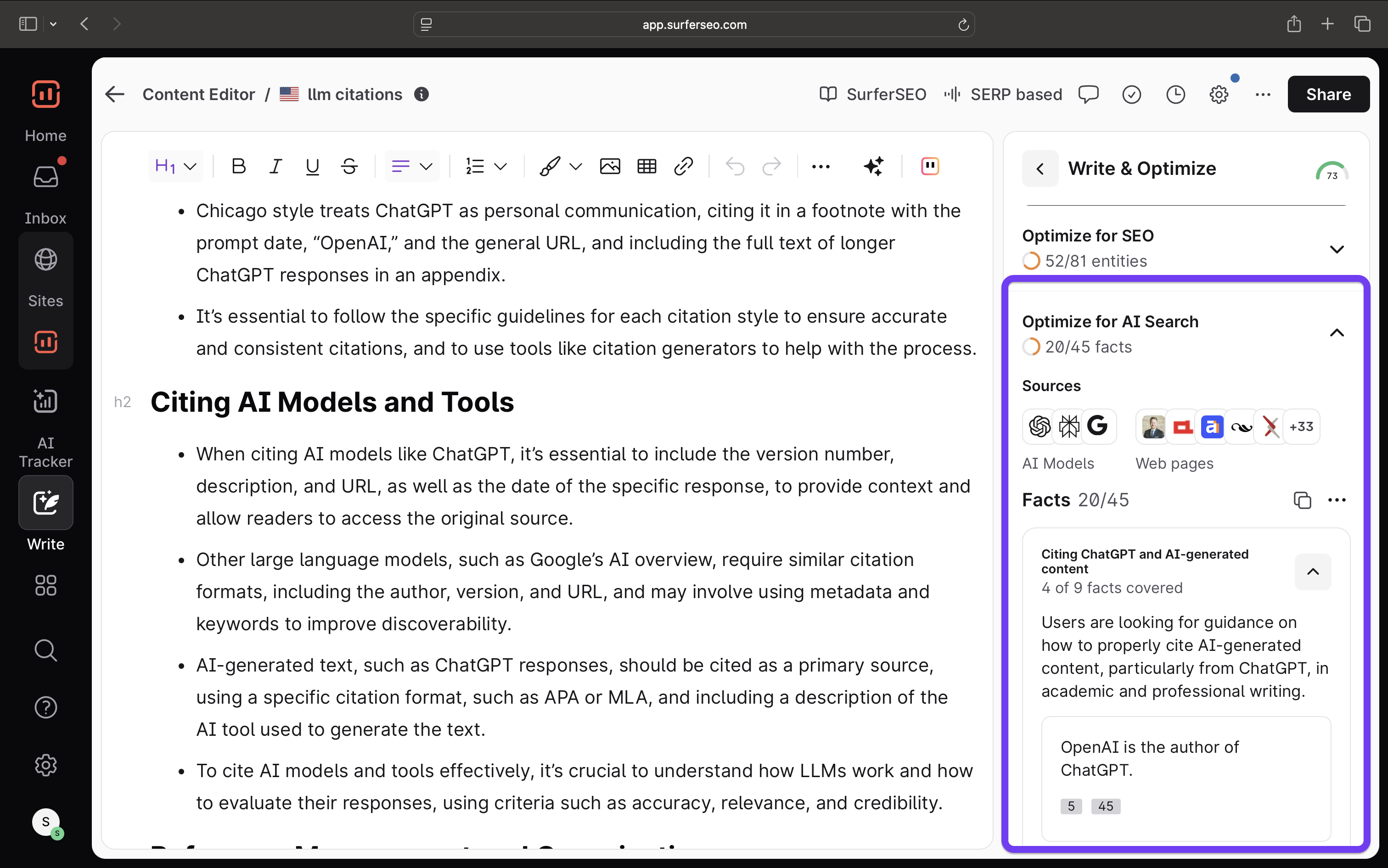
Pricing: the AI Search Analytics plan costs $82/month billed yearly ($95 month to month) and tracks 50 prompts daily across ChatGPT, Perplexity, Gemini, Google AI Overviews and AI Mode, with Mention Gap, brand sentiment, five brand spaces and MCP. The Standard plan ($99/month yearly) adds the Content Editor and tracks 25 prompts weekly in ChatGPT; Pro ($182/month yearly) tracks 50 prompts daily in all five engines with the content tools. You can start for free.
Pros:
- Reads real AI answers, not just API results
- Connects AI visibility tracking with SEO and content optimization in one platform
- Mention gap, sentiment and source reports point to outreach targets
Cons:
- Doesn't track Claude or Microsoft Copilot
- The Content Editor isn't in the AI Search Analytics plan; you need Standard or higher
2. Profound
Best for: enterprise brands that need depth, many engines and compliance.
Profound is an enterprise AI visibility platform. Its Answer Engine Insights show how AI engines describe your brand, with citation analytics, sentiment and a FactCheck agent for inaccurate claims. Prompt Volumes estimate which questions people ask AI assistants in your category, Agent Analytics shows how AI crawlers access your site, and its AI Marketer agents turn the data into content and tasks.
Profound says it captures answers from each engine's front-end interface rather than through API calls. Enterprise covers up to 9 engines, including ChatGPT, Perplexity, Google AI Mode, Gemini, Microsoft Copilot, DeepSeek, Claude and Google AI Overviews, and adds API access, CSV and JSON exports, SSO/SAML and SOC 2 compliance.
Pricing: no public price for brands. A 7-day free trial tracks 50 prompts daily in ChatGPT, Gemini and Google AI Overviews (prompts can't be customized on the trial); Enterprise pricing is custom. Agencies get separate plans.
Pros:
- Among the broadest engine coverage here, including Copilot and Claude
- Enterprise features: SSO, SOC 2, API, exports
Cons:
- No public pricing, so it's hard to budget for
- More than most small teams need
See the full side-by-side: Surfer vs Profound.
3. Peec AI
Best for: marketing teams that want flexible prompt tracking with unlimited seats.
Peec AI tracks your visibility, position, sentiment and share of voice against competitors, with source analytics that show which domains and URLs AI cites. Gap analysis and recommended actions point to where competitors appear and you don't, and crawl insights (via CDN integrations) show how AI bots access your site.
On the Starter, Pro and Advanced plans you choose 3 models from ChatGPT, AI Mode, AI Overviews, Microsoft Copilot, Gemini and Naver AI; Perplexity and Claude are paid add-ons. Peec says it collects answers through each platform's web interface. MCP is on every plan, the API starts on Pro and the Looker Studio connector on Advanced.
Pricing: Starter costs €85/month (€70/month billed yearly) for 50 prompts, with unlimited users. Pro is €205/month (€180 yearly) for 150 prompts; Advanced is €425/month (€360 yearly) for 350 prompts with multi-country tracking. There's a free trial.
Pros:
- Unlimited users on every plan
- Clear source and citation analytics
Cons:
- Only 3 engines on the entry plan; Perplexity costs extra
- Priced in euros, so US costs move with the exchange rate
See the full side-by-side: Surfer vs Peec AI.
4. Semrush AI Visibility Toolkit
Best for: teams already using Semrush for SEO.
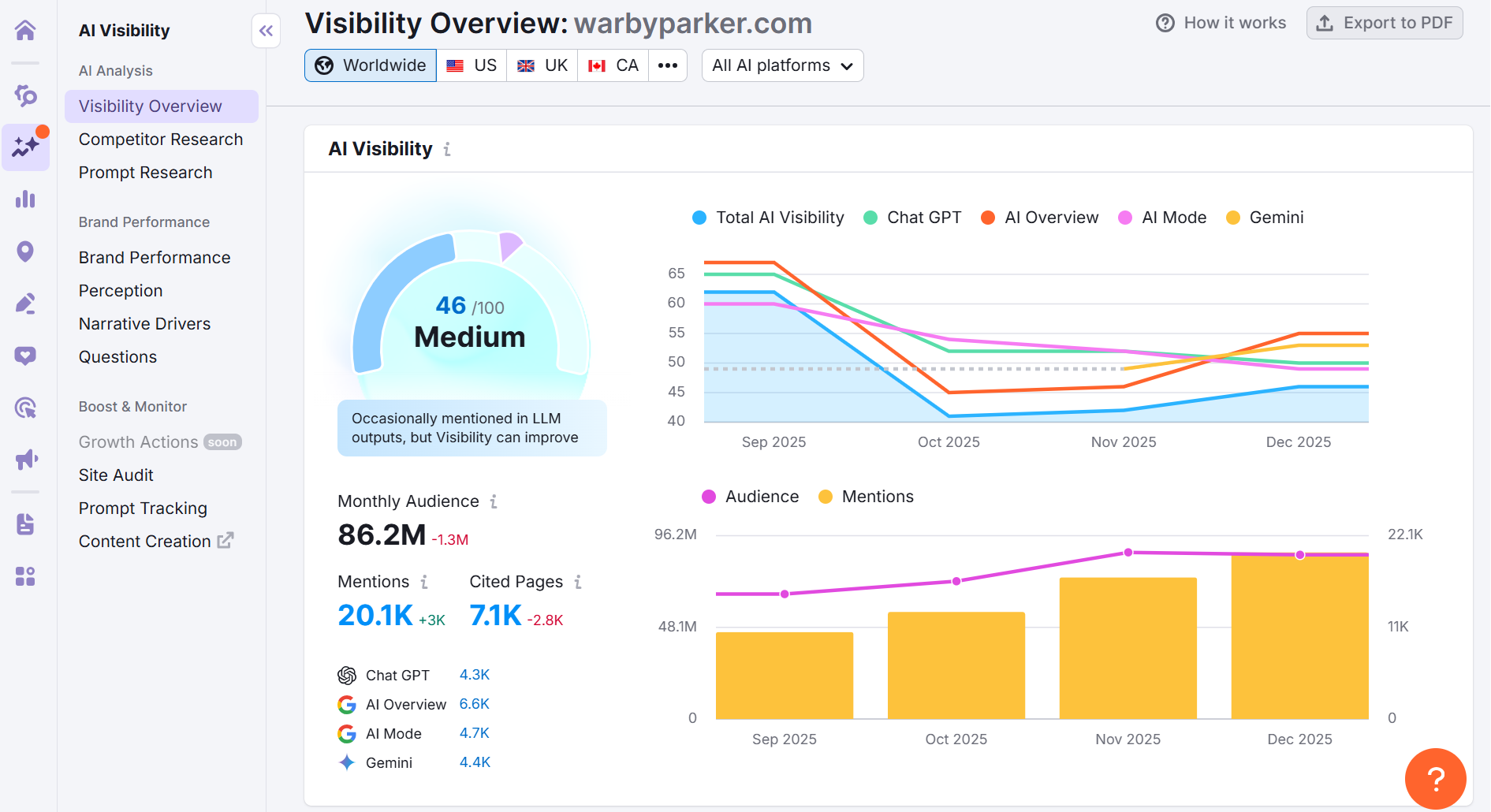
Semrush's AI Visibility Toolkit approaches AI search from a familiar angle. You add a domain and competitors, and Semrush aggregates how those brands appear across AI generated answers. The dashboard centers on an AI visibility score out of 100, plus mentions, cited pages and monthly audience. You can drill down by region or AI platform to see which topics and prompts surface your brand.
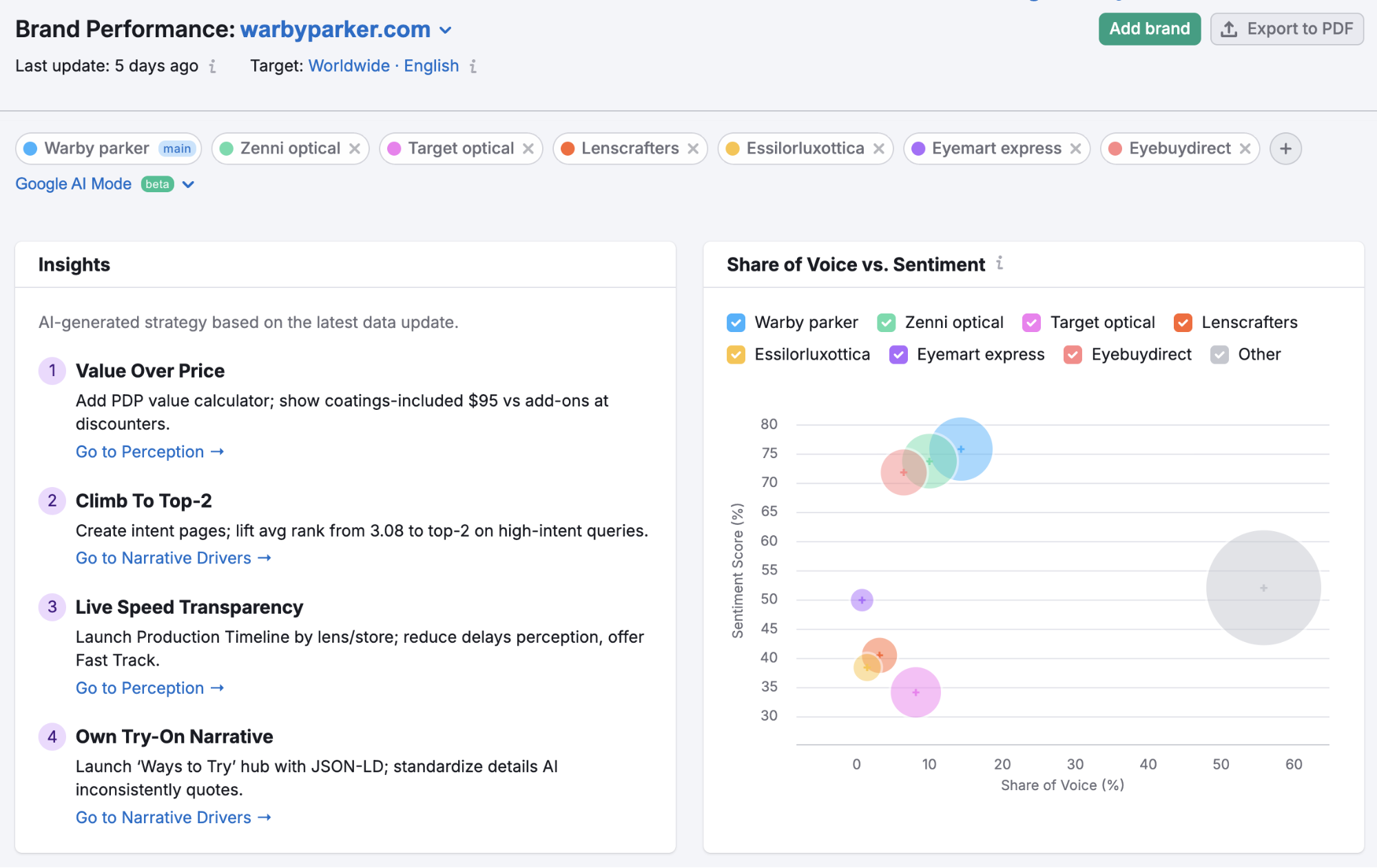
Prompt Research clusters AI questions around a topic with demand and difficulty signals, which helps you decide which prompts to track. The Brand Performance tab is a highlight: plain-language insights on what you're doing well and what to improve, plus share of voice, sentiment analysis and "narrative drivers," the domains and questions shaping how AI describes your brand.
Pricing: the toolkit costs $99/month per domain for 25 prompts tracked daily, and 50 more prompts cost $60/month. It doesn't have its own free trial. Semrush One bundles start at $199/month with 50 prompts. Semrush's pricing page lists mentions from ChatGPT, Google AI, Gemini and Perplexity.
Pros:
- Strong brand and competitor-level analysis
- Prompt research helps you find the questions worth tracking
Cons:
- 25 prompts on the base plan is the fewest per dollar here
- Analysis-focused; content optimization happens in other Semrush tools
See the full side-by-side: Surfer vs Semrush.
5. Ahrefs Brand Radar
Best for: large-scale brand visibility data without defining prompts first.
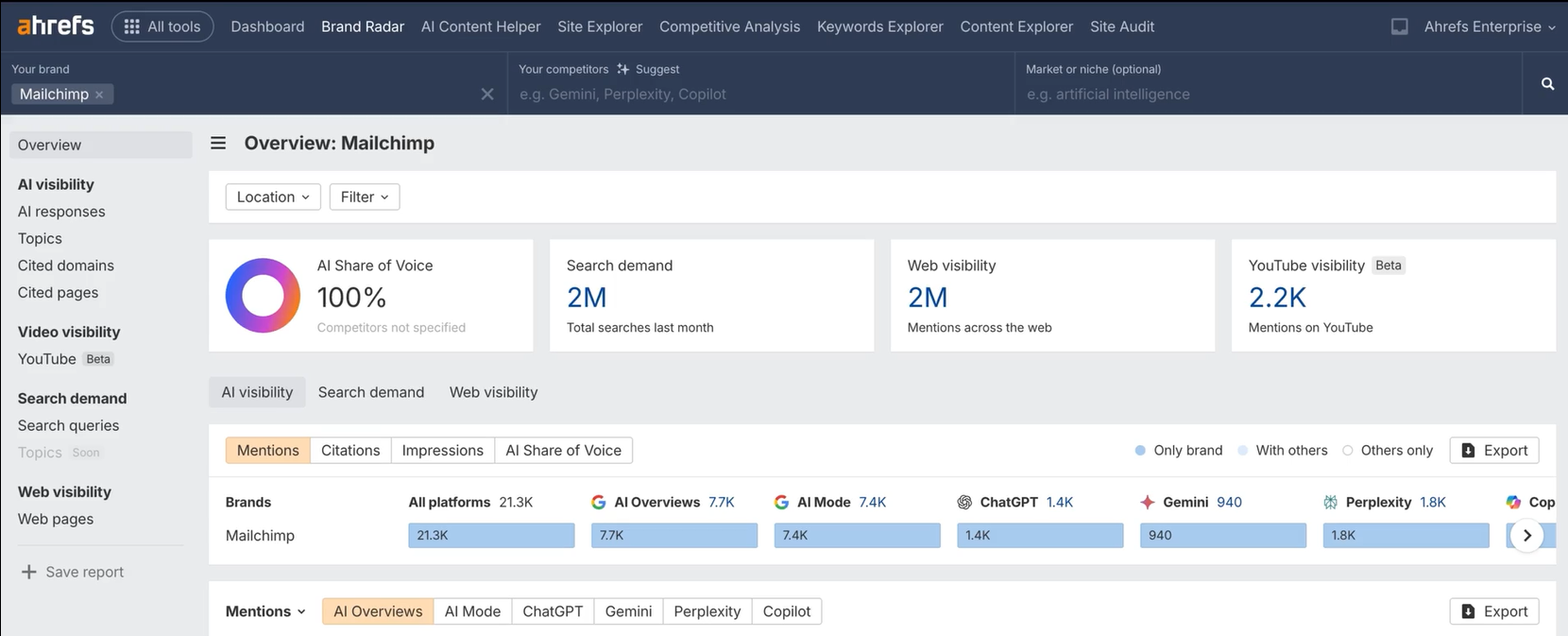
Brand Radar is Ahrefs' AI visibility tool. Setup is simple: enter your brand domain, list competitors and choose your market. Instead of a fixed set of prompts you define, Brand Radar draws on Ahrefs' database of about 500 million prompts, so you get an AI visibility score almost immediately rather than waiting for fresh runs. The index covers ChatGPT, Perplexity, Gemini, Copilot, Google AI Overviews and AI Mode; Claude is available through custom prompts.
You'll see AI share of voice, mentions, citations and estimated impressions, plus YouTube, TikTok and Reddit sources. Filters let you answer questions like where your brand is mentioned but not cited, or which third-party sites shape how AI describes your product.
Pricing: Brand Radar AI starts at $199/month and is sold on its own, with a free Ahrefs account. Custom-prompt packages start at $50/month. Regular Ahrefs plans (from $129/month) include a small number of AI prompt checks, and Ahrefs also offers a free AI Visibility Checker.
Pros:
- Instant data from a very large prompt database
- Powerful filters for analyzing thousands of results
Cons:
- $199/month entry price
- Custom prompts, and Claude, cost extra
See the full side-by-side: Surfer vs Ahrefs.
6. Otterly.AI
Best for: a simple, low-cost start with AI visibility monitoring.
Otterly.AI tracks brand visibility, sentiment and cited sources across ChatGPT, Google AI Overviews, Perplexity and Microsoft Copilot, with Google AI Mode, Gemini and Claude as add-ons. It includes weekly recommendations, query fan-out and prompt research tools, and GEO audits, and supports unlimited countries and languages.
The Standard and Premium plans add an API, an MCP server, agent analytics and a Looker Studio connector. Semrush also offers an Otterly app in its App Center.
Pricing: Lite costs $29/month ($25/month billed yearly) for 15 prompts; AI Mode and Gemini are $9/month each on Lite and Claude $29/month. Standard is $189/month for 100 prompts and Premium $489/month for 400. The 7-day free trial needs no card.
Pros:
- Low entry price for a self-serve tracker
- Copilot included on the base plan
Cons:
- Only 15 prompts on the entry plan
- Collection method isn't stated
See the full side-by-side: Surfer vs Otterly.AI.
7. SE Ranking and SE Visible
Best for: agencies that want AI visibility next to rank tracking and SEO.
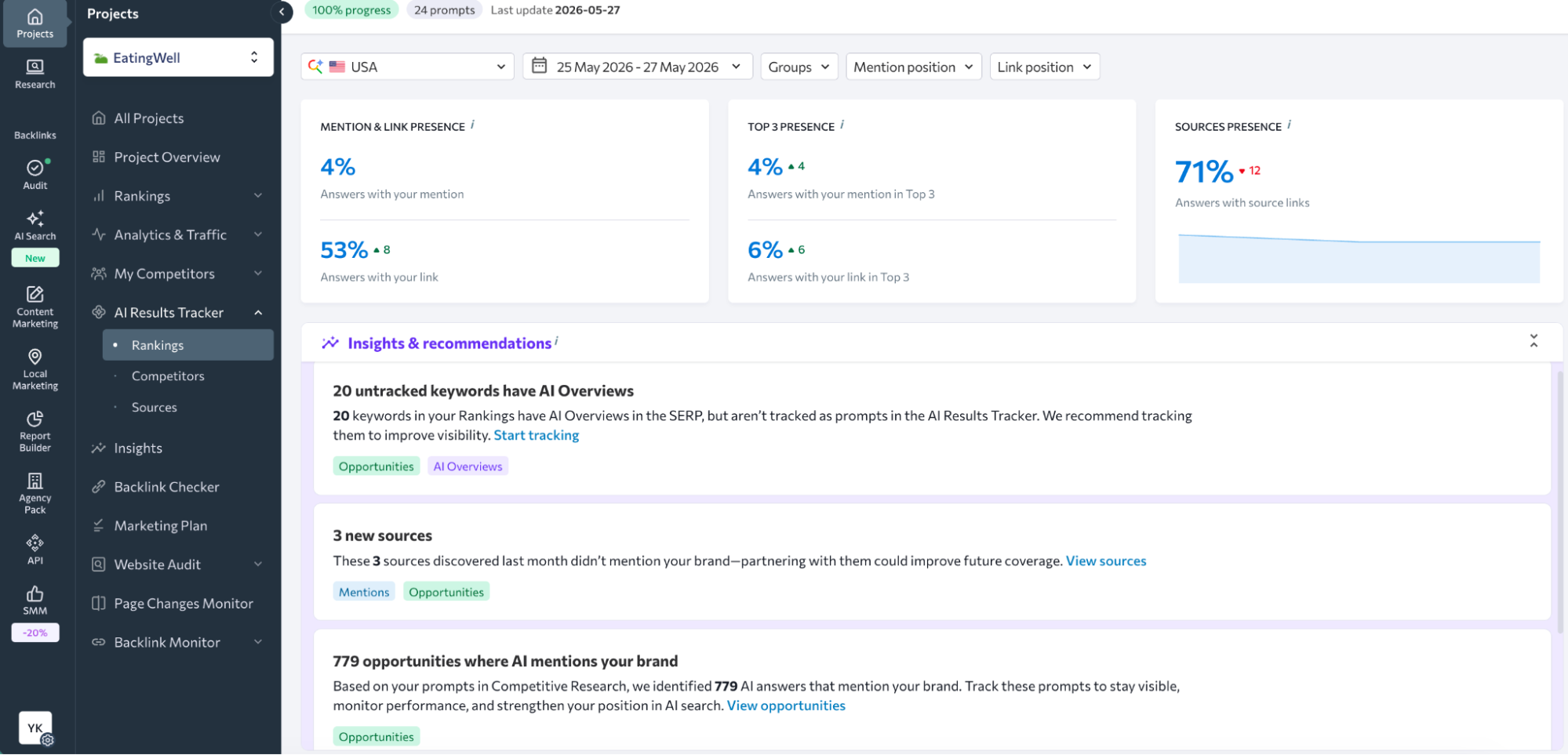
SE Ranking's AI search tracking sits inside the same SEO platform where you manage keyword research, rank tracking and site audits. That's useful: when AI mentions shift, you can check whether rankings or page structure changed too. We added a domain and prompts, and the tracker collected brand mentions, link citations and position data, with competitor visibility side by side.
The Insights feature turns AI visibility data into a to-do list: prompts where competitors are mentioned and you aren't, and frequently cited sources that don't mention you. AI Competitor Research analyzes any domain's AI presence without a project, and GA4 integration ties AI visibility to real traffic.
SE Visible is SE Ranking's standalone AI visibility product. It tracks ChatGPT, Gemini, AI Mode and AI Overviews through the browser interface, not API results; SE Ranking says Claude is coming soon. Perplexity isn't covered yet.
Pricing: SE Visible Basic costs $99/month ($79 yearly) for 200 prompts, with a 10-day free trial; Core is $189/month for 450 prompts. In SE Ranking, the AI Search add-on costs €79/month (€63.20 yearly) for 200 prompts in AI Overviews, AI Mode and ChatGPT.
Pros:
- 200 prompts on the entry plan, the most of any tool here at that price
- Connects AI visibility with rank tracking, GA4 and the full SEO suite
Cons:
- No Perplexity yet
- In-depth sentiment is still marked "coming soon"
See the full side-by-side: Surfer vs SE Ranking.
8. Scrunch
Best for: brands that want persona-level benchmarking and an AI agent experience layer.
Scrunch tracks citations and benchmarks your visibility by competitor, persona, topic and region, and runs site audits for AI readiness. On Enterprise it adds the Agent Experience Platform (AXP), which serves AI-readable versions of your pages, plus API access and SSO.
Scrunch says it collects answers through a combination of browser automation and official platform APIs, chosen per platform. Prompts run daily for the first 14 days, then every 72 hours by default.
Pricing: Core costs $250/month for 125 prompts and 5,000 responses a month across ChatGPT, Perplexity, Google AI Overviews and Copilot, with a 7-day trial. Enterprise is custom and covers 9 engines, adding Claude, Gemini, Meta AI, AI Mode and Grok. Agency Core costs $500/month.
Pros:
- Persona and region benchmarking
- AI-readable page versions on Enterprise
Cons:
- No Gemini or AI Mode on Core
- Mix of browser and API data
See the full side-by-side: Surfer vs Scrunch.
9. AthenaHQ
Best for: teams that want many AI engines and a free starting point.
AthenaHQ tracks sources and competitor insights and adds content recommendations with a content optimization agent. The free Essential plan covers ChatGPT, Perplexity, AI Overviews, Gemini and Copilot; Starter adds AI Mode, Claude, Grok, DeepSeek, Meta AI and Mistral, for 11 engines in total.
Pricing: AthenaHQ uses credits (1 credit = 1 AI response) instead of prompts. Essential is free with 300 credits; Starter costs $295/month ($245 billed yearly) with 3,600 credits and unlimited topics and prompts. API access and extra credits are paid add-ons.
Pros:
- Free plan with five engines
- 11 engines on Starter
Cons:
- Credit-based pricing is harder to compare
- Big jump from free to $295/month
See the full side-by-side: Surfer vs AthenaHQ.
10. ZipTie
Best for: analysts who want deep data and to pay only for the prompts and engines they track.
ZipTie tracks brand mentions, citations and sentiment across seven AI engines: ChatGPT, Google AI Overviews, AI Mode, Perplexity, Microsoft Copilot, Gemini and Bing's AI answers. It classifies cited sources by type, scores each brand with an "AI Success Score" and captures the Google and Bing top 10 next to each AI Overview check, so you can compare AI and organic results for the same query.
Unlimited seats, projects, competitors and white-label reports come with every plan, and API and MCP access is a $10/month add-on. ZipTie's methodology page is upfront about the limits: it doesn't track AI crawlers or referral traffic and has no prompt-volume data.
Pricing: instead of fixed tiers, you build a plan from prompts, refresh frequency and engines. The Starter preset tracks 30 prompts daily in ChatGPT, AI Overviews and Perplexity from $25.65/month, and annual billing takes 20% off. The 7-day trial (25 daily prompts) needs no card.
Pros:
- Pay only for the prompts and engines you need
- AI answers and organic top 10 side by side
Cons:
- The plan calculator takes some time to figure out
- No AI crawler or referral tracking
11. Writesonic
Best for: teams that want AI visibility tracking, content creation and site fixes in one subscription.
Writesonic has grown from an AI writer into an AI search visibility platform. Its AI Visibility Tracker is on every plan and, according to Writesonic, crawls AI platforms like a real user rather than through APIs. Every plan also includes AI Bot Analytics and monitoring of ads in ChatGPT and Google AI, and the Action Center (from Growth) suggests on-page and off-page fixes.
Pricing: Starter costs $99/month ($79 yearly) for 50 prompts tracked daily in ChatGPT, Gemini and Google AI Overviews. Basic ($249/month) and Growth ($499/month) raise the limits; sentiment starts on Growth. Enterprise is custom and covers all nine platforms, including Perplexity, Claude, Copilot, Grok and AI Mode. You can start free.
Pros:
- Tracking, content tools and AI bot analytics in one place
- Real-user collection, not APIs
Cons:
- Self-serve plans cover only three engines
- Sentiment only from $499/month
See the full side-by-side: Surfer vs Writesonic.
12. Rankscale
Best for: spotting weaknesses before you start tracking, on a small budget.
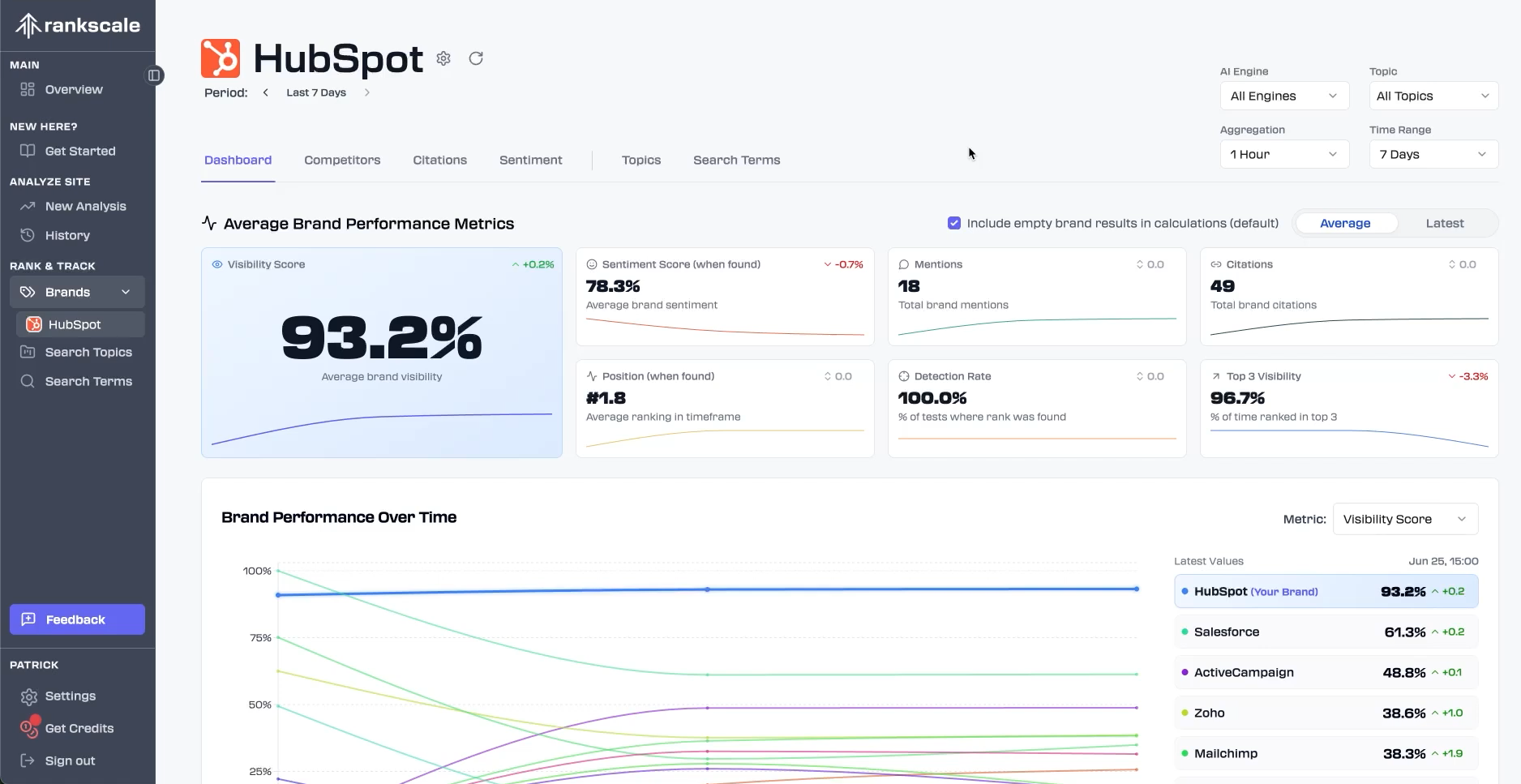
Rankscale starts with a website analysis that gives an AI search readiness score, split into content quality and relevance, authority and trust, technical SEO and page structure, and engagement. To track visibility, you set up a brand with its topics and competitors, then add search terms to monitor.
It covers 17+ AI engines on every plan, including ChatGPT, Perplexity, Google AI Mode and AI Overviews, Gemini, Claude, Copilot, DeepSeek, Mistral and Grok, with citation and sentiment analysis, query fan-outs and an MCP server. Rankscale reads some engines through their interfaces and others through APIs.
Pricing: Essentials costs $17/month, billed yearly only, with 120 credits. Pro costs $99/month ($84 yearly) with 1,200 credits and adds Looker Studio, and there's a 7-day Pro trial with limited credits. Unused credits roll over from Pro up.
Pros:
- Readiness audit shows what to fix before you track
- Low entry price with very broad engine coverage
Cons:
- Credit-based limits take some getting used to
- Mixes interface and API data, depending on engine
13. LLM Pulse
Best for: low-cost weekly tracking with paid add-on engines.
LLM Pulse tracks share of voice, mentions and citations with recommendations, across ChatGPT, Perplexity, Google AI Mode, AI Overviews and Gemini on every plan. Claude, Copilot, Grok, DeepSeek, Meta AI and others are paid add-ons. MCP is on all plans; sentiment starts on Growth, and the API and Looker Studio connector on Scale.
Pricing: Starter costs €49/month (€40.83 yearly) for 50 prompts tracked weekly, or €79/month for daily tracking. Weekly plans include a 14-day trial; a payment method is required.
Pros:
- 50 prompts for under €50
- Many optional engines
Cons:
- Daily tracking costs more
- No sentiment on Starter
14. Amplitude AI Visibility
Best for: a free first look at your AI visibility.
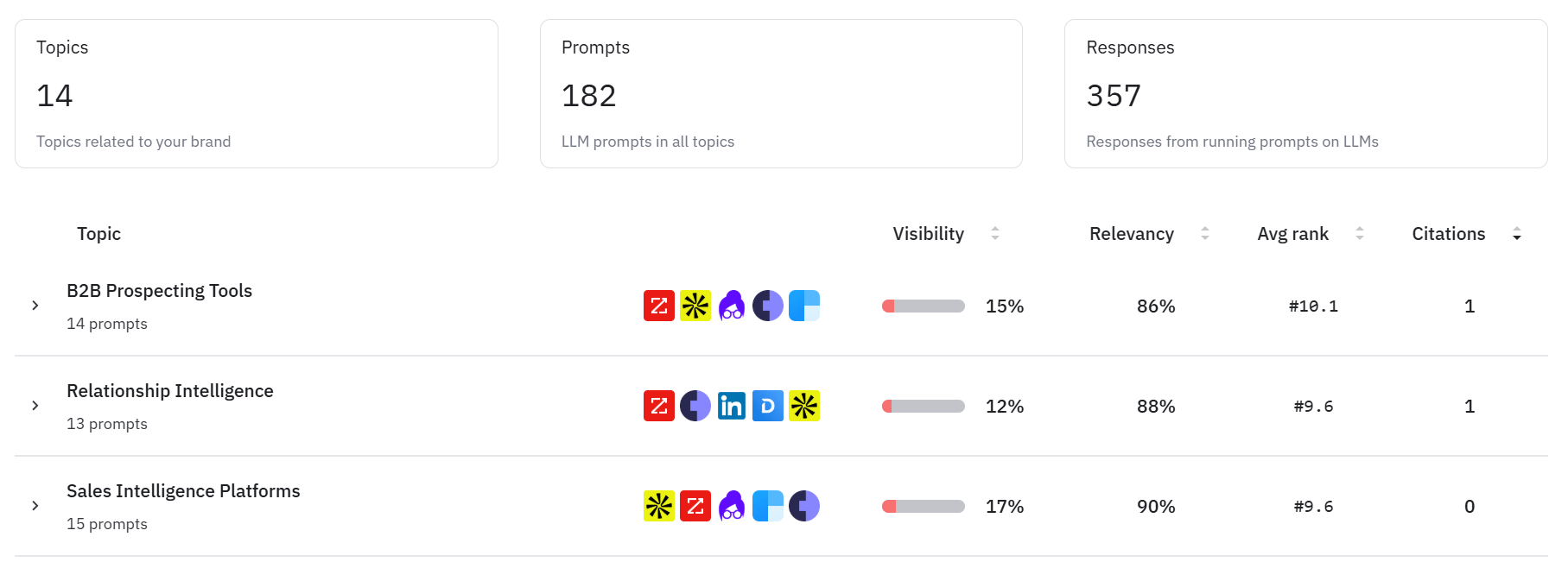
Amplitude's AI Visibility tool runs on its free plan. You enter your brand or website and get a report without defining prompts first; sign up to control prompts, region and language. The Prompts, Sources and Competitors tabs show visibility, average rank and citations by topic and prompt, and how you compare with each competitor.
Pricing: included in every Amplitude plan, including Free, "with limited volumes." It tracks ChatGPT and Google AI Overviews.
Pros:
- Free, with a report before you set up prompts
- Solid competitor and source analysis
Cons:
- Only two engines
- No content optimization beyond tracking
What other AI visibility tools are worth knowing?
Seven more AI monitoring tools come up often in AI answers and roundups. They didn't make our main list because they're enterprise-only, add-ons to another product, or newer, but each fits a specific need:
How much do AI visibility tools cost?
AI visibility tools cost from $0 to about $300 per month on entry plans, and enterprise plans are custom. A fairer comparison is the price per tracked prompt on the entry plan, at the monthly price unless a plan is sold yearly only:
Cost per prompt is only part of the picture: check how many engines each plan includes, how often data refreshes and whether answers come from real interfaces. ZipTie's preset covers three engines and SE Visible's four, while Surfer's covers five. Yearly billing lowers most of these: Surfer to $1.64 per prompt, Peec AI to €1.40, Otterly.AI to $1.67, Writesonic and Promptwatch to $1.58, and SE Visible to $0.40. Tools priced in credits (AthenaHQ, Rankscale) or custom (Profound) aren't directly comparable.
How do you track AI visibility in Surfer?
In Surfer, you add your domain and topics, let it suggest the prompts your buyers ask, and then track your mention rate, position and cited sources daily across five AI engines. Here's the setup, step by step:
How do you improve your AI visibility once you track it?
You improve AI visibility by winning the prompts you lose: make your pages easy to cite, earn mentions on the sources AI already trusts, and keep ranking in search. These steps move the numbers:
- Fix the prompts you lose. For each prompt where competitors appear and you don't, check which sources AI cites and whether you have a page that answers the question directly.
- Make pages easy to cite. Answer the question in the first sentences of each section and cover the topic's key facts. Our guide on how to get cited by AI covers this step by step.
- Earn mentions on cited sources. Pitch the listicles, reviews and communities that AI already cites; this is digital PR with a target list. See our guide to LLM optimization.
- Keep ranking in search. AI engines retrieve from search indexes, so traditional SEO still drives AI search visibility. Read more about generative engine optimization.
- Measure AI traffic. Pair your AI visibility tool with Google Analytics and Google Search Console to see whether visibility turns into visits.
How do you choose the right AI visibility tool?
Choose the AI visibility tool that covers your buyers' AI platforms, shows citations as well as mentions, and fits your prompt count and budget. Use these five questions to narrow your shortlist:
- Which AI platforms does your audience use? Most tools cover ChatGPT, Perplexity, Gemini and Google's AI features. If you need Claude, Copilot or Meta AI, check plan details: they're often add-ons or enterprise-only.
- Does it read real AI answers? Tools that collect answers from the interfaces people use reflect what buyers see more closely than API results.
- Does it show citations, not just mentions? Source data tells you which pages to improve and which sites to pitch.
- Can your team act on the data? Prompt-level detail, competitor visibility and recommendations matter more than a single visibility score.
- Does the price fit your prompt count? Compare cost per tracked prompt, refresh frequency and how many engines are included.
Then test your top two on the same prompts for a couple of weeks. AI answers vary between runs, so look at trends, not single results. Comparing Surfer with a specific tool? Our comparison pages put Surfer side by side with Profound, Peec AI, Semrush, Ahrefs and other SEO and AI visibility tools.
Frequently asked questions
What are AI visibility tools?
AI visibility tools track how often your brand, website or product appears in AI generated answers across ChatGPT, Perplexity, Gemini, Google AI Overviews and AI Mode. They show the prompts that trigger mentions, your position in AI responses, the sources AI cites and how competitors compare.
What is the best AI visibility tool?
It depends on your needs. Surfer is best for tracking and improving visibility in one tool, Profound for enterprise depth, Peec AI for flexible team tracking, and Semrush or Ahrefs if you already use their SEO platforms. Otterly.AI, ZipTie and Rankscale are among the cheapest paid options.
Are AI visibility tools the same as GEO tools and LLM trackers?
Mostly, yes. "AI visibility tool," "AI search visibility tool," "AI brand visibility tool," "LLM tracking tool" and "GEO tool" usually describe the same software: it runs prompts in AI engines and reports mentions, citations and sentiment. Some GEO tools also help you optimize content, which is what Surfer, Writesonic and AthenaHQ add on top of tracking.
Can I check my AI visibility for free?
Yes. Amplitude's AI Visibility tool and AthenaHQ's Essential plan are free, Ahrefs has a free AI Visibility Checker and HubSpot a free AI Search Grader, and Surfer offers a free AI visibility audit. Surfer, Profound, Peec AI, Otterly.AI, Scrunch, ZipTie, Rankscale and SE Visible offer free starts or trials.
Why do AI visibility tools show different results for the same prompts?
AI answers change between runs, engines, locations and over time, and tools collect them differently: some read the real interfaces, others use APIs. Track a set of prompts over weeks and compare trends rather than single answers.
Do AI visibility tools track traffic from ChatGPT and Perplexity?
Some do. SE Ranking connects to GA4, Similarweb reports AI referral traffic, and Profound, Writesonic and Promptwatch show how AI agents and crawlers access your site. You can also track AI referral traffic in Google Analytics with a filter for AI sources.