Generative engine optimization (GEO) is the practice of optimizing content so generative AI search engines, such as ChatGPT, Google AI Mode and AI Overviews, Perplexity, Gemini, and Claude, retrieve it, cite it, and recommend your brand in their answers. The term comes from a 2023 research paper that tested nine optimization methods on 10,000 queries: adding quotations raised visibility in AI answers by about 41% and adding statistics by about 33%, while keyword stuffing made it worse.
This guide explains what generative engine optimization (GEO) is, how it differs from SEO and AEO, what the original GEO research found, and ten GEO strategies backed by 2026 data. It's for SEOs, content marketers, and brands that want to show up in AI-generated answers.
What is generative engine optimization?
Generative engine optimization (GEO) is a set of practices that increase how often, and how prominently, your content appears in responses from generative engines: AI systems that search the web and write an answer instead of listing links. The goal of GEO is to make your web pages easy for large language models (LLMs) and other AI models to retrieve, understand, trust, and quote, often from multiple sources at once. Where SEO focuses on search rankings in traditional search engines, GEO focuses on brand visibility inside AI responses.
The term was introduced in the paper "GEO: Generative Engine Optimization" by Pranjal Aggarwal and colleagues, first published in November 2023 and presented at KDD 2024. The researchers built GEO-bench, a set of 10,000 queries, and measured how content changes affected visibility in AI-generated responses.
In practice, GEO covers three things:
- Content: direct answers, original facts, quotations, statistics, and clear structure that AI can extract.
- Coverage: ranking across the topic cluster and the fan-out queries AI engines run behind the scenes.
- Brand presence: brand mentions, reviews, user-generated content, and coverage on the third-party sites that generative AI engines already cite.
One clarification: Google doesn't treat GEO as a separate discipline. Its guide to generative AI features says that from Google Search's perspective, optimizing for AI features (what some call AEO or GEO) is still SEO. Other AI search engines work differently, though, which is where GEO adds to traditional SEO.
Why GEO matters in 2026
Generative search is no longer a side channel of digital marketing. More and more people search with AI tools and AI platforms first. Google AI Mode passed 1 billion monthly users in May 2026, and ChatGPT reached 800 million weekly users in October 2025. AI referral traffic is still a small share of total website traffic, about 0.32% in early 2026 according to SE Ranking, but it has grown about sixteenfold since 2024.
Visibility inside AI answers also affects clicks from Google. Seer Interactive found that brands cited in an AI Overview earned about 120% more organic clicks per impression than brands that weren't. For the bigger picture, see our guide to AI SEO.
GEO vs. SEO vs. AEO
Generative engine optimization (GEO), search engine optimization (SEO), and answer engine optimization (AEO) overlap heavily. The difference is mostly where you want to appear and how success is measured.
Most GEO work builds on your existing SEO strategy rather than replacing it, because AI engines retrieve content from search indexes before they write an answer. Technical SEO, content quality, and user intent matter in both. Read more in our guide to answer engine optimization.
What the original GEO research found
The GEO paper tested nine ways of rewriting content and measured how much more of the AI answer was drawn from it (a metric called position-adjusted word count). Here's how each method performed on the GEO-bench test set and on Perplexity:
Three findings stand out:
- Evidence wins. Adding quotations (+42.6%), statistics (+32.8%), and source citations (+27.7%) did the most. AI engines favor content that backs up its claims.
- Old SEO tricks fail. Keyword stuffing lowered visibility by 8.7%. Writing for keyword density doesn't help with generative engines.
- GEO levels the playing field. Lower-ranked websites gained the most. For pages in fifth position, citing sources increased visibility by 115.1%, while the top-ranked page lost 30.3% with the same method.
The study used 2023-era models, so treat the exact numbers as directional. But newer research points the same way: a 2026 study found that restructuring content alone raised citation rates by 17.3% across six generative engines.
How generative engines work: training data vs. retrieval
Generative AI systems answer questions in two ways, and GEO has to account for both:
- From AI training data: the large language model answers from what it learned during training, with no live search and usually no citations. What the web said about your brand before the model's cutoff shapes these answers, which is why consistent brand mentions across many sources matter.
- With retrieval-augmented generation (RAG): the AI search engine runs live searches, often several fan-out queries per prompt, pulls passages from the results, and writes an answer that cites its sources. Google AI Overviews, AI Mode, and Perplexity are generative search engines that work this way for most queries.
- Hybrid: ChatGPT and Gemini decide per prompt whether to search the web or answer from memory.
Because most commercial and fresh questions trigger a live search, retrieval is where GEO has the most leverage. Surfer's research shows what drives citations there:
- Fan-outs matter: pages ranking for the main query and its fan-out queries were 161% more likely to be cited in AI Overviews.
- Authority matters less: across about 5 million cited URLs, domain authority had almost zero correlation with citations.
- The top of the page wins:38% of AI Overview citations come from the first 100 words.
For the full breakdown, read our guide on how to get cited by AI.
10 generative engine optimization strategies
These GEO strategies combine the original research with what Surfer and others have measured since.
1. Target the conversational prompts your audience asks
People don't type keywords into AI assistants. They describe their situation. "Best laptop" becomes "best laptop for a graphic design student under $600", and every detail changes the sources AI cites. ChatGPT's own search queries are getting more specific too: Peec AI found that in over 20 million ChatGPT fan-outs, the average query length doubled from about 6 to about 12 words in four months.
Map the real situations of your audience, written in natural language: their role, budget, constraints, goals, and search intent. Then make sure your content answers those specific versions of the question, not just the head term. Try it below: add context to a simple query and see how the prompt, and what AI would search for, changes.

2. Answer the question first
Start every page and section with a one or two sentence answer, then elaborate. AI systems extract passages, and a direct answer is the easiest passage to reuse. A page can rank on Google's first page and still be skipped by AI Mode if the answer is buried under a long intro.
3. Create content with quotations, statistics, and sources
This is the most proven GEO tactic. Back key claims with specific numbers, quote recognized experts, and link to your sources. This is also where content marketing and GEO meet. Better still, publish data only you have, such as product data, surveys, or benchmarks, so AI has a reason to cite you rather than someone repeating the same facts. Write each fact as one quotable sentence: "According to [source]'s [year] [study], [finding]."
4. Write fluently and simply
In the GEO study, fluency optimization raised visibility by 28.7% and easier-to-understand text by 13.8%. Use short sentences, plain words, and smooth transitions. Use technical terms where your audience expects them (that method added 18.5%), but define them.
5. Cover the whole topic cluster
AI engines run several searches per prompt, from about 2 for ChatGPT to 5 to 11 for Google AI Mode. Build topic clusters so your site answers the subtopics those fan-outs touch. Don't create a page for every fan-out query: Google calls that scaled content abuse.
6. Structure content for extraction
Give each section one job: a descriptive heading, a direct answer, then supporting detail. Use lists for options, numbered steps for processes, and tables for comparisons. Keep related information together so a single passage can answer a single sub-question.

7. Build brand authority off your site
Generative engines summarize what the web says about you, not just what you say about yourself. For factual questions, keep your own site and listings accurate: Yext found that 86% of AI citations came from brand-managed sources. For recommendations, earn mentions in the blogs, reviews, and lists AI cites. Surfer found that mentions in blog posts correlate most strongly with how strongly AI recommends a brand. Be explicit on your own pages about what you do, who it's for, and which problems you solve.
8. Publish beyond text
Generative engines pull from video, images, and forums too. YouTube was the most-cited domain in AI Overviews in Surfer's analysis of 36 million responses, at about 23% of citations. For how-to topics, a clear video with an accurate title and description can be cited where text isn't. Join relevant Reddit and community discussions honestly, too, and treat social media marketing as part of GEO: AI engines read those conversations.

9. Keep content fresh and crawlable
Ahrefs found that AI assistants cite content that's 25.7% fresher than Google's organic results. Update key pages with new data, not just new dates. On the technical side, keep pages fast and indexable in Google and Bing, and don't block AI crawlers used for search, such as OAI-SearchBot and PerplexityBot. Google says its AI features don't use llms.txt or any special schema; structured data still helps with rich results, but focus on clean, crawlable HTML that AI crawlers can read.
10. Measure, test, and iterate
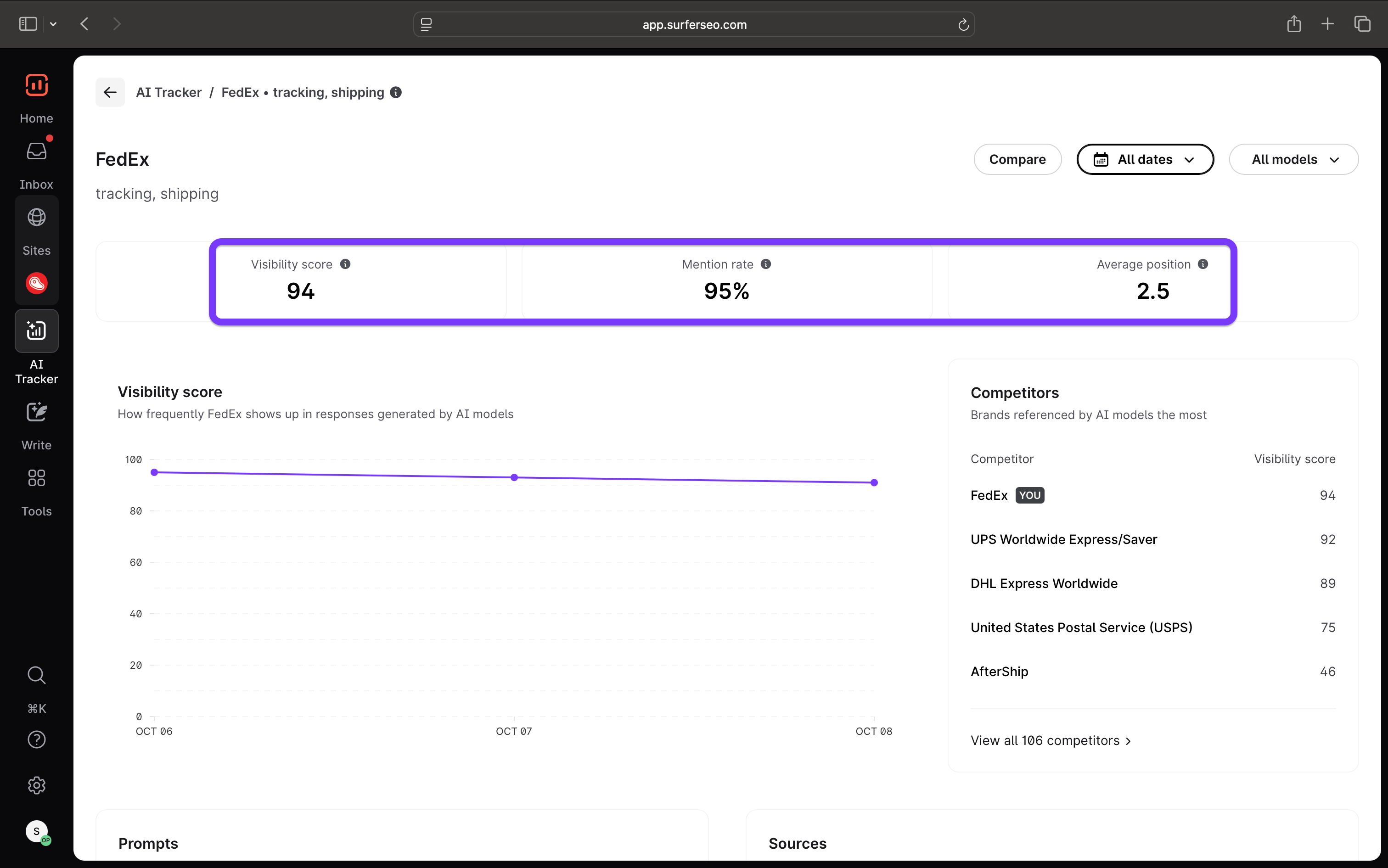
GEO needs its own metrics. Track how often AI engines mention and cite your brand for the prompts that matter, your share of voice against competitors, and the traffic and conversions AI sends you. Measure with real answers, not API calls: Surfer found the brands mentioned in API results overlap with what users see by only 15.5% to 31.6%. Then test: change one variable at a time on a group of pages, such as the intro, added statistics, or structure, and compare citation rates.
How to measure GEO performance
Traditional SEO metrics like rankings and clicks miss most of what happens in AI-driven search, so track your AI search visibility separately from your search performance in Google. Track these GEO KPIs alongside them:
- AI visibility: the share of your tracked prompts where your brand appears in AI-generated answers.
- Mentions and citations: how often AI names your brand and links to your pages, per AI engine.
- Share of voice: your AI mentions compared with competitors for the same prompts.
- Sentiment and accuracy: whether AI describes your brand and products correctly.
- AI referral traffic and conversions: visits from ChatGPT, Perplexity, Gemini, and Claude in GA4, and what they convert into. Here's how to track AI traffic in Google Analytics.
- Generative AI performance in Search Console: Google's report on how people find your content through its AI features.
Learn how Surfer calculates visibility score and how to improve your AI visibility.
GEO tools
You can do GEO with a mix of content tools and AI visibility trackers, on top of the SEO tools you already use:
Compare more options in our list of the best AI visibility tools.
Common GEO mistakes
- Keyword stuffing: it lowered visibility in the GEO study.
- A page per fan-out query: fan-outs are unstable, and Google treats mass-produced pages as spam.
- Chasing technical shortcuts: llms.txt and AI-specific schema don't affect Google Search.
- Publishing unedited AI-generated content: it rarely adds the original facts that get cited.
- Judging by one answer: AI answers vary between runs. Track a set of prompts over time.
- Forgetting SEO: AI engines retrieve from search results, so pages that don't rank or aren't indexed rarely get cited.
Frequently asked questions
What is GEO in SEO?
GEO, or generative engine optimization, is the part of SEO focused on getting content cited in AI-generated answers from tools like ChatGPT, Google AI Mode, and Perplexity. It builds on SEO fundamentals and adds tactics like answer-first writing, adding statistics and quotations, and earning third-party mentions.
Is GEO replacing SEO?
No. Generative engines retrieve content from search indexes, so SEO still decides whether your pages are considered. GEO adds a layer on top: making your content easy to extract and attribute, and building the brand presence AI relies on.
Is GEO better than SEO?
Neither is better: they work together. SEO gets your pages into the search results that generative engines retrieve from, and GEO makes those pages easier to cite. A brand with strong SEO and no GEO misses AI answers; a brand doing GEO without SEO rarely gets retrieved at all.
Is AI SEO the same as GEO?
Mostly. AI SEO is the broader term: it covers using AI to do SEO as well as optimizing for AI search. GEO refers specifically to optimizing for generative engines. Large language model optimization (LLMO) and AEO are closely related terms.
What's the difference between GEO and AEO?
Answer engine optimization (AEO) focuses on being the direct answer in features like featured snippets, voice search, and AI Overviews. GEO is broader: it covers being cited and recommended across generative AI engines like ChatGPT, Perplexity, Gemini, and AI Mode. In practice, the tactics overlap.
What do generative engine optimization services include?
GEO services usually include an AI visibility audit, prompt tracking across AI engines, content optimization for extraction and citations, digital PR to earn mentions on cited sources, and reporting on citations and AI referral traffic. Ask any provider how they measure results and whether they track real AI answers or API output.
How do you measure GEO?
Track AI visibility (how often your brand appears for your target prompts), citations, mentions, share of voice against competitors, and AI referral traffic and conversions in GA4. Use a tool that collects real answers from the AI interfaces people use.
Does llms.txt help with GEO?
Not for Google: it says its Search features don't use llms.txt. There's no public confirmation that other major AI search engines use it to choose sources, so it's a low priority compared with content quality, structure, and crawlability.