To get cited by AI search engines like ChatGPT, Google AI Mode, and Perplexity, you need pages that get retrieved for the query and its fan-outs, answer the question in the first lines of each section, and contain facts the AI can attribute to you, plus mentions on the third-party sites AI already trusts. Ranking alone isn't enough: in Surfer's study of 10,000 keywords, 67.82% of pages cited in Google's AI Overviews didn't rank in the top 10 for the query or any of its fan-outs.
This guide explains how AI search engines choose which sources to cite, what the latest 2026 research says about LLM citations, and the nine things that most improve your chances of getting cited. It's for SEOs, content marketers, and brands that want more AI visibility. If you're new to the topic, start with our guides to AI SEO and generative engine optimization.
What are LLM citations?
LLM citations are the links and source names an AI assistant shows next to its answer to tell you where the information came from. When ChatGPT, Perplexity, Gemini, Claude, or Google's AI Mode search the web before answering, they read several pages and credit some of them as sources. Answers built only from a model's training data usually have no citations at all, which is why live web search is where AI citations happen.
Being cited is different from being used. An AI system can read your page, use its information, and still not link to it. Researchers who studied about 14,000 real conversations with search-enabled AI models call this the attribution gap: 61% of answers drew on more websites than they credited. Perplexity's Sonar models visited a median of 10 sites per query and cited about 5.
Ahrefs saw the same pattern at a larger scale. Across 1.4 million ChatGPT prompts, only about half of the URLs ChatGPT retrieved ended up cited in the final answer. Getting retrieved puts you in the running. Getting cited takes something the AI can attribute to you specifically.
Why AI citations matter
AI citations are now part of brand visibility in AI responses, and they pay off in clicks too. Seer Interactive tracked 5.47 million queries and found that brands cited in an AI Overview earned about 120% more organic clicks per impression than brands that weren't cited. AI referral traffic is still small, about 0.32% of all website traffic in early 2026 according to SE Ranking's study of 101,574 websites, but it has grown about sixteenfold since 2024.
How AI search engines choose which sources to cite
AI search engines don't rank pages the way Google's blue links do. They run a retrieval-augmented generation (RAG) pipeline: break the prompt into sub-queries, retrieve pages for each, split them into passages, pick the most relevant ones, write an answer, and attach citations to the claims they can trace to a source. Here's what matters at each step.
1. Retrieval: each engine searches a different index
AI engines don't all search the same web. A page that's invisible in one can be cited in another.
- ChatGPT searches the web through Bing. Seer Interactive found that 87% of ChatGPT search citations matched Bing's top 20 results, compared with 56% for Google's.
- Google AI Mode and AI Overviews use Google's index and its query fan-out technique.
- Perplexity runs its own crawler, PerplexityBot, and its own index.
- Claude: Anthropic lists Brave Search as a web search subprocessor.
Every engine also fans out: it turns your prompt into several sub-queries and retrieves results for each. That's why query fan-out is the first thing to understand about AI citations.
2. Selection: authority matters less than you think
Once pages are retrieved, AI engines filter them hard, and classic authority signals barely register. Surfer analyzed 20,000 prompts and about 5 million cited URLs across AI Mode, AI Overviews, ChatGPT, and Perplexity: domain authority had almost zero correlation with how often a page was cited. A SIGIR 2026 study of 11,500 queries found that traditional Google search is significantly more likely than Gemini or AI Overviews to pull from popular and institutional websites.
Freshness, on the other hand, does matter. Ahrefs analyzed about 17 million cited URLs and found that AI assistants cite content that's 25.7% fresher than the pages in Google's organic results, about 1,064 days old on average.
3. Extraction: AI quotes passages, not pages
AI systems don't read your whole page. They score individual passages and sentences against the query and feed only the best ones to the model. The space is limited: Dan Petrovic of DEJAN analyzed 883,262 snippets and found that Gemini works with a grounding budget of about 1,929 words per query. The top source gets about 531 words (28%), while the fifth gets about 266 (13%).
Position on the page matters too. Surfer found that 38% of AI Overview citations come from the first 100 words of a page. A great insight in paragraph twelve is much less likely to be used than the same insight in your intro.
4. Citation: AI credits what it can attribute
An AI engine cites a source when it can confidently tie a specific claim to it. Pages with distinct facts, original data, named frameworks, or expert commentary are easy to attribute. Pages that repeat what everyone else says give the AI no reason to credit them over anyone else. The question to ask about every page: what here could only have come from us?
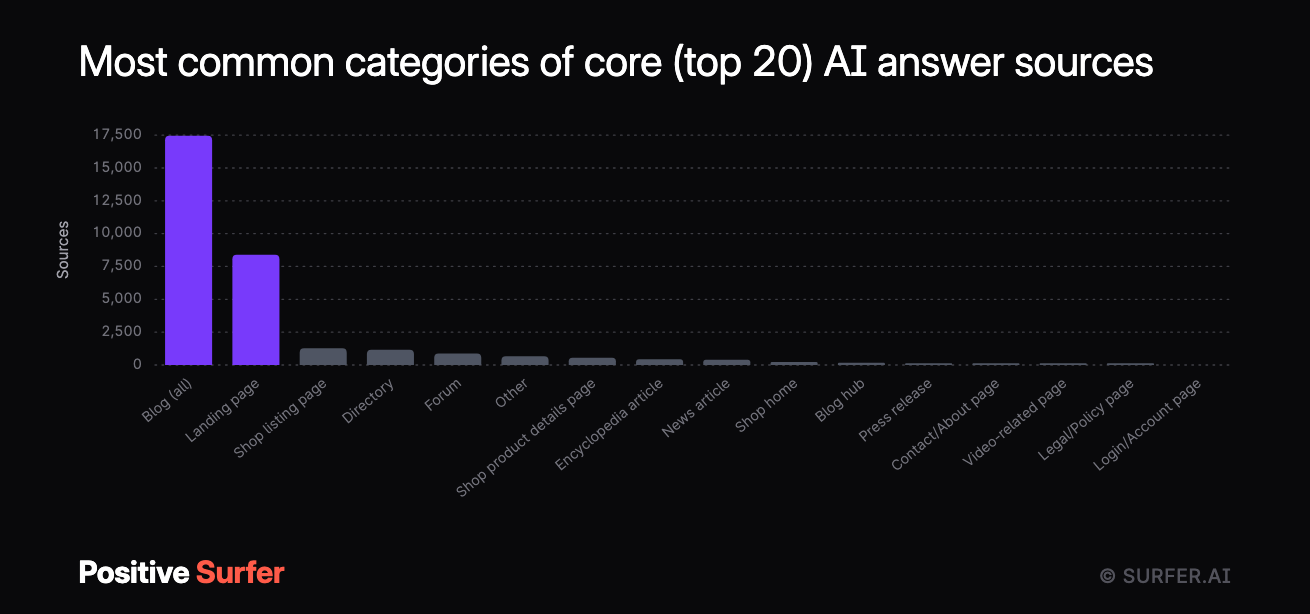
What gets cited also depends on the platform and the topic. Across 36 million AI Overviews, YouTube, Wikipedia, and Google.com were the most-cited domains overall, but health answers leaned on NIH and gaming answers on YouTube and Reddit. And in Surfer's research on the sources that keep reappearing in AI answers, blog posts and landing pages dominated:
How to get cited by AI: 9 ways
These steps are based on Surfer's research and the studies above. Start with the first four: they apply to every page you publish.
1. Rank for the query and its fan-outs
AI engines retrieve from search results, so traditional SEO still decides whether you're in the candidate set. But rank for the cluster, not just the head term. In Surfer's study, pages ranking for the main query and its fan-out queries were 161% more likely to be cited in AI Overviews than pages ranking for the main query alone. Build topic clusters that cover the subtopics AI searches for behind the scenes.
2. Answer the question at the top of each section
Write every section so its first sentence answers the question in its heading. Phrase headings as the questions people ask, then give a direct answer of about 20 to 30 words before adding context. Keep links out of that first sentence: a clean, self-contained answer is easier to lift. Do the same for the page as a whole, with the core answer in the first 100 words.
Paste one of your sections into the checker below to see how extractable it is:
3. Structure content for AI extraction
Structure alone moves the needle. A March 2026 study found that restructuring content without changing what it says raised citation rates by 17.3% across six generative engines. Another 2026 study of 21,143 AI citations found that the pages in the top quarter for citation influence had about 1,943 words and 10.6 headings, and almost nine times the list density of the bottom quarter.
Good content structure is what makes content LLM-friendly. In practice:
- Descriptive headings: "How to calculate APR" instead of "More info". Headings work as a table of contents for both readers and AI.
- One idea per section: roughly 75 to 225 words that make sense without the rest of the page.
- Define terms before you use them: don't assume the reader, or the model, knows the jargon.
- General to specific: start with what and why, then move to how and when.
- Steps, lists, and tables: number processes, use bullet points for options, and compare things in tables. Comparison content and question-and-answer content are especially easy for AI to reuse.
- No filler: cut warm-up sentences and vague claims. Every paragraph should earn its place.
4. Publish facts only you have
Original research and first-hand data are the strongest reason for an AI to cite you rather than a competitor. They also signal E-E-A-T: experience, expertise, authoritativeness, and trust. In the Princeton GEO study, which tested nine optimization methods on 10,000 queries, adding quotations improved visibility in generative engine responses by about 41% and adding statistics by about 33%, more than any other method.
You don't need a research department to do this:
- Publish aggregated data from your product or customers.
- Run a small survey and report exact numbers.
- Turn case studies into evidence: baseline, change, result.
- Add expert quotes from people with first-hand experience.
- Cite authoritative sources for every claim you didn't produce yourself, with specific data points rather than vague references.
Then make each fact easy to lift. Write it as one sentence with the source built in, for example: "According to Surfer's 2026 study of 5 million AI citations, domain authority had almost no correlation with how often a page was cited."
5. Cover the key facts of your topic
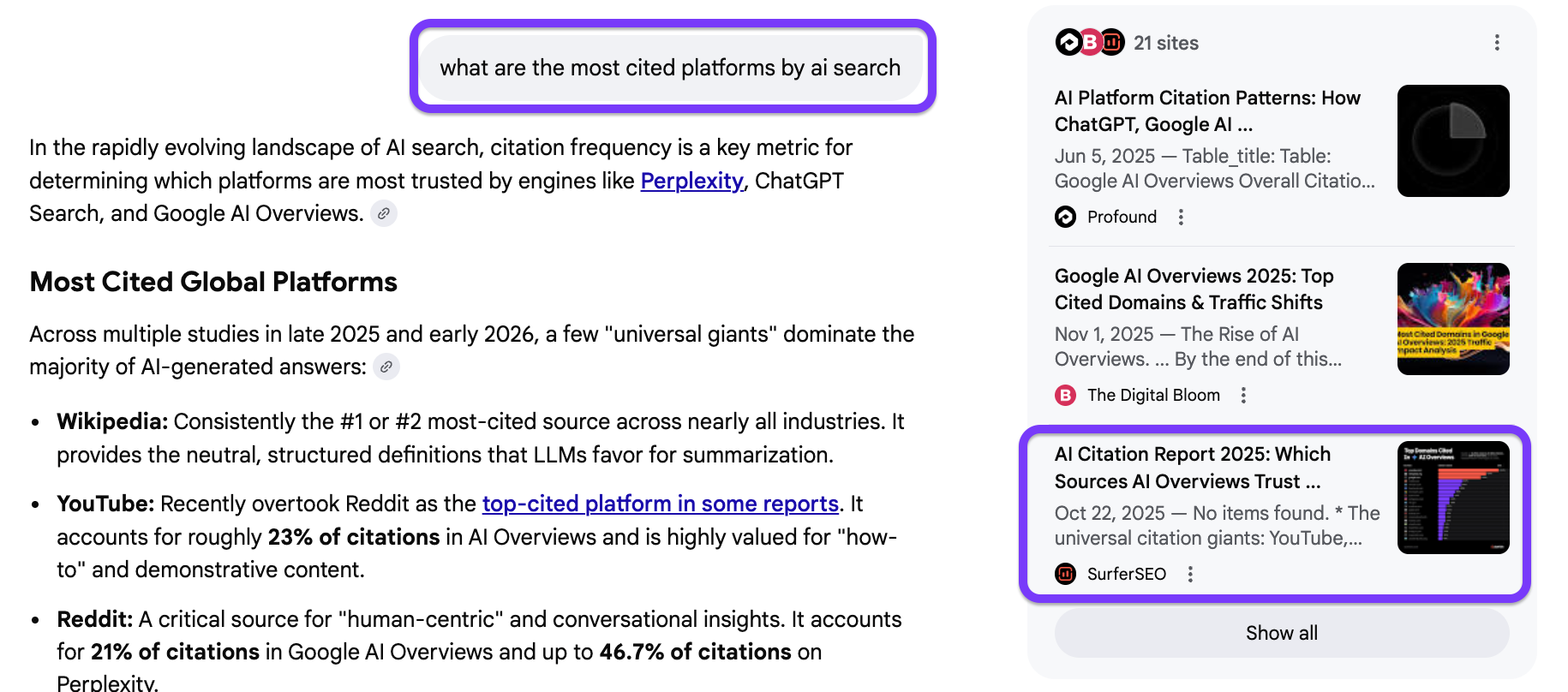
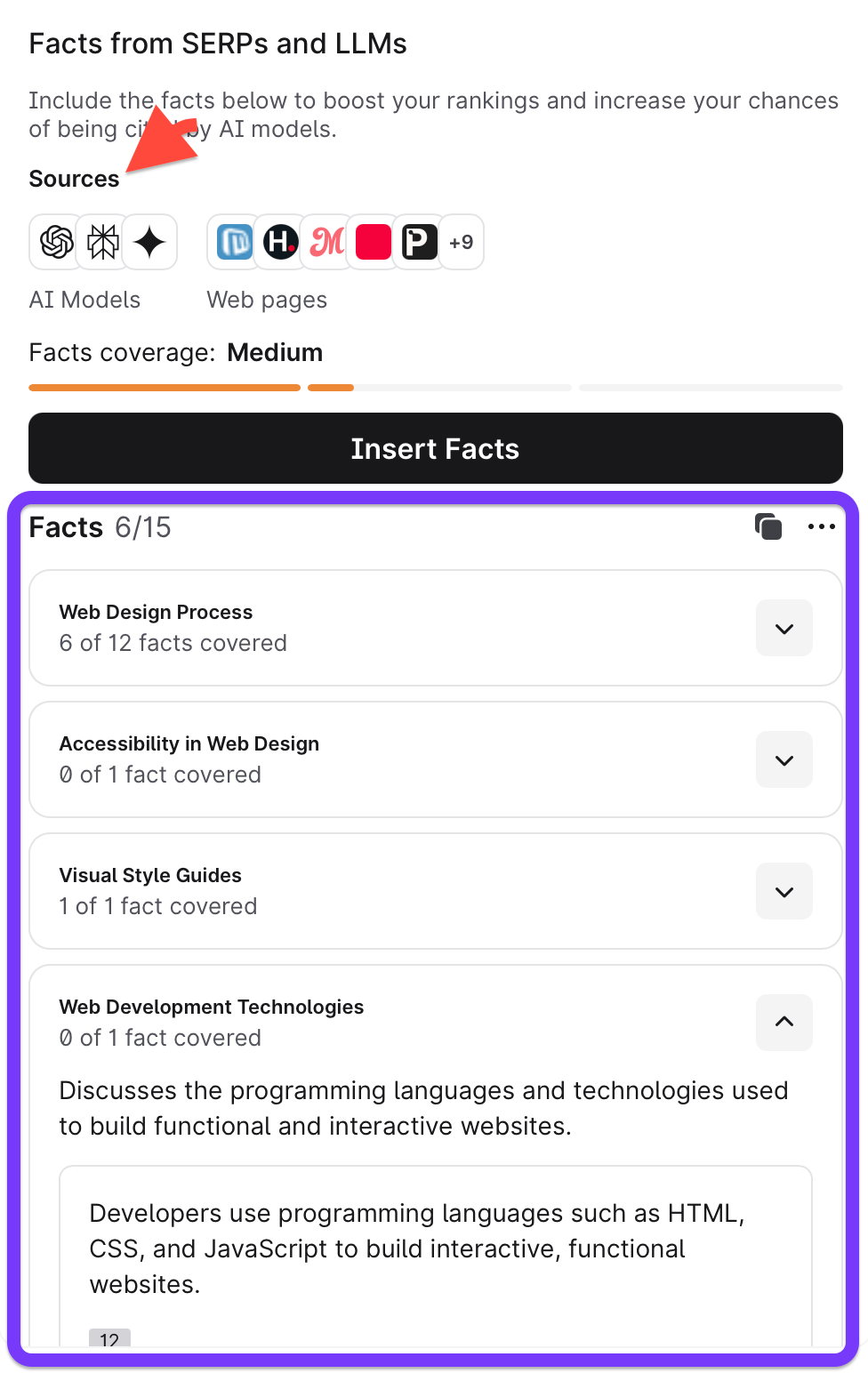
Beyond original data, AI engines look for pages that cover the facts a complete answer needs. Surfer analyzed 57,253 URLs and found that pages cited in AI Overviews covered 31% of a topic's key facts, compared with 24% for pages that weren't cited. Surfer's Content Editor lists the facts AI Overviews, AI Mode, ChatGPT, Gemini, and Perplexity mention for your keyword, with their sources, so you can see what your draft is missing.
6. Keep pages fresh, for real
With AI assistants preferring content that's about 26% fresher than organic results, outdated pages lose citations, especially for pricing, tools, comparisons, and "best" lists. But a new date on an unchanged page isn't an update. Refresh the numbers, examples, and screenshots, show a visible "last updated" date alongside the publish date, and review your key pages every quarter. Evergreen definitions can stay older if they're still accurate. Our content refresh guide shows how to prioritize.
7. Earn brand mentions on the sites AI already cites
AI engines don't only cite your website. They summarize what the web says about you. Third-party mentions and third-party citations work like digital PR for AI platforms, and which sources matter depends on the question:
- Factual questions (pricing, features, locations): brand-managed sources dominate. Yext analyzed 6.8 million AI citations and found that 86% came from brand-managed sources, such as websites (44%) and business listings (42%). Forums like Reddit made up 2%.
- Recommendation questions ("best X for Y"): third-party coverage decides. Surfer found that mentions in blog posts correlate most strongly with how strongly AI recommends a brand.
- Experience questions: reviews, Reddit threads, and YouTube videos carry the first-hand perspective AI looks for.
- Explanatory questions: editorial coverage in relevant publications that your target audience already reads.
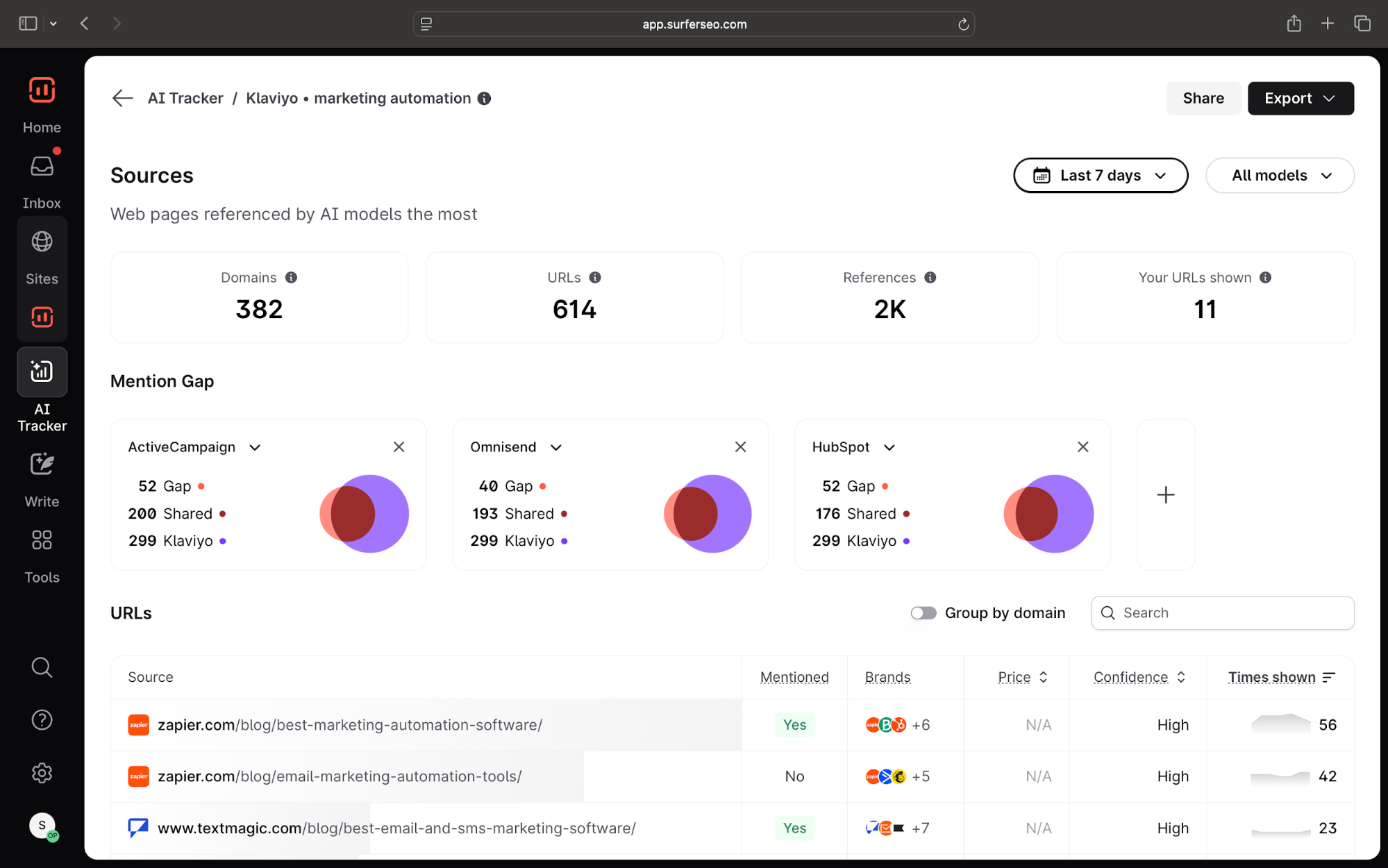
Use an AI visibility tool to see which pages AI cites for your prompts, then pitch the ones that are missing you. Lead with how you'd make their page more complete, not with a sales pitch.
8. Make your brand easy to recognize
AI engines need to understand who you are before they recommend you. Keep your brand name, product names, and descriptions consistent across your site, social profiles, and listings. Publish clear About, product, and pricing pages that answer the common questions about your brand. Schema markup such as Organization schema, Person schema, and Article schema helps search engines understand your entities and can earn rich results, but Google says there's no special schema for its AI features.
Google is also moving in your favor here. In October 2026 it said AI Mode and AI Overviews are showing more inline links, higher in responses, and that it's testing a section that highlights a task's one or two official sites.
9. Be indexable everywhere AI crawlers look
Because each engine uses a different index, you need to be findable in all of them. Make sure Google and Bing can crawl and index your important pages (Bing Webmaster Tools helps with ChatGPT's source). Check that your robots.txt and CDN don't block AI crawlers used for search, such as OAI-SearchBot and PerplexityBot. Blocking them keeps you out of AI-generated answers on those platforms. And keep key information in HTML text, not only in images or scripts.
How to get cited by ChatGPT, AI Overviews, and Perplexity
The nine steps apply everywhere, but each platform has its quirks:
| Platform | Where it finds sources | What matters most | Guide |
|---|---|---|---|
| ChatGPT | Bing's results; usually two or three searches per prompt, with increasingly specific queries | Bing indexing and rankings; pages that answer precise questions | How to rank in ChatGPT |
| Google AI Overviews and AI Mode | Google's index, through many fan-out queries | Cluster coverage and Google rankings | AI Overviews, AI Mode |
| Perplexity | Its own crawler; it searches the web for every query | Fresh content | How to rank in Perplexity |
How to track your AI citations
Rankings and clicks from traditional search don't show whether AI cites you, and much of the value happens without a click: in one user study of Google AI Mode, 77.6% of sessions had no external visit. Track citations directly:
- Pick 25 to 50 prompts your buyers ask, across ChatGPT, AI Overviews, AI Mode, and Perplexity.
- Track brand mentions, citations, and share of voice over time with citation tracking across AI platforms. Use a tool that scrapes real answers: Surfer found that API results overlap with what users see by only 15.5% to 31.6%.
- Audit the pages that already get cited and copy what works: direct answers, original data, clear structure.
- Segment AI referral traffic in GA4 to see how much AI traffic you get and how it converts compared with organic visitors. Here's how to track AI traffic in Google Analytics.
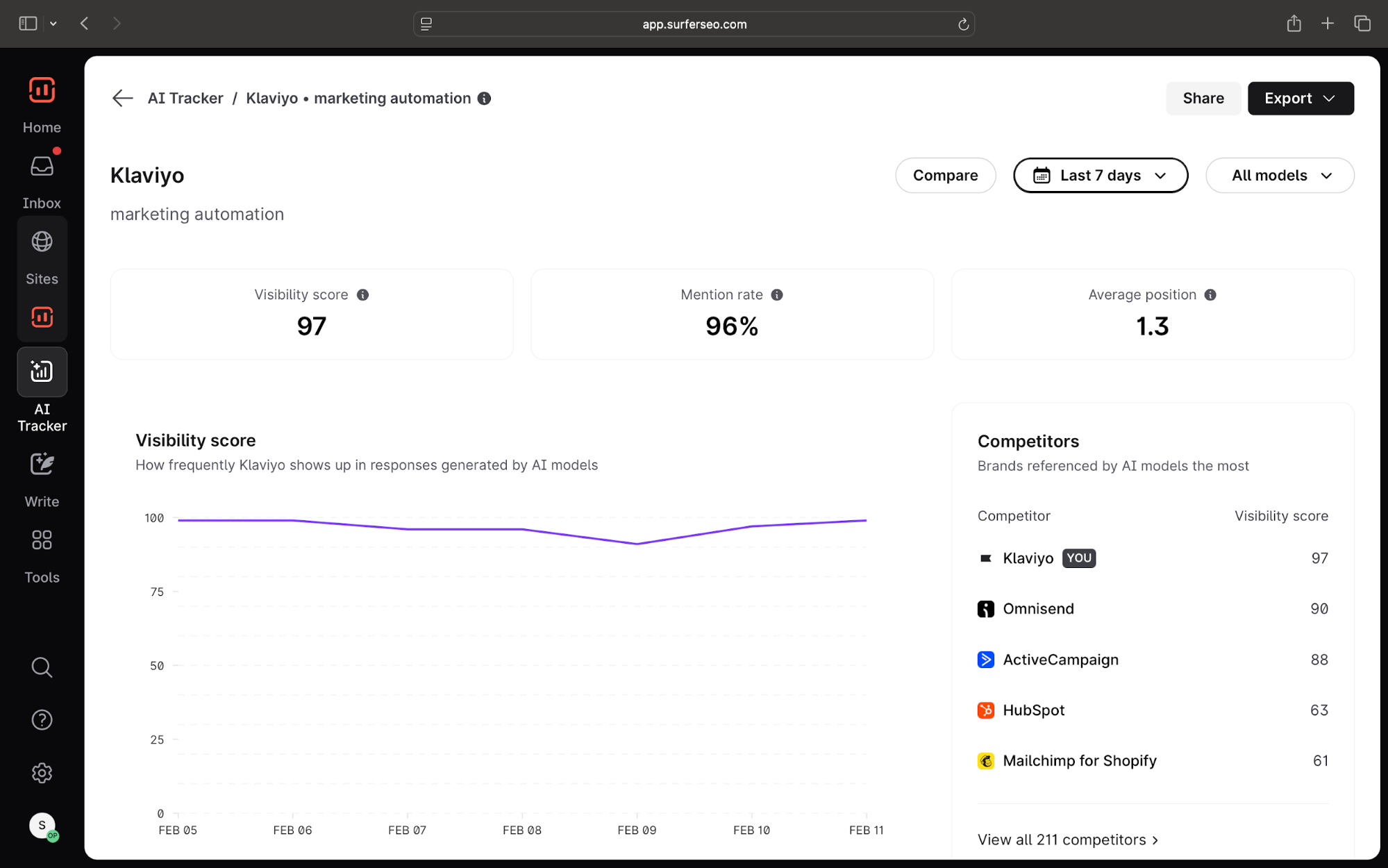
Structural fixes can show up in AI answers within days. Authority from original data and mentions builds over months, so track both and keep iterating.
Frequently asked questions
How do I get my website cited by AI?
Rank for your topic's main query and its fan-out queries, answer each question in the first sentence of its section, publish original facts the AI can attribute to you, keep important pages updated, and earn mentions on the third-party pages AI already cites.
How do I get cited by ChatGPT?
ChatGPT searches the web through Bing, so make sure Bing indexes your pages and you rank there. Then give precise, direct answers with specific data, keep pages fresh, and get mentioned on the review sites, lists, and publications ChatGPT cites for your topic.
Does domain authority matter for AI citations?
Very little. Surfer's analysis of about 5 million cited URLs found almost zero correlation between domain authority and how often a page was cited. Relevance, structure, freshness, and original information matter more.
Does schema markup help you get cited by AI?
Not directly for Google: it says its AI features need no special schema. Structured data still helps search engines understand your entities and can earn rich results, so use it where it accurately describes your content.
Why does AI use my content without citing it?
AI systems often read more pages than they credit. Research on about 14,000 conversations found that 61% of answers used more sites than they cited. AI cites the sources it can tie to a specific claim, so distinct facts and original data improve your odds.
How long does it take to get cited by AI?
Structural changes like clearer headings and direct answers can affect AI answers within days of being crawled. Building the authority that comes from original data, mentions, and topical depth usually takes a few months.