LLM optimization (LLMO) is the practice of making your brand and content easy for large language models like ChatGPT, Google Gemini, Claude, and Perplexity to understand, trust, and mention in their answers. Also called LLM SEO, it works on two fronts: what models learned about you in their training data, and what they find when they search the web in real time. In Surfer's study of 289,105 source pages, brands mentioned in more blog posts were recommended more strongly by AI, which is why LLMO reaches beyond your own website.
This guide explains what LLMO is, how it differs from SEO, GEO, and AEO, how LLMs decide what to say about your brand, and eight strategies backed by 2026 data. You'll also learn how to measure your LLM visibility, so you can see what's working.
What is LLMO (large language model optimization)?
LLMO, short for large language model optimization, is the process of improving how often and how accurately AI chatbots and conversational AI tools mention your brand, recommend your products, and cite your content. The goal isn't a ranking. It's being part of the answer when someone asks an AI tool about your category.
A quick note on the term: in machine learning, "LLM optimization" also means making models run faster and cheaper, with techniques like quantization and batching. This guide is about the marketing meaning: optimizing your brand's visibility in LLM responses.
LLMO covers three areas:
- Your brand entity: what LLMs know about who you are, what you sell, and who you're for.
- Your content: whether your pages get retrieved and quoted when an AI model searches the web.
- Your reputation: what other websites, reviewers, and communities say about you, which LLMs summarize.
LLMO vs. traditional SEO, GEO, and AEO
You'll see several names for optimizing for AI search. They overlap heavily, and Google itself says that optimizing for its AI features is still SEO. The difference is mostly emphasis:
For the content side, see our guides to generative engine optimization and answer engine optimization. This guide puts the brand first. If you're new to the wider topic, start with our AI SEO guide.
Why LLM optimization belongs in your SEO strategy
AI chatbots and other AI platforms have become a primary research tool for many users, especially for comparing products and services:
- Scale: ChatGPT reached 800 million weekly users in October 2025, and Google AI Mode passed 1 billion monthly users in May 2026.
- Fewer clicks, more answers: on Google queries with an AI Overview, Seer Interactive measured an organic click-through rate of 2.36% in February 2026, versus 3.82% on queries without one.
- Mentions drive clicks: in the same Seer study, brands cited in an AI Overview earned about 120% more organic clicks per impression than brands that weren't.
- Small traffic, big value: AI isn't a big traffic driver yet: AI assistants sent only 0.32% of website traffic across 101,574 sites in an SE Ranking study. But AI search drove 12.1% of Ahrefs' signups from 0.5% of its traffic, and Vercel reported in June 2025 that ChatGPT refers about 10% of its new signups.
The business value is in the answer itself. When someone asks an AI chatbot for the best tool in your category and your brand isn't named, you've lost that buyer before they ever see a search result.
How LLMs decide what to say about your brand
Unlike traditional search engines, which return a list of web pages, LLMs write one answer. They build LLM responses from two sources, and LLMO has to work on both.
1. Training data
LLMs learn patterns of human language from vast amounts of public text during training, most of it from web pages. They break text into tokens and represent meaning as embeddings, which is why they understand concepts and relationships rather than matching keywords. Everything a model "knows" about your brand without searching comes from there: how often you were mentioned, in what context, and next to which other brands and topics. Training data has a cutoff date, so it changes slowly, and you can't edit it directly. You can only shape what the web says about you before the next training run.
2. Live retrieval
For most questions about products, prices, and recent topics, AI search engines also search the web in real time. This process is called retrieval augmented generation (RAG): the model runs several related searches (fan-out queries), pulls the most relevant passages, and writes an answer that cites some of them.
- Google AI Overviews and Google AI Mode retrieve from Google's own index.
- ChatGPT relies heavily on Bing: 87% of its search citations matched Bing's top 20 results in Seer Interactive's test.
- Perplexity uses its own crawler and index, and Microsoft Copilot uses Bing.
- Google Gemini grounds its answers in Google Search.
Which source wins depends on the prompt. A question about your brand leans on model memory, while "best tools for X in 2026" leans on live search results. Try it below:
LLM optimization strategies: 8 ways to get mentioned by AI
These strategies combine Surfer's own research on AI search with what works across ChatGPT, Gemini, and Perplexity. The first three shape what LLMs know about you; the rest help your content win in live retrieval.
1. Define your brand entity clearly and consistently
LLMs connect your brand to topics, categories, and other relevant entities based on how the web describes you. If your homepage says "AI writing assistant," your LinkedIn says "content platform," and review sites call you an "SEO tool," the model gets a blurry picture.
- Write one clear sentence that says what you are, who you're for, and your category, and use it everywhere: your own website, social profiles, directories, and press materials.
- Keep an accurate About page with your founding date, leadership, products, and pricing model.
- Add Organization structured data with
sameAslinks to your official profiles. Structured data helps search engines connect your entity, though Google says its AI features don't need special schema. - Check how knowledge aggregators like Wikipedia, Wikidata, and industry directories describe you, and correct errors through their proper processes.
- Make your unique value proposition explicit. "The fastest way to X for Y teams" gives a model something specific to repeat.
2. Earn brand mentions where LLMs look
Brand mentions are increasingly important, and they're the core of LLMO. Surfer analyzed AI recommendations and the 289,105 source pages behind them, and found that mentions in blog posts correlated most strongly with how strongly AI recommended a brand, more than mentions in reviews or news.
Look at where AI gets its answers for your category. In Surfer's AI citation report covering 36 million AI Overviews, YouTube was cited in about 23% of them, and community sites and niche publishers led in specific industries. When ChatGPT recommends budget laptops, for example, its sources include YouTube reviews, Reddit threads, and tech publishers:
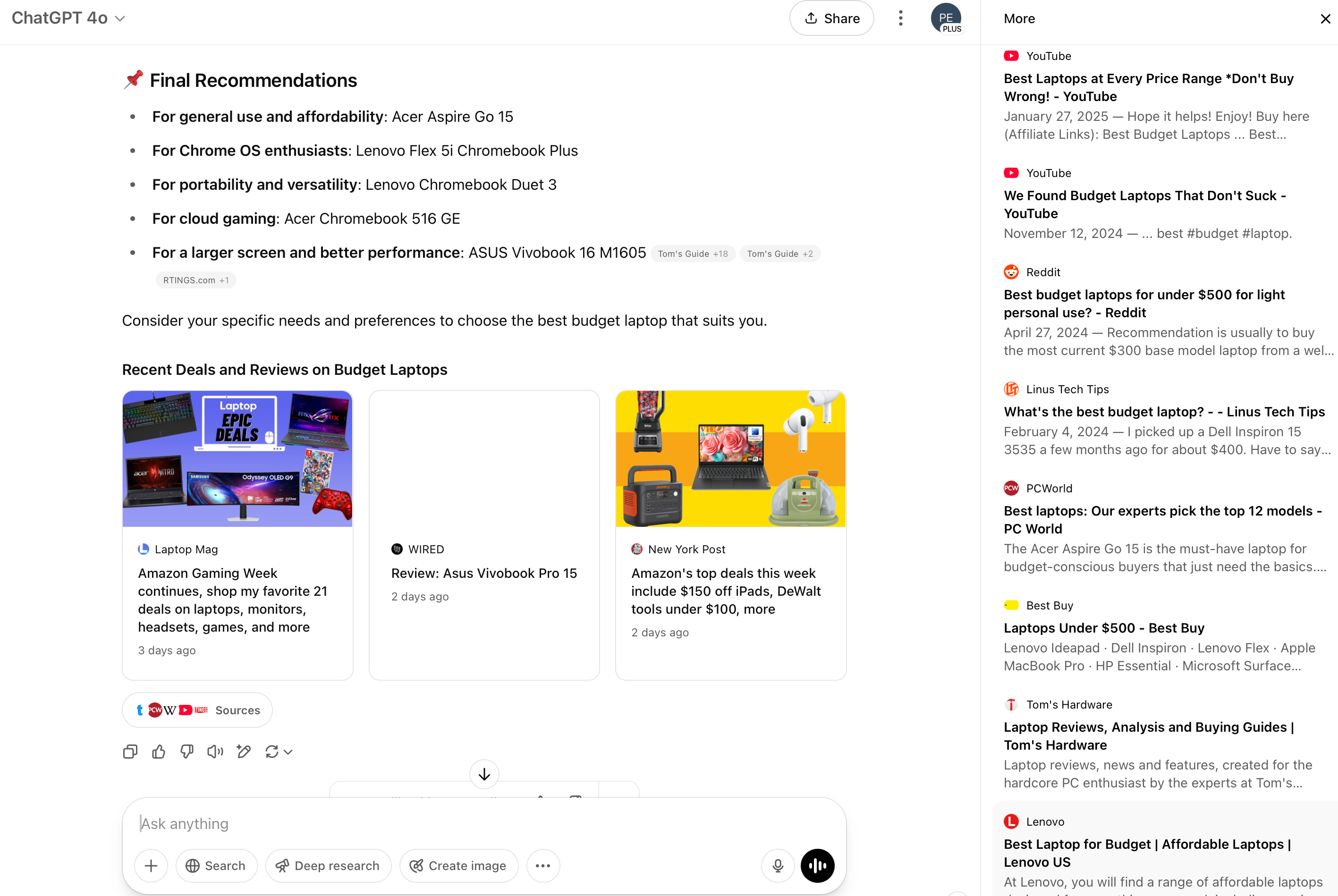
- Get included in the "best X" listicles and comparison posts AI already cites for your category.
- Use digital PR to pitch expert commentary and data to industry publications, not just press releases.
- Show up on YouTube with reviews, tutorials, and comparisons. Video and images give AI another format to cite, and digital PR works better when you have assets others want to embed.
Our guide to LLM seeding shows how to find and earn these mentions step by step.
3. Build a presence in communities and user-generated content
For product and "best of" questions, LLMs lean on what real people say. Reddit threads, forums, Stack Overflow answers, and review sites show up again and again in AI responses, as in this ChatGPT answer about fluoride-free toothpaste:
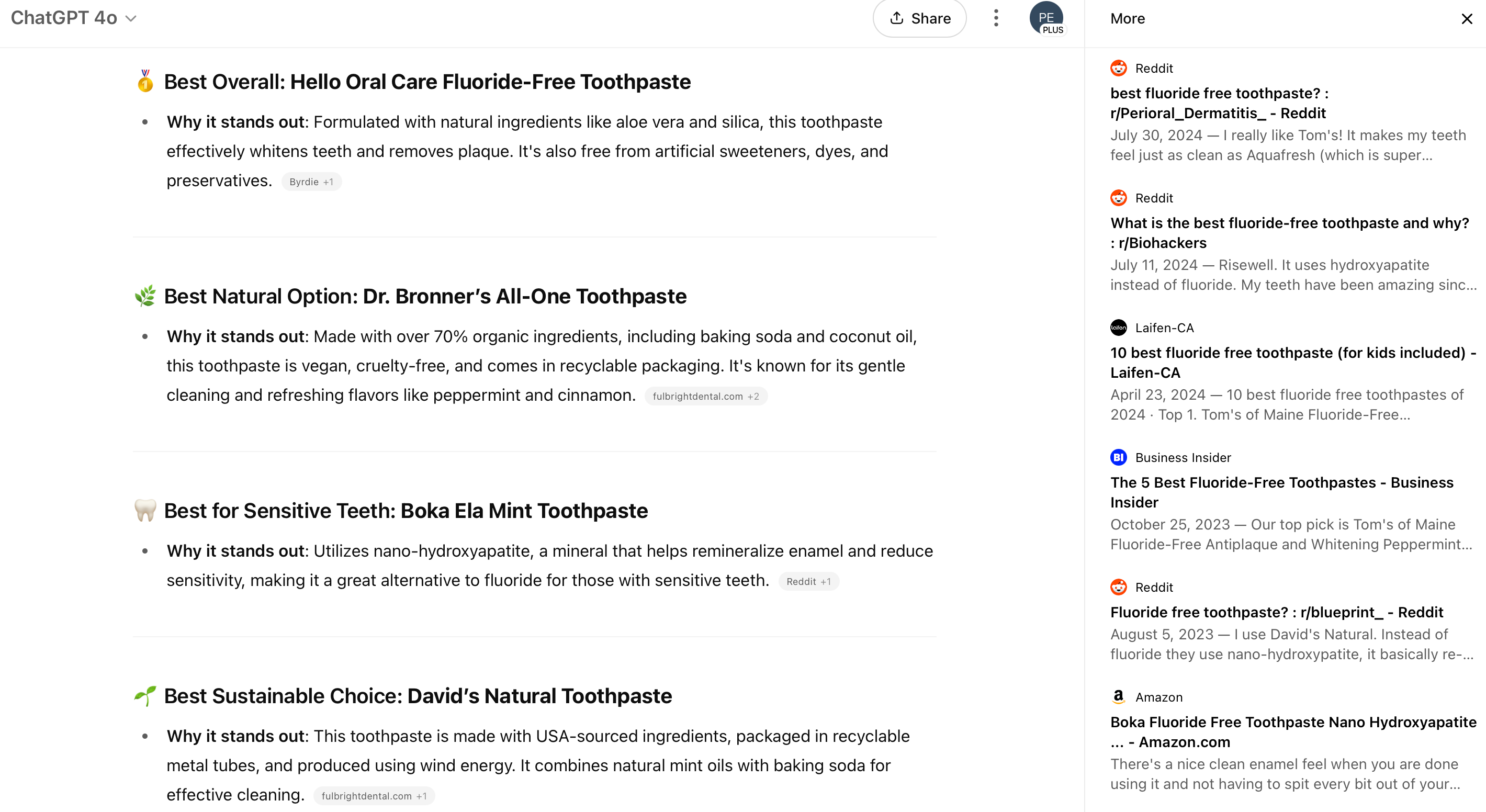
You can't fake this. Answer questions in your niche honestly, encourage happy customers to leave detailed reviews that mention their use case, and fix the problems people complain about. User-generated content shapes both the next round of training data and today's live retrieval.
4. Keep traditional SEO strong: rank for the topic and its fan-outs
Traditional SEO performance is still the primary driver of AI visibility, because AI models retrieve from search indexes. Surfer found that pages ranking for both the main query and its sub-queries were 161% more likely to be cited in AI Overviews.
Ranking for one keyword isn't enough, though. In Surfer's study of 10,000 keywords, 67.82% of AI Overview citations didn't rank in Google's top 10 for the query or any of its fan-outs. And domain authority had almost no correlation with citations, so smaller brands can win with relevant content. Use keyword research to map the sub-questions around each topic, plan your content strategy around topic clusters, and track keywords for both the main query and its fan-outs. Fix technical SEO basics like indexing, internal links, and page speed so search engines can reach everything.
5. Create content LLMs can extract and quote
When an AI model retrieves your page through retrieval augmented generation, it looks for a passage that answers the question on its own. LLM-friendly content makes those passages easy to find:
- Answer first. Put direct answers in the first one or two sentences of each section. Surfer found that 38% of AI Overview citations come from the first 100 words of a page.
- Use clear structure. Question-based headings, short paragraphs, lists, and tables. Pages cited in AI Overviews scored 19.95% better on subheadings and 17.46% better on concept definitions in Surfer's analysis.
- Write in natural language. LLMs match meaning, not exact keyword matches, so concept clarity beats keyword density. Write the way people ask questions.
For a deeper look at passage-level writing, see how to get cited by AI.
6. Publish original data and cover the key facts
LLMs favor content that adds something new, so dig deeper than the pages already ranking. Pages cited in AI Overviews covered 31% of a topic's key facts, compared with 24% for pages that weren't cited. In the original GEO research, adding statistics raised visibility in AI answers by about 33% and adding quotations by about 41%.
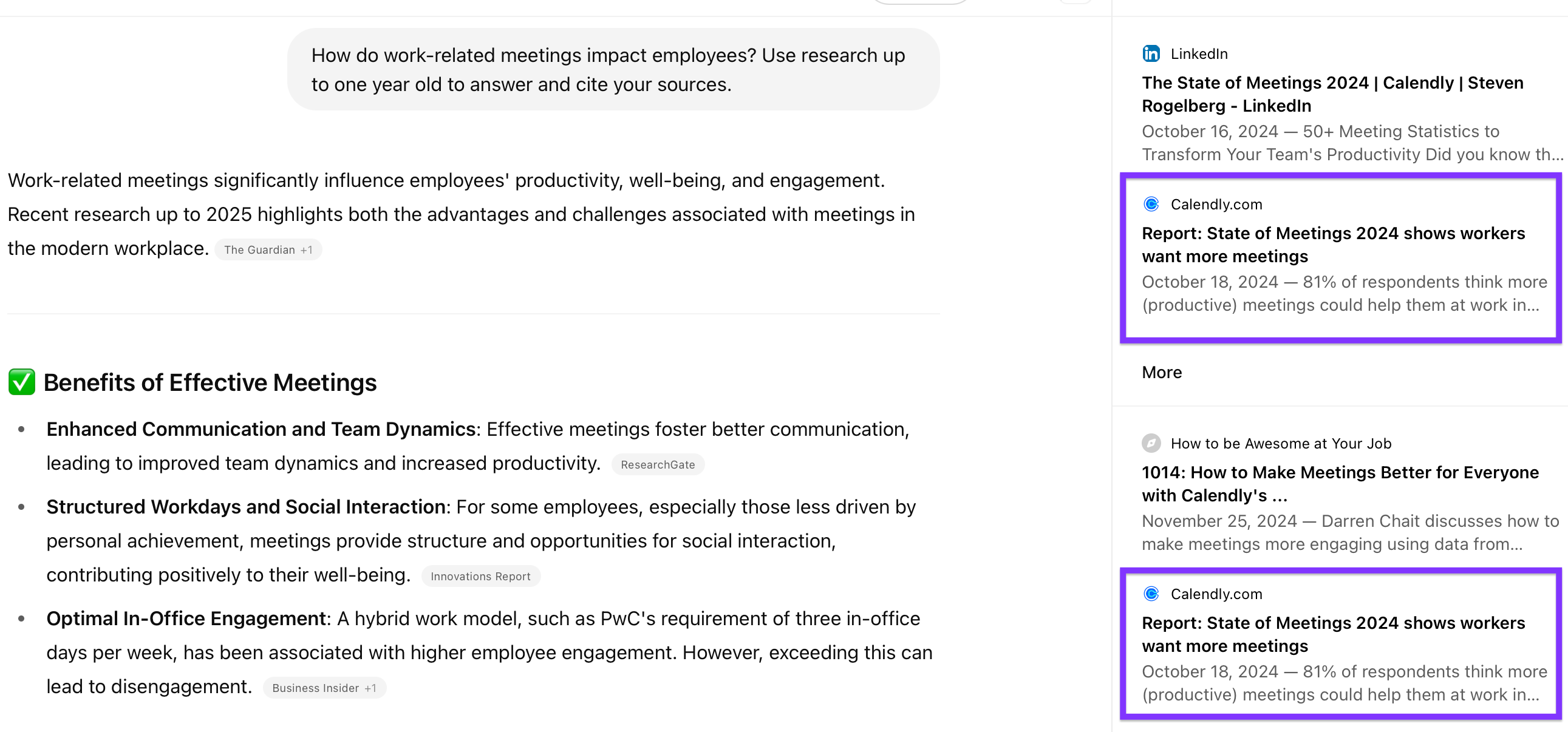
Quantitative data like survey results, benchmarks, and product usage numbers is the easiest to cite. Original research works on both fronts: it gets cited directly, and it earns mentions from large publishers that quote your data. Calendly's State of Meetings report, for example, is cited by ChatGPT as a source in answers about how meetings affect employees:
7. Make your site accessible to AI crawlers
If AI search engines can't crawl your pages, they can't cite them. AI companies run separate crawlers for search and for training:
- Search crawlers like OAI-SearchBot (ChatGPT), PerplexityBot, and Claude-SearchBot decide whether you can appear in live answers.
- Training crawlers like GPTBot, ClaudeBot, and Google-Extended affect future training data, not today's citations.
Keep Googlebot and Bingbot unblocked, and render key content in HTML rather than only through JavaScript. Our AEO guide includes a robots.txt builder for AI crawlers.
8. Keep your facts fresh and skip the myths
Outdated pricing, features, and statistics hurt you twice: AI search engines skip stale pages, and wrong facts spread into AI responses. Ahrefs found that AI assistants cite content that's 25.7% fresher than pages in Google's organic results. Update your most important pages regularly and show a visible "last updated" date.
Skip tactics that don't hold up. Google's July 2026 guide to AI search says it doesn't use llms.txt, that its AI features don't need special schema, and that creating a separate page for every fan-out query counts as scaled content abuse.
Common LLMO mistakes
- Optimizing only your own website: LLMs summarize what the whole web says about you, so third-party mentions matter as much as your own pages.
- Chasing one prompt: AI responses vary between runs. Surfer found that only 0.6% of fan-out queries appeared in every run of the same prompt, so track many prompts over time.
- Blocking AI search crawlers by accident: a blanket block on AI bots can remove you from ChatGPT and Perplexity answers.
- Inconsistent brand descriptions: a different category on every profile makes it harder for models to place you.
- Abandoning SEO: AI search engines retrieve from search indexes, so pages that don't rank rarely get used.
How to measure your visibility in LLM responses
Measuring success in LLMO means tracking AI responses, not just rankings. Focus on these metrics:
- Mention rate: how often your brand appears in AI answers for your target prompts.
- Share of voice: your mentions compared with competitors' for the same prompts.
- Position and sentiment: whether AI recommends you first, and how it describes you. Sentiment analysis shows whether AI mentions are positive, neutral, or negative.
- Citations: which of your pages AI links to, and which third-party sources it uses when it mentions you.
- AI referral traffic and conversions: visits from AI chatbots in Google Analytics.
Where your data comes from matters. In Surfer's study of API results vs. scraped AI answers, roughly 75% of the brands named didn't overlap between the two methods. Use an AI visibility tool that collects answers from the real interfaces people use, like Surfer's AI Tracker.
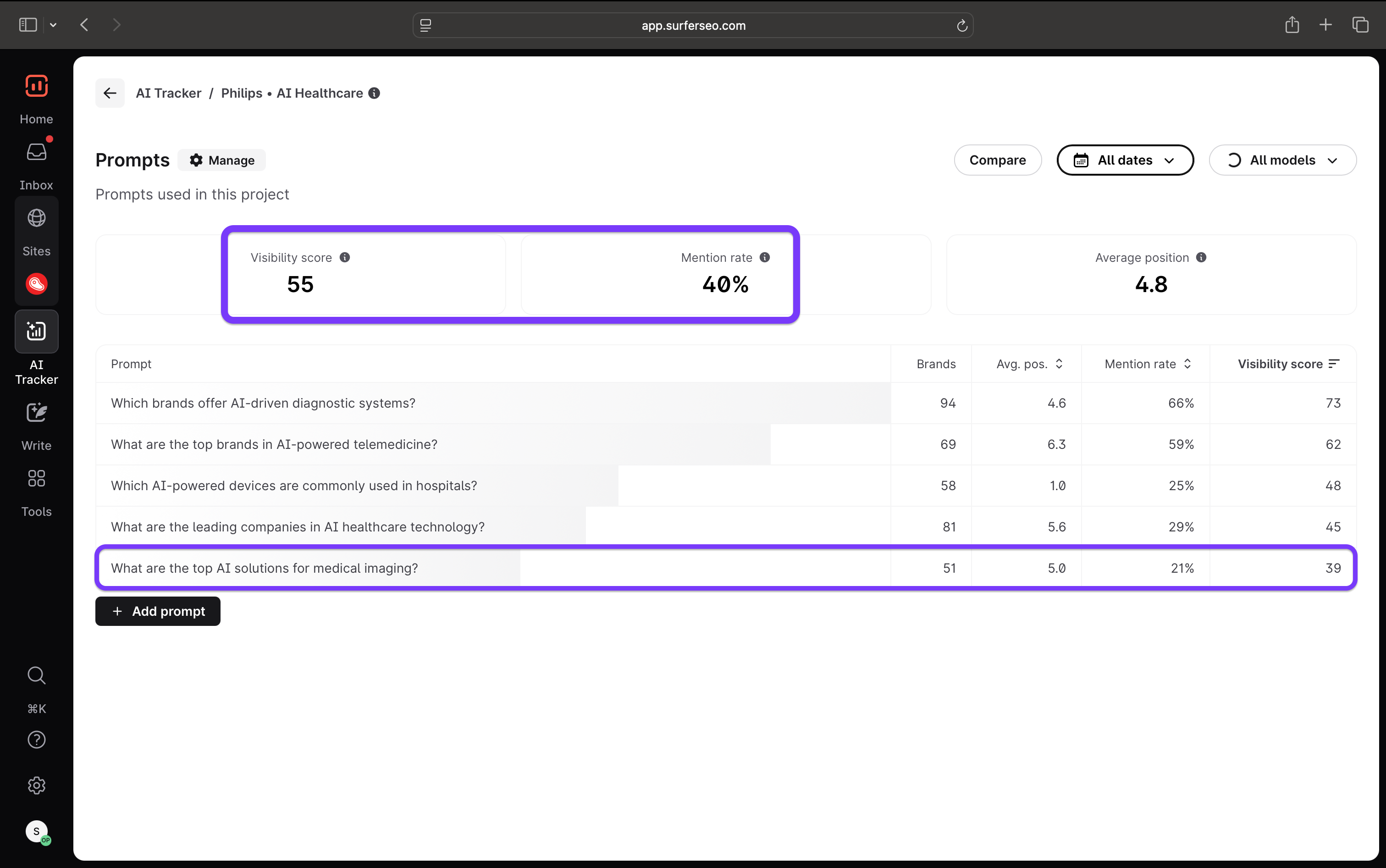
To track AI referral traffic in Google Analytics, build a regex filter for the AI assistants you care about:
Clicks from Google AI Overviews and AI Mode arrive as regular Google Search organic traffic, so check the Generative AI performance report in Search Console for those. Here's more on tracking AI traffic in Google Analytics.
Frequently asked questions
What does LLMO mean?
LLMO stands for large language model optimization: the practice of improving how often and how accurately AI chatbots like ChatGPT, Gemini, Claude, and Perplexity mention and recommend your brand. It's also called LLM SEO.
What is LLM SEO?
LLM SEO is another name for LLMO. It applies SEO principles to large language models: making your content easy to retrieve and quote, and building the brand mentions that shape what AI says about you.
What's the difference between GEO and LLMO?
The tactics overlap almost completely. GEO usually focuses on getting content cited in generative AI answers, while LLMO puts more emphasis on the brand: what models know about you and whether they recommend you.
Is LLMO the same as AI SEO?
Mostly. AI SEO is a broader term that also covers using AI tools for SEO work, while LLMO focuses on your visibility in LLM responses. Both build on the same SEO strategy.
Is SEO dead because of AI?
No. AI search engines retrieve content from search indexes, and pages that rank for a topic and its sub-questions are far more likely to be cited. LLMO builds on SEO rather than replacing it.
How do I optimize content for LLMs?
Answer questions directly at the top of each section, use clear headings and lists, cover the key facts of the topic, add original data, keep pages fresh, and make sure AI search crawlers can access them.
How long does LLMO take to work?
Changes to content that AI retrieves live can show up within weeks of a recrawl. Changing what models learned in training takes longer, because it depends on new training runs and on mentions building up across the web.
Does llms.txt help with LLMO?
There's no evidence it helps with Google: Google says its search features don't use llms.txt. Focus on crawlable pages, clear answers, and third-party mentions first.