Query fan-out is the technique AI search engines like Google AI Mode, ChatGPT, and Perplexity use to break one prompt into several related sub-queries, search the web for each, and merge the results into a single answer. It decides which pages an AI system even considers citing. In Surfer's study of 10,000 keywords, pages that ranked for the main query and its fan-out queries were 161% more likely to be cited in Google's AI Overviews than pages ranking for the main query alone.
This guide explains how the query fan-out process works, how many sub-queries each AI engine runs, what Surfer's research found about fan-outs, and how to optimize your content for them without chasing every single query. It's for SEOs and content teams who want more AI search visibility.
What is query fan-out?
Query fan-out is when an AI system expands one user query into multiple related searches, retrieves results for each, and uses them to build its final answer. Google describes fan-out queries as a set of concurrent, related queries the model generates to fetch additional relevant search results for the user's question.
Google's own example: for the query "how to fix a lawn that's full of weeds", the fan-out queries might include "best herbicides for lawns", "remove weeds without chemicals", and "how to prevent weeds in lawn". Each of those sub-queries has its own search results, and the AI can cite pages from any of them.
Google introduced the term at I/O 2025, when its Head of Search, Elizabeth Reid, explained that AI Mode recognizes when a question needs advanced reasoning, uses a custom version of Gemini to break it into subtopics, and issues many queries at once on the user's behalf. But fan-out isn't unique to Google. ChatGPT, Perplexity, Gemini, Grok, and Claude all run their own sub-queries when they search the web.
Here's what that looks like in ChatGPT. Using Surfer's free Keyword Surfer extension for Chrome, you can see the searches ChatGPT ran behind an answer:
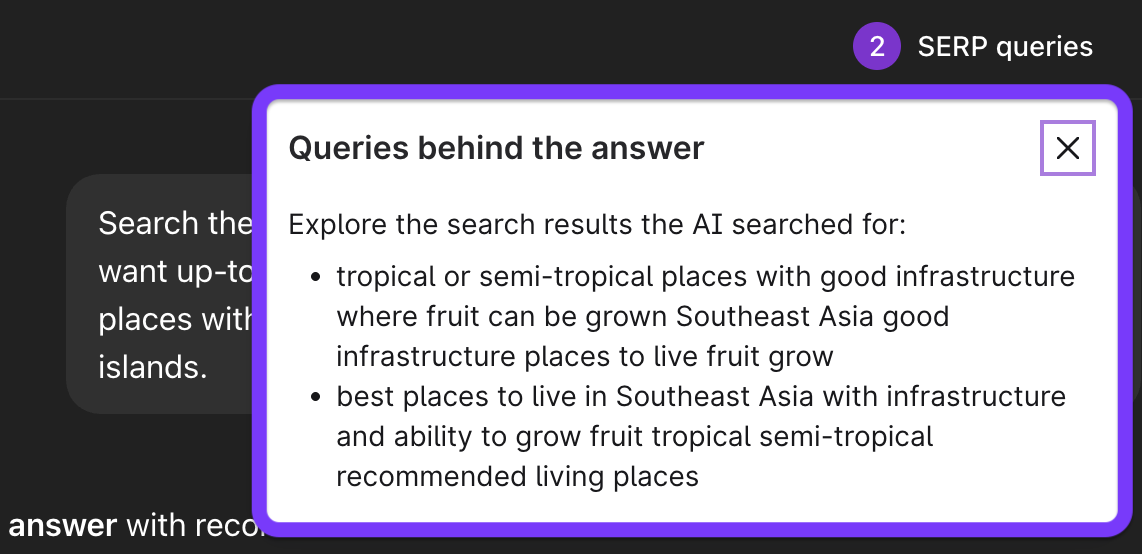
The fan-out queries read like the searches a person would run anyway, just compressed into one step. ChatGPT then merges what it found into one generated answer with cited sources.
Query fan-out vs. query expansion
Query expansion is an older search technique: the engine adds synonyms and related terms to one query to retrieve more relevant documents. Query fan-out goes further. Instead of widening one search, the AI model writes several separate searches (sometimes called synthetic queries), runs them in parallel, and reasons across all the results before writing a final answer.
Query fan-out in AI search vs. fan-out in databases
"Fan-out" also has an older meaning in software engineering: one database or API request that triggers many downstream queries, which can raise latency and costs. This guide is about the AI search meaning, where the fan-out happens inside a search engine and decides which web pages get retrieved and cited.
How query fan-out works
The exact implementation differs between AI search systems, but the fan-out process follows the same five steps:
- Interpret the prompt. The AI model works out the user intent behind the original query and decides whether it needs fresh information from the web. Simple questions are often answered from the model's own knowledge with no fan-out at all.
- Generate sub-queries. The model breaks a broad query into specific search queries: definitions, comparisons, prices, reviews, alternatives, and follow-up questions the user is likely to ask next. Context matters here. The user's city, conversation history, and personal data can change which sub-queries are generated.
- Retrieve results. Each sub-query is sent to a search index, which returns its own search engine results. That's why a page that doesn't rank for the original query can still be retrieved through a fan-out.
- Select passages. The system pulls the most relevant passages from the retrieved pages, not whole pages, and compares them for accuracy and coverage.
- Synthesize the final answer. The AI writes one direct answer from the selected passages and cites some of the sources it used.
7 types of fan-out queries
Ahrefs' analysis of Google's patent applications describes seven kinds of sub-queries AI search engines generate. Here's how they'd look for the prompt "best running shoes for flat feet":
Try it yourself. Pick an example below, or type a topic to see the kinds of angles AI engines typically fan out into:
How many fan-out queries do AI engines run?
It depends heavily on the AI engine and the prompt. Google's AI products fan out the most, while ChatGPT and Perplexity usually run only a couple of searches per prompt.
- Google AI Mode:Ahrefs reports that AI Mode typically makes 5 to 11 sub-queries. Citing Seer Interactive and Nectiv data, it adds that 59% of prompts trigger 5 to 11 searches and 24% trigger 12 to 19.
- Gemini 3 (the model family behind AI Mode):Seer Interactive measured 10.7 fan-out queries per prompt across 501 prompts on the Gemini 3 API, up 78% from 6.01 with Gemini 2.5. The range was 3 to 28 per prompt.
- Gemini with grounding: in Surfer's own test of 1,600 runs, most prompts triggered up to five fan-outs, usually two to four, and some triggered none because the original SERP or the model's knowledge was enough.
- ChatGPT, Perplexity, and Grok:Peec AI analyzed 5 million fan-out queries in April 2026 and found 2.1 per prompt for ChatGPT, 1.4 for Perplexity, and 6.8 for Grok.
- Deep research modes: Google says Deep Search in AI Mode can issue hundreds of searches for a single report, and in Ahrefs' test ChatGPT Deep Research ran 420 searches for one shopping question.
ChatGPT's queries are also getting more specific. In over 20 million ChatGPT fan-outs between October 2025 and January 2026, the number per prompt stayed flat, but the average query length roughly doubled, from about 6 words to about 12. ChatGPT now writes fewer, longer, more precise search queries rather than more of them.
What Surfer's research found about query fan-outs
Surfer's data team ran two studies on query fan-out patterns: one on how stable fan-outs are, and one on how they affect citations in Google's AI Overviews.
Fan-outs are unstable
AI models are nondeterministic: give them the same prompt twice and you can get different answers. Fan-outs are no exception. Across 1,600 runs with Gemini grounding:
- Only about 27% of fan-out queries stayed consistent across repeated runs of the same prompt. We call them core keywords.
- 66% of fan-out queries appeared only once, and just 0.6% appeared in every run.
So a list of fan-outs you pull today is a snapshot, not a keyword list you can rely on next week.
But they stay close to the original query
Fan-outs vary, but they don't wander far. Most had a cosine similarity of 0.75 to 0.95 with the original query, meaning AI usually expands on the user's input rather than looking for unrelated angles. For "how to use hashtags on Instagram", the fan-outs included "how many hashtags on Instagram post", "Instagram story hashtags", and "Instagram reel hashtags". They look just like traditional search queries.
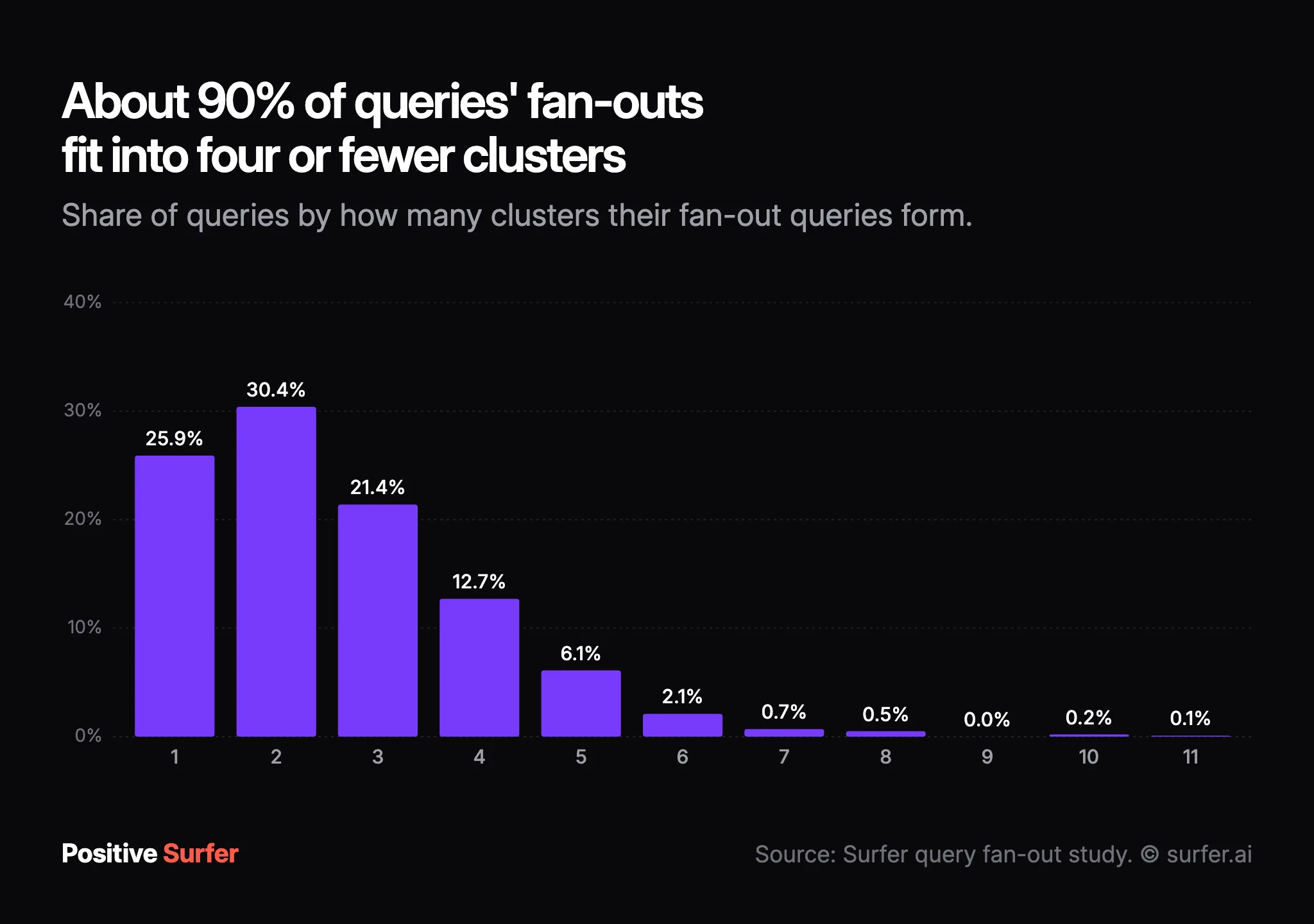
They also share search results. 84% of fan-out queries shared at least one top-20 URL with the original query, and 56% shared five. And about 90% of fan-outs fit into four or fewer clusters. That's the key finding for optimization: individual fan-outs are unpredictable, but the clusters they fall into are stable.
Ranking for fan-outs gets you cited
In the second study, we pulled the top 10 pages for 10,000 keywords. 76% had an AI Overview, so we used Gemini to pull their fan-out queries (33,000 in total) and scraped the top 10 for those too. The more fan-out queries a page ranked for, the more likely it was to be cited in the AI Overview, with a Spearman correlation of 0.77.
- 161% more likely to be cited: of the cited pages that rank, 51.2% ranked for the main query and at least one fan-out, while only 19.6% ranked for the main query alone.
- Fan-outs beat the head term: pages ranking only for fan-outs were cited 29.2% of the time, versus 19.6% for pages ranking only for the main query. That's 49% more.
- Ranking isn't everything: 67.82% of cited pages didn't rank in the top 10 for the query or any fan-out. For the top three visible citations, that dropped to 45.86%, so most of the citations people actually see do rank.
As always with this kind of study, correlation isn't causation. Stronger pages tend to rank for more queries and get cited more. But the pattern is consistent: covering the topic around a query matters more than ranking for the query itself.
Why query fan-out matters for SEO and AI visibility
Query fan-out changes what "ranking" means in AI search. A single keyword no longer decides your AI search visibility, because the AI engine is searching for many related queries at once and citing whatever answers each part best.
That has three practical consequences:
- You can be cited without ranking for the head term. Ranking for a lower-difficulty fan-out can be enough, which opens AI answers to smaller sites.
- Topical coverage beats single-keyword pages. The page or site that covers the subtopics AI fans out into is retrieved more often.
- Search volume isn't the full picture. Many fan-out queries have little or no search volume, yet they shape which brands appear in AI answers.
How to find fan-out queries
You can't see fan-outs in Google Search Console, and traditional rank tracking doesn't show them either. But there are several ways to find fan-out queries for your topics:
- Keyword Surfer (free): the Chrome extension shows the queries ChatGPT searched behind an answer, when the model exposes them.
- Surfer's AI Tracker: its fan-out report shows the queries and phrases AI engines research behind each tracked prompt, across ChatGPT, AI Mode, AI Overviews, and Perplexity.
- Gemini API with grounding: if you're technical, the API returns the search queries Gemini used. Google uses Gemini for AI Mode and AI Overviews, so it's a useful proxy, though production systems add their own instructions.
- Other AI visibility tools: platforms such as Ahrefs Brand Radar and Semrush's AI Visibility Toolkit also report the prompts, sources, or fan-outs behind AI answers.
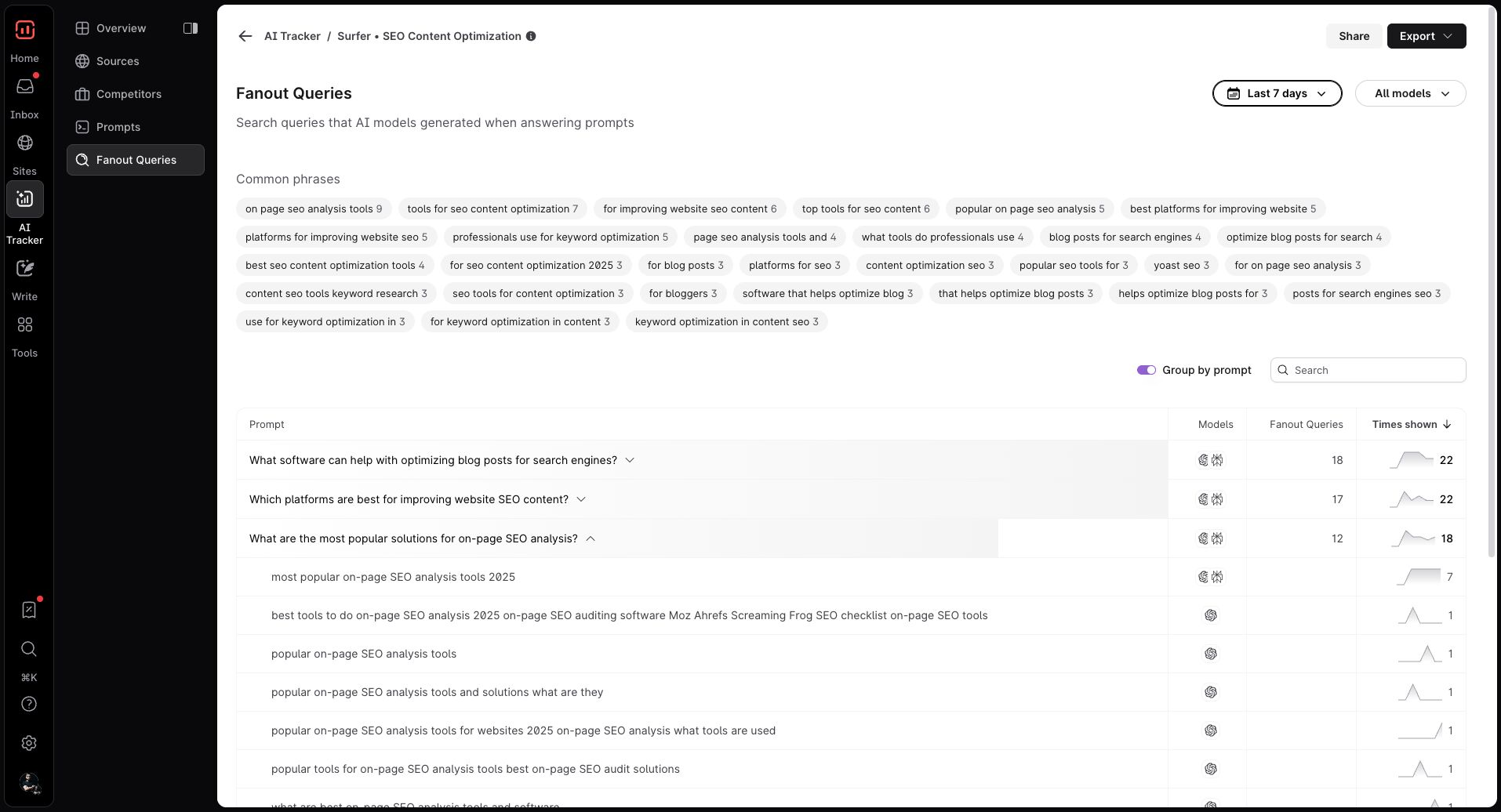
Whichever query fan-out tool you use, run important prompts several times. With only about 27% of fan-outs stable, one run will mislead you. Group the results into clusters and focus on the themes that keep coming back.
How to optimize for query fan-out: 6 steps
Your first instinct might be to pull every fan-out query and write a page for each one. Don't. Fan-outs change from run to run, differ between AI engines, and depend on the user. And Google is explicit: creating separate content for every fan-out query mainly to manipulate rankings or AI responses violates its scaled content abuse spam policy. Here's what works instead.
1. Build topic clusters, not fan-out pages
If your site covers a topic deeply, you'll already answer most of the questions AI systems fan out into, no matter which sub-queries get triggered for a given user. That's topical authority, and it also helps traditional search, because you rank for more queries. 90% of SEOs in Surfer's survey rated topical authority as important.
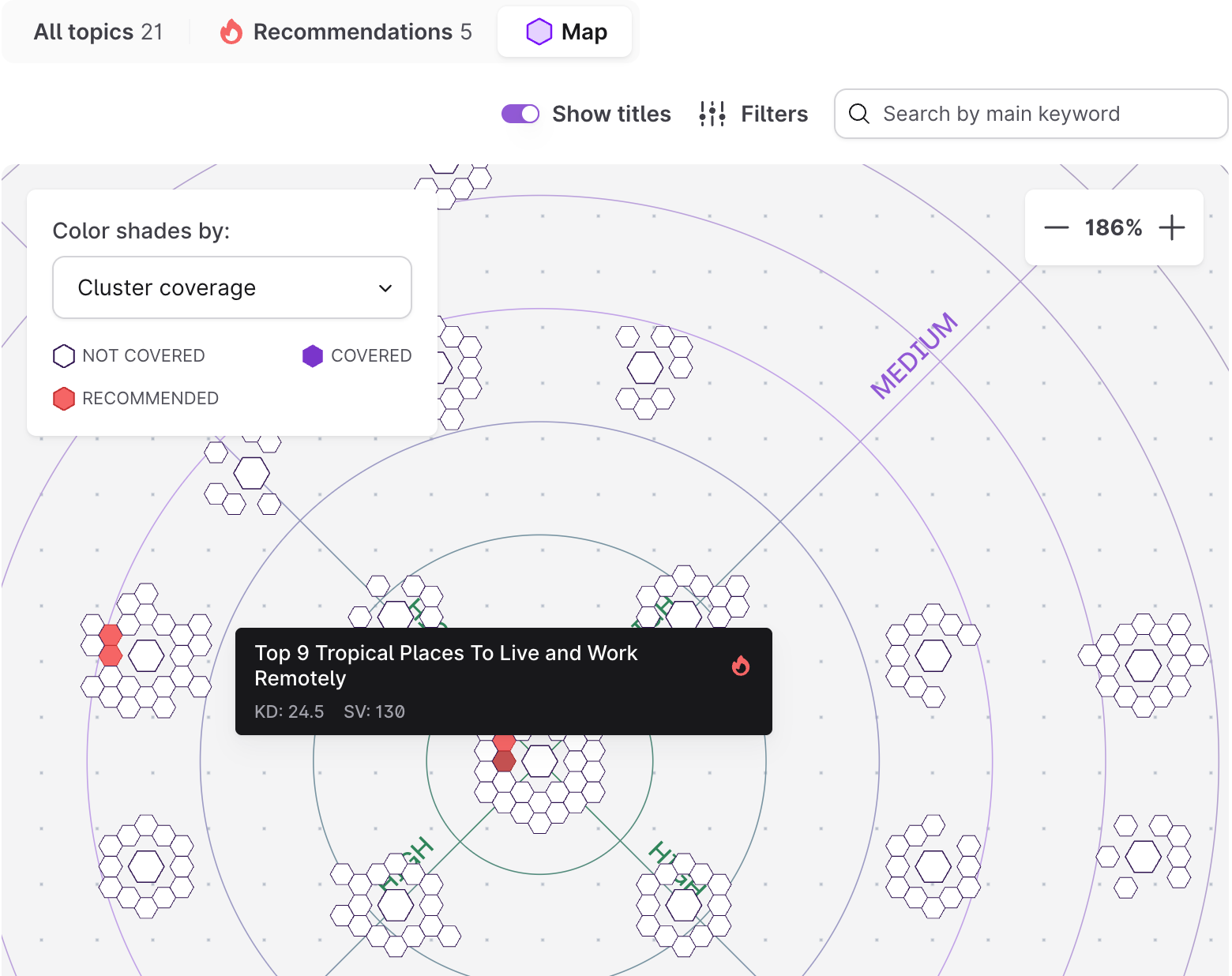
Start with a topical map. Surfer's Topical Map takes a site or topic, finds semantically related keywords, clusters them, and shows where your content gaps are. Use one pillar page for the broad query and cluster pages for the bigger subtopics, linked together. Learn more about topic clusters and topical authority.
2. Start with low-difficulty subtopics
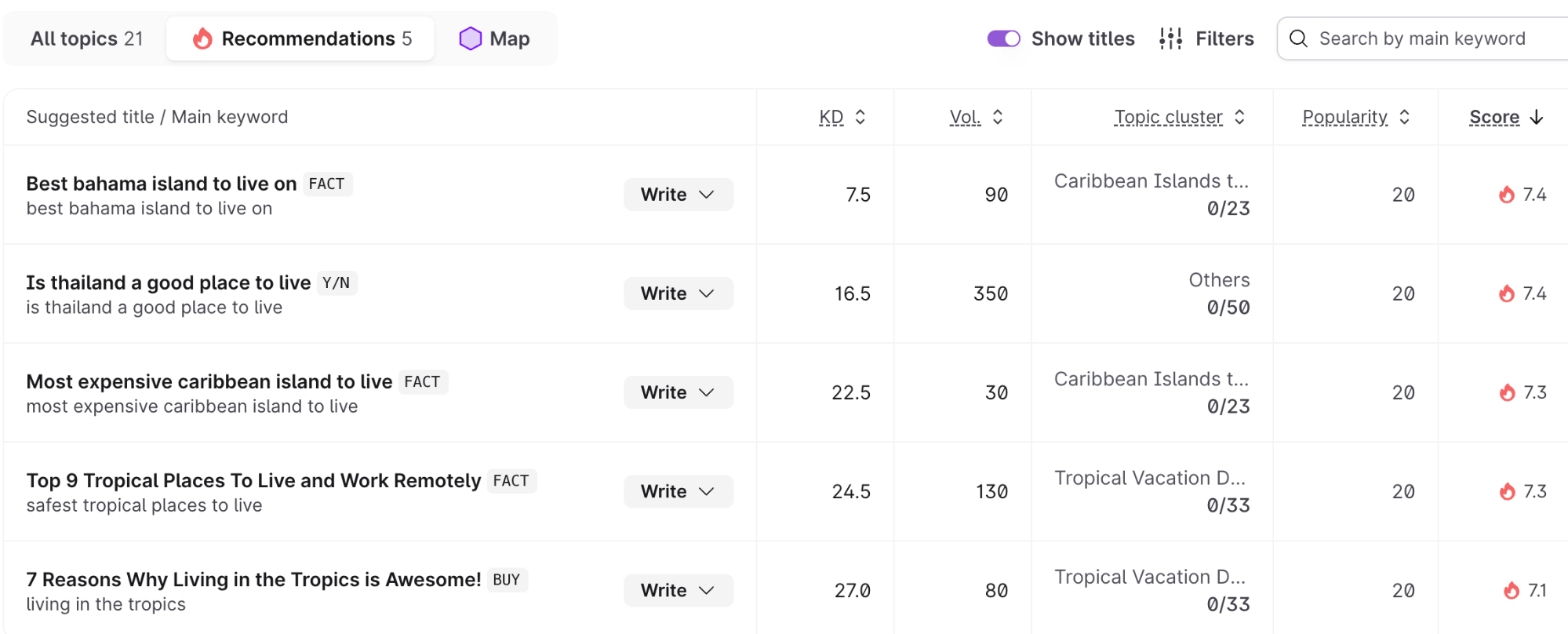
Since ranking only for fan-outs got pages cited 49% more often than ranking only for the main query, you don't have to win the hardest keyword first. Fan-out style subtopics are often easier to rank for. Filter your topical map for low-difficulty topics, publish those first, then work up to the harder ones.
3. Cover the core subtopics on every page
No page can cover everything, but your main page should cover the subtopics the top-ranking pages agree on. Compare the headings of the pages that rank, add the missing ones, and answer the related questions people ask. A Content Editor makes this quick: it shows competitors' headings, the topics and questions to cover, and the key facts AI engines mention for your keyword. Include those facts, because pages cited in AI Overviews cover more of a topic's key facts than pages that aren't.
4. Write self-contained, answer-first sections
AI systems retrieve passages, not pages. Each fan-out query might pull a different section of your article, so each section should make sense on its own. Lead every section with a clear answer, then add supporting data, examples, or comparison tables. Keep all the information about one subtopic together instead of scattering it across the page.
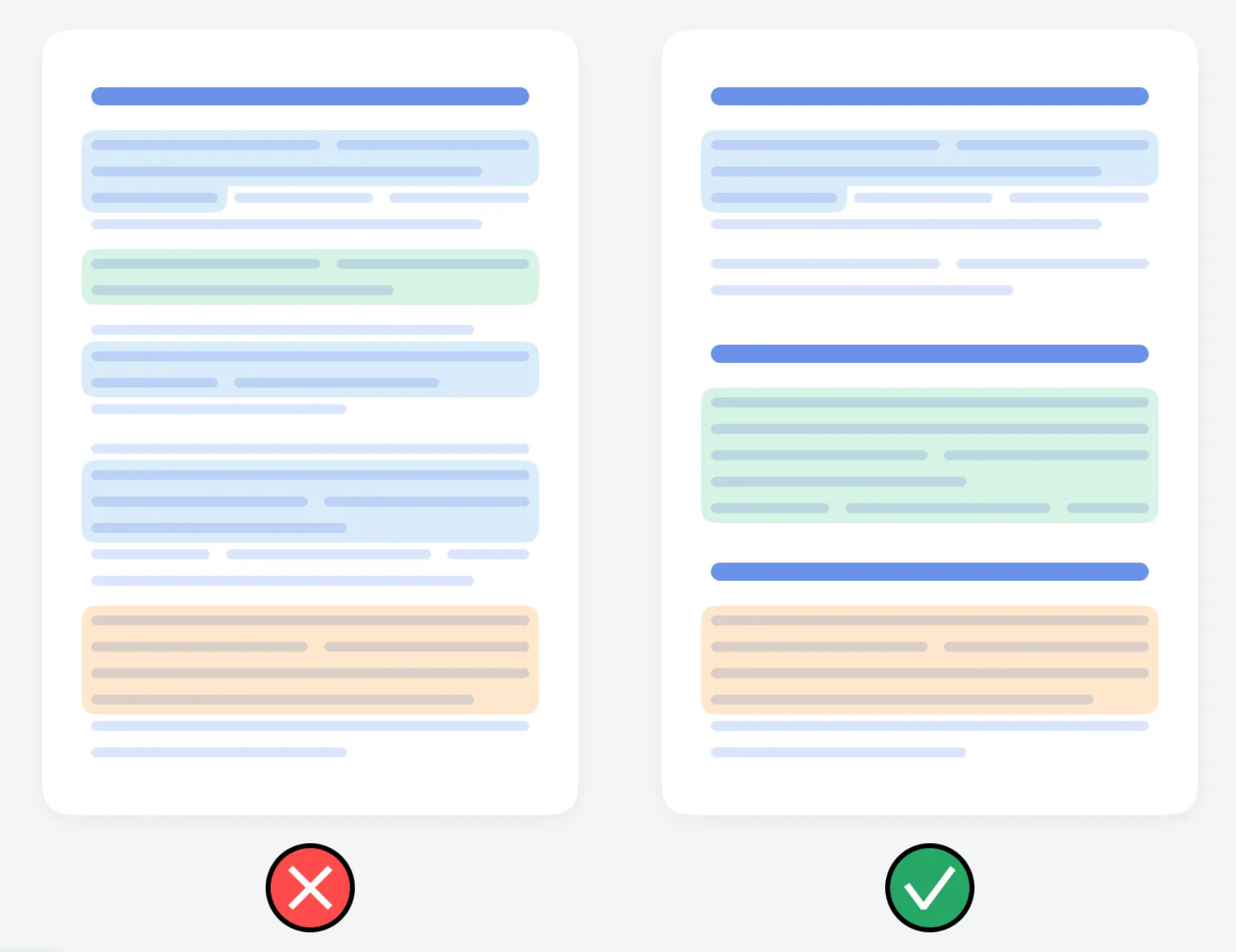
The same applies to the top of the page: 38% of AI Overview citations come from the first 100 words.
5. Get mentioned on pages AI already cites
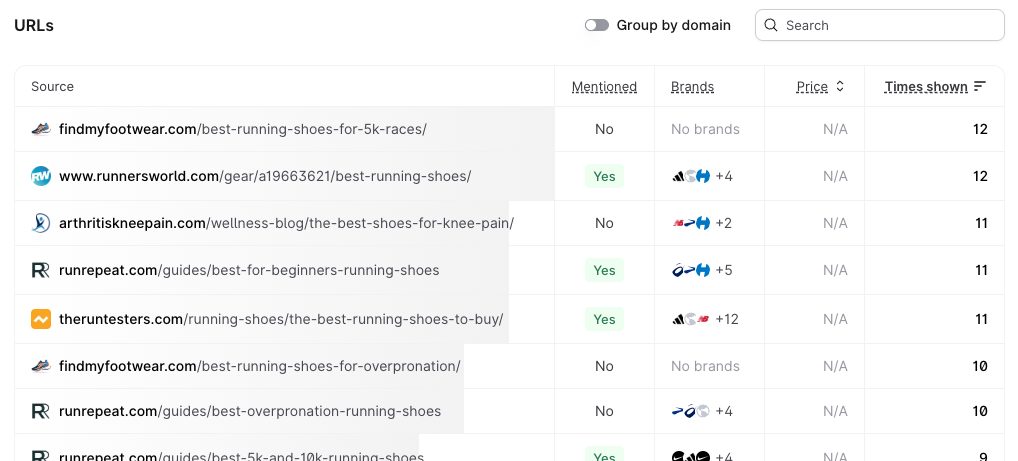
Fan-outs often land on third-party pages: reviews, "best of" lists, comparisons, forums, and news sites. If your brand is mentioned on the pages AI already retrieves, you're covered for many fan-outs at once. Use an AI visibility tool to see the sources AI engines cite for your prompts, then look for honest gaps: a list that's missing a tool category you fit into, or a comparison that's outdated. Lead with how you'd improve their page, not a hard sell.
6. Avoid cannibalization and keep tracking
As you build out clusters, make sure two pages don't target the same intent. Pages competing for the same queries confuse search engines and split your authority. Check for keyword cannibalization regularly, track your prompts in an AI visibility tool, and update pages when the fan-out themes for your topic shift.
Frequently asked questions
What does query fan-out mean?
Query fan-out means an AI search engine splits one user query into several related sub-queries, searches for each, and combines the results into one answer. Google uses it in AI Mode and AI Overviews, and ChatGPT, Perplexity, Gemini, and Grok use similar processes.
Is query fan-out only used by Google AI Mode?
No. Google named the technique when it launched AI Mode, but any AI system that searches the web to answer a prompt fans out in some way. ChatGPT averages about two searches per prompt, Grok nearly seven, and Gemini 3 more than ten, according to recent studies.
How many queries does Google AI Mode generate?
Google doesn't publish a number. Gemini 3, the model family behind AI Mode (Gemini 3.5 Flash has been its default since May 2026), generated 10.7 fan-out queries per prompt on average in Seer Interactive's test of 501 prompts, with a range of 3 to 28. Deep Search can run hundreds.
Can I see which fan-out queries ChatGPT uses?
Yes. The free Keyword Surfer Chrome extension shows the queries ChatGPT searched behind an answer when the model exposes them, and Surfer's AI Tracker reports fan-out queries for tracked prompts across several AI engines.
Should I create a page for every fan-out query?
No. Fan-outs are unstable, with only about 27% repeating across runs, and Google says creating separate content for every fan-out query to manipulate results violates its scaled content abuse policy. Build topic clusters and cover subtopics within strong pages instead.
What's the difference between query fan-out and query expansion?
Query expansion adds related terms to a single search. Query fan-out creates several separate searches, runs them in parallel, and reasons across all their results to write one answer.