AI SEO means two things: using AI to do SEO faster, and optimizing your content so AI search engines like Google AI Mode, ChatGPT, Perplexity, and Gemini cite and recommend your brand. You need both. Traditional SEO is still the foundation, because AI search runs on top of search results. But ranking alone is no longer enough: in Surfer's data, 38% of AI citations come from the first 100 words of a page, and pages that also rank for fan-out queries are 161% more likely to be cited.
This guide covers both sides of AI SEO, from content creation with generative AI to AI search optimization, using the latest 2026 data and Surfer's research on more than 5 million AI citations. It's written for SEOs, content marketers, and marketing leads who need to grow visibility in Google and in AI answers at the same time.
What is AI SEO?
AI SEO is the practice of improving your website's visibility across both traditional search engines and AI search tools, from Google to AI chatbots like ChatGPT, and of using artificial intelligence and machine learning to run search engine optimization more efficiently. The term covers two different jobs that most teams now do at the same time.
You'll also see other names for the second job: generative engine optimization (GEO), answer engine optimization (AEO), and LLM optimization (LLMO). Many marketing teams simply call it AI search optimization. Google's own documentation puts it bluntly: from Google's point of view, AEO and GEO are still SEO. We cover the differences in our guides to generative engine optimization and answer engine optimization.
Why AI SEO matters in 2026: the numbers
AI search is no longer an experiment. Here is where the largest platforms stand as of October 2026:
- Google AI Mode has more than 1 billion monthly users, and AI Mode queries have more than doubled every quarter since launch. At I/O 2026, Google also brought AI Overviews and AI Mode into one AI Search experience and made Gemini 3.5 Flash the default model.
- ChatGPT reached 800 million weekly active users in October 2025, and it has kept growing since.
- AI referral traffic is still small but growing fast. It made up 0.32% of all website traffic in early 2026, up from 0.02% in 2024, according to SE Ranking's study of 101,574 websites. ChatGPT sends about 75% of it.
The bigger impact is on Google itself, where AI search results sit above the organic search results on the results page.
How AI Overviews affect clicks
Every major study agrees that AI Overviews reduce clicks on organic results:
- Ahrefs found that an AI Overview correlates with a 58% lower click-through rate for the top-ranking page (300,000 keywords, December 2025 data).
- Pew Research Center found users clicked a traditional result in 8% of visits when an AI summary appeared, versus 15% without one.
- Seer Interactive tracked 5.47 million queries across 53 brands. Organic CTR on AI Overview queries fell to 1.31% in December 2025, then recovered to 2.36% in February 2026.
The interactive chart below shows Seer's monthly organic CTR for queries with and without an AI Overview, January 2025 to February 2026.
The same Seer study holds the most important number in this guide: brands cited in an AI Overview earned about 120% more organic clicks per impression than brands that weren't cited (2.07% vs 0.94% CTR on informational queries). Paid CTR was higher too: 15.74% vs 11.19%. Seer is careful to note this is correlation, since stronger brands are also more likely to be cited. But the direction is clear. If an AI answer is going to appear anyway, you want to be in it.
Is SEO dead? No, but rankings and citations are drifting apart
AI search engines don't replace search results. They read them. Google's AI features use its core ranking systems, retrieval-augmented generation, and query fan-out, where one question is split into many related searches behind the scenes. ChatGPT, Perplexity, and Gemini also run live web searches for most prompts. In Surfer's tests, the consumer versions of these tools triggered a web search on 88% to 100% of prompts.
So traditional SEO still matters. But Surfer's research shows the link between ranking and being cited is looser than most people assume:
- Most AI Overview citations don't rank in the top 10. In a study of 10,000 keywords, 67.82% of cited pages didn't rank in Google's top 10 for the query or any of its fan-outs. For the top three visible citations, that number dropped to 45.86%, so ranking still helps where it counts.
- Fan-outs matter more than the head term. Pages ranking for the main query and its fan-out queries are 161% more likely to be cited. Ranking only for fan-outs beats ranking only for the main keyword by 49%.
- Domain authority doesn't predict citations. Across 20,000 prompts and ~5 million cited URLs, domain strength correlated with AI citations at roughly zero for AI Mode, AI Overviews, ChatGPT, and Perplexity.
- Coverage of key facts does. Pages cited in AI Overviews covered 31% of a topic's key facts, compared with 24% for pages that weren't cited (57,253 URLs analyzed).
In short: SEO gets you into the pool of candidates. Structure, facts, and topical coverage decide whether AI picks you.
AI search optimization: 7 steps to get cited by AI
These steps are based on Surfer's analysis of more than 650,000 AI-generated answers and Google's own guidance for its AI features.
1. Answer the query in your first 100 words
AI models decide quickly whether a page answers the question. Surfer found that 38% of AI Overview citations come from the first 100 words of a page, up from 20% in an earlier sample.
Two intro signals lead the ranking for every model we studied:
- Early query confirmation: does your opening show you're answering the exact question? AI Mode weights it at 28.6%, AI Overviews at 22.3%, ChatGPT at 17.9%, and Perplexity at 13.7%.
- Early query answer: do you give a short version of the answer before you elaborate? Its average importance is 18.6% across all four models.
In practice, open with a one or two sentence answer that repeats the core question, include one specific and citable fact, and save the background for later. Use clean, semantic HTML with real headings, lists, and tables, and write H2s and H3s that read like questions or clear statements, not vague labels like "Best practices." Keep a clear structure with short paragraphs, bullet points, and tables where they help.
Remember that user queries in AI tools are longer and more conversational than classic search queries, and they often come with follow-up questions. Answer the most likely follow-up questions in the sections right after your intro.
2. Cover the key facts of your topic
AI answers are built from facts: definitions, numbers, steps, comparisons. Pages that cover more of the facts AI engines expect are cited more often. Make a list of the facts every good answer to your topic should include, then check your page against it.
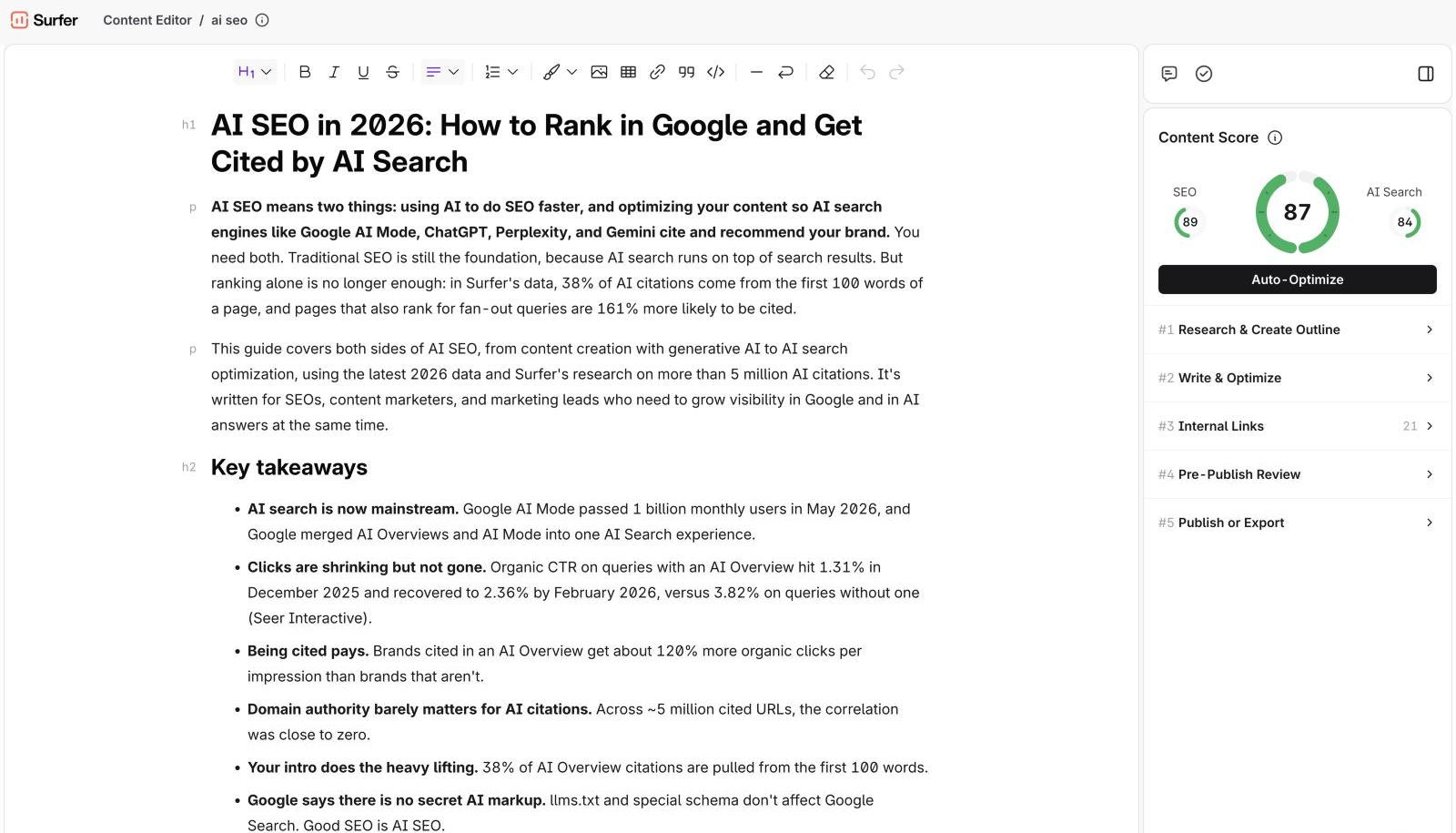
Surfer's Content Editor does this automatically. Its AI Search guidelines pull the facts that AI Overviews, AI Mode, ChatGPT, Gemini, and Perplexity mention for your keyword, show the source of each, and score how many your draft covers.
3. Rank for fan-out queries, not just the main keyword
When someone asks AI a question, it runs several related searches in the background. To show up, you need to rank across that whole set. The tricky part is that fan-outs are unstable: only about 27% of fan-out queries stay the same across repeated runs of the same prompt. However, about 90% of them fall into four or fewer topic clusters.
That makes topic clusters the practical answer. Cover the main question on one strong page, cover the closely related subtopics in its sections, and support it with linked pages on the bigger subtopics. Learn more in our guide to query fan-out.
4. Earn mentions where AI looks
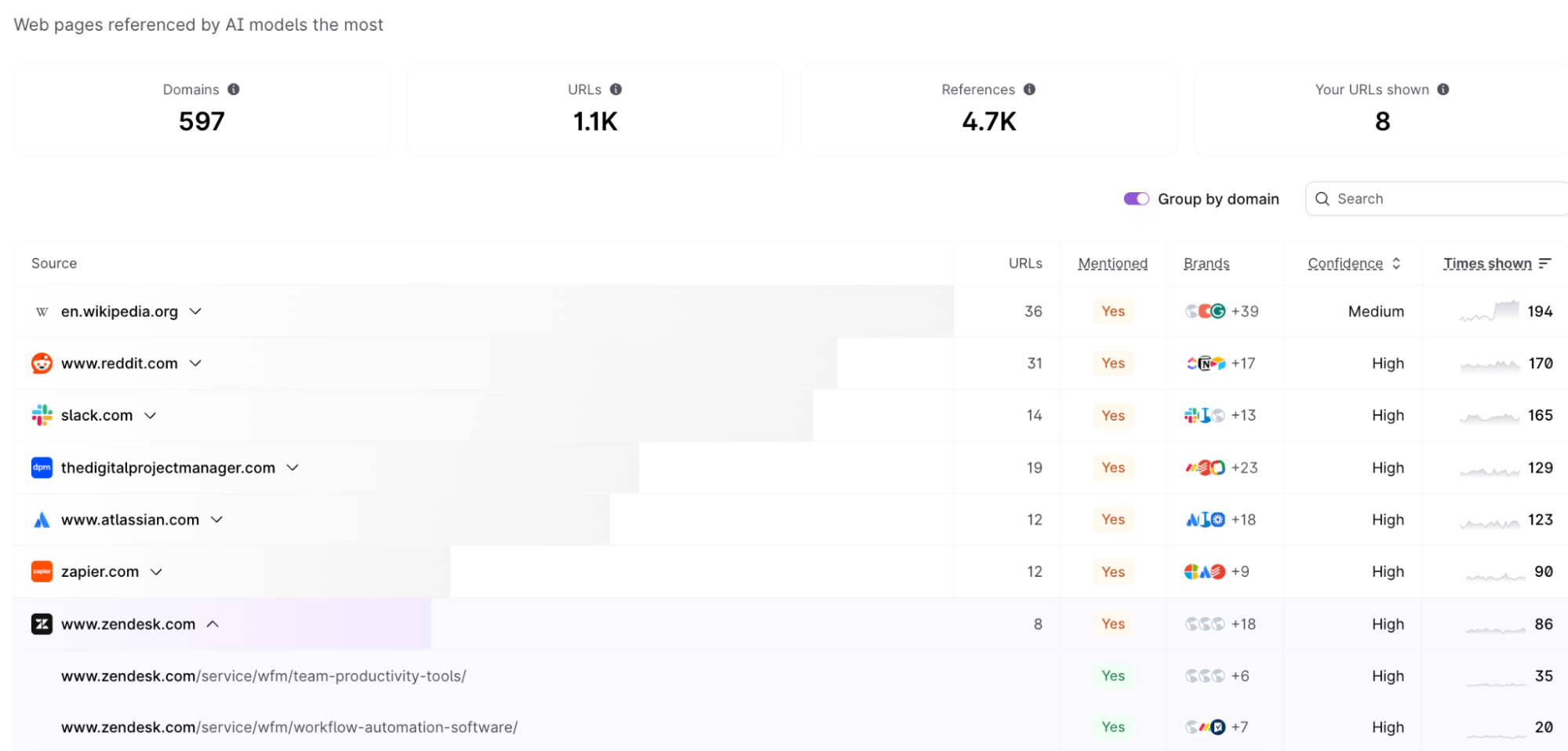
AI tools don't only cite your website. They summarize what the web says about you. In Surfer's analysis of 36 million AI Overviews, YouTube (~23%), Wikipedia (~18%), and Google.com (~16%) were the most-cited domains overall. But the mix changes a lot by industry:
For brand recommendations, third-party coverage is critical. Surfer studied 289,105 cited URLs and found that mentions in blog posts correlate most strongly with how strongly AI recommends a brand, even though blogs make up only 28.7% of cited sources. ChatGPT also cites far more sources per answer than Google's AI features, so being mentioned across many of them matters more there.
Practical ways to earn mentions:
- Get included in reputable "best of" lists and comparisons in your category.
- Publish original research that others reference.
- Create YouTube videos for how-to topics.
- Collect positive reviews on the review sites and marketplaces that show up in AI answers for your category.
- Take part in Reddit and community discussions honestly. Google warns that inauthentic mentions don't work and that its spam systems catch them.
5. Write non-commodity content
Google's guide to generative AI features (updated July 2026) asks for content with a unique, first-hand point of view instead of summaries of what already ranks. AI can already produce the generic answer. Your page needs something it can't get elsewhere: your data, your examples, your expert opinion. See our guide to non-commodity content.
6. Keep it crawlable, simple, and fresh
Technical SEO is the entry ticket. Pages must be indexable and eligible for a snippet to appear in Google's AI features. Google also cleared up several myths:
- No special markup: Google Search doesn't use llms.txt or any AI-specific schema markup. Structured data still helps with rich results and must match visible content.
- No forced chunking: there is no ideal page length, and you don't need to split content into tiny pieces.
- No rewriting for AI: AI systems understand synonyms, so you don't need awkward keyword variants.
Fix the technical SEO basics first: indexing issues, duplicate content, slow pages, and thin product pages. Other AI search engines use their own crawlers, such as OpenAI's OAI-SearchBot and PerplexityBot. Check that your robots.txt and CDN don't block the ones you want to appear in. And keep important pages up to date, because outdated numbers are an easy reason for AI to pick a competitor. Our content refresh guide shows how.
7. Track AI visibility with real answers, not API data
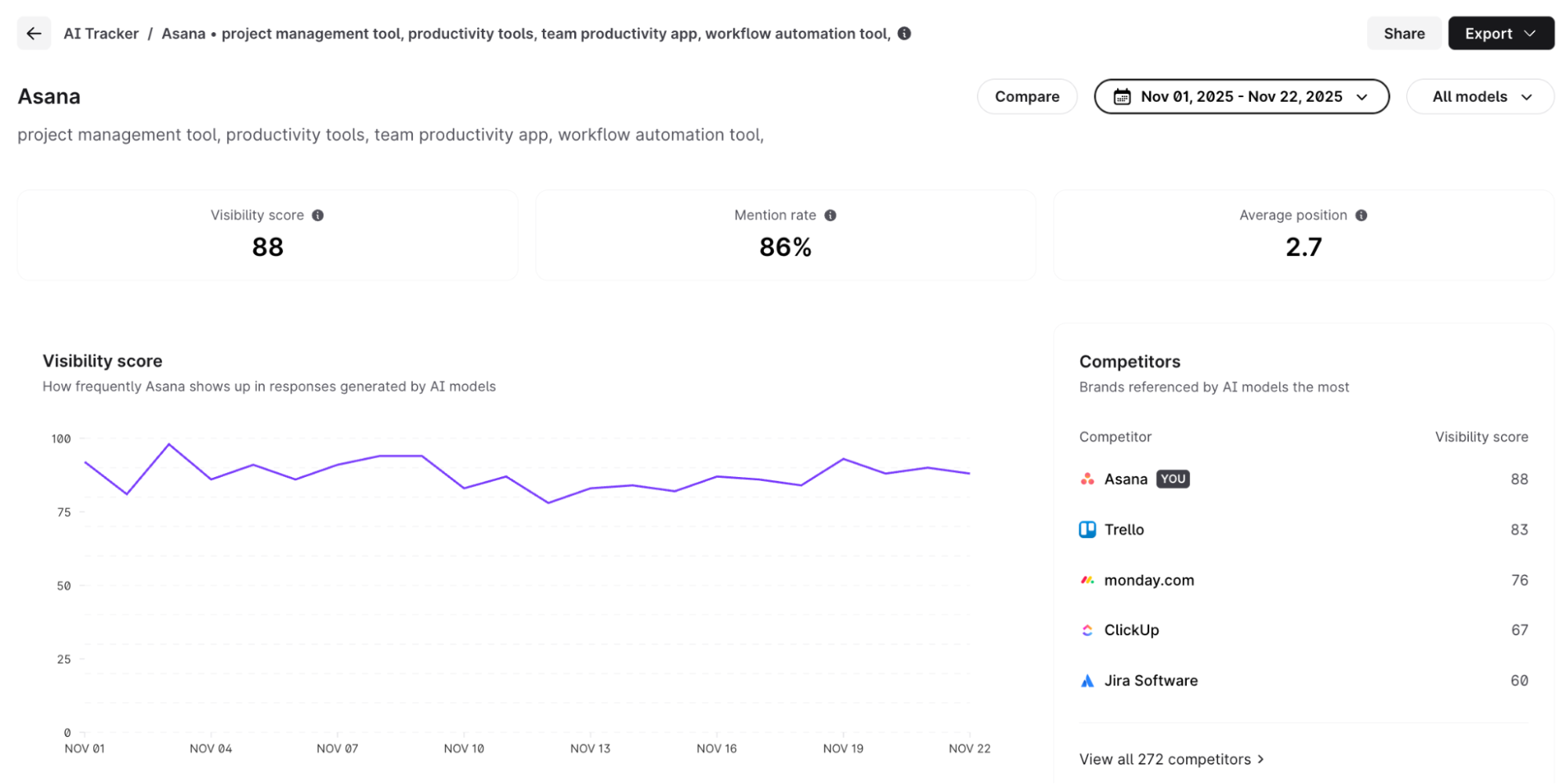
You can't improve what you don't measure, and how you measure matters. Surfer compared 13,779 AI answers collected through official APIs with answers scraped from the interfaces real people use. The overlap in mentioned brands was only 15.5% to 31.6%. If your AI visibility tool relies on APIs, it's mostly measuring something your buyers never see.
AI answers are also nondeterministic: the same prompt can return different brands and sources each time. Track a broad set of prompts across several AI platforms and over time, rather than judging visibility on a single answer.
How to use AI for SEO
The other half of AI SEO is using AI tools to do the work. AI is best at speed and scale. Humans are still needed for strategy, original insight, and quality control. Here's where AI helps most.
Keyword research and clustering
AI can group thousands of keywords by search intent and SERP overlap in minutes, which used to take days in spreadsheets. It's also good at generating the conversational, long-tail questions people type into AI assistants. Use it to brainstorm, then validate search volume and difficulty for your target keywords in an SEO tool. AI is also good at matching relevant keywords to user intent, which matters far more today than keyword density. Because AI understands semantic relationships between terms, it can turn a raw keyword list into topic clusters and surface long-tail keywords that often convert better than head terms. Read more about keyword clustering.
Competitor analysis, content gaps, and briefs
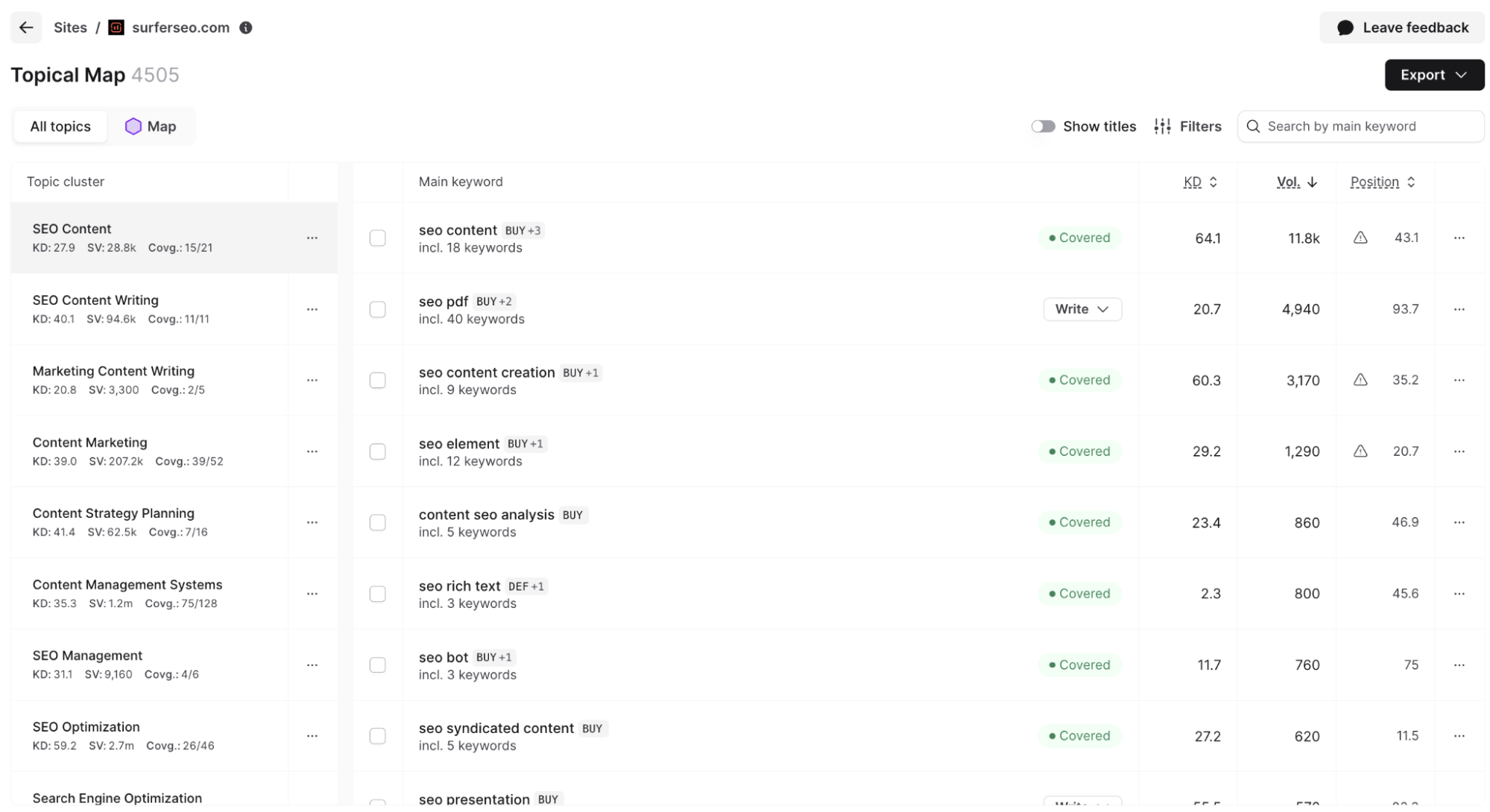
AI can compare your site with competitors to find the topics and keywords they cover and you don't. It can also analyze the top-ranking pages and AI answers for a keyword and turn them into a brief: the headings, terms, questions, and facts a page should cover. Surfer's Topical Map does this at the site level, showing which topics you already own and which ones you're missing.
Content creation with generative AI tools
AI can produce a solid first draft, but publishing it unedited is risky. Google doesn't penalize content for being AI-written. It targets low-value content produced at scale, under its scaled content abuse policy. Use generative AI tools to draft, then add your expertise, examples, and data before publishing. That's what turns an AI draft into high quality content. See how AI content affects SEO.
On-page optimization and content refreshes
AI-powered content editors compare your draft with what ranks and what AI engines cite, then suggest missing terms, facts, and questions, and flag readability issues. This is where AI saves the most time on existing content, because it can audit hundreds of pages and flag which ones are outdated or underperforming.
Technical SEO audits
AI-powered crawlers can scan thousands of URLs at once and flag crawl issues, broken links, and indexing problems. The bigger win is prioritization: AI can estimate the traffic impact of each issue, so your developers fix what matters first. It can also generate meta descriptions and image alt text across large catalogs, which a human should spot-check before publishing.
Link building and digital PR
AI can analyze competitors' backlink profiles, find reputable sites in your niche, and draft personalized outreach. Links still matter for Google rankings. For AI citations, our data shows domain authority matters far less than being mentioned on the pages AI actually cites, so aim outreach at those pages.
Automation and AI agents
AI agents can now handle multi-step SEO work, such as finding pages that lost traffic, pulling fresh data, and drafting the update for a human to review. Start with repetitive tasks that have clear rules, such as internal linking suggestions, meta descriptions, and reporting. See our guide to SEO automation.
Can ChatGPT do SEO?
ChatGPT can help with parts of SEO, such as brainstorming keywords, outlining, rewriting, and writing schema or regex. It can't see live search volumes, rankings, or your Search Console data on its own, and it can be confidently wrong about facts. Use it as an assistant inside a workflow built on real search data, not as a replacement for one.
AI SEO tools
Most SEO tools now include AI-powered features. Most SEO teams combine a traditional SEO platform, a content optimization tool, and an AI visibility tracker. Here's what each job requires:
For a full comparison, see our list of the best AI SEO tools and AI visibility tools.
How to measure how your content performs in AI search
Search engine rankings and clicks still matter, but they miss the visibility you get inside AI answers. Track these metrics side by side:
- AI visibility: the share of tracked prompts where your brand appears. Learn how Surfer calculates visibility score.
- Mentions and citations: how often AI names your brand and links to your pages.
- Share of voice: your visibility compared with competitors for the same prompts.
- Generative AI performance in Search Console: Google now reports how people find your content through its AI features in a dedicated report.
- AI referral traffic and conversions: segment ChatGPT, Perplexity, Gemini, and Claude in GA4. Here's how to track AI traffic in Google Analytics.
- Branded search: people who see you in AI answers often search for your brand later.
- User behavior data: compare engagement and conversion rates of AI visitors with organic visitors to see which pages actually convert.
A 30-day AI SEO plan
Here's a simple plan to build AI SEO into your SEO strategy and stay ahead of competitors. Tick off each step as you go.
Frequently asked questions
Is SEO still relevant in 2026?
Yes. Google AI Mode, AI Overviews, ChatGPT, and Perplexity all retrieve content from the web, and Google's AI features run on its core ranking systems. SEO is what gets your pages into the set AI chooses from. For digital marketing teams, what changed is that ranking alone no longer guarantees visibility, so you also need answer-first content, fact coverage, and brand mentions.
What is AI SEO called now?
There is no single name yet. Common terms include AI SEO, AI search optimization, generative engine optimization (GEO), answer engine optimization (AEO), and LLM optimization (LLMO). They describe the same goal: being visible and cited in AI-generated answers.
How do you do SEO for AI search?
Answer the query in the first 100 words, cover the key facts of the topic, rank for related fan-out queries through topic clusters, earn mentions on sites AI cites, keep pages crawlable and fresh, and track AI visibility using real answers.
Is there an AI that can do SEO?
AI tools and agents can handle much of the execution, such as research, clustering, briefs, drafts, optimization, and reporting. They still need a human to set strategy, add original insight, and check facts before anything is published.
Do I need llms.txt or special schema for AI search?
Not for Google. Google says its Search features don't use llms.txt or any AI-specific markup. Standard structured data is still useful for rich results.
What is the 80/20 rule in SEO?
It's the idea that about 20% of your pages or keywords drive about 80% of your results. In AI SEO, it's a good way to prioritize: start with the pages and prompts closest to revenue and improve those first.