Answer engine optimization (AEO) is the practice of structuring content so answer engines, such as Google AI Overviews and AI Mode, ChatGPT, Perplexity, featured snippets, and voice assistants, can find it, trust it, and use it as the answer, with your brand cited as the source. It builds on SEO, but the goal shifts from ranking a page to owning the answer. Format matters: in Surfer's study of 405,576 AI Overviews, 78% contained a list, and pages cited in them covered more of a topic's key facts than pages that weren't.
This guide explains what AEO is, how answer engines choose sources, and ten AEO strategies with 2026 data, plus how to measure results. It's for SEOs, content marketers, and businesses that want their answers to show up wherever people ask questions.
What is answer engine optimization (AEO)?
Answer engine optimization (AEO) is the process of optimizing content to be selected as the direct answer to a user's question by AI-powered search engines and answer features. Instead of competing for a blue link in traditional search results, you compete to be the passage that AI systems and large language models quote, summarize, or read aloud to human readers.
Answer engines include:
- Google AI Overviews and AI Mode: AI-generated answers at the top of Google, which Google merged into one AI Search experience in 2026.
- AI assistants with search: ChatGPT, Perplexity, Gemini, Claude, and Microsoft Copilot.
- Classic answer boxes: featured snippets, People Also Ask, and knowledge panels drawn from Google's Knowledge Graph.
- Voice assistants: Gemini, Siri, and Alexa, which read out a single answer in voice search results.
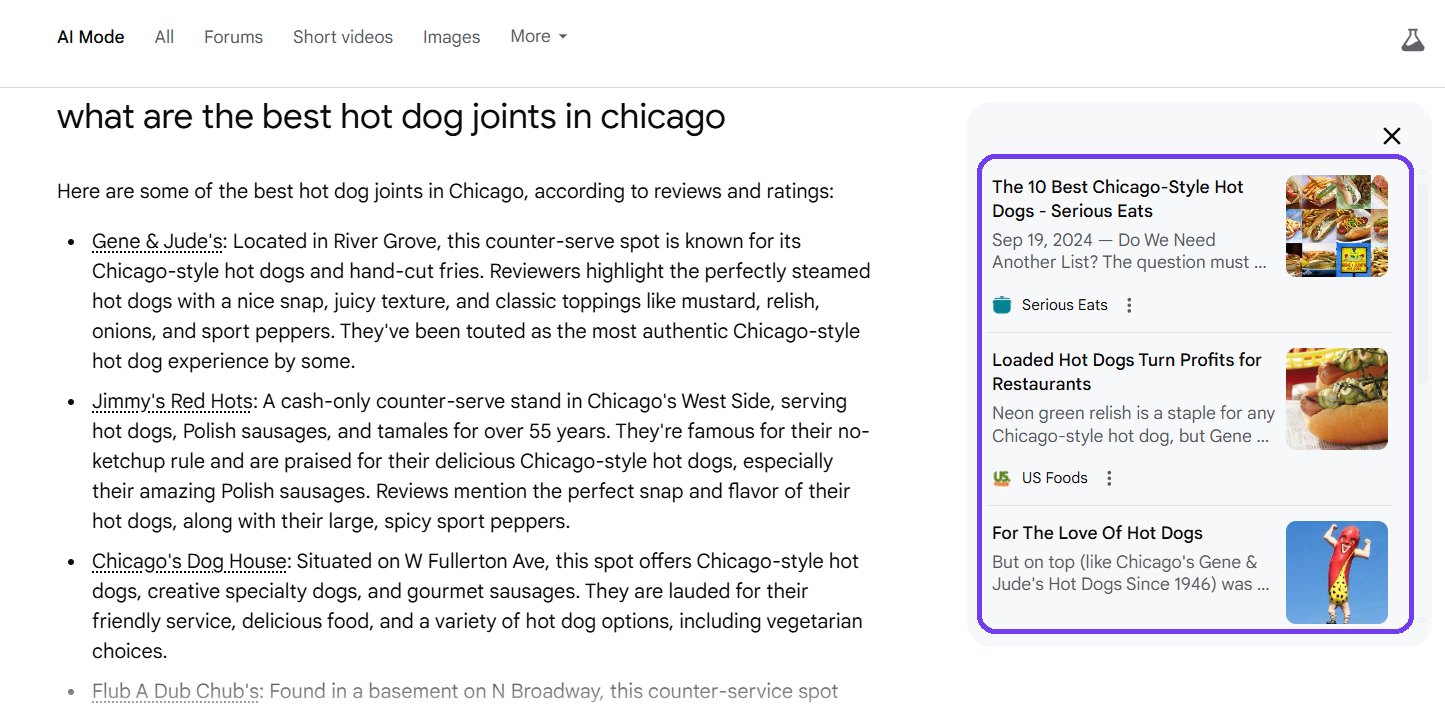
When you ask Google's AI Mode a question, it compiles an answer from several sources and lists them alongside the response. AEO is about being one of those sources.
AEO vs. SEO
Traditional search engine optimization (SEO) aims to rank pages on search engine results pages. AEO aims to have your content used inside the answer people read before they click, or instead of clicking.
AEO vs. GEO (generative engine optimization)
You'll also hear about generative engine optimization (GEO). The terms overlap so much that many teams use them interchangeably. AEO comes from the era of featured snippets and voice search and focuses on being the answer. GEO focuses on being cited and recommended across generative AI engines. The tactics are almost the same. Read our full guide to generative engine optimization, and note that Google itself treats both as part of SEO.
Why AEO matters in 2026
Answer engines are now where a large share of searches start and end:
- Scale: Google AI Mode passed 1 billion monthly users in May 2026, and ChatGPT reached 800 million weekly users in October 2025.
- Fewer clicks: in a Pew Research Center study, users clicked a traditional result in only 8% of visits with an AI summary, versus 15% without one. Seer Interactive found organic click-through rates on AI Overview queries fell to 1.31% in December 2025, versus about 3% without one.
- Being the answer pays: in the same Seer study, brands cited in an AI Overview earned about 120% more organic clicks per impression than brands that weren't.
- High-intent visitors: AI search sent 0.5% of Ahrefs' traffic in one month but 12.1% of its signups, a conversion rate 23 times higher than traditional organic search.
In short, AEO protects your search visibility in the places where clicks are disappearing, and it wins the website traffic that arrives ready to act. It belongs in every digital marketing and content strategy now, not as a side project.
How answer engines choose their sources
Answer engines use retrieval-augmented generation (RAG): they search an index, often with several related fan-out queries, pull the most relevant passages, and write an answer that cites some of them. Modern answer engines judge semantic relevance to the user's intent, not just keywords, and each one searches a different index:
- Google AI Overviews and AI Mode use Google's index and its query fan-out technique.
- ChatGPT searches through Bing: 87% of ChatGPT search citations matched Bing's top 20 results in Seer Interactive's test.
- Perplexity uses its own crawler and index.
Ranking helps, but it isn't the whole story. In Surfer's study of 10,000 keywords, 67.82% of AI Overview citations didn't rank in Google's top 10 for the query or any of its fan-outs, although most of the top three visible citations did. Pages that ranked for the query and its fan-outs were 161% more likely to be cited, and domain authority had almost no correlation with citations. Structure and relevance matter more than size. For the full picture, see how to get cited by AI.
AEO strategy: 10 ways to optimize for answer engines
This answer engine optimization strategy combines Surfer's research on AI Overviews with what works across ChatGPT and Perplexity.
1. Lead every section with a direct answer
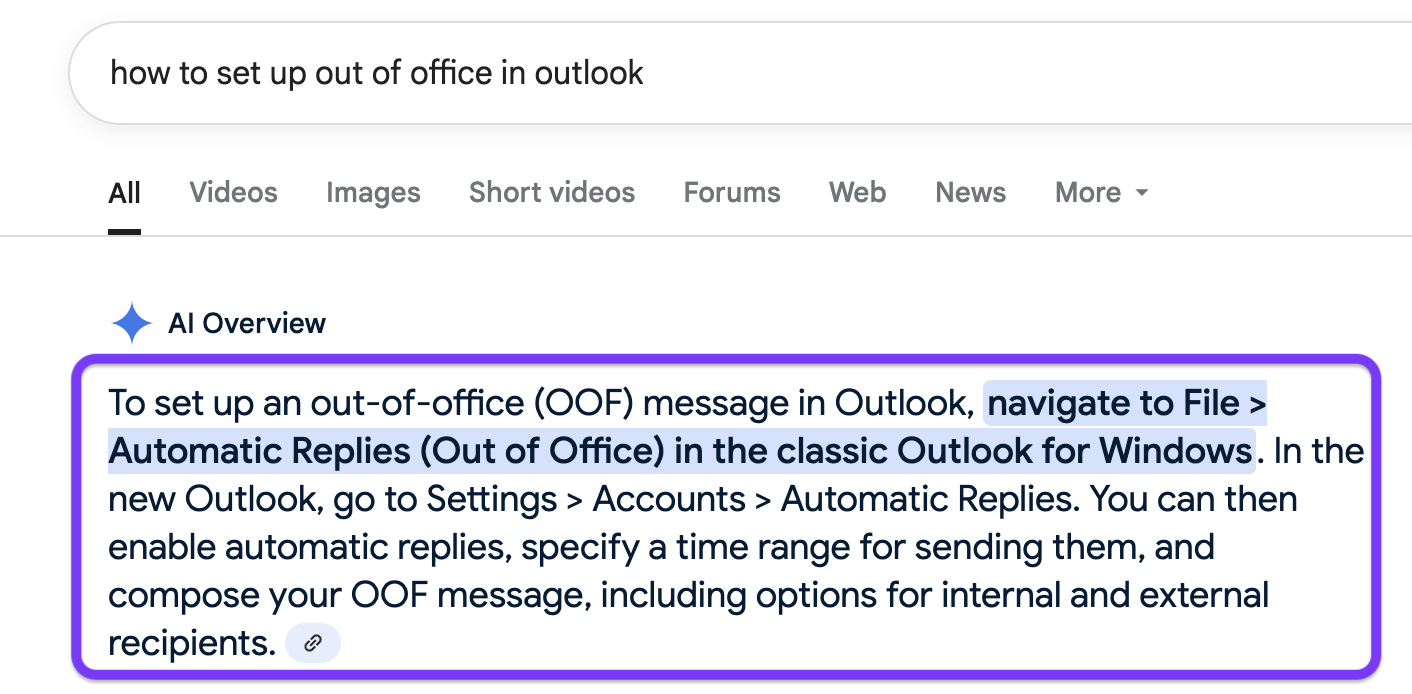
Write the answer first, in one or two sentences, then add the detail. Each section should work as a self-contained answer block: if an AI engine pulls only that section, it should still fully answer the question. Use active voice and subject-first sentences, such as "You can set up an out-of-office reply in Outlook by...".
The top of the page matters most: Surfer found that 38% of AI Overview citations come from the first 100 words of a page.
2. Use question-based headings
People ask answer engines full questions in natural language, so headings phrased as user queries match how content gets retrieved. "How does creatine affect muscle growth?" tells both readers and AI exactly what the section answers; "Creatine benefits" doesn't. Use H2s for the main questions and H3s for the follow-ups, so the outline alone summarizes the page.
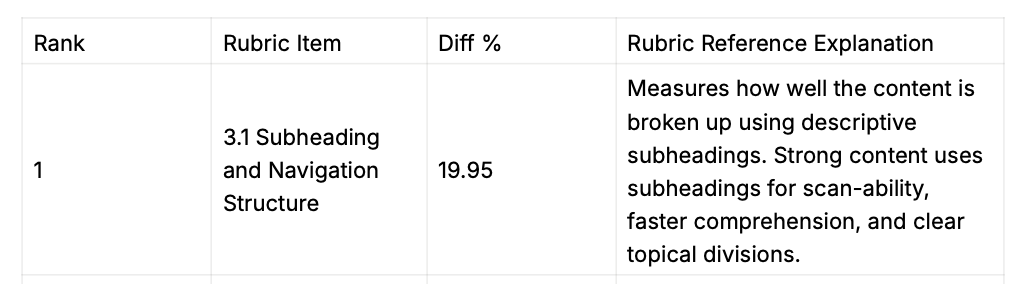
In Surfer's analysis of pages cited in AI Overviews, cited pages scored 19.95% better on subheadings and navigation structure than pages that weren't cited.
3. Format answers as lists and tables
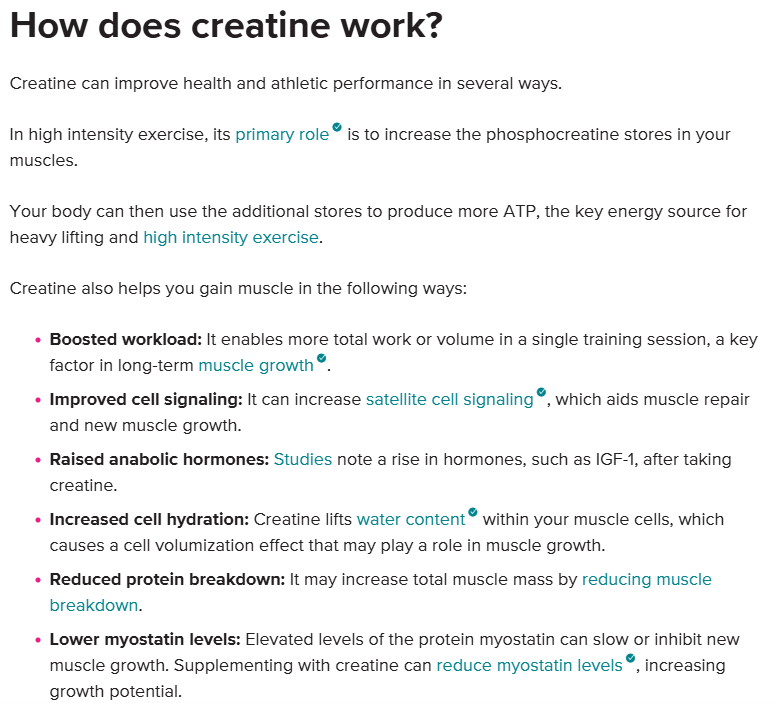
Answer engines love structure. In Surfer's study of 405,576 AI Overviews, 78% contained an ordered or unordered list, and each overview cited about 5 sources on average. Use bullet points for options, numbered steps for processes, and tables for comparisons. Keep paragraphs to two or three sentences and answers concise. You're writing for AI platforms and your target audience at the same time.
4. Define concepts and connect them
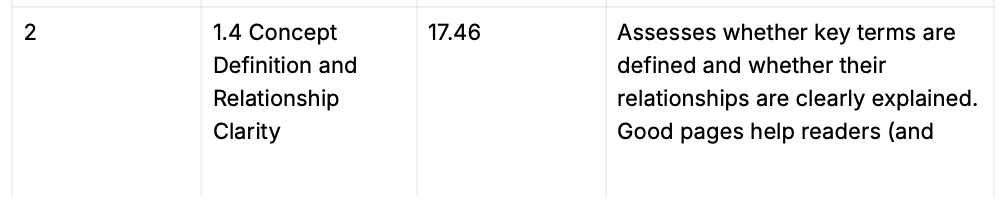
Start sections by defining the key term before you explain it. Pages that did this scored 17.46% better in Surfer's AI Overview analysis. Then connect related entities: an article about technical SEO audits should also explain crawlability, site speed, and site structure, and how they relate. Linking phrases like "for example" and "as a result" help AI understand how ideas connect.
5. Cover the key facts and follow-up questions
Answer engines assemble answers from facts. Pages cited in AI Overviews covered 31% of a topic's key facts, compared with 24% for pages that weren't cited. Find the facts and follow-up questions for your topic (People Also Ask, AI answers, and Surfer's Content Editor all show them) and answer them on the page or in linked cluster pages.
6. Add original, citable data
An answer engine credits the source it can tie a specific claim to. In the original GEO research, adding statistics raised visibility in AI answers by about 33% and adding quotations by about 41%. Publish numbers only you have, such as survey results, product data, or benchmarks, and write each one as a single quotable sentence with its source. Expert authors and first-hand experience also strengthen E-E-A-T, which helps AI models decide which high-quality content to trust.
7. Keep structured data accurate and aligned
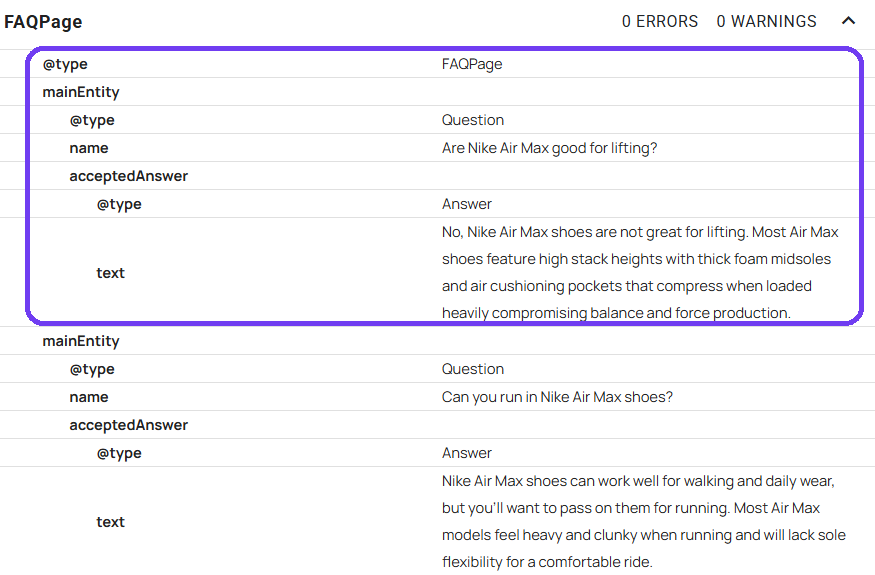
Structured data, or schema markup, helps search engines understand your page, and FAQPage, HowTo, Article, Organization, and Product markup can earn rich results. But Google says its AI features don't need any special schema, so treat structured data as support, not a shortcut. The rule that matters: schema markup must match what's visible on the page, and your meta tags should describe the page accurately too.
8. Let AI search crawlers in
If answer engines can't crawl your pages, nothing else matters. AI companies run separate crawlers for search and for model training, and blocking the wrong one can remove you from AI answers:
- Search (affects citations):OAI-SearchBot for ChatGPT search, PerplexityBot for Perplexity, and Claude-SearchBot for Claude.
- Training (doesn't affect citations): GPTBot, ClaudeBot, Google-Extended, and Applebot-Extended.
- Google and Bing: AI Overviews and AI Mode rely on Googlebot, and ChatGPT search relies heavily on Bing, so keep both crawling freely.
Use the builder below to generate the robots.txt rules for your choice. Google says it doesn't use llms.txt, so there's no need to rely on it for Google.
9. Earn mentions where answer engines look
Answer engines summarize what the web says about you. For factual questions about your brand, keep your own pages and listings accurate. For recommendations, earn mentions in the blogs, reviews, and lists AI already cites: Surfer found that mentions in blog posts correlate most strongly with how strongly AI recommends a brand. Publish research others can reference, contribute expert commentary, and take part in community discussions honestly.
10. Keep your answers fresh
Answer engines avoid outdated information, especially for prices, tools, rules, and "best" lists. Ahrefs found that AI assistants cite content that's 25.7% fresher than the pages in Google's organic results. Review your most important answers every quarter, update the facts and examples rather than just the date, and show a visible "last updated" date. Our content refresh guide shows how to prioritize.
Common AEO mistakes
- Burying the answer: long intros and background before the actual answer make a section hard to extract.
- Vague headings: "Overview" or "More info" tell answer engines nothing about the question a section answers.
- Blocking AI search crawlers: a blanket block on AI bots can remove you from ChatGPT and Perplexity answers, not just from training data.
- Schema that doesn't match the page: markup has to describe what's visible, or it becomes a trust problem.
- Generic content: if your answer is the same as everyone else's, an answer engine has no reason to cite you over them.
- Judging by one answer: AI answers vary between runs, so track a set of questions over time.
How to optimize for each answer engine
Start with the engine your audience uses most, then expand. Our guides cover how to rank in AI Overviews, ChatGPT, and Perplexity in detail.
How to measure AEO success
Traditional SEO metrics like rankings and clicks miss most of the value of AEO, because AI responses often answer the question without a visit. Track these AEO metrics:
- Share of answer: how often your brand appears in AI answers for your target questions.
- AI citations: how often answer engines link to your pages in AI-generated summaries.
- Brand mentions: how often your brand is named, even without a link.
- AI referral traffic and conversions: visits from ChatGPT, Perplexity, and other assistants in GA4. Here's how to track AI traffic in Google Analytics.
- Generative AI performance in Search Console: Google now reports how people find your content through its AI features.
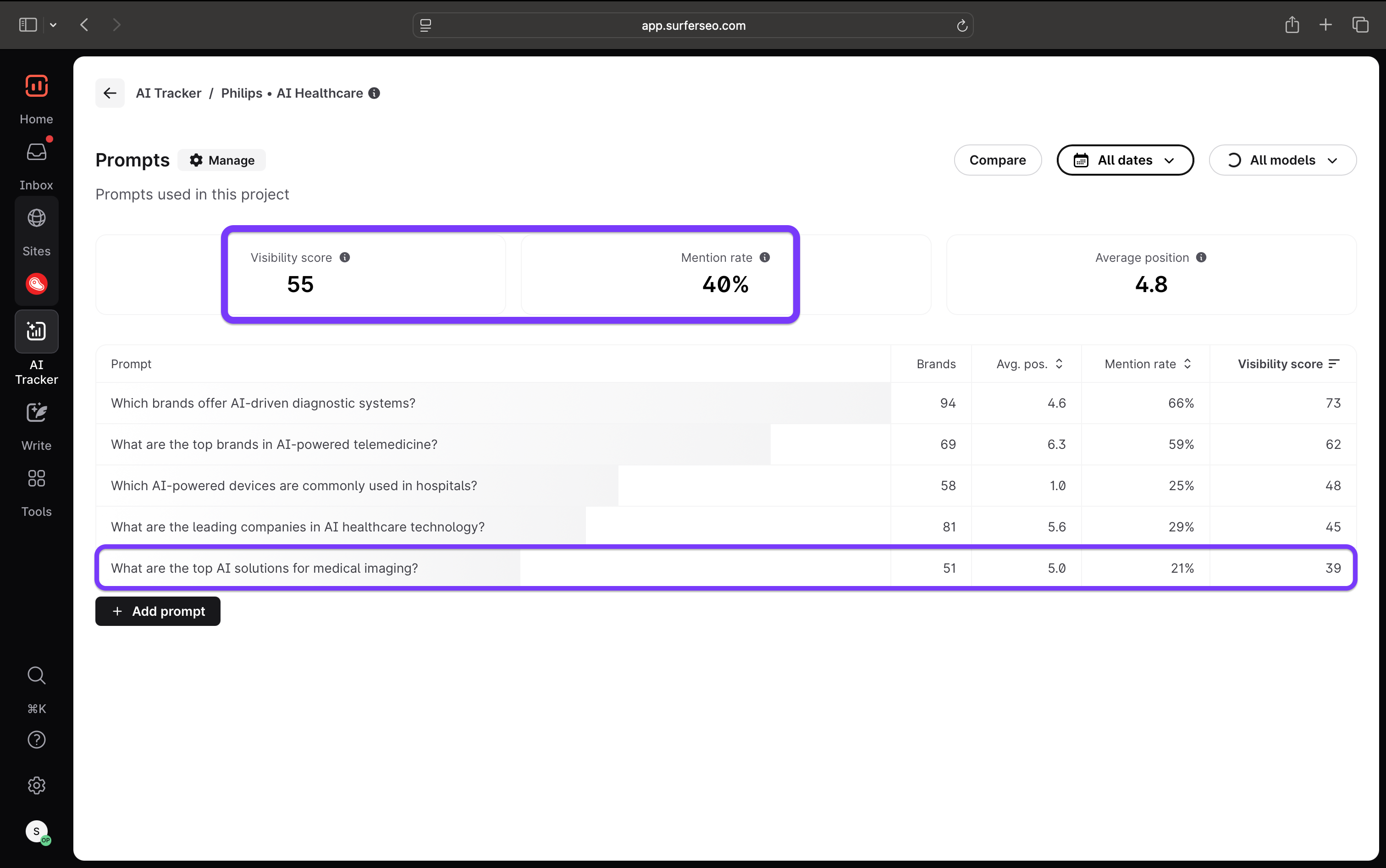
Use an AI visibility tool that collects real answers from the interfaces people use. In Surfer's AI Tracker, for example, you can see that Philips is mentioned in only 21% of answers to "What are the top AI solutions for medical imaging?", which shows exactly where to improve.
Frequently asked questions
What is AEO in SEO?
AEO, or answer engine optimization, is the part of SEO focused on getting your content used as the answer in AI Overviews, AI Mode, ChatGPT, Perplexity, featured snippets, and voice assistants. It relies on direct answers, question-based headings, clear structure, and citable facts.
Is AEO replacing SEO?
No. Answer engines retrieve content from search indexes, so pages that aren't indexed or don't rank for the topic rarely get used. AEO builds on SEO by making your content easier to extract and cite.
What's the difference between AEO and GEO?
AEO focuses on being the answer in answer engines and features like AI Overviews, featured snippets, and voice search. GEO focuses on being cited and recommended across generative AI engines like ChatGPT and Perplexity. The tactics overlap almost completely.
Is AEO the same as SEO?
No, but they share foundations. SEO aims to rank pages in search results; AEO aims to have your content used as the answer. Doing both gives you the most visibility, because answer engines retrieve from the pages that search engines index and rank.
How long does AEO take to work?
Structural changes, like adding direct answers and question headings, can show up in AI answers soon after the page is recrawled. Building the authority that comes from original data and third-party mentions takes months.
What are answer engine optimization services?
AEO services usually include an audit of your AI visibility, prompt tracking, content restructuring for direct answers, technical fixes such as crawler access, and digital PR to earn mentions. Ask providers how they measure results and whether they track real AI answers.
Do I need llms.txt for AEO?
Not for Google: it says its Search features don't use llms.txt. Focus first on crawlable pages, direct answers, and allowing AI search crawlers like OAI-SearchBot and PerplexityBot.