A brand mention is any reference to your brand name, product name, or branded terms on an external website, whether or not it includes a hyperlink. Mentions now shape how search engines and AI models judge your brand, so tracking where and how you are mentioned, and earning mentions on the pages AI cites, is part of SEO.
In this guide, I’ll explain what brand mentions are, why they matter for SEO and AI visibility, and how to earn more of them. In short:
- Surfer’s study of nearly 290,000 URLs found a correlation of about 0.41 between how often cited sources mention a brand and how often AI recommends it.
- Mentions help search engines connect your brand to topics and shape how AI models categorize and recommend you.
- Google Alerts shows where you are mentioned, while an AI visibility tracker shows the prompts, sources and sentiment behind AI answers.
- Five steps earn more mentions: close competitor gaps, get into the formats AI trusts, build presence everywhere, claim unlinked mentions, and use digital PR.
What are brand mentions?
A brand mention is any reference to your brand name, product name, or branded terms on an external website, whether or not it includes a hyperlink.
If your brand is mentioned in a blog post, news article, review site, online community, or social media platform, that reference counts as a brand mention. The mention does not need to link back to your website to carry value.
For example, when a blogger writes "I really love my new Breville espresso machine" without linking to Breville's site, that's a brand mention. Or, when a Reddit commenter says "we switched to HubSpot last quarter," that's a brand mention too.
Brand mentions have a two-fold impact:
- They build authority in traditional search engines: When your brand is consistently mentioned across trusted websites, search engines interpret those signals as indicators of credibility, relevance, and brand recognition.
- They influence visibility in AI-generated answers: AI models analyze patterns across cited sources. Brands that are consistently mentioned across multiple trusted pages are more likely to be recommended.
Surfer’s study of nearly 290,000 URLs across 922 prompts found a moderately strong positive correlation (approximately 0.41) between how often a brand is mentioned across cited sources and how often AI systems recommend that brand.
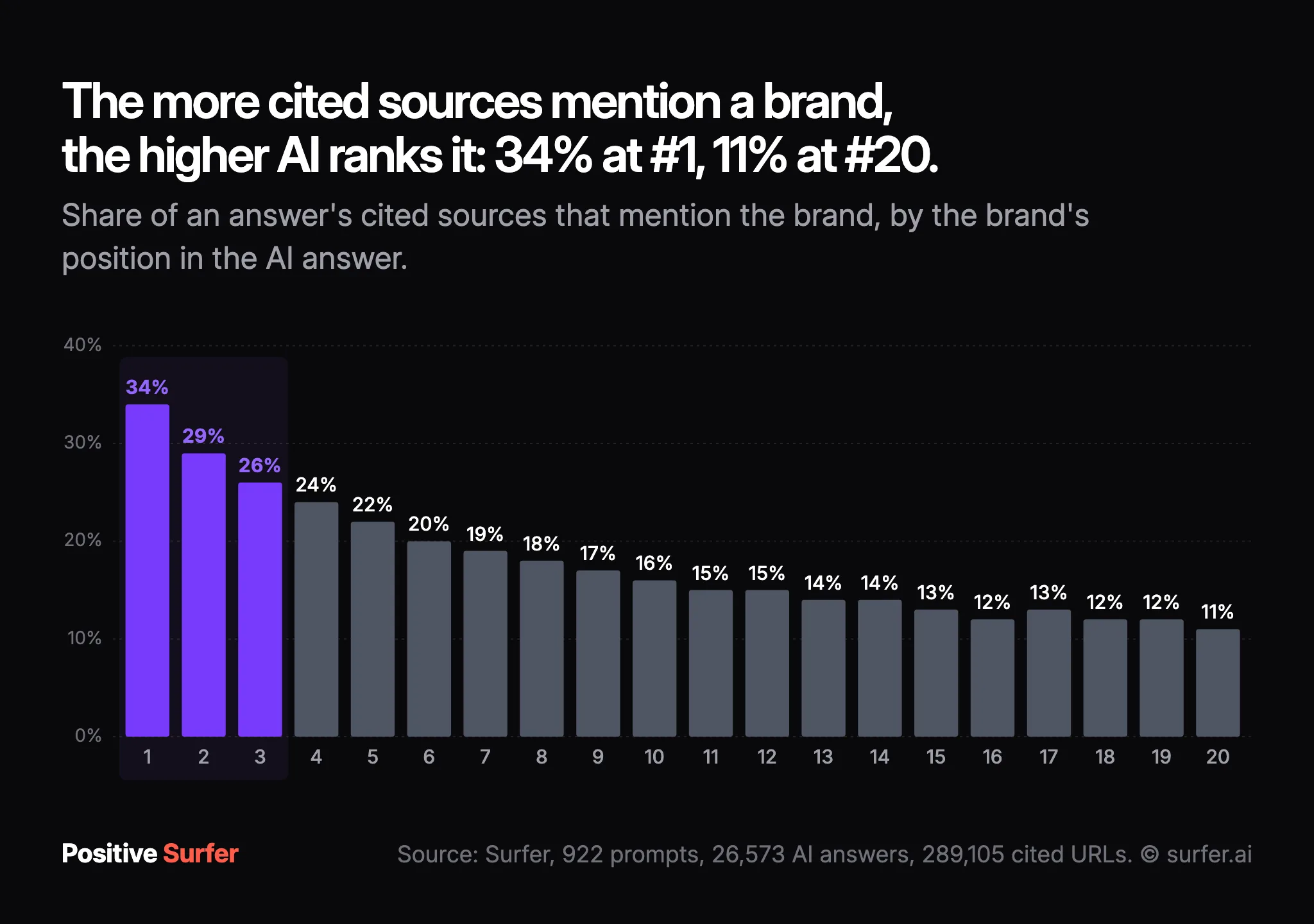
In other words, brands that are consistently mentioned online are more likely to appear in AI-generated recommendations.
How brand mentions impact search and AI visibility
Brand mentions influence how both search engines and AI models interpret your brand’s authority. Here’s a quick look at how this works:
Brand mentions and SEO
Google’s NLP systems scan billions of web pages to identify brands and map relationships between them. When your brand name is consistently mentioned alongside specific industry keywords, Google strengthens the connection between your brand and those topics.
This builds your entity profile in Google’s Knowledge Graph.
If your brand is consistently mentioned across relevant, high-quality sources like news sites, niche blogs, and review platforms, search engines are more likely to treat you as a credible authority. That can influence rankings, featured snippets, and overall brand-related search visibility.
Brand mentions and AI-generated answers
Large language models are trained on massive text datasets that include web pages, articles, transcripts, and public databases. Your brand’s presence across that training data determines whether AI “knows” your brand and how it categorizes it.
The more consistently your brand appears across reputable sources, the more likely it becomes part of AI-generated answers.
For example, Ahrefs analyzed 75,000 brands and found that branded web mentions had the strongest correlation with AI visibility (0.664 Spearman Correlation), whereas backlinks reached only 0.218.
The top three correlations were all off-site brand signals:
- Web mentions (0.664)
- Branded anchors (0.527)
- Branded search volume (0.392)
In practical terms, mentions outperform links roughly 3:1 for AI visibility.
But earning brand mentions isn’t just about volume. You also have to earn them in the right topical context and with the right brand sentiment. For example, if your brand appears in a “best CRM for startups” roundup and is described as easy to use and affordable, AI systems will associate you with startup-friendly CRM solutions.
But if the same article highlights complexity or steep pricing, that sentiment shapes how you’re recommended.
The framing of the brand mention shapes when, why, and how AI recommends you.
How to analyze and track brand mentions
If you can’t see where and how your brand is being mentioned, you can’t influence how search engines and AI models perceive it. Tracking is what turns brand mentions from passive signals into valuable insights.
For traditional web mentions, Google Alerts (a free media monitoring tool) provides real time alerts on when and where your brand name is mentioned online. This helps you monitor and track mentions across news articles, blog posts, and review sites.
But Google Alerts relies on simple string matching. It tells you that your brand is mentioned online, but it does not explain the context, sentiment, or how that mention influences search engines or AI models.
A brand mention by itself doesn’t offer much insight. You want to see the context in which your product is being mentioned.
That’s why for AI-specific visibility, you need a dedicated brand monitoring tool that tracks mentions in the context of how users come across them, whether it's through a query they typed into Google or ChatGPT.
To get this data, enter your brand and niche in Surfer's AI Tracker.
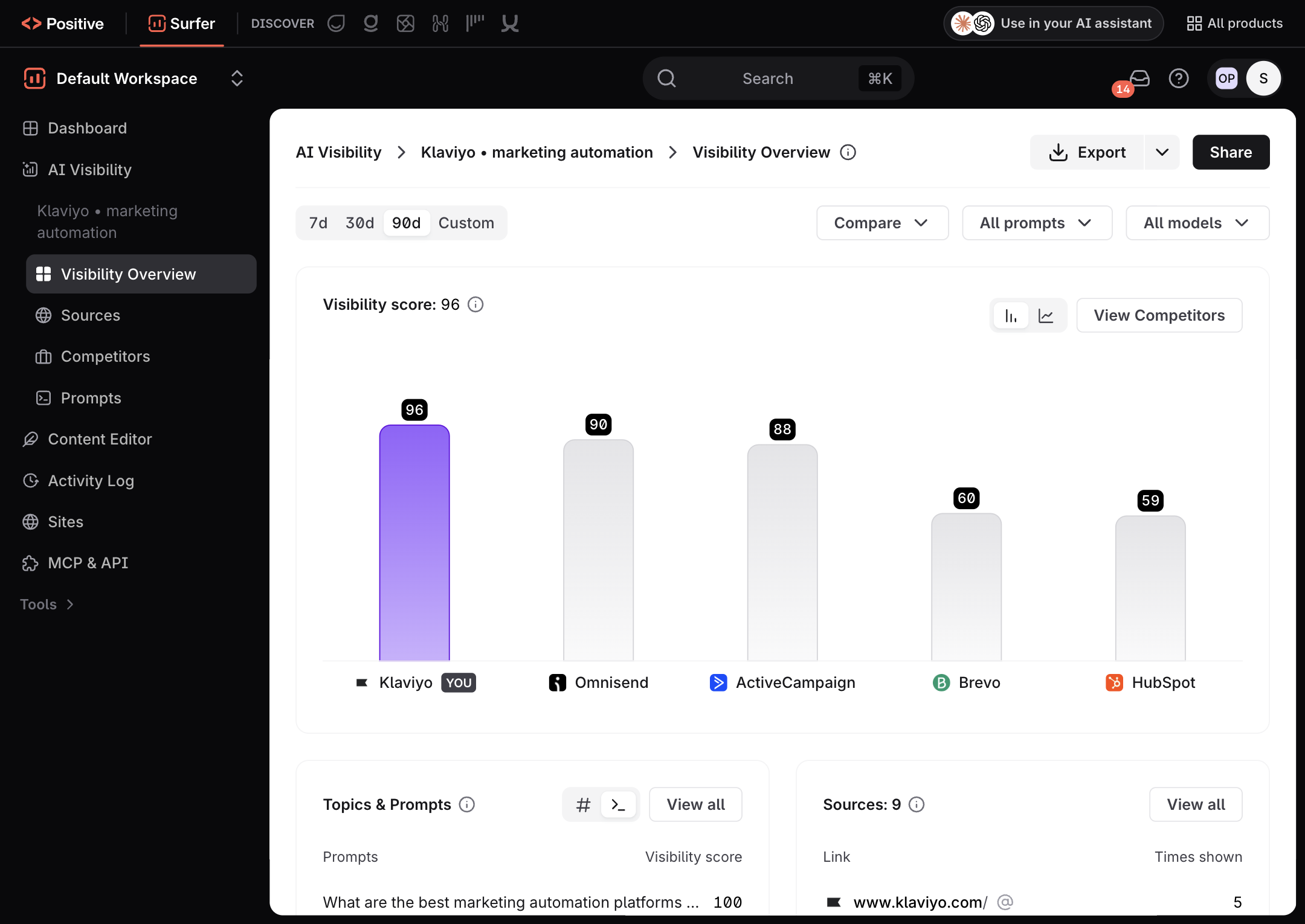
Here you’ll see your Visibility score, mention rate, and average position—an overview of how your brand is represented in AI answers.
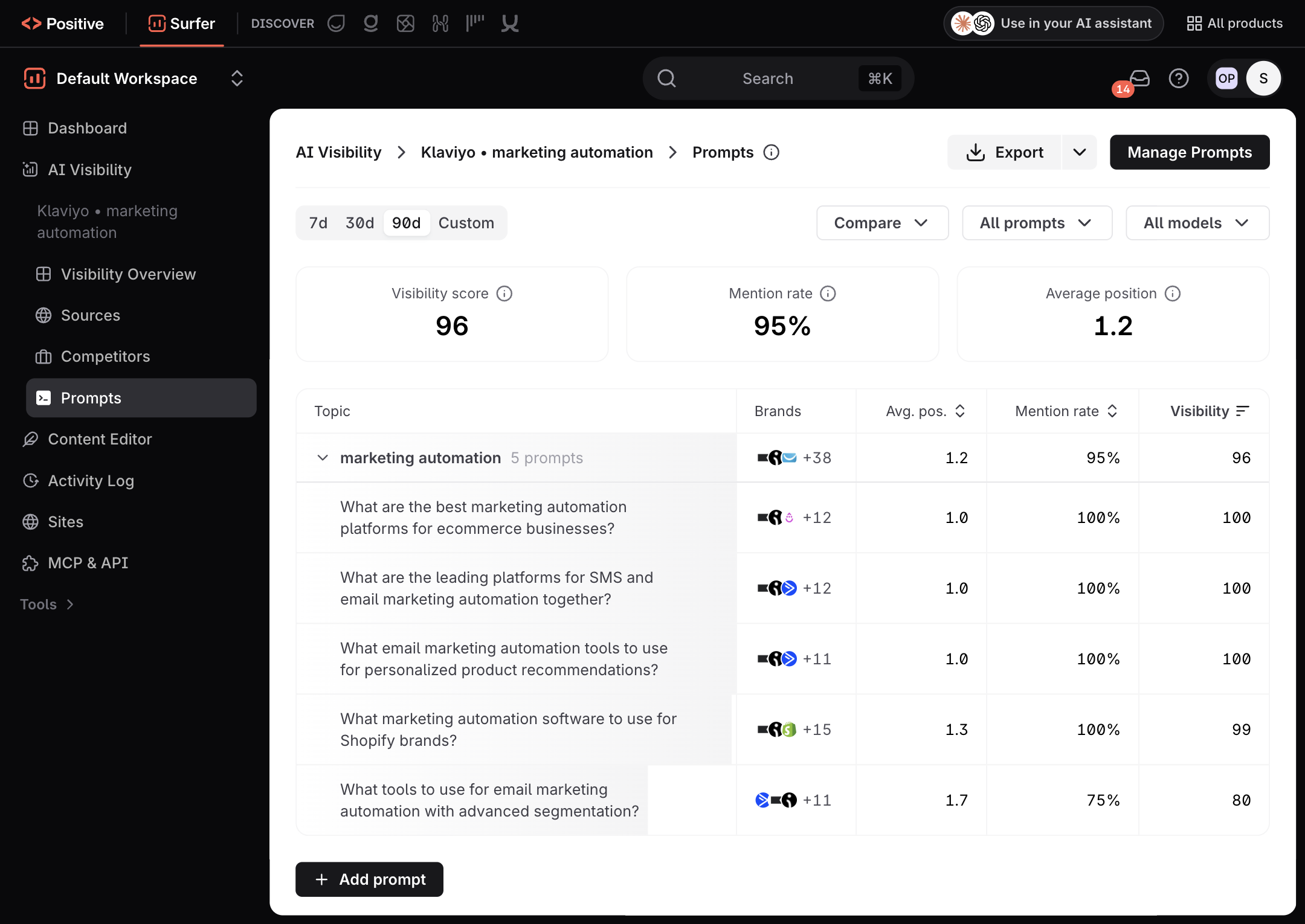
Open the Prompts report to see which queries your brand is being mentioned for.
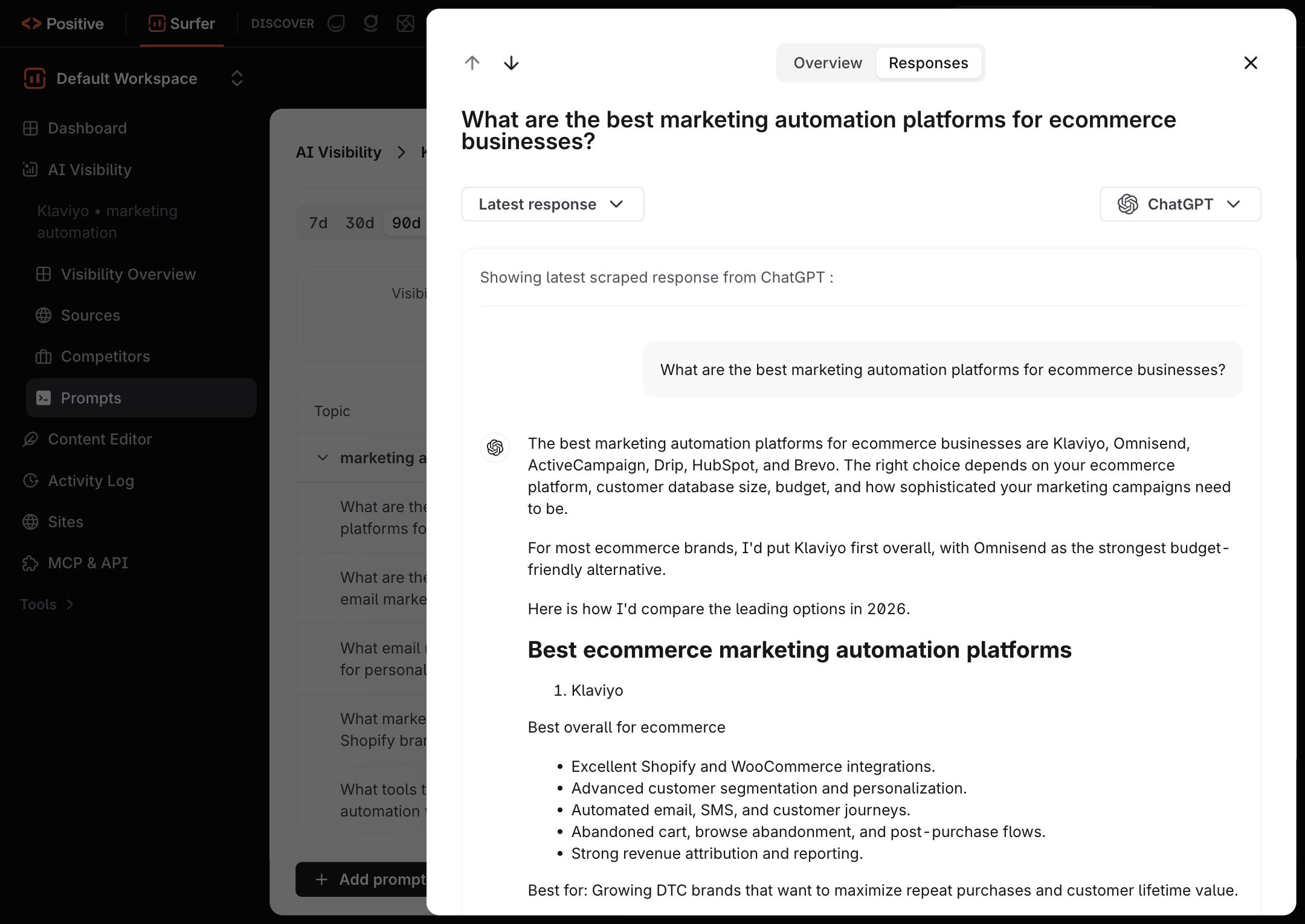
You can refer to the Responses tab to see exactly what AI models are saying about you.
Now that you know what they’re saying, you can easily find out where they’re extracting information from.
In the Sources report, you can see which pages mention your brand in AI-generated answers across 5 different models—ChatGPT, Google’s Gemini, AI mode, and AI overviews and Perplexity, giving you an overview of your brand’s AI visibility.
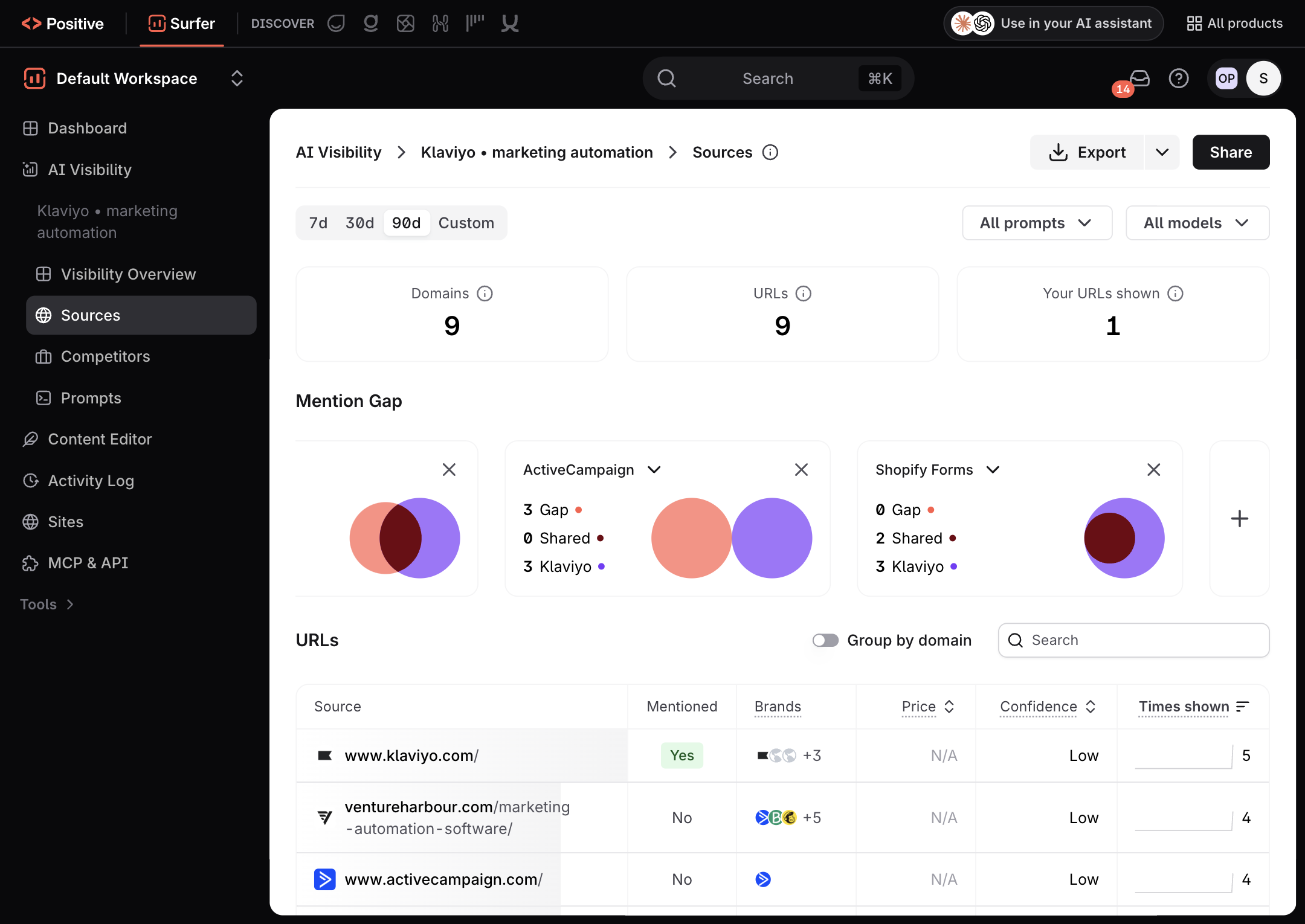
When tracking brand mentions, don't forget about citations. This refers to when an AI-generated response uses your page as a source.
Monitoring both brand mentions and page citations can reveal whether AI trusts your brand enough to recommend it, or only trusts your content enough to cite it as a source, or ideally, both.
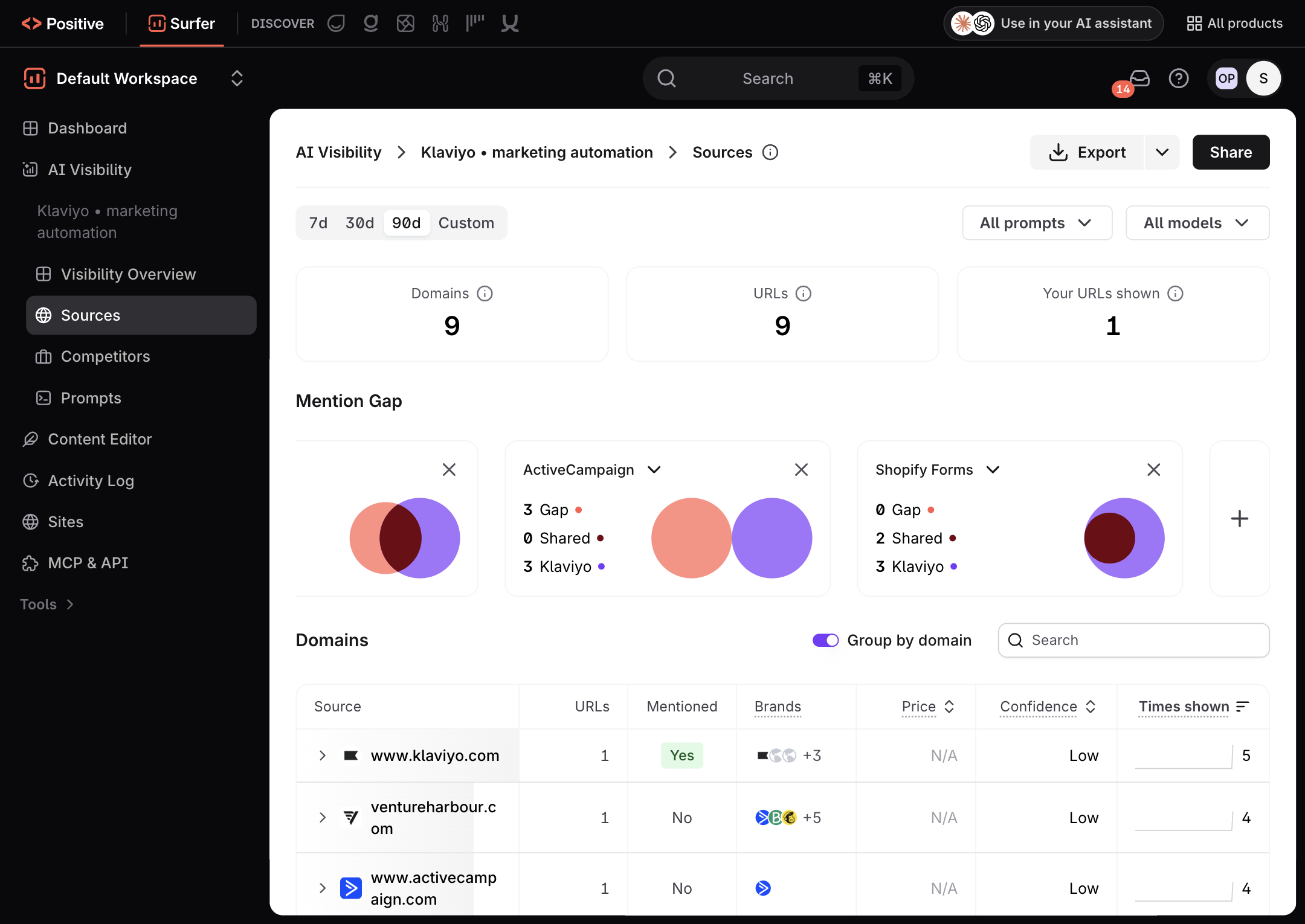
For example, here I can see klaviyo.com among the domains cited in AI answers, with its homepage showing up most often:
The report also shows you whether your brand is mentioned in a positive or negative sentiment in AI-cited sources. A Surfer study also found that you can have a thousand mentions, but if the sentiment is negative or confused, the AI will hesitate to recommend you.
Even though this Shopify marketing apps roundup mentions Klaviyo, it ranks the brand fourth with mixed sentiment:
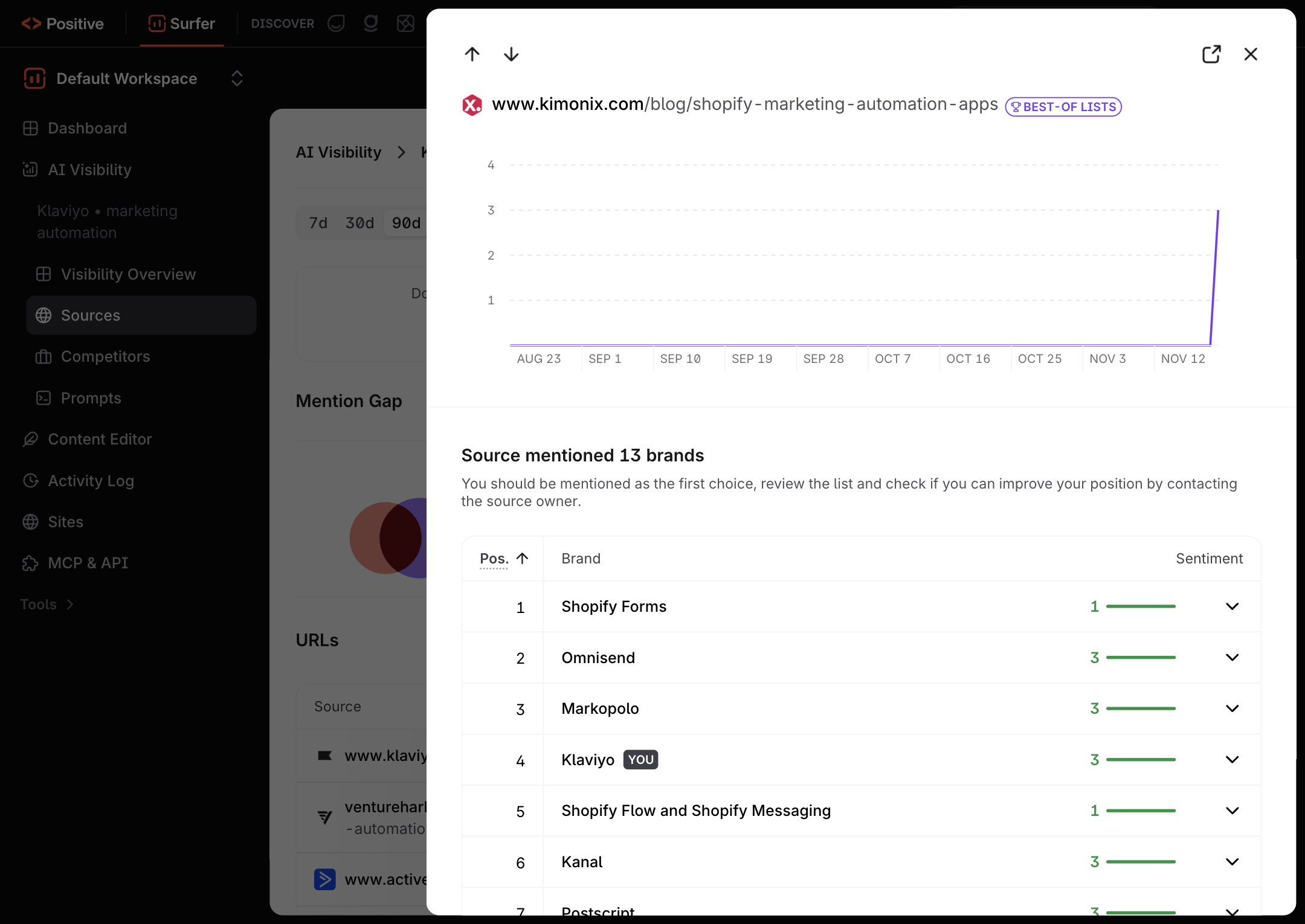
Since both tools are competitors, this is not a surprise. But it’s important to keep an eye out for negative mentions, so you can address them. Try to keep your response windows for addressing negative feedback within the first few hours, to address critical issues within 24 hours.
Continue tracking your brand’s mention visibility for topics relevant to your target audience. You can enter your own prompts and make amendments as you see fit.
For example, when users began treating LLMs as search engines, we started tracking Surfer’s brand mentions in prompts specifically related to AI visibility tools.
Brand mentions are no longer a “nice to have.” Because in AI-driven search, you don’t win by publishing more content.
You win by being consistently mentioned in the right context and through positive mentions. The brands that build a system around earning and optimizing mentions will dominate both traditional search and AI visibility.
5 steps to earn (and reclaim) brand mentions
So far, we’ve covered how to find and monitor brand mentions across search engines and AI models. Now let’s talk about how to actively generate them across multiple platforms.
Earning brand mentions goes beyond digital PR and traditional link building. It involves a mix of on-page and off-page SEO work that increases your brand’s presence across content types cited by AI, including roundups, comparison pages, review platforms, and niche blogs.
If you want to improve brand visibility in both search engines and AI-generated answers, you need a deliberate strategy. These are the five steps I like to follow to boost digital word of mouth:
1. Identify pages that mention competitor brands but not you
Instead of building brand mentions from scratch, one of the fastest ways to earn brand mentions is by identifying where your competitors are already mentioned and closing that visibility gap.
AI systems frequently cite:
- “Best tools” roundups
- Comparison pages
- Listicles
- Industry guides
- Review sites
This means, if a competitor’s brand name appears on those pages and yours does not, that is a direct opportunity to reclaim visibility.
Since these pages are already influencing AI-generated answers, your goal is to ensure your brand appears alongside competitors in the same context.
If you want to monitor brand mentions manually, start by running category-relevant prompts in ChatGPT, Google AI, and Perplexity. For example, you can enter prompts or queries like:
- “Best project management tools for startups”
- “Top email marketing platforms for e-commerce”
- “What are the best PLG tools for small teams”
Look at the AI responses and note which sources are cited.
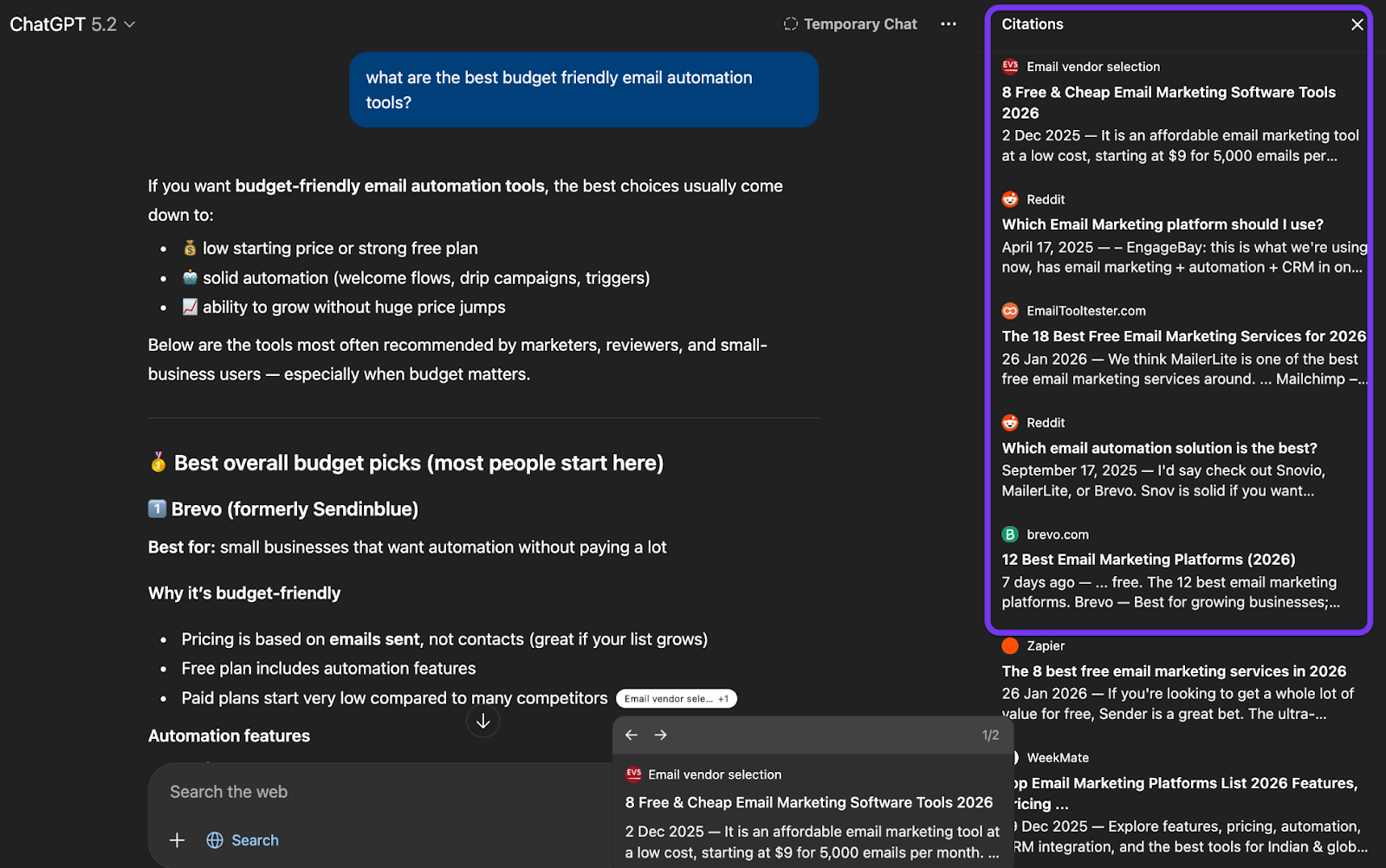
Then visit those pages and check whether your brand is mentioned. If competitors are consistently mentioned and your brand is missing, you’ve identified a brand mention gap.
This approach helps you find high-impact pages that shape AI visibility and brand perception.
Manual research works, but it’s difficult to scale and has its limitations. To systematically track brand mentions and gaps, I like to use an LLM optimization tool.
Using Surfer’s AI Tracker, head to the Mention Gap report in the Sources tab. This shows you a list of pages that cite you and your competitors, as well as gaps where you are not mentioned but your competitor is.
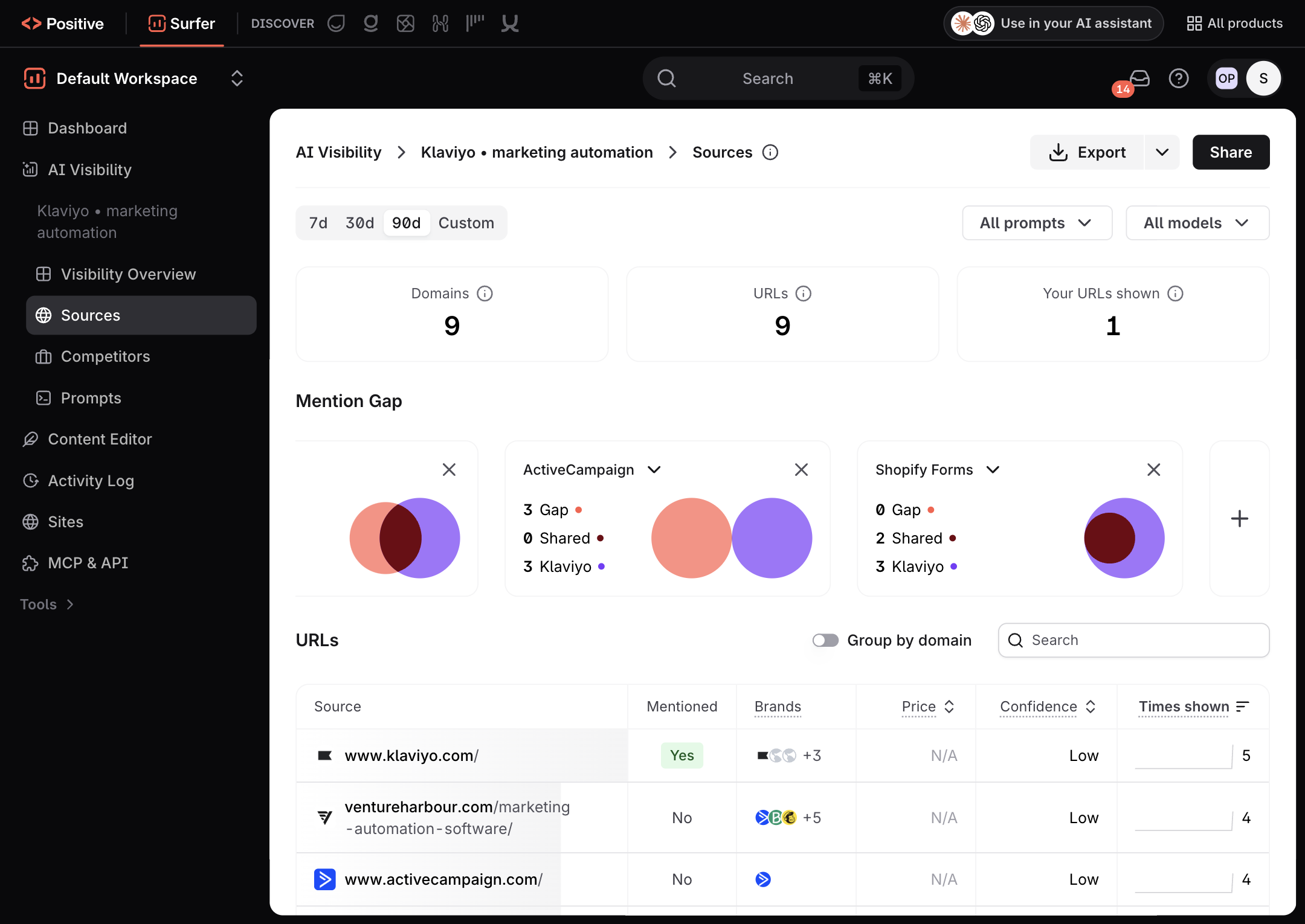
Open a cited page that shows Mentions as No to see which competitor brands appear there instead of yours.
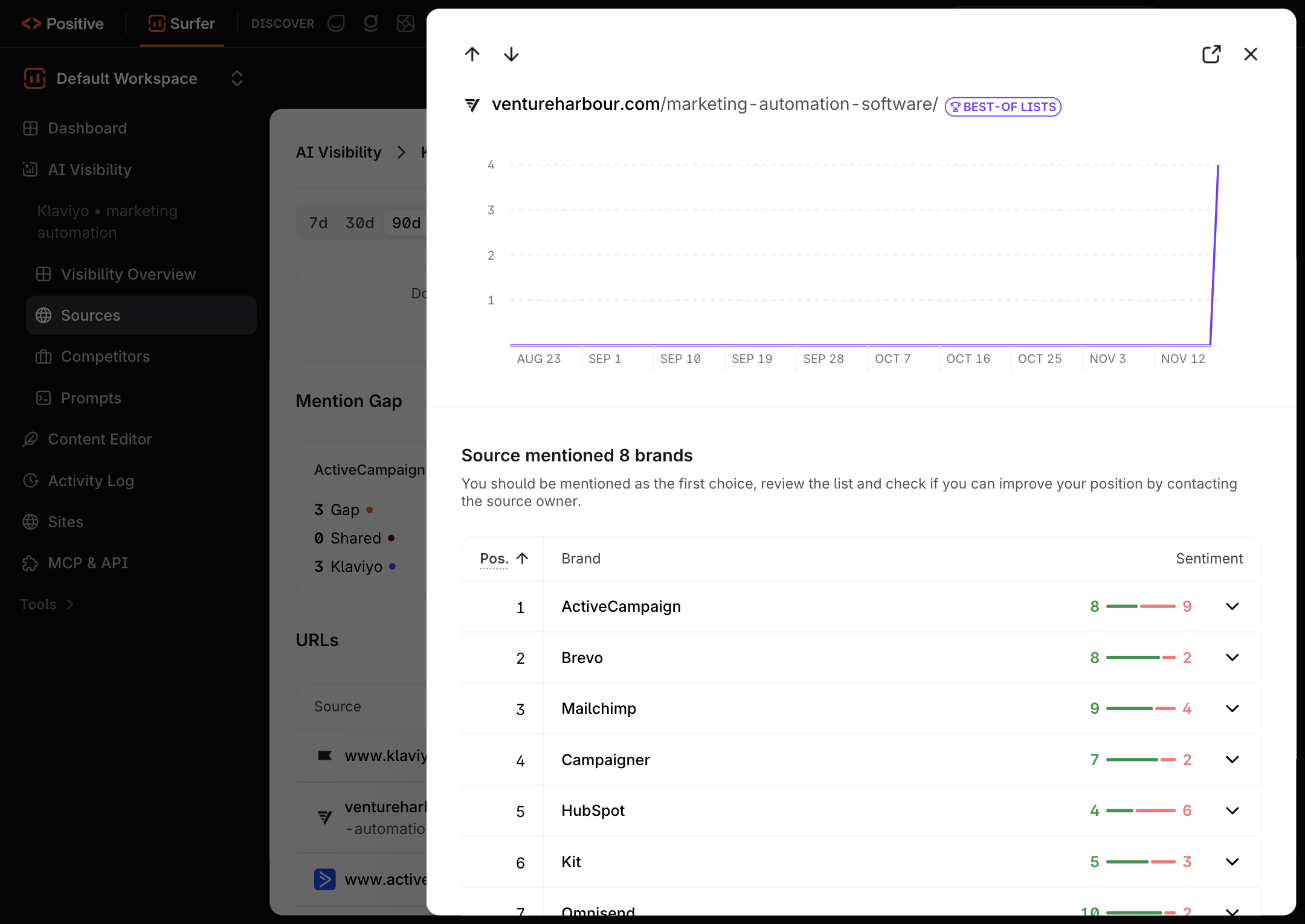
But keep in mind that not every mention gap deserves outreach. Instead, focus on:
- Pages cited frequently across multiple AI platforms
- Pages that appear in AI-generated answers for commercially relevant queries
- Sources with strong brand authority and consistent visibility
In Surfer, you can sort by the “times shown” column to prioritize frequently mentioned sources. A page cited 40 or 50 times across AI models has significantly more impact than a page cited once.
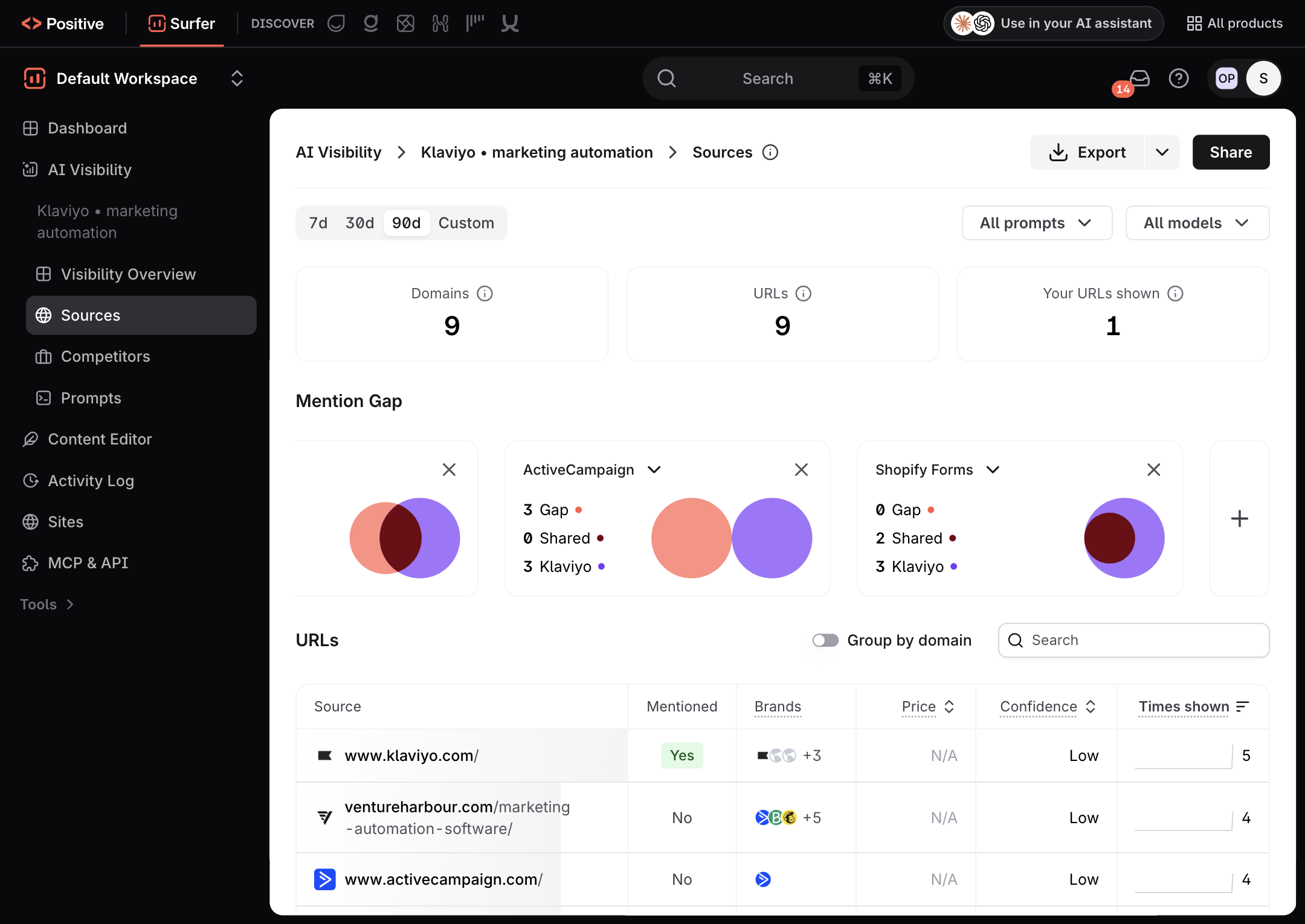
By prioritizing high-frequency sources tied to high-intent queries, you increase your chances of improving both SEO brand mentions and AI visibility.
This approach turns brand monitoring into competitive intelligence. So instead of waiting for people to talk about you, you actively identify where your brand should appear and take steps to earn that placement.
2. Get your brand into the content formats AI search engines trust most
Not all content formats carry equal weight with AI. The types of pages that get cited vary significantly by platform and industry.
That means, a mention in a YouTube video, a Reddit thread, or a trusted industry publication can influence AI visibility differently than a mention on a low-authority blog.
According to an Ahrefs December 2025 study, YouTube mentions have the strongest correlation with AI visibility (~0.737). That is higher than branded web mentions (~0.66–0.71) across ChatGPT, AI Mode, and AI Overviews.
This means appearing in video content can have a stronger relationship with AI recommendations than a single brand mention in a traditional blog.
Citation behavior also varies by industry. Surfer’s 2025 AI Citation Report shows that:
- In finance, AI systems frequently cite accessible explainers like Investopedia and NerdWallet.
- In health, they rely on sources like Healthline, Mayo Clinic, and WebMD.
- In e-commerce, they pull from peer reviews and how-to discussions on Reddit and Wirecutter.
- In gaming, they often reference community-driven platforms like Fandom.
The point is, AI models repeatedly cite the sources that dominate authority within each niche. If your brand does not appear in these relevant environments, your brand visibility in AI-generated answers will remain limited.
That’s why it’s important to analyze which platforms and content formats are most frequently cited in your industry, then prioritize earning different types of brand mentions there, including:
- YouTube collaborations through influencer marketing
- Expert contributions to trusted publishers for news mentions
- Inclusion in high-authority roundups or news articles covering industry trends
- Participation in online communities and social media channels that AI models consistently reference
In short, AI citation patterns are almost like a reflection of industry norms. So your brand mention strategy should align with them.
3. Adopt a search everywhere strategy for brand visibility
AI models do not rely on a single type of source, which is why search everywhere optimization should be at the core of your strategy for boosting brand mentions online.
ChatGPT, Google’s AI Overviews, and Perplexity each cite different platforms and content formats. More importantly, multiple studies show that some of the most cited domains by AI include platforms like Reddit, YouTube, industry publications, and even social media platforms.
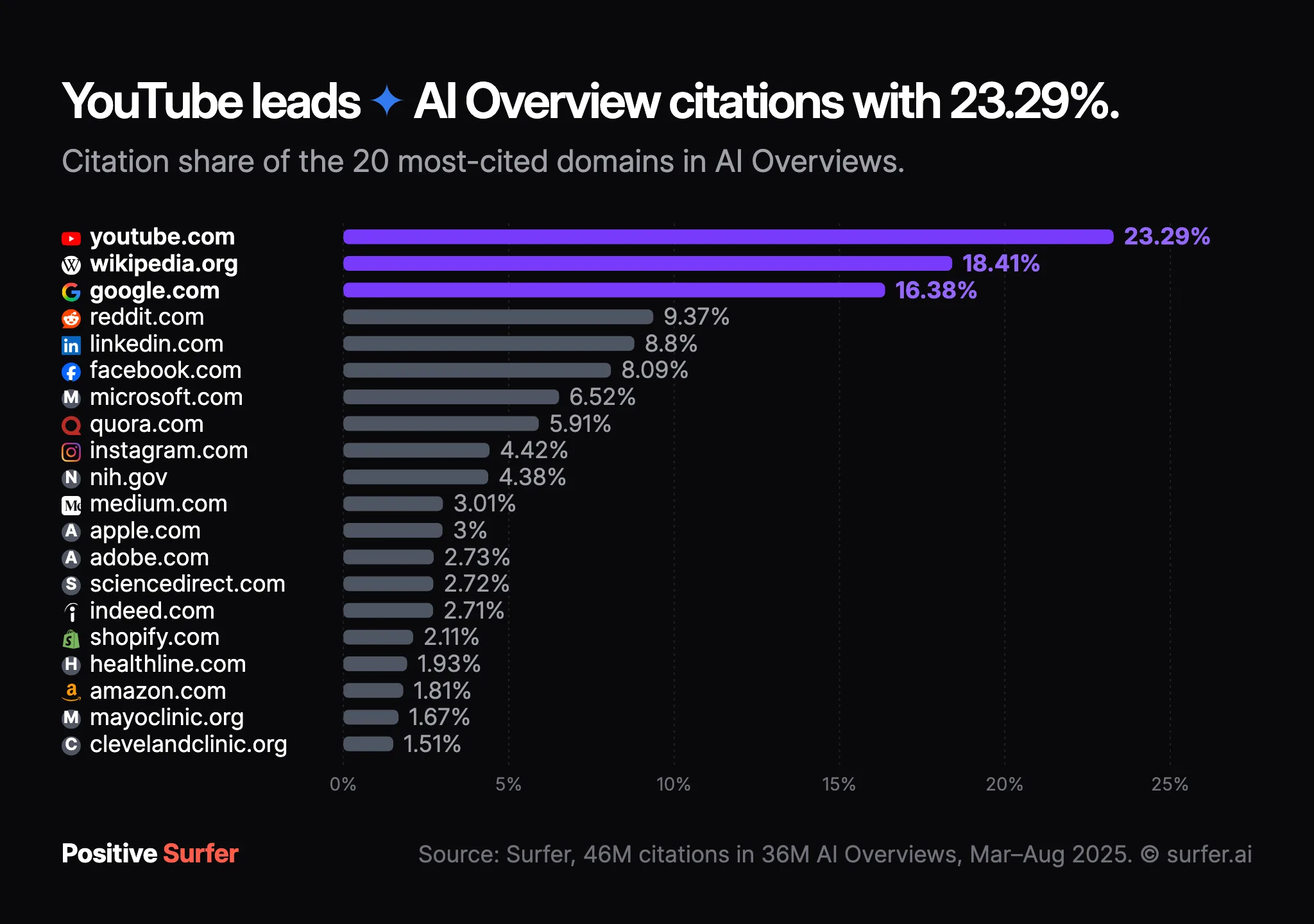
That means, if your brand mentions are concentrated only in blog posts or listicles, your visibility will fluctuate depending on which source types an AI system prioritizes.
A diversified brand presence reduces that risk.
Instead of optimizing for one channel, ensure your brand appears across the platforms your audience already uses—video, forums, review sites, social media posts, and online communities. This strengthens brand visibility across search engines and AI-generated answers.
YouTube demonstrates how quickly citation dynamics can shift.
Bluefish data reported by Adweek shows YouTube now appears in 16% of LLM answers, compared to Reddit’s 10%. Earlier in 2025, Reddit was in the lead. Now, YouTube is cited roughly 200 times more than any other video platform in AI search results.
Long-form videos provide structured, transcript-based content that AI models can parse easily. Titles, descriptions, and chapters help models understand topic associations and brand context.
To improve YouTube-driven brand mentions:
- Create long-form explainers and tutorials rather than short clips
- Include your brand name clearly in video titles
- Ensure transcripts accurately spell your brand name
- Use chapters to structure content logically
When those videos get cited, they often surface inside AI Overviews alongside other sources—so the brand mention travels with the video into the AI answer itself:
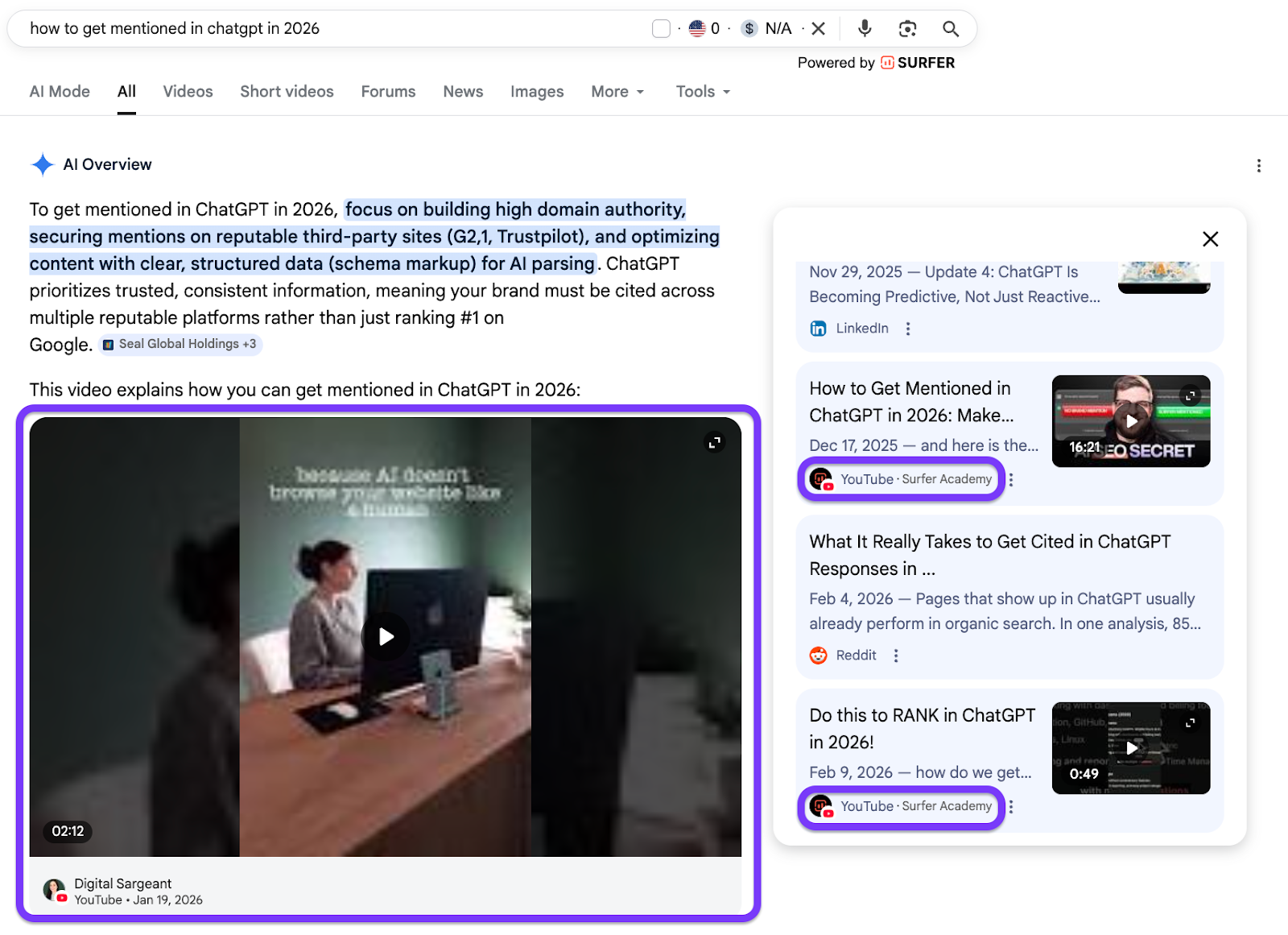
According to an Ahrefs December 2025 study, the volume of YouTube mentions correlates slightly more strongly with AI visibility than video reach. That means, consistent brand mentions matter more than one viral upload.
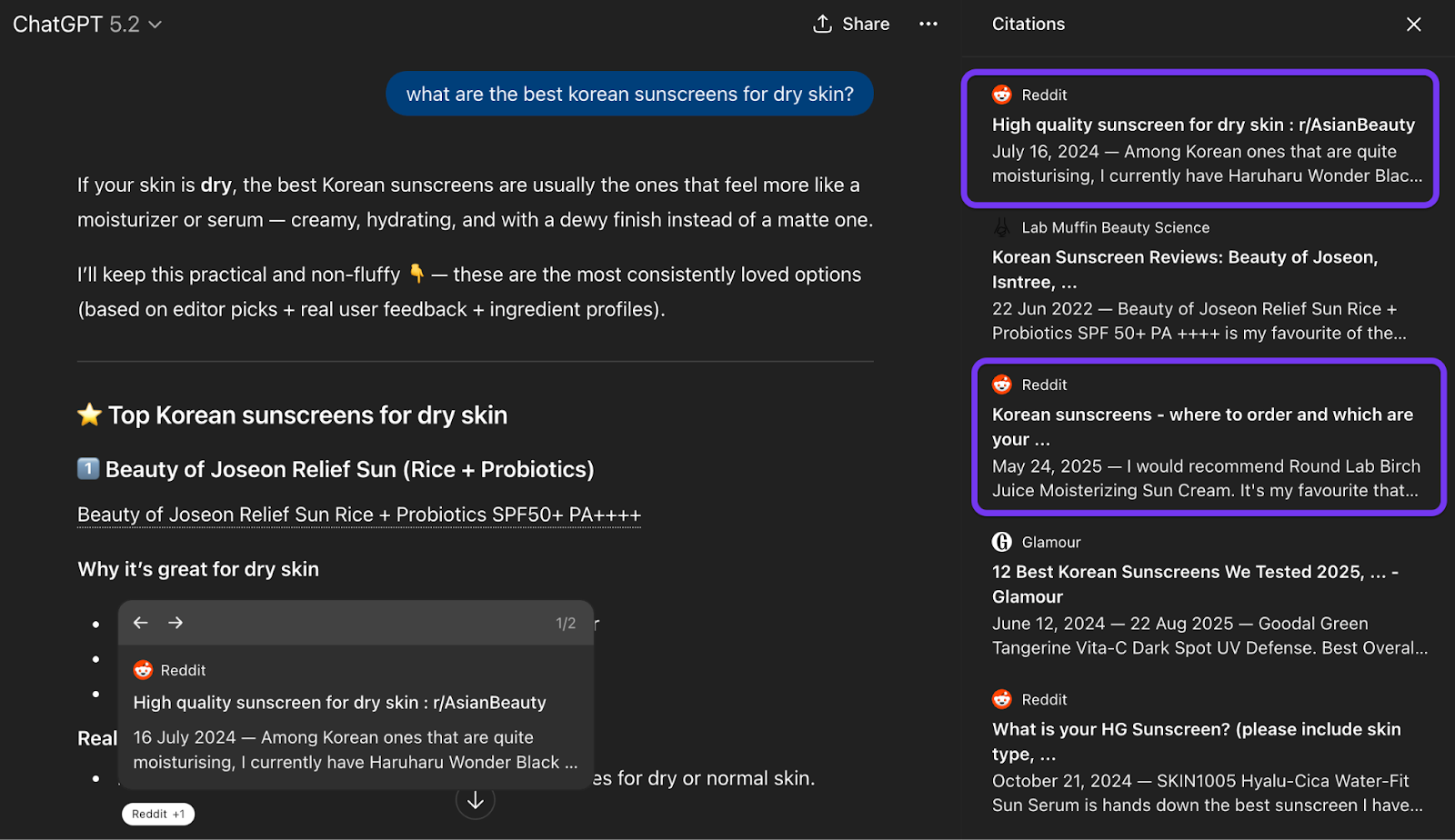
Since Reddit remains one of the most cited domains aggregated across major AI platforms, start participating authentically in niche subreddits relevant to your industry. Provide helpful responses and mention your brand naturally when appropriate.
Over time, these discussions strengthen brand perception and increase your likelihood of being mentioned in AI answers. ChatGPT and other LLMs frequently pull Reddit threads into their Citations sidebar for peer comparisons and user-driven discussions:
Review platforms also influence AI citation behavior. Software review sites like G2 are among the most cited review platforms across ChatGPT, Perplexity, and Google AI Overviews. You can encourage satisfied customers to leave detailed, experience-based reviews on relevant review sites.
Each authentic brand mention across YouTube, Reddit, review platforms, and community discussions reinforces your brand’s authority. Diversifying your presence ensures that shifts in AI citation behavior do not limit your visibility.
In short, a search everywhere strategy protects your brand’s presence across both traditional search engines and AI systems.
4. Claim un-linked mentions
Unlinked mentions are plain-text references to your brand with no hyperlink. For example, a roundup might list your product by name but not link to your website. Or a comparison page may discuss your features without including you as an official option.
Both linked and unlinked mentions carry SEO value, but they work differently:
- Linked mentions pass PageRank and drive referral traffic.
- Unlinked mentions strengthen entity recognition and topical authority.
Search engines use these references to understand how your brand is connected to specific topics, and AI models rely on them even more. When your brand is repeatedly mentioned alongside certain use cases, features, or audiences, it becomes part of how AI systems categorize and recommend you.
That’s why unlinked mentions are often the lowest-hanging fruit. The opportunity is already there; you just need to formalize it.
Start by identifying pages that already shape AI visibility in your space. These are the roundups, comparison pages, and guides that appear repeatedly in AI-generated answers.
You can find these pages manually by running relevant prompts in ChatGPT, Google’s AI Overviews, or Perplexity, then checking which sources are cited and whether your brand appears. But doing this consistently requires a system, and can be difficult to scale and keep track of.
Instead, I like looking at the Sources tab in Surfer’s AI Tracker.
You’ll immediately spot where competitors are mentioned for the most frequently cited pages and whether your brand appears or not.
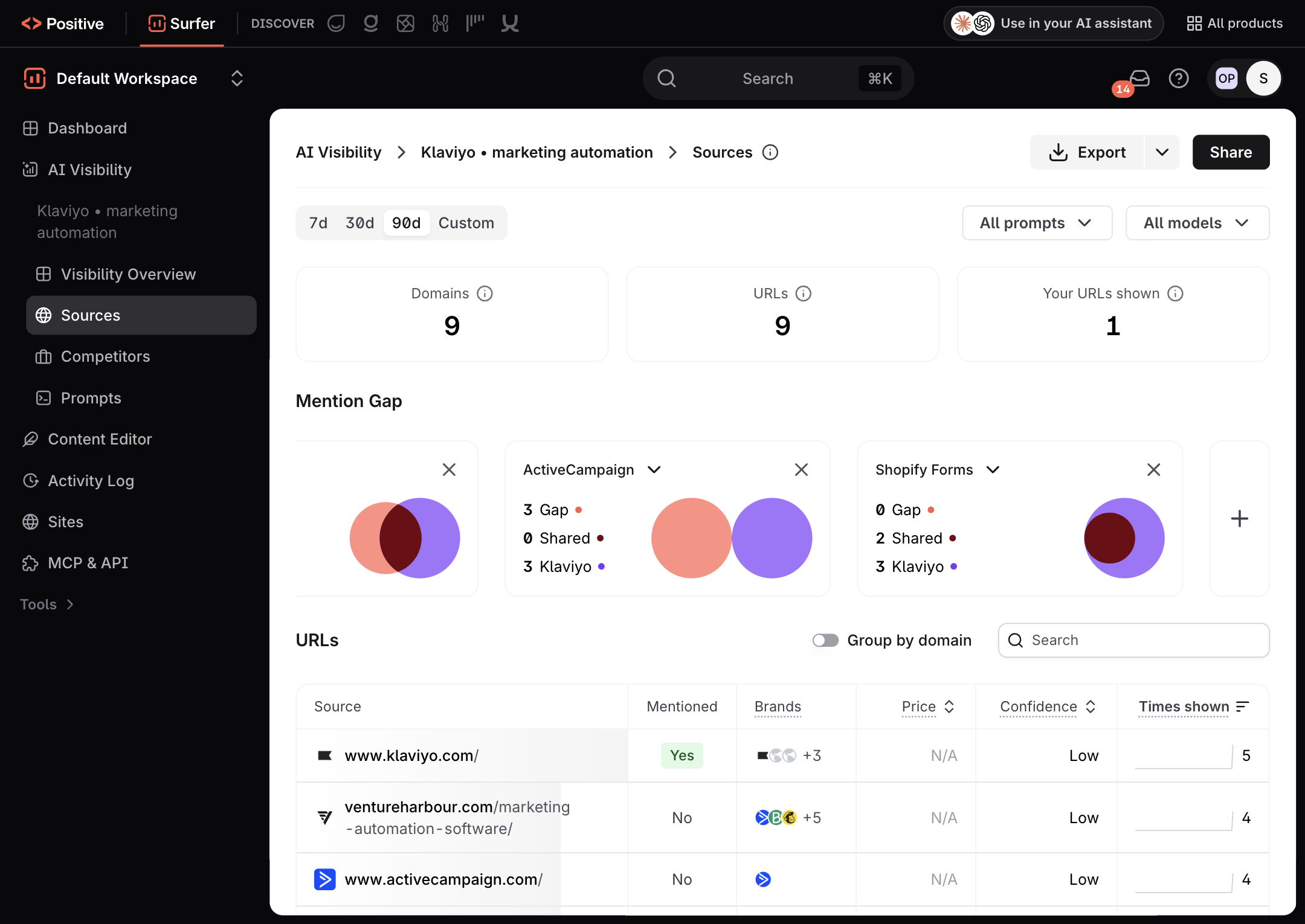
If a page shows up repeatedly in AI answers and includes competitor brands but not yours, that’s a visibility gap worth closing.
You can also sort by the Times shown column to focus on pages that influence AI answers most often to prioritize your efforts. If sponsored placements align with your strategy, the Price column can also surface potential link partnering opportunities:
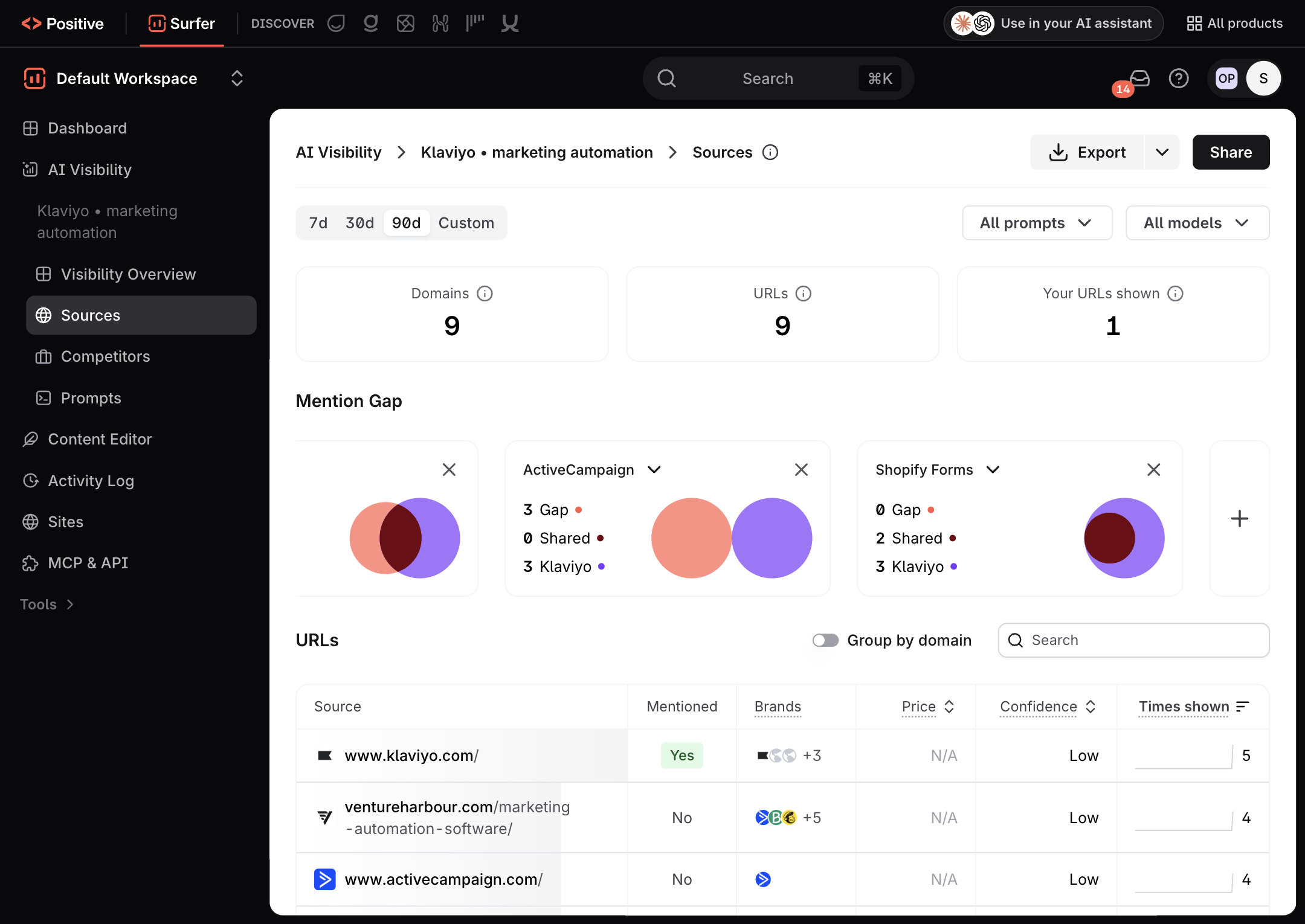
Once you’ve identified a strong publisher, reach out to them with a specific pitch. Keep your outreach message simple and structured:
- Reference the exact article they published (which shows you’ve read it).
- Explain the specific value your brand adds—maybe a different pricing tier, feature set, audience, or use case.
- Provide a short, ready-to-use description of your product.
- Include a relevant link to the most appropriate page.
- Suggest natural placement text to make their job easier.
- Position your inclusion as improving the resource, not as a favor to you.
This works because you’re not just cold-pitching. You’re asking to be included in content that already covers your category and is influencing AI-generated answers.
Plus, the publisher has already written about your category. Their page is already ranking and is being cited in AI responses. So, you're actually improving their content, and not just trying to extract value from it.
Of course, not every outreach message will get a response; some sites might request payment, and larger publications may require relationship building.
Always remember that unlinked mentions are not a one-time win. It’s an ongoing process. New content will always get published, competitors get added, and AI citation patterns shift.
So it’s best to revisit this quarterly for monitoring mentions.
Over time, converting plain-text mentions into linked brand mentions compounds your brand authority across both traditional search engines and AI-generated answers.
5. Use digital PR to generate editorial coverage
Digital PR is one of the most effective ways to earn brand mentions on the authoritative sites AI systems already cite.
News outlets, industry publications, and expert roundups are consistently referenced in AI-generated answers. And when your brand appears in those environments, it strengthens both traditional SEO signals and the credibility signals large language models rely on for brand perception.
An analysis from Hard Numbers found that about 61% of the signals that inform AI’s understanding of brand reputation originate from editorial media sources.
That means news outlets, industry publications, expert roundups, and data-backed reports shape how AI models categorize and recommend brands.
More importantly, brand monitoring through digital PR serves as social proof, influencing potential customers' purchasing decisions.
The most effective digital PR campaigns usually revolve around three approaches:
- Original research
Publishing proprietary data like surveys, benchmark reports, or trend analyses gives journalists and other publications a reason to cite you. When an article references your findings, your brand becomes associated with that topic. Repeated citations strengthen topical authority and increase the likelihood of appearing in AI-generated answers.
- Expert commentary
Providing quotes to journalists positions your brand inside active industry conversations. But remember that the framing of that coverage matters. A quote in a cybersecurity article trains AI systems differently than a single brand mention in a general startup roundup. Be intentional about which topics and digital platforms you target for your brand online.
- Newsjacking
When major industry news breaks, journalists look for fast expert reactions. If your brand can provide relevant insight quickly, you increase your chances of being quoted in high-authority coverage that AI systems frequently cite.
For example, when Google rolls out a core update, SEO-related companies that publish immediate, data-backed analysis often get referenced in industry articles. Those mentions associate the brand with algorithm expertise in both search engines and AI models.
Timely coverage also supports the “freshness” signals that search engines and LLMs prioritize.
And you don’t need a large PR budget for your marketing team to make this work.
Original data studies, benchmark reports, and industry analyses can generate editorial coverage through focused outreach. Publications prioritize credible numbers and insights. So, if your brand shows something worth citing, you can earn mentions on authoritative sites without running a full-scale campaign.
Building a brand mention strategy for visibility
If you want to improve search visibility today, you need to treat brand mentions as a system.
That means:
- Identifying what AI systems cite in your industry — not assuming blogs are enough
- Understand your brand's sentiment analysis across mentions, so you can improve and maintain a consistent brand reputation
- Closing competitor citation gaps where your brand is missing from trusted roundups and comparison pages
- Earning editorial coverage through digital PR, original research, and expert commentary
- Building presence in user-driven platforms like YouTube, Reddit, and review sites
- Tracking brand mentions and citations consistently, so you know whether your visibility is improving
Because AI systems are not just ranking pages. They are evaluating your digital brand consensus.
As AI search expands, the conversation about your brand mentions across the web is becoming the new algorithm, and the brands that intentionally build, optimize, and analyze brand mentions will control their own visibility across the web.
Do unlinked brand mentions help SEO?
Yes, but differently from links. Linked mentions pass PageRank and drive referral traffic, while unlinked mentions strengthen entity recognition and topical authority. Search engines use these references to understand how your brand connects to specific topics, and AI models rely on them even more when they categorize and recommend brands.
Are brand mentions more important than backlinks for AI visibility?
In one analysis of 75,000 brands, branded web mentions correlated with AI visibility at 0.664, while backlinks reached only 0.218. That suggests mentions outperform links roughly 3:1 for AI visibility, though a correlation alone does not show that mentions cause AI recommendations.
How often should you look for new brand mention opportunities?
Revisit unlinked mentions and mention gaps quarterly. New content keeps getting published, competitors get added to roundups, and AI citation patterns shift, so a page that left your brand out last quarter may be worth pitching now.
Which platforms should you target for brand mentions?
Start with the sources AI systems already cite in your industry. Across platforms that often means YouTube, Reddit, industry publications and review sites such as G2, but citation behavior varies by industry, so check which domains and formats dominate AI answers in your own category first.
Does the context of a brand mention matter?
Yes. If a roundup describes your product as easy to use and affordable, AI systems learn to associate you with that use case. If the same article highlights complexity or steep pricing, that sentiment shapes how you are recommended. Volume alone is not enough.