Peec AI is a thoughtful product, especially for deep data on AI search visibility and detailed prompt-level monitoring for your brand. Surfer approaches the problem more broadly, tying AI visibility tracking to SEO and content optimization workflows. I tested both side by side to see where each one fits.
Both are strong AI platforms, but they’re solving slightly different problems. In short:
- Prompt monitoring is close to identical: both show visibility, sentiment, average position, brands mentioned and sources for each prompt.
- Visibility metrics are comparable, but Surfer surfaces them upfront while Peec AI invites deeper exploration.
- Surfer has a dedicated Competitors tab with Mention Gap analysis, while Peec AI handles competitors through prompt and source data.
- Peec AI goes deeper on source retrieval and suggested Actions, while Surfer ties the same signals into content optimization in the Content Editor.
- As of November 2026, Surfer’s Pro plan costs $182/month billed annually and Peec AI’s Pro plan costs $245/month ($208/month billed annually).
Peec AI vs. Surfer: A quick overview
If you want the short version: both are strong AI platforms, but they’re solving slightly different problems.
Peec AI is built primarily as a monitoring tool for AI search analytics, rather than an optimization engine. It helps you monitor AI visibility, track prompt performance, analyze source citations, surface competitor gaps, and understand how your brand appears across models like ChatGPT, Perplexity, and Google AI Overviews.
Surfer covers much of that same AI search visibility tracking and monitoring, but with a broader workflow in mind.
It connects AI search visibility insights to SEO research, content optimization, and publishing, which makes it feel less like a standalone monitoring tool and more like an optimization platform.
Essentially, Surfer isn’t just helping you with AI visibility tracking, but also helps keep your SEO in check and align your strategy with GEO/AEO.
That distinction showed up pretty consistently while testing. Peec AI often felt deeper in the data monitoring aspect, while Surfer often felt more actionable and connected to overall content and SEO optimization, not just a standalone AI visibility tracker.
A few quick observations throughout my Peec AI review:
- Prompt monitoring: Both platforms offer very similar output, if not the same. Both surface relevant prompts, sources, brands mentioned, and actual AI responses pretty nicely.
- AI search analytics depth: Peec AI goes deeper in places, especially around source-level retrieval and recommended “Actions.”
- Ease of navigation: Surfer often surfaces the same visibility data with less digging. I found that made data comparison a lot easier.
- Competitor benchmarking: Surfer has an edge here, particularly for spotting mention gaps. I didn’t find a dedicated area in Peec AI for competitor tracking, but Surfer does this well, especially by pointing out gaps between you and competitor brands.
- Content optimization: This is where the products start diverging more clearly. Peec AI focuses on diagnosing visibility opportunities and data points. Surfer extends into actually understanding this data and improving your visibility, along with overall SEO.
So, if your priority is specialized AI visibility tools for monitoring and competitive intelligence, Peec AI is a solid option.
But, if your team wants those same insights tied to a broader SEO and generative engine optimization workflow, Surfer may be the stronger fit.
That said, this isn’t one of those comparisons where one tool clearly “wins.” My review for Peec AI is more like a question of what layer of the content workflow you’re trying to solve.
I find Peec AI to be a strong platform for AI search analytics and tracking visibility across major AI engines, but Surfer has the broader workflow advantage—coming from a content marketer who’d look at the larger picture.
The rest of this Peec AI review gets into where those differences show up in practice.
Feature-by-feature Peec AI review vs. Surfer for AI visibility tracking
A lot of the core features of Peec AI revolve around a question most other AI visibility trackers are trying to answer right now: where does your brand show up across AI search, why does it show up there, and what can you do with that information?
For this Peec AI review, I looked at the features that felt most central to that: prompt monitoring, AI visibility tracking, competitor analysis, source retrieval, and the workflows each platform gives you to act on those insights.
I also compared each of these side by side with Surfer, not to force a winner, but to understand where the products overlap and where they take different approaches.
From there, I went feature by feature.
1. Prompt monitoring
Starting from the dashboard, Peec AI and Surfer both surface a familiar set of signals: visibility metrics, prompts, sources, competitors, and AI mentions. Though they package and prioritize them a little differently.
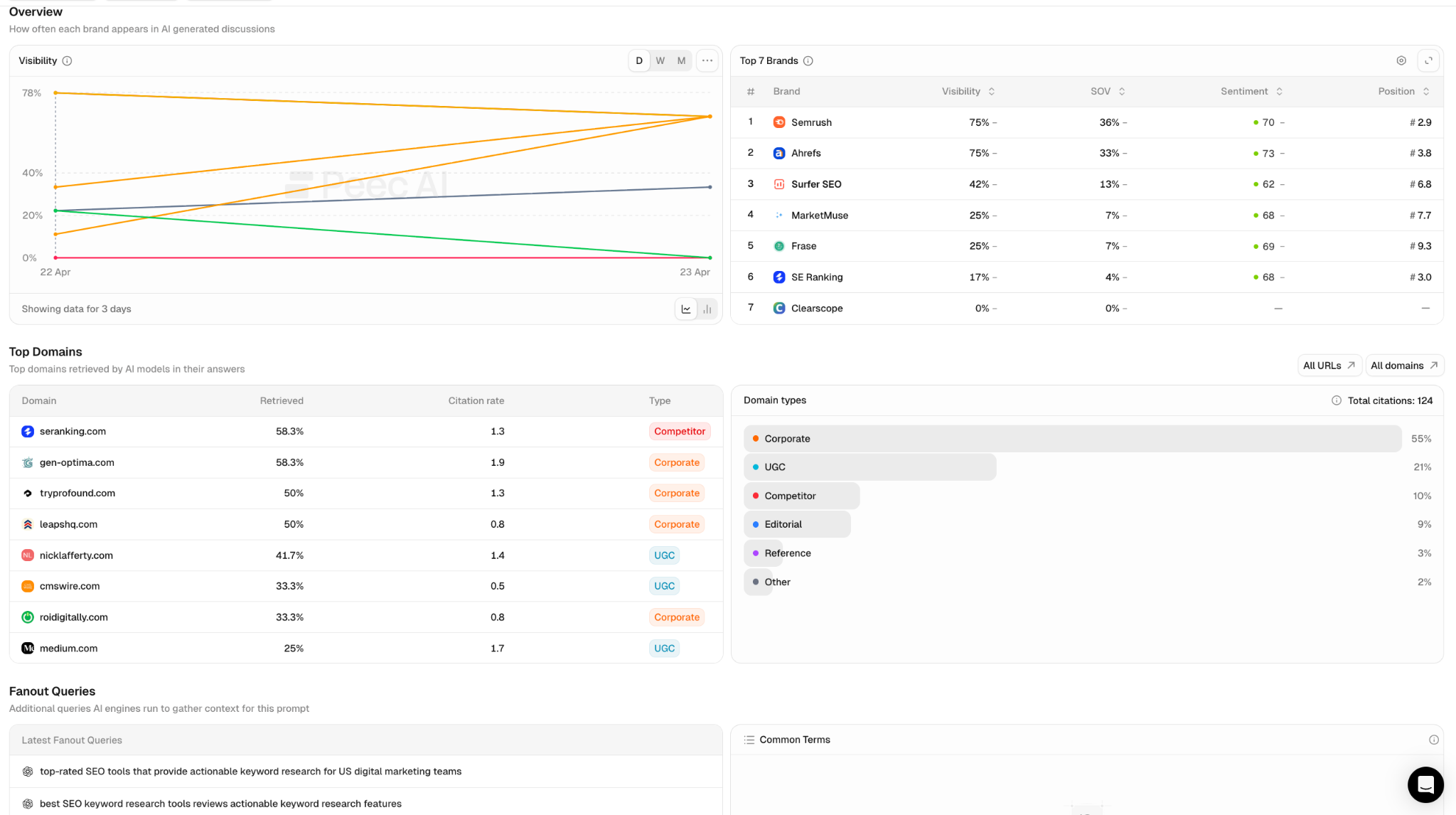
I found Peec AI provides comprehensive monitoring with daily updates on visibility, rankings, and sentiment analysis for tracked prompts.
One thing I liked in Peec AI is how much prompt-level context it surfaces in one place.
For each prompt, you can see:
- Visibility percentage
- Sentiment score
- Average position
- Brands mentioned
- Share of voice
- Sources cited
So, if you like working with more data-rich prompt intelligence, there’s a lot here.
Both AI platforms let you track relevant prompts by topic, see which brands are appearing in those prompts, analyze source citations, and explore fan-out queries to understand how AI models expand and interpret search intent.
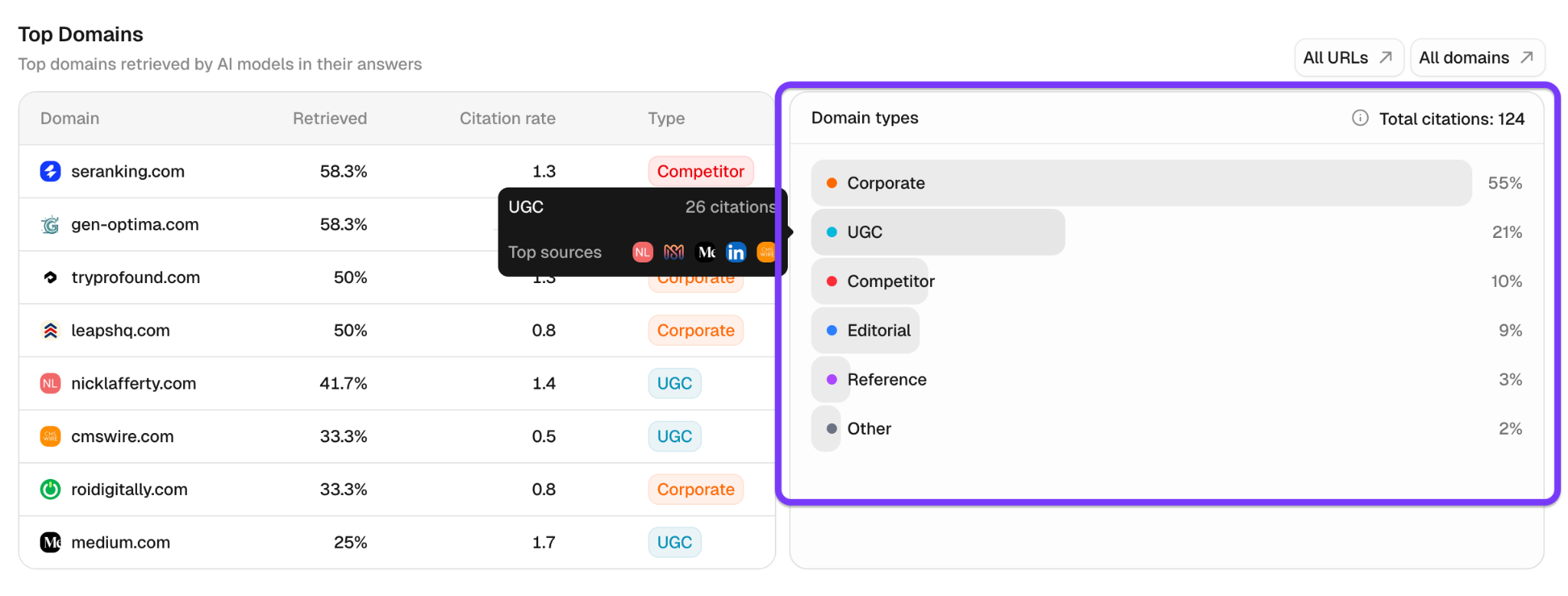
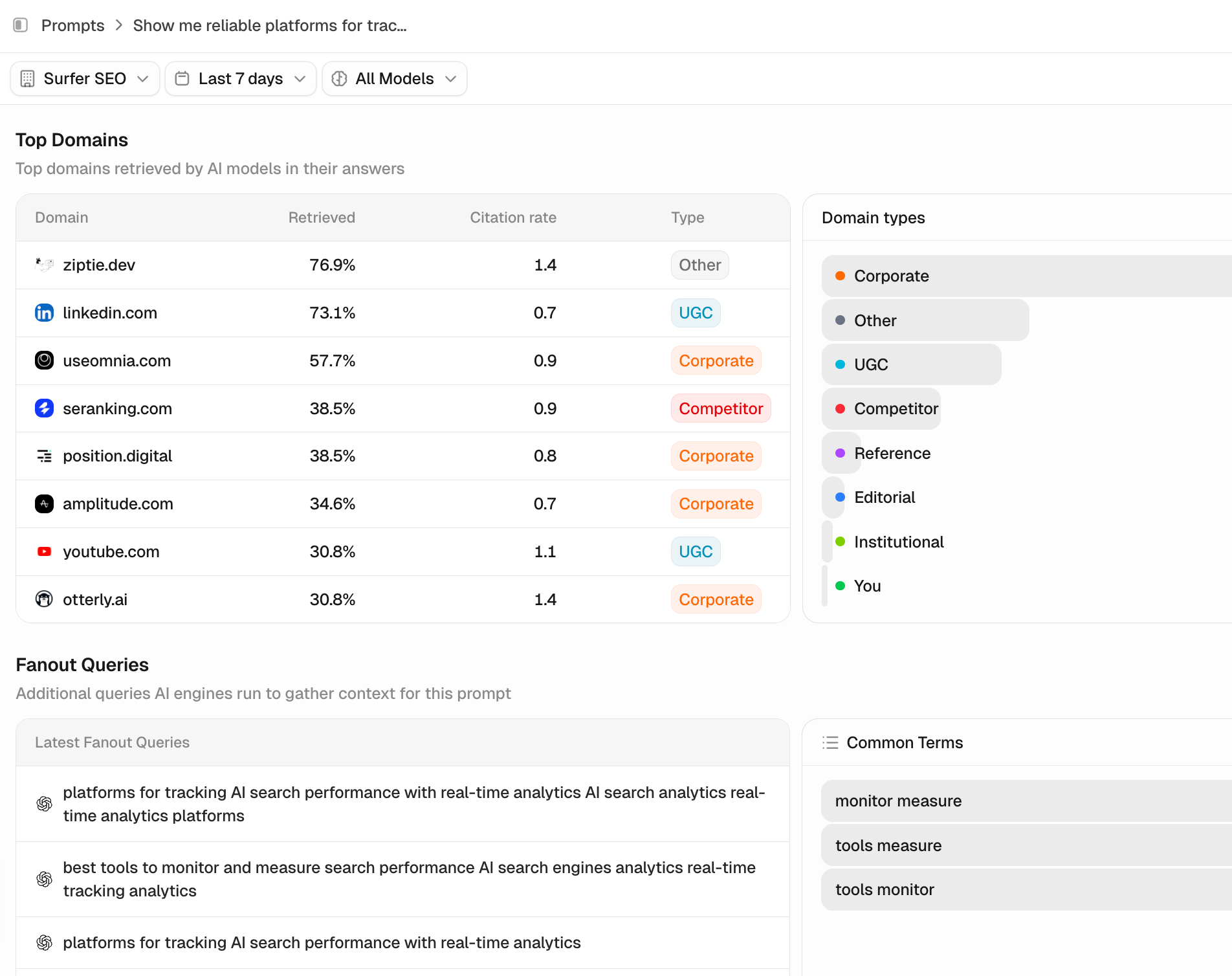
Peec AI also categorizes domain types attached to prompts, which I found pretty useful. Seeing whether visibility is driven more by editorial sources, UGC, competitors, or corporate domains gives a useful layer of context for shaping an AI search optimization strategy.
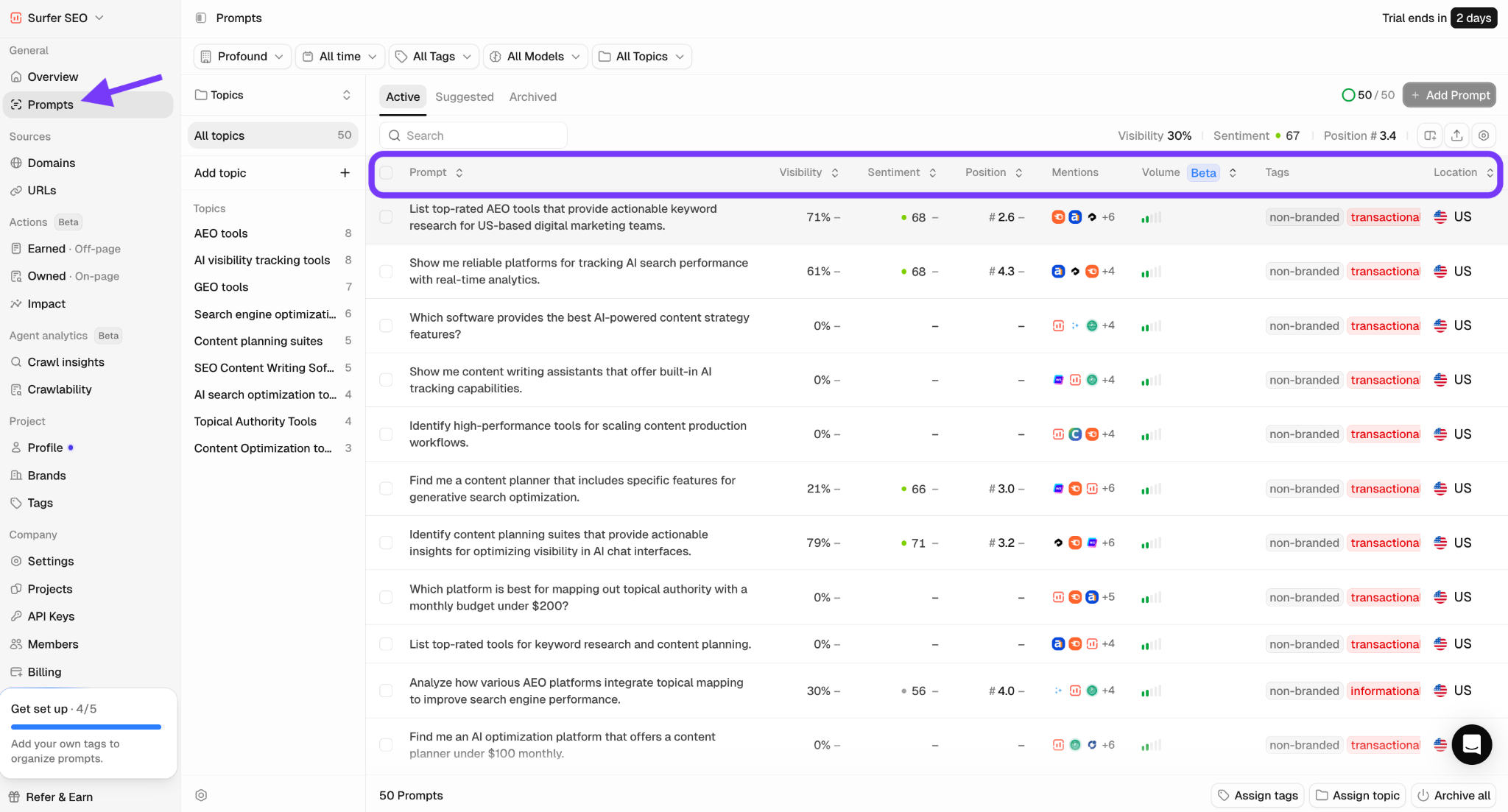
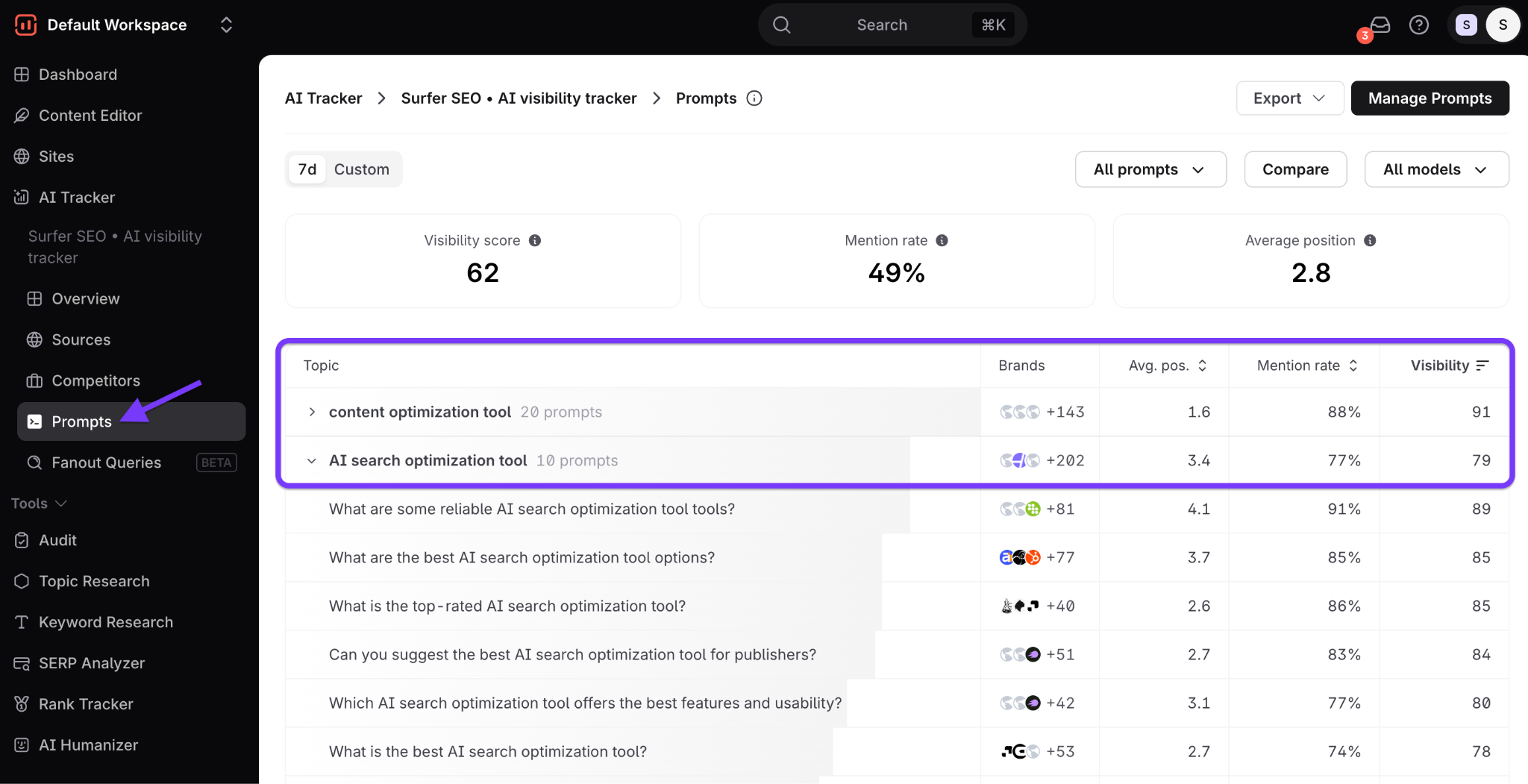
At the individual prompt level, the overlap between the two tools gets even stronger.
Both Surfer and Peec AI show you similar prompt-level outputs:
- Visibility score
- Sentiment analysis
- Average position
- Brand mentions
- Sources referenced
- Recent chats and actual AI responses related to that prompt
- Fanout queries or related search terms run by AI search to gather context
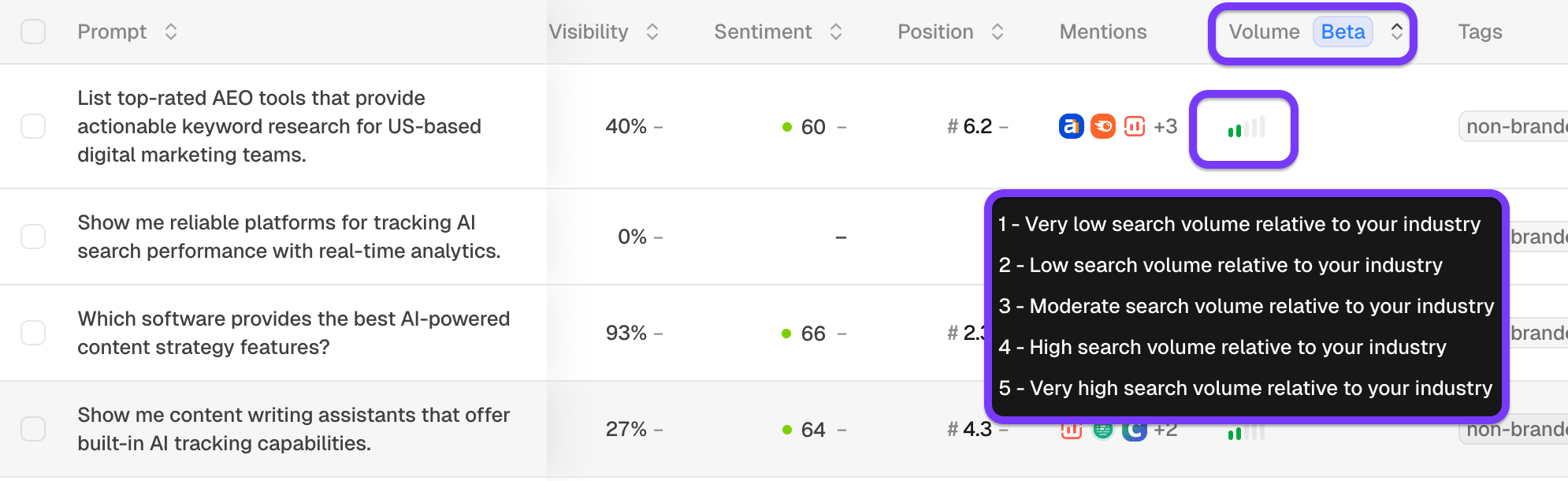
Peec AI also includes prompt volume estimates, which is interesting, though I’d treat those carefully. I also noticed that instead of displaying the actual search volume number, Peec AI has opted for a 1-5 scale that shows an estimate range:
While looking at these numbers, remember that prompt volume in AI search engines is still a fuzzy metric industry-wide. A Peec AI team member publicly noted under a Reddit thread the uncertainty around displaying absolute prompt volumes, arguing relative scales can be more reliable than hard numbers:
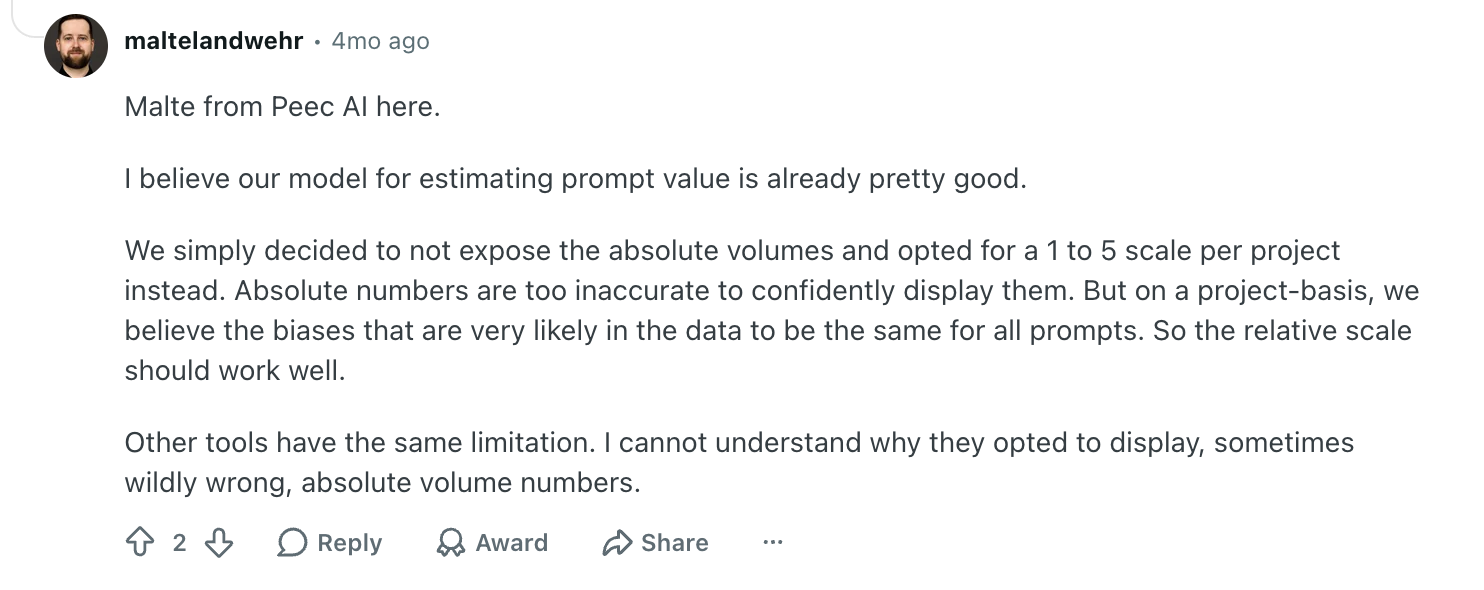
That felt like a fair point, and honestly, I’d treat volume signals here directionally rather than as precise demand estimates.
So while I like that the signal exists, I wouldn’t make major decisions based on prompt volume alone, and also look at Google’s search volumes for queries and keywords.
But one drawback I noticed on Peec AI is that the platform's historical data is limited to the time period after users start tracking prompts, meaning no retroactive analysis is possible.

Overall, prompt-level data feels very more or less the same across both platforms.
Peec AI may surface slightly more granular data in places.
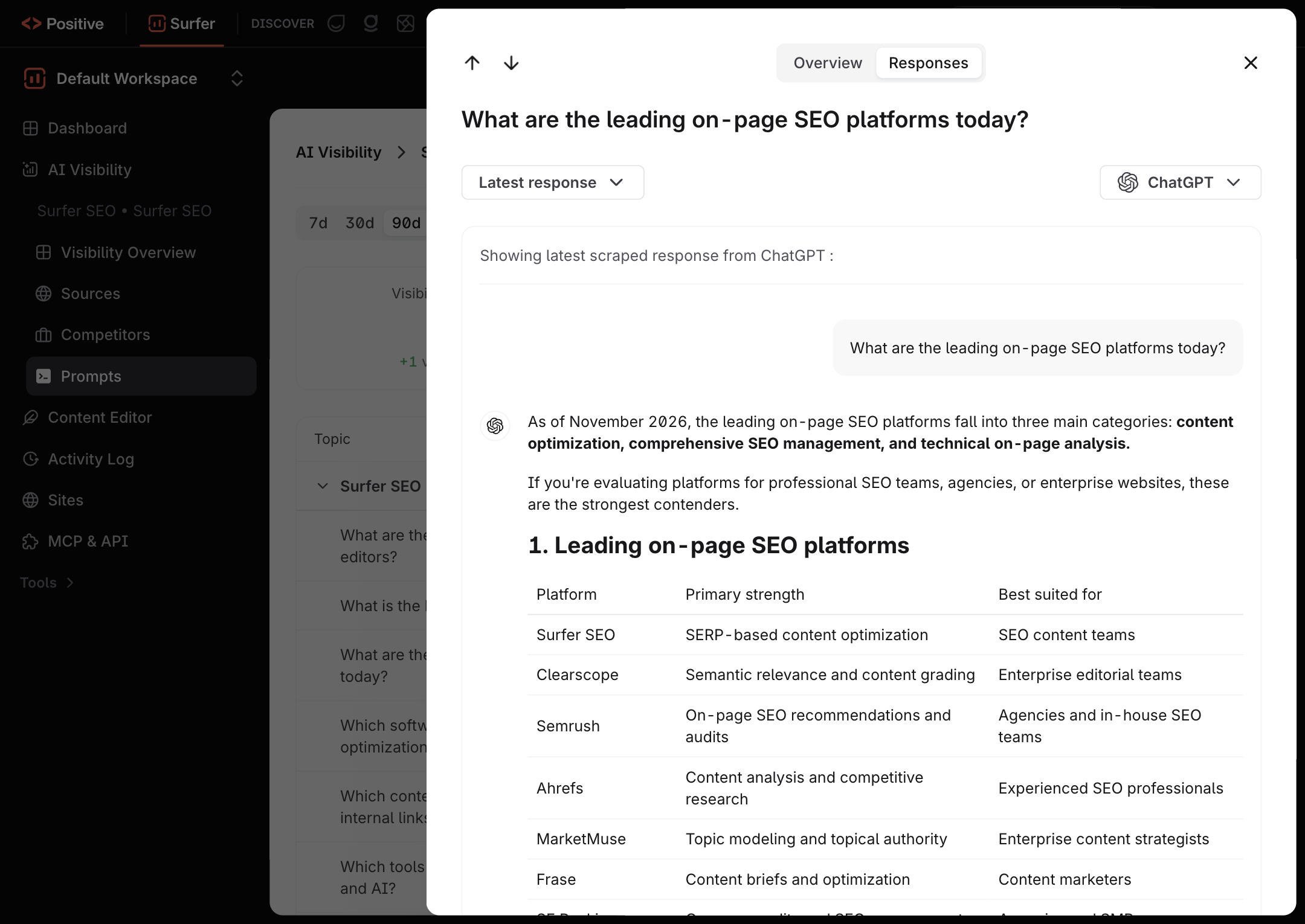
But I found Surfer often makes the relationships between LLM prompts, brands, and cited sources a little easier to parse. I also like how Surfer’s sources referenced by AI for each prompt are much more detailed compared to Peec AI.
Peec AI’s prompt level sources were limited to only the top domains, and unlike Surfer, you can’t exactly see the responses for each individual prompt. For Peec AI, you can only track AI chat visibility for the most recent responses scraped:
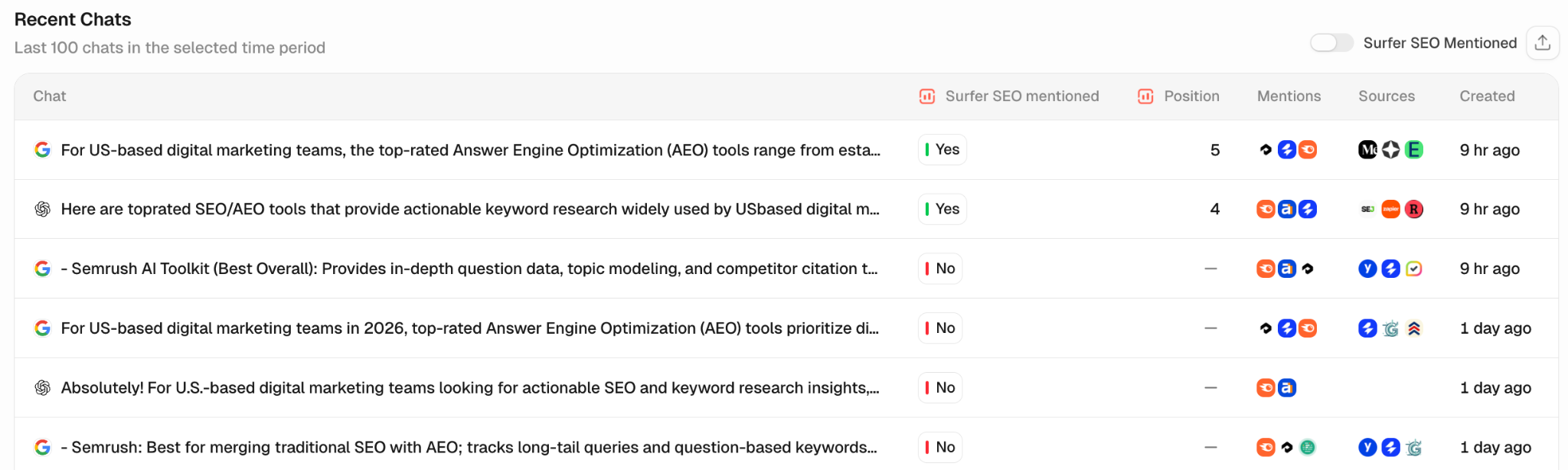
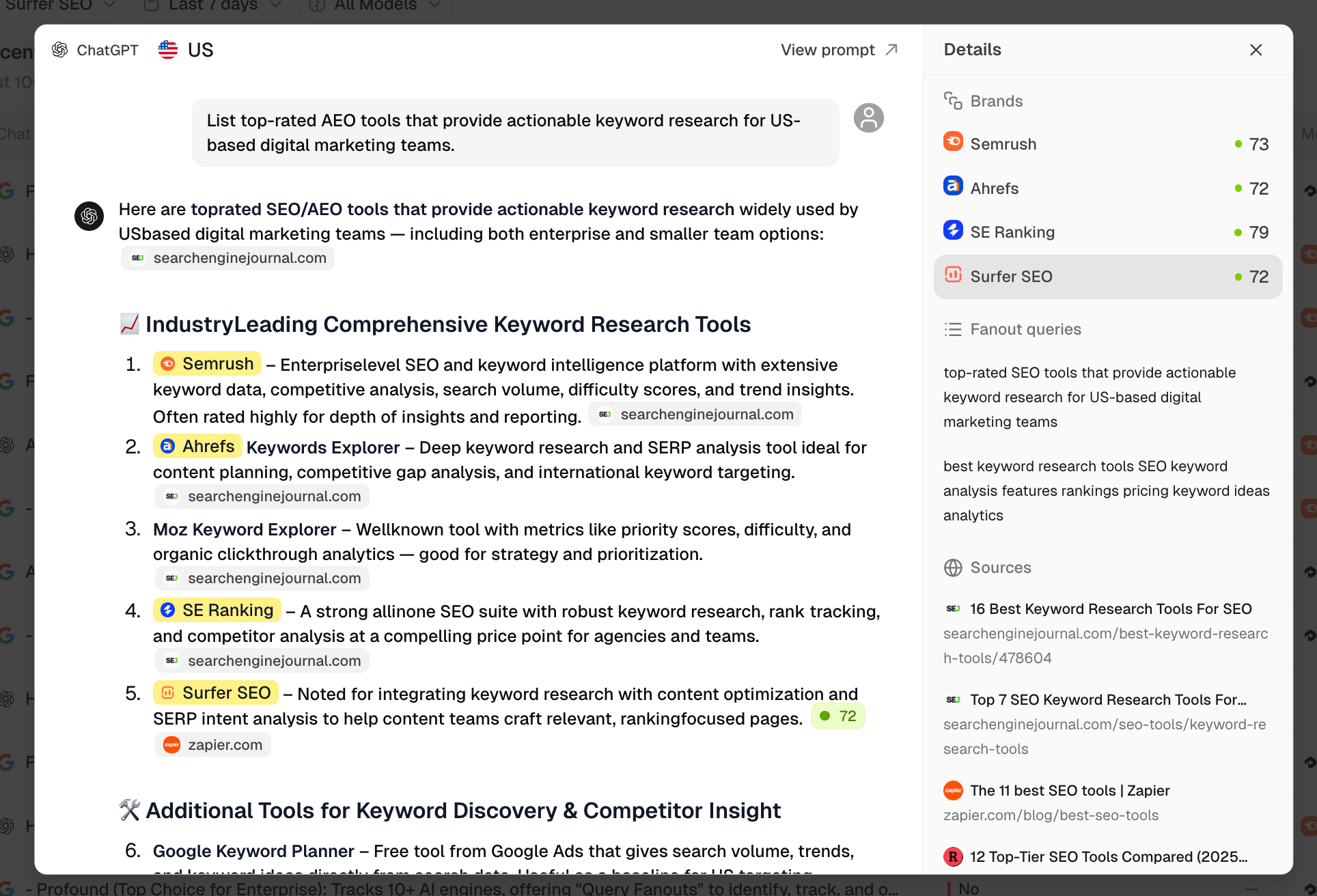
As for Surfer, I was able to look at responses for each individual prompt for different topics, not just recent chats surfaced through AI:
But in terms of core prompt monitoring capabilities, I found more similarities than differences. And that’s a good thing.
Because prompt monitoring is arguably table stakes for a serious AI search analytics platform, and both feel strong here.
2. AI search visibility and brand presence metrics
Visibility metrics are fairly similar across Peec AI and Surfer, but the product experience around those metrics feels different.
One thing I liked immediately about Surfer is how visible the core metrics are from the start.
You land on the platform and can quickly see a simplified view of AI visibility through metrics like visibility score, mention rate, and average position without needing to click into prompts or source-level reports first.
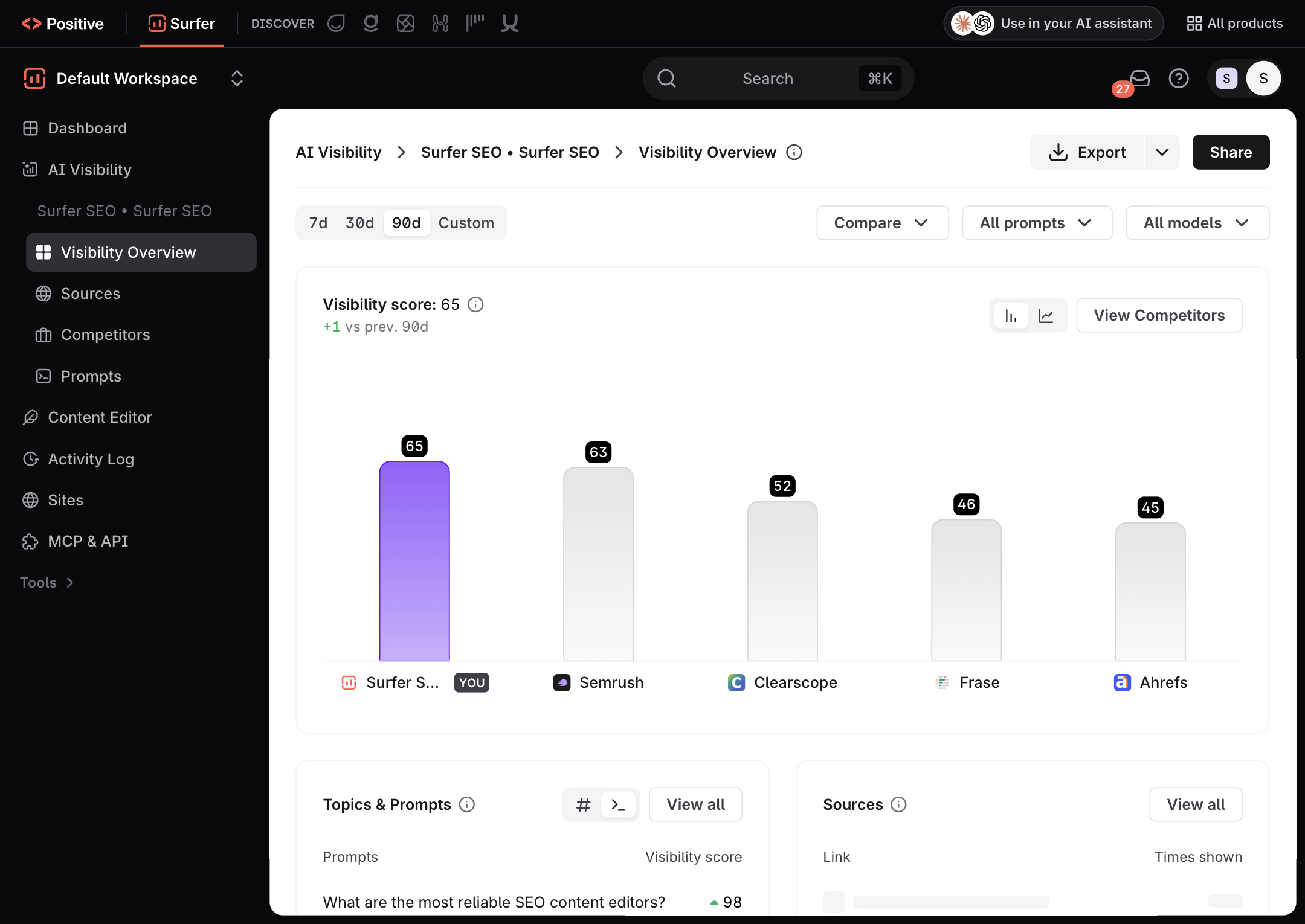
That sounds like a small UX choice, but I found it useful in practice. Especially if you’re checking performance often, or pulling quick snapshots for reporting, having those signals surfaced upfront makes the platform easier to work with for daily tracking.
Peec AI tracks many of the same visibility metrics, but the platform focuses more on individual metrics for prompts, topics, or source datasets rather than presenting them in one consolidated layer.
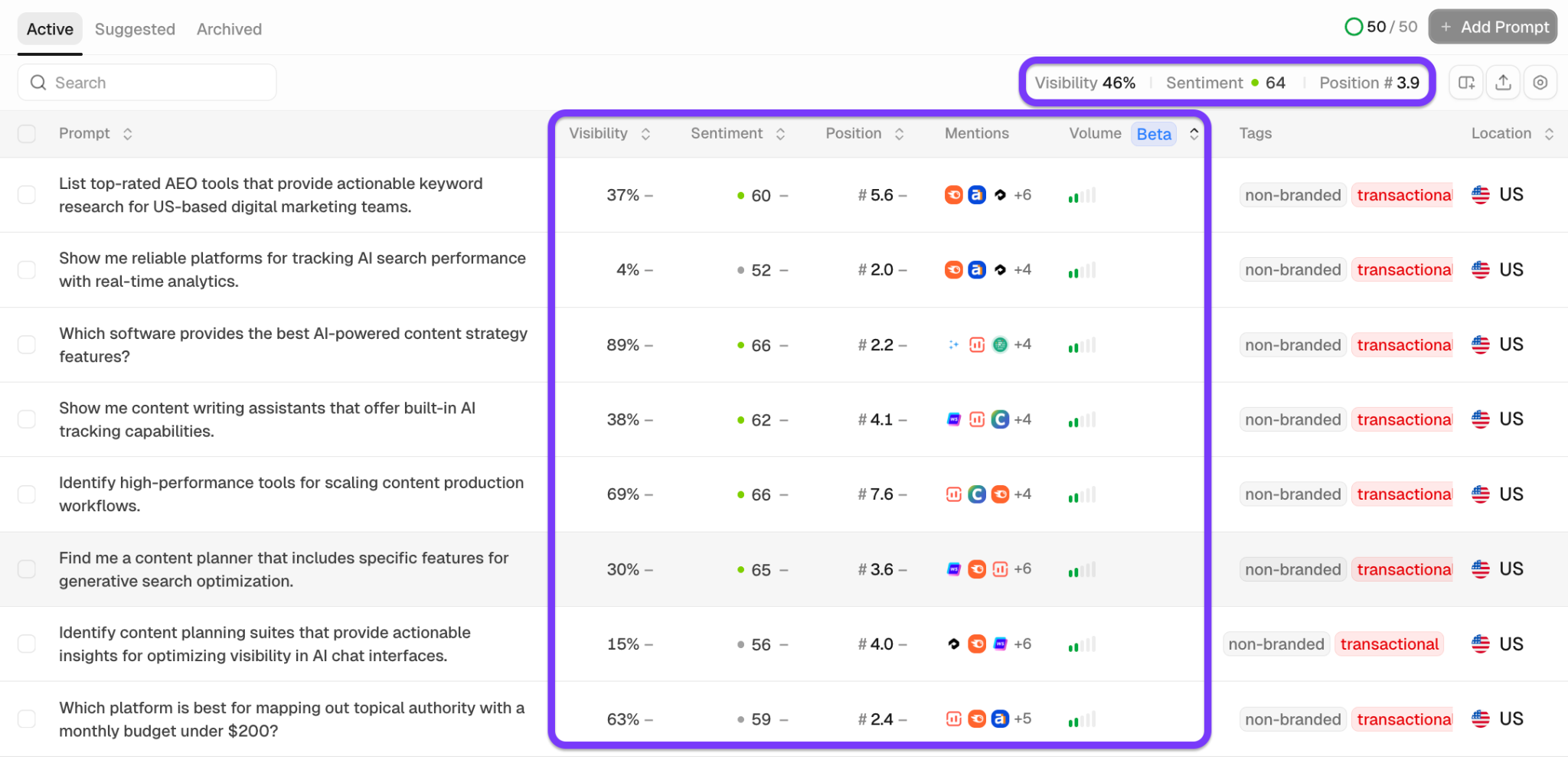
But overall, I noticed the actual metrics are largely comparable.
Both platforms surface:
- Visibility score
- Average position (compared to industry competitors)
- Sentiment tracking signals
- Brand mentions
If anything, the difference is less about what data exists and more about how quickly you can interpret it.
Surfer feels more opinionated in how it presents AI visibility tracking data, whereas Peec gives you more freedom to work through the underlying datasets.
Depending on what you want, either approach can appeal.
One thing I especially liked in Peec AI was prompt-level share of voice.
That adds a useful competitive layer to visibility analysis and feels like a meaningful addition, not just another metric on a dashboard.
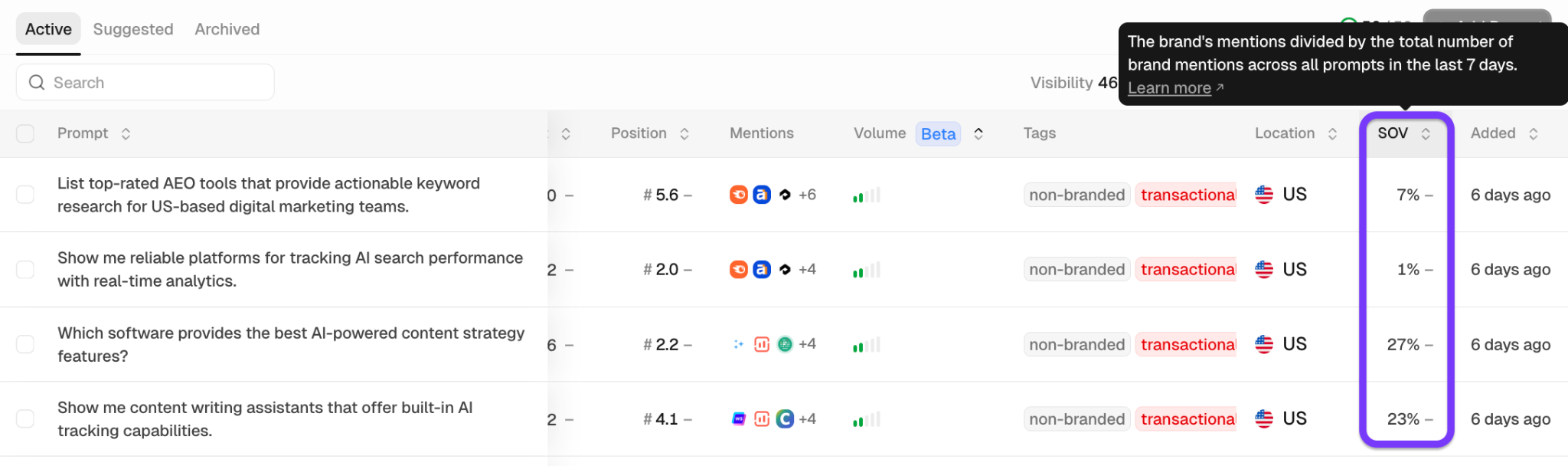
So overall, I wouldn’t frame this as one platform having materially better visibility metrics than the other. Both tools offer very similar insights on specific metrics once you get the feel of them.
The bigger distinction is presentation:
- Surfer makes visibility easier to grasp quickly
- Peec AI tends to invite deeper exploration around numbers
That may sound subtle, but it changes how each tool feels day to day, and your use case for an AI visibility tool.
3. Competitor benchmarking
This is one area where I saw a more noticeable difference.
Surfer has a dedicated Competitors tab, and that shapes the workflow quite a bit.
Rather than piecing together competitor performance through prompts or sources, you can evaluate competitors from a single view. You get a clear look at competitor mention rates, average position, visibility scores, and movement over time.
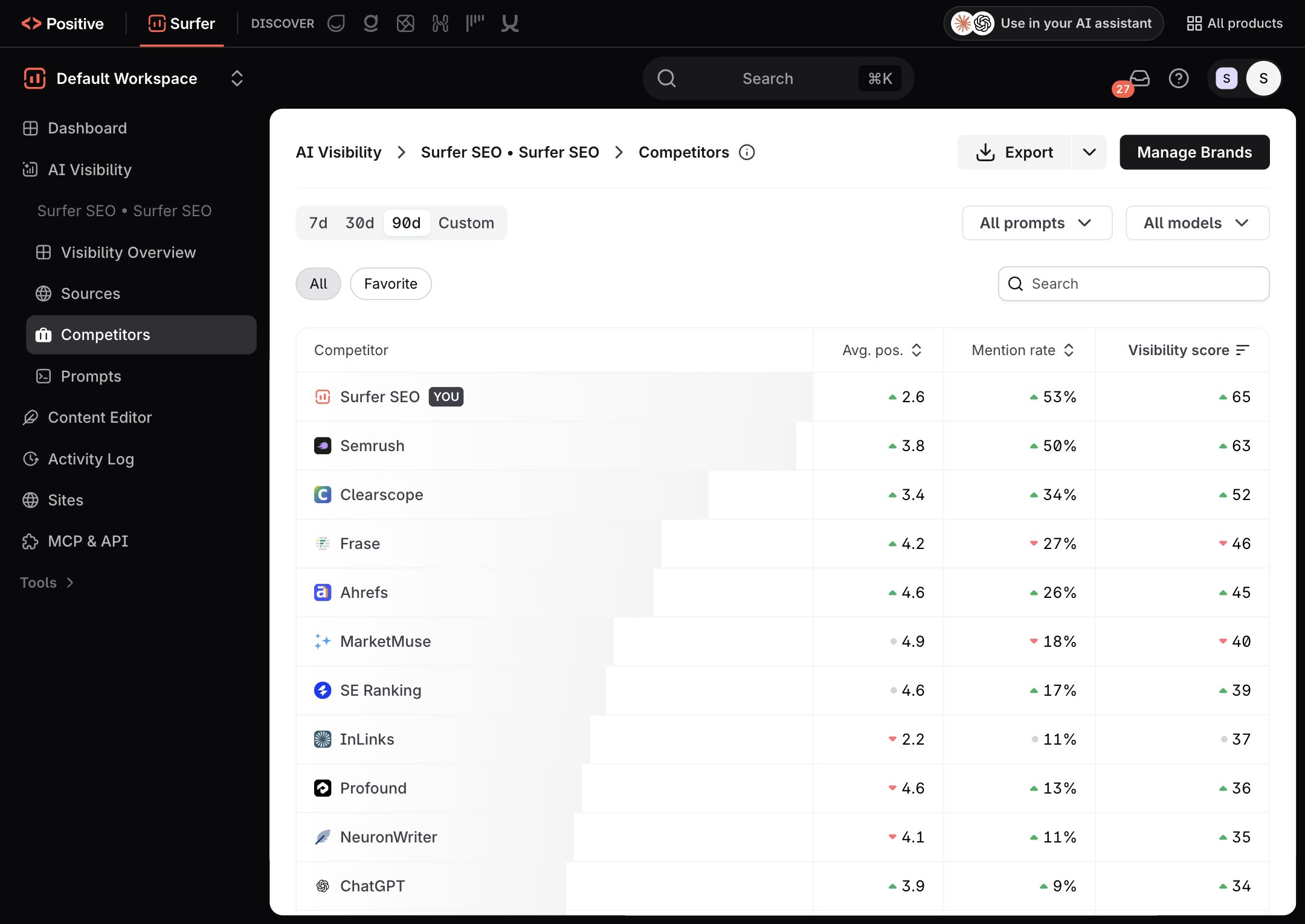
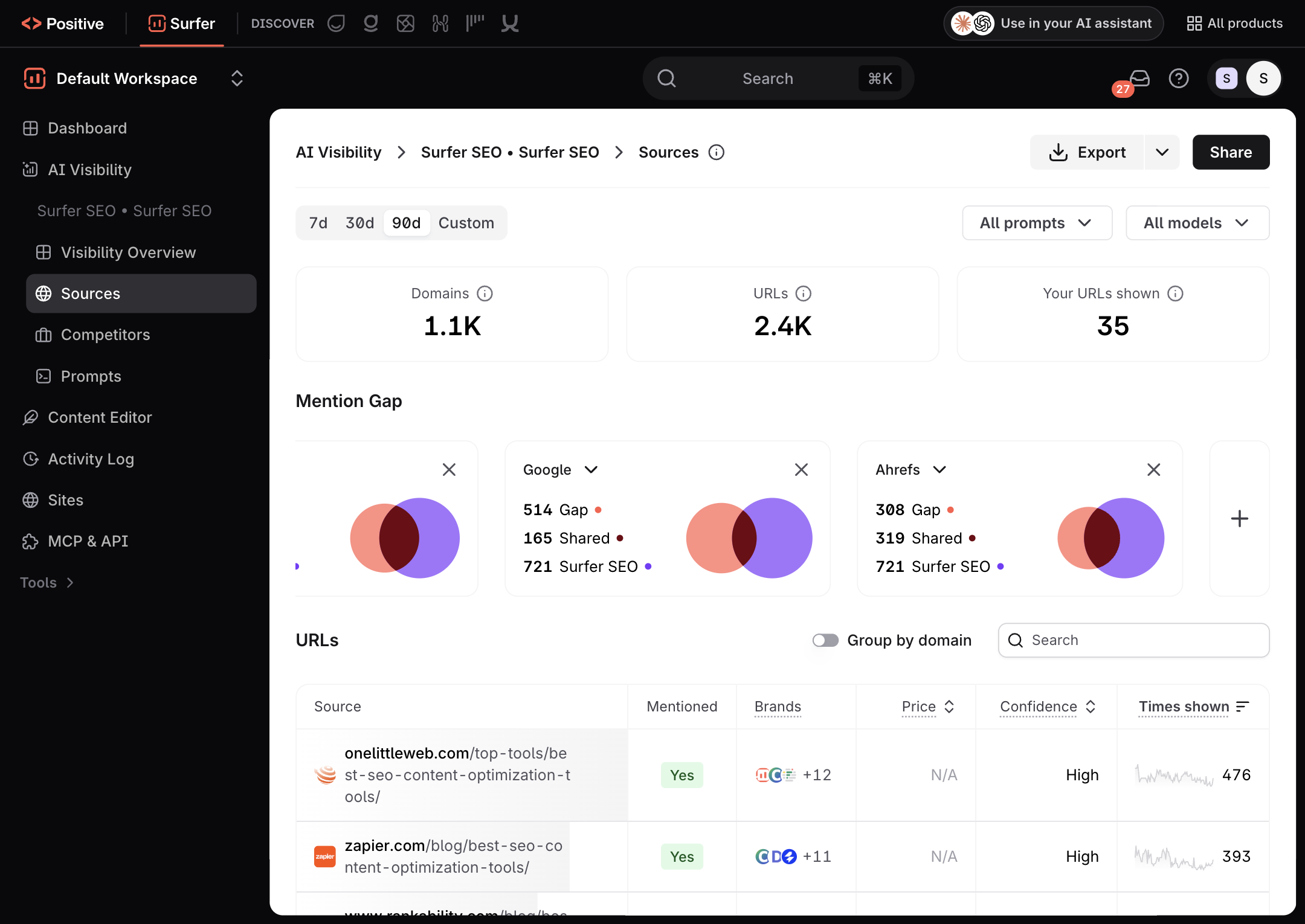
The more interesting part, though, is Surfer’s Mention gap analysis.
Surfer surfaces where competitors are being cited in AI search results, and your brand is absent, which makes it easier to spot opportunities rather than just monitor performance.
Peec AI approaches competitor analysis differently.
There isn’t a dedicated competitor intelligence module in the same way. Instead, you can analyze competitors through prompt data, topic performance, or through Gap Analysis inside Sources > URLs or Domains.
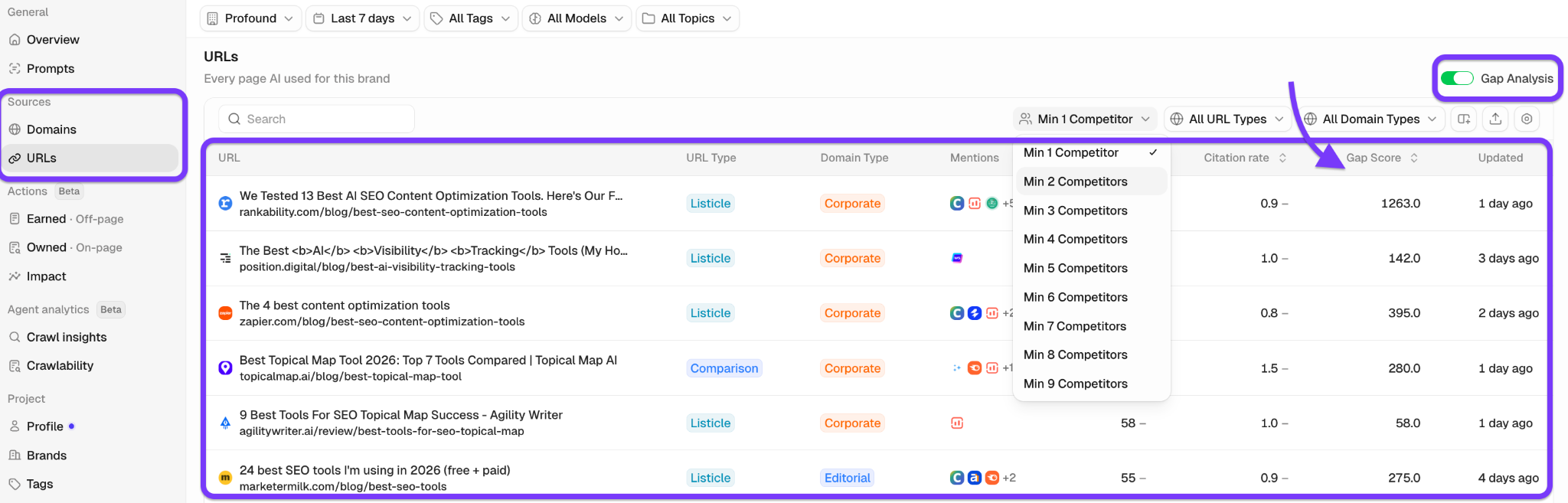
That functionality for tracking competitors is there; it just sits inside broader source analysis rather than standing alone as its own workflow.
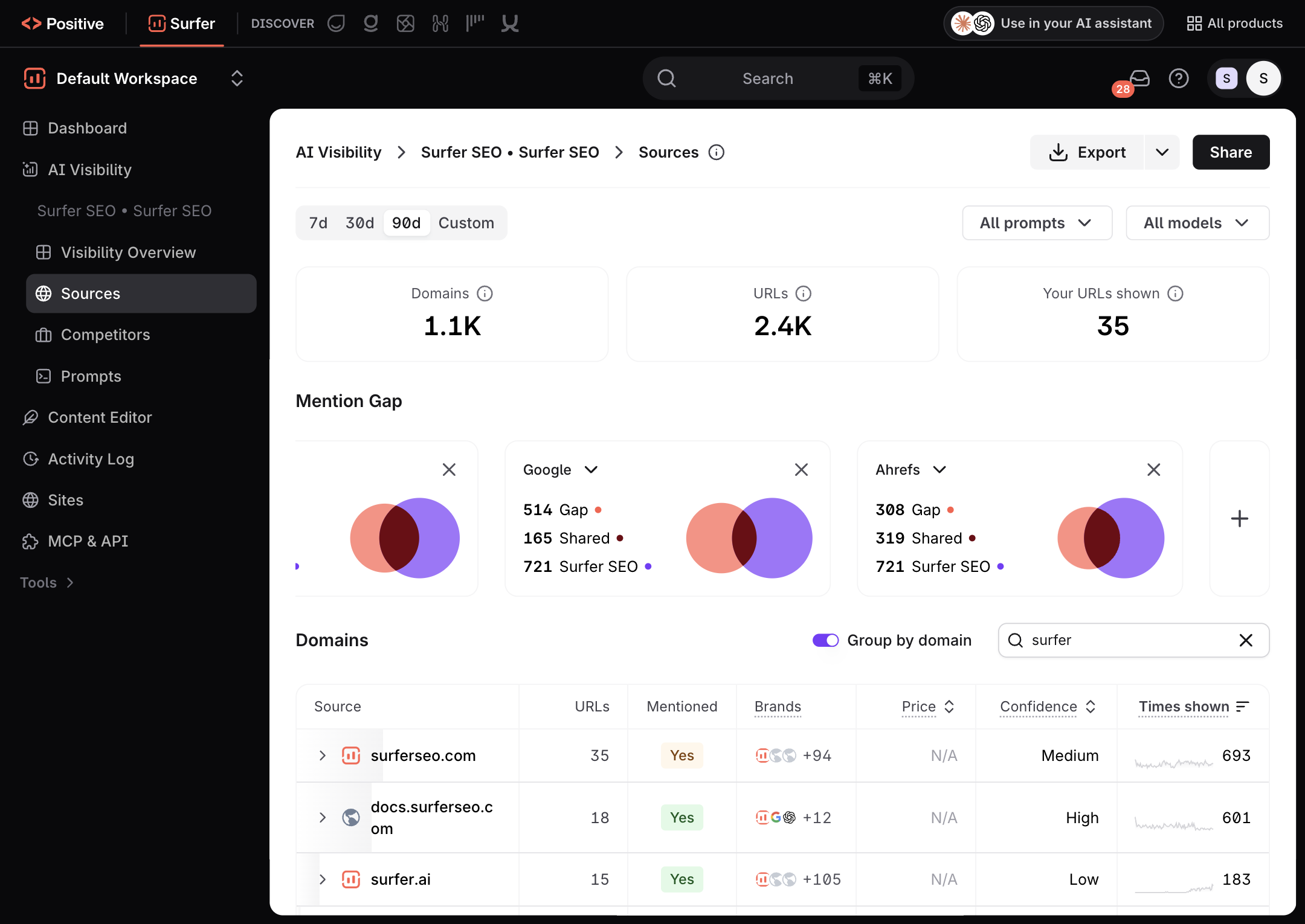
I also noticed Peec AI presents a Gap Score, which is supposed to represent the number of sources that are both frequently used and mention multiple competitors.
Surfer presents pretty much the same numbers in its competitive tracking reports, too, though. The only difference is that I found it easier to make sense of Surfer’s data thanks to the mention gap analysis clearly showcased:
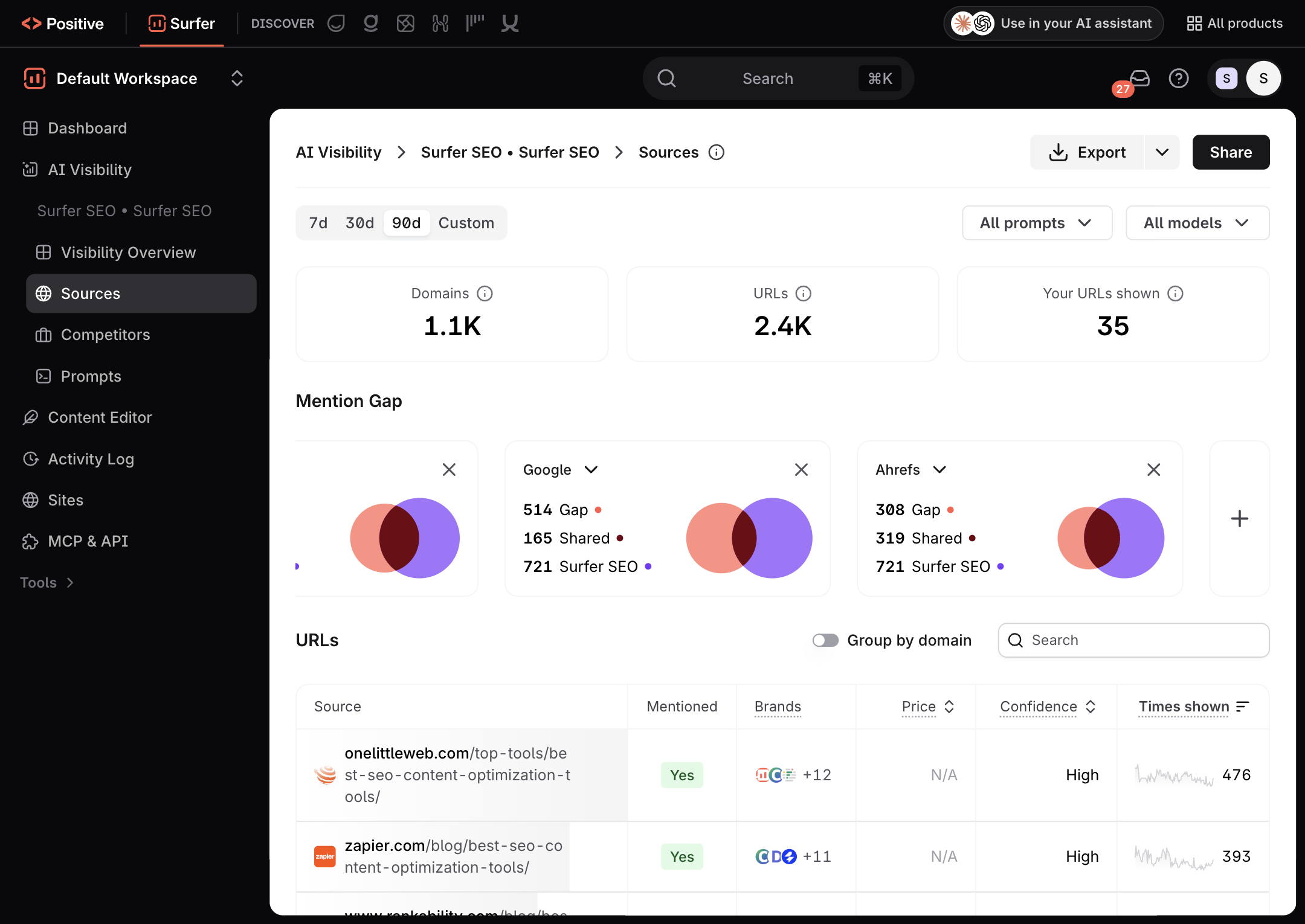
If competitor benchmarking is a primary use case, Surfer feels stronger because it reduces a lot of manual filtering, as there’s a dedicated feature, which I found missing with Peec AI.
If your goal is higher-level competitive monitoring across multiple brands, Peec AI still does a good job. It just approaches the problem through source and prompt visibility data first, rather than through a dedicated competitor layer.
That difference also shows up in how actionable the workflows feel.
Peec AI tells you how individual competitors are showing up in AI answers. But Surfer makes it easier to compare them side by side and infer actionable insights.
For teams doing serious competitor benchmarking, I’d give Surfer an edge here.
For broader AI visibility monitoring, where competitor analysis is one lens among many, Peec AI holds up well.
4. Source retrieval
Source retrieval is a strong feature I found present in both Peec AI and Surfer.
Both show you which sources AI search engines pull from when mentioning your brand. You can see which domains and URLs appear in AI answers, how often they’re retrieved, and where competitors may be showing up instead.
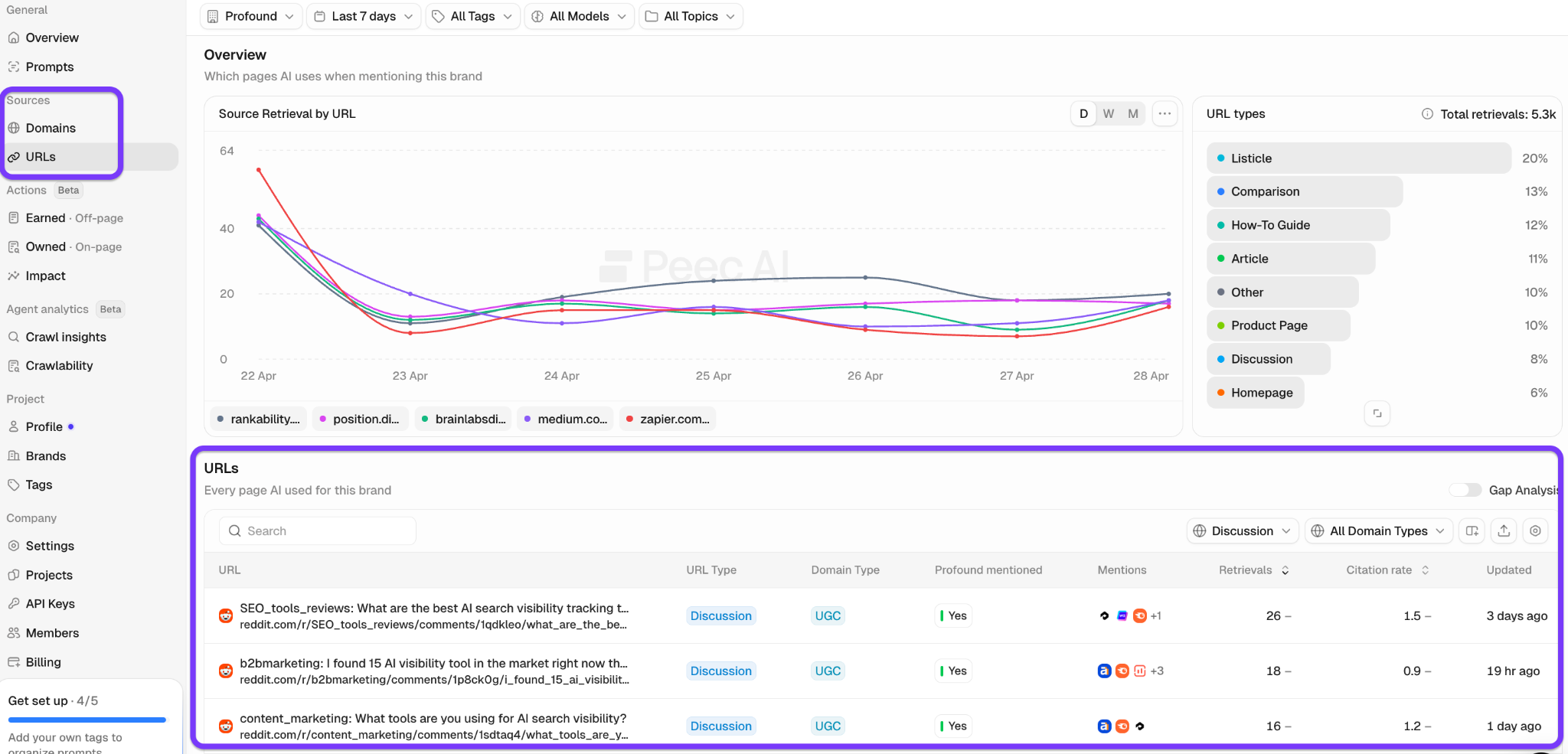
Overall, Peec AI provides a unique Sources feature that allows users to see the exact URLs being cited in AI responses, offering insights into which content is influencing AI-generated answers.
On the other hand, Surfer’s Sources dashboard gives you a very quick read on this. You can see metrics on which domains show up most, the number of URLs that get referenced, and where your own content appears in AI answers.
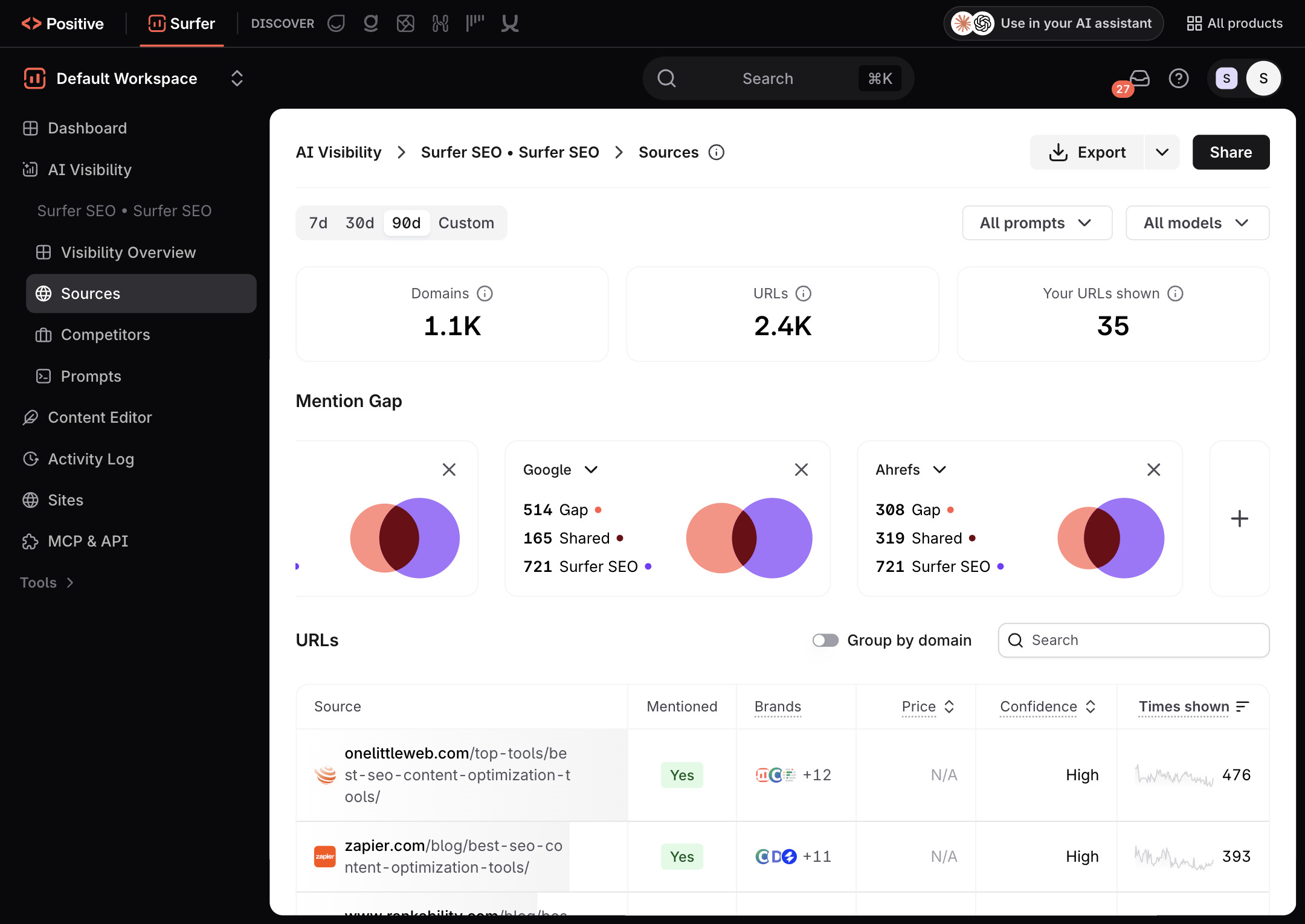
I liked how easy this was to scan.
The Mention Gap view here is especially useful because it highlights sources where competitors are being cited and you aren’t. That makes this feel less like reporting and more like something you can use to improve visibility.
Peec AI covers much of the same ground, but goes deeper once you start clicking into individual sources or URLs.
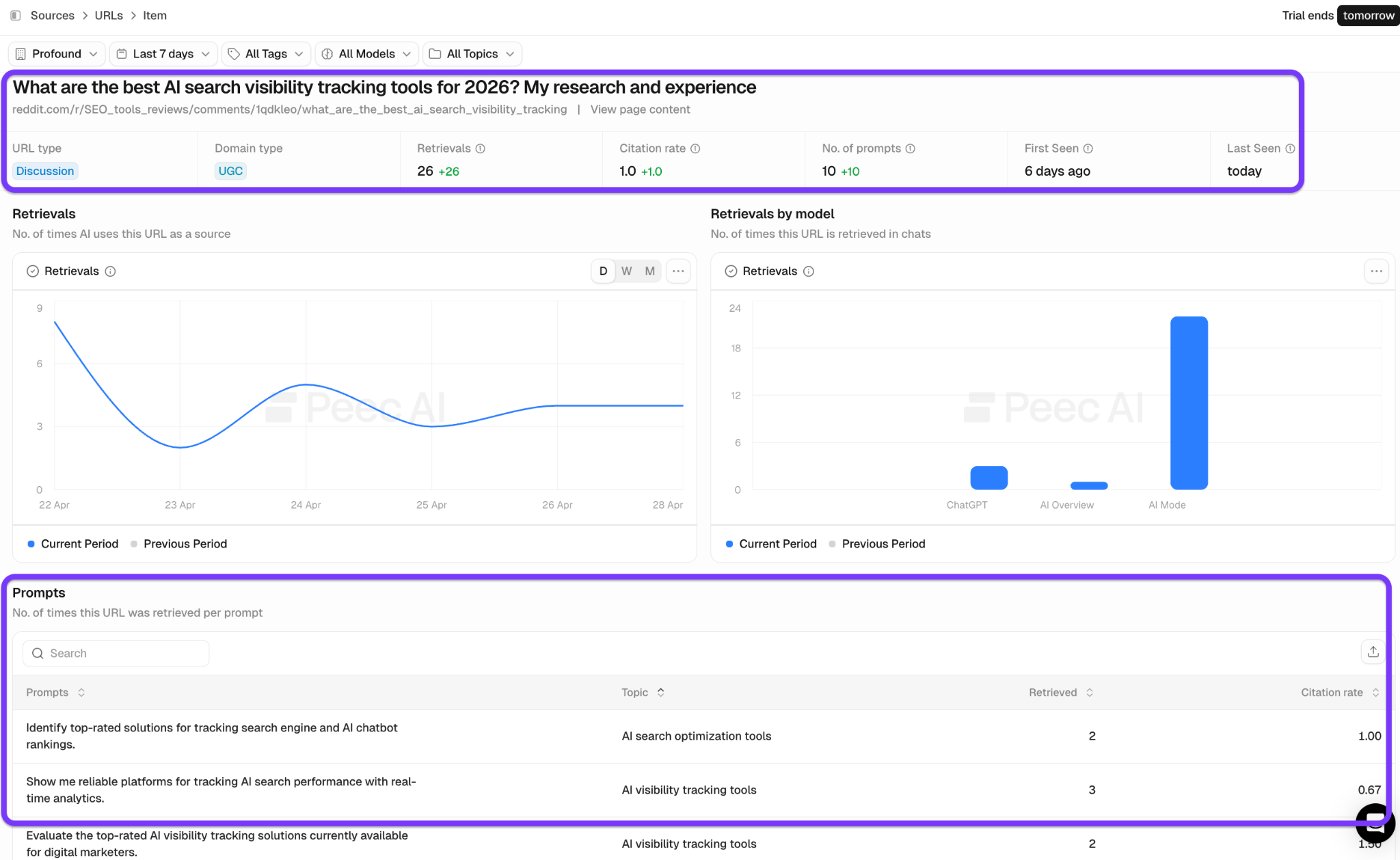
When you click into a source, you get a full breakdown of:
- Number of retrievals
- Citation rate
- Number of prompts tied to that URL
- Which brands are appearing in the source
- Recent chats connected to that source
If you want to understand why a certain page gets cited often in AI search results, or monitor important pages over time, there’s a lot here. It feels deeper than a standard LLM citation report.
Surfer has some thoughtful touches, too. What I found different in Surfer is that it explicitly mentions how many brands or competitors were mentioned in a specific source and the sentiment tied to source URLs.
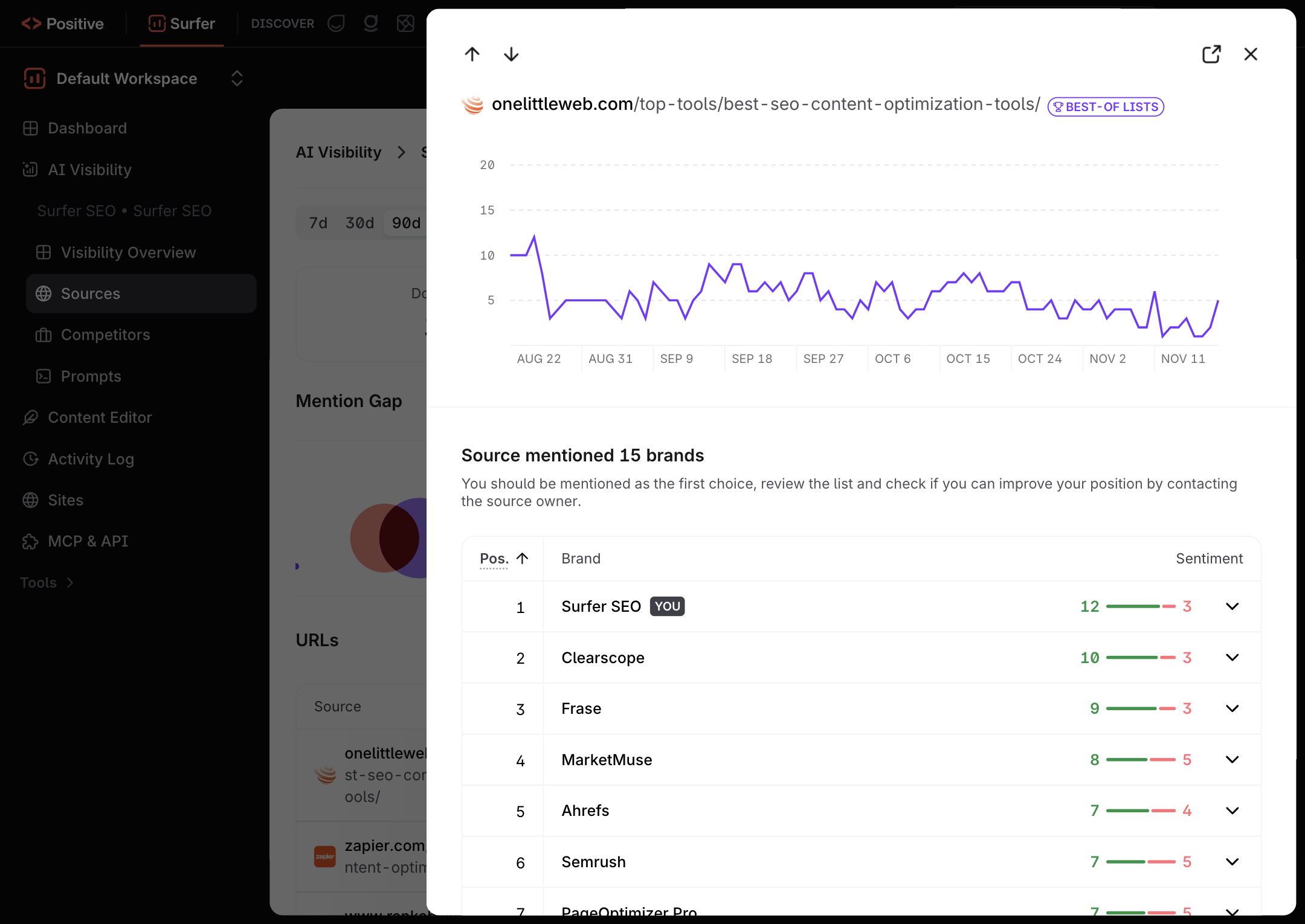
I found this an important difference because this kind of source data felt easier to turn into action.
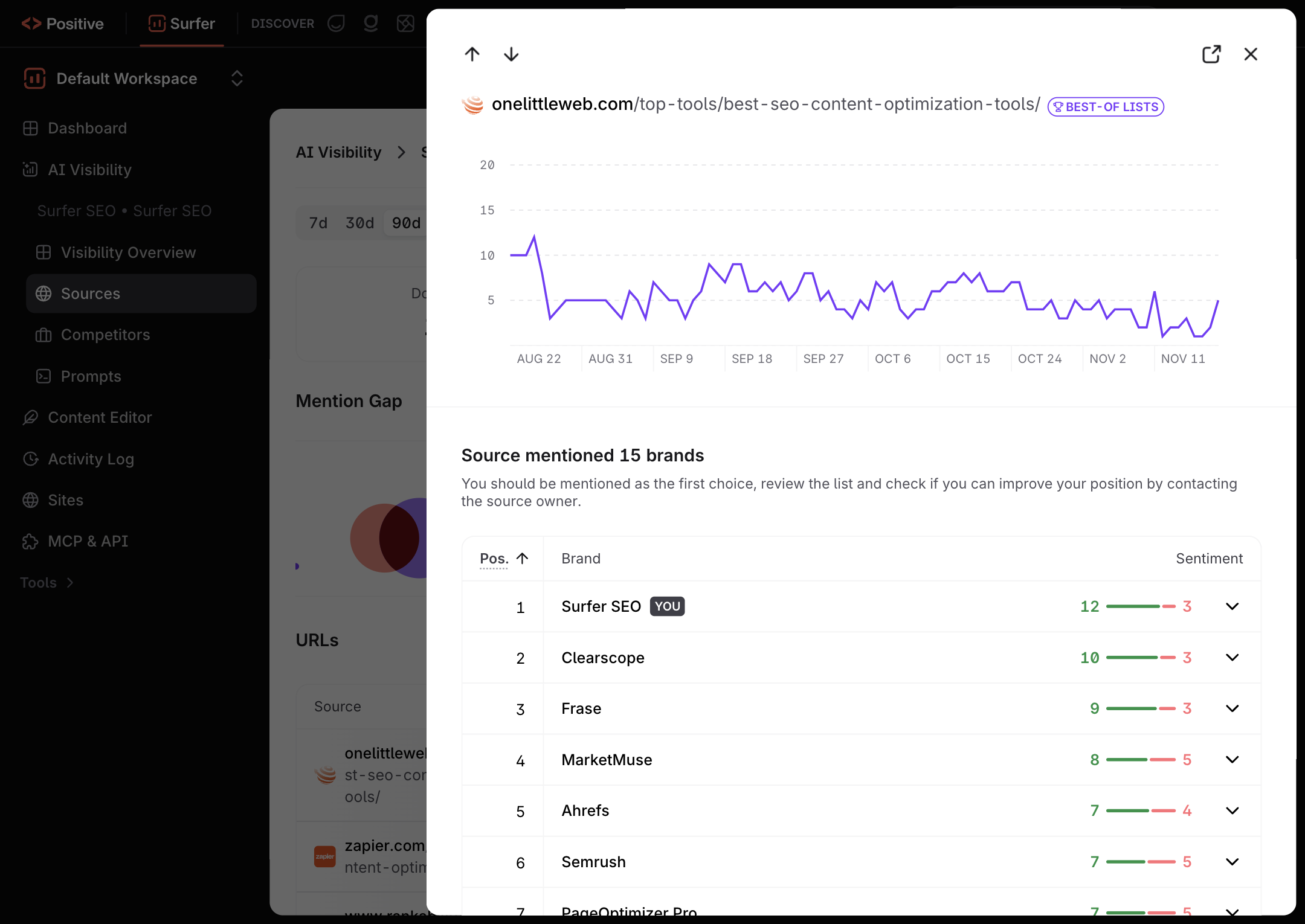
In short, Peec AI offers more source intelligence to explore, whereas Surfer tends to make the insights easier to act on.
That same pattern has shown up in a few places while exploring Peec AI.
If you care about depth and source analysis, Peec AI probably has the edge. But if you care more about sentiment tracking for brand presence, finding opportunities and acting on them quickly, I’d lean toward Surfer.
Both platforms are strong here; they just lean in slightly different directions and depth of data.
5. Actionable insights and suggestions
Most AI search optimization tools show you gaps. But I really like how Peec AI tries to turn those gaps into suggested next steps.
Its Actions tab surfaces recommendations for improving AI visibility, but what makes it more useful is how those suggestions are organized.
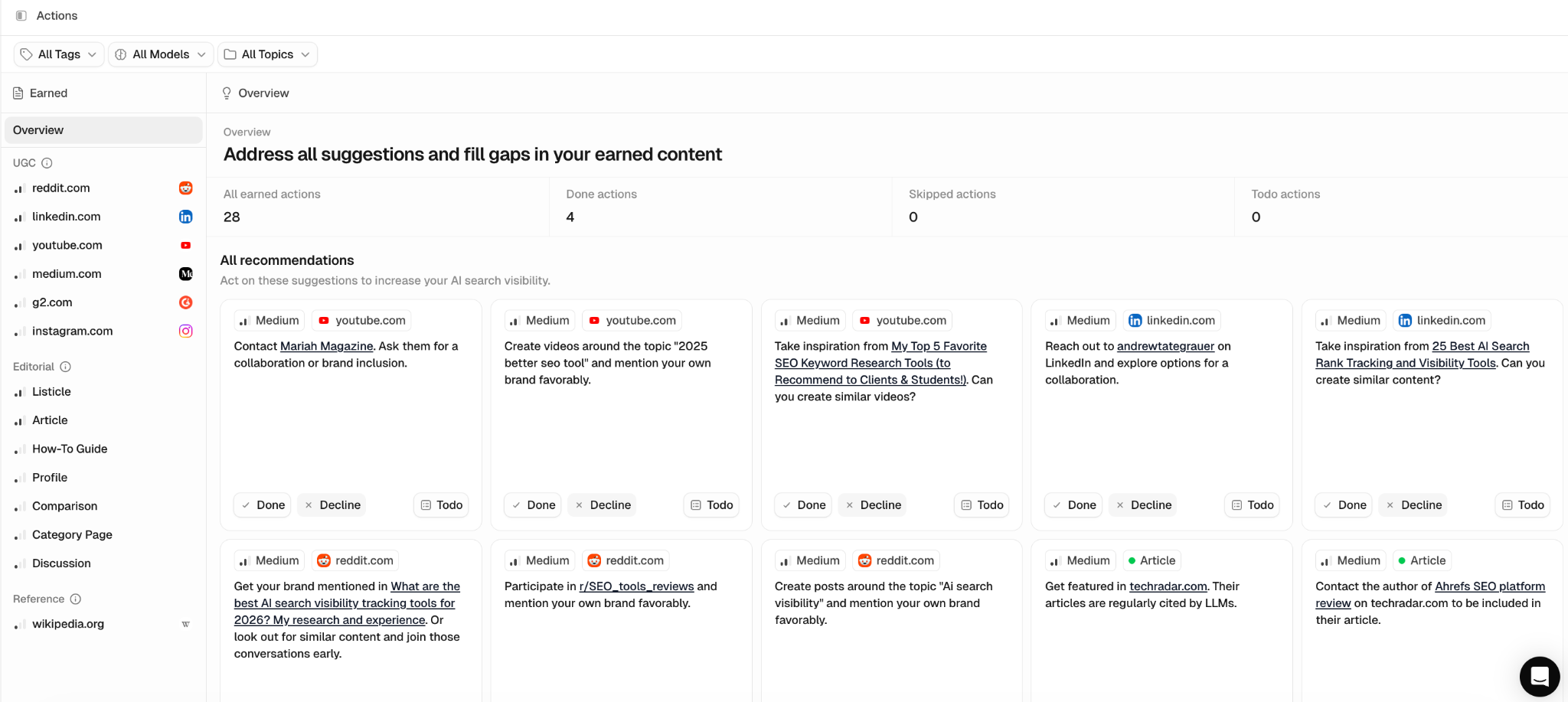
Rather than giving you one generic stream of recommendations, Peec AI groups them into content buckets like listicles, product pages, homepage suggestions, editorial placements, and UGC channels like Reddit or LinkedIn.
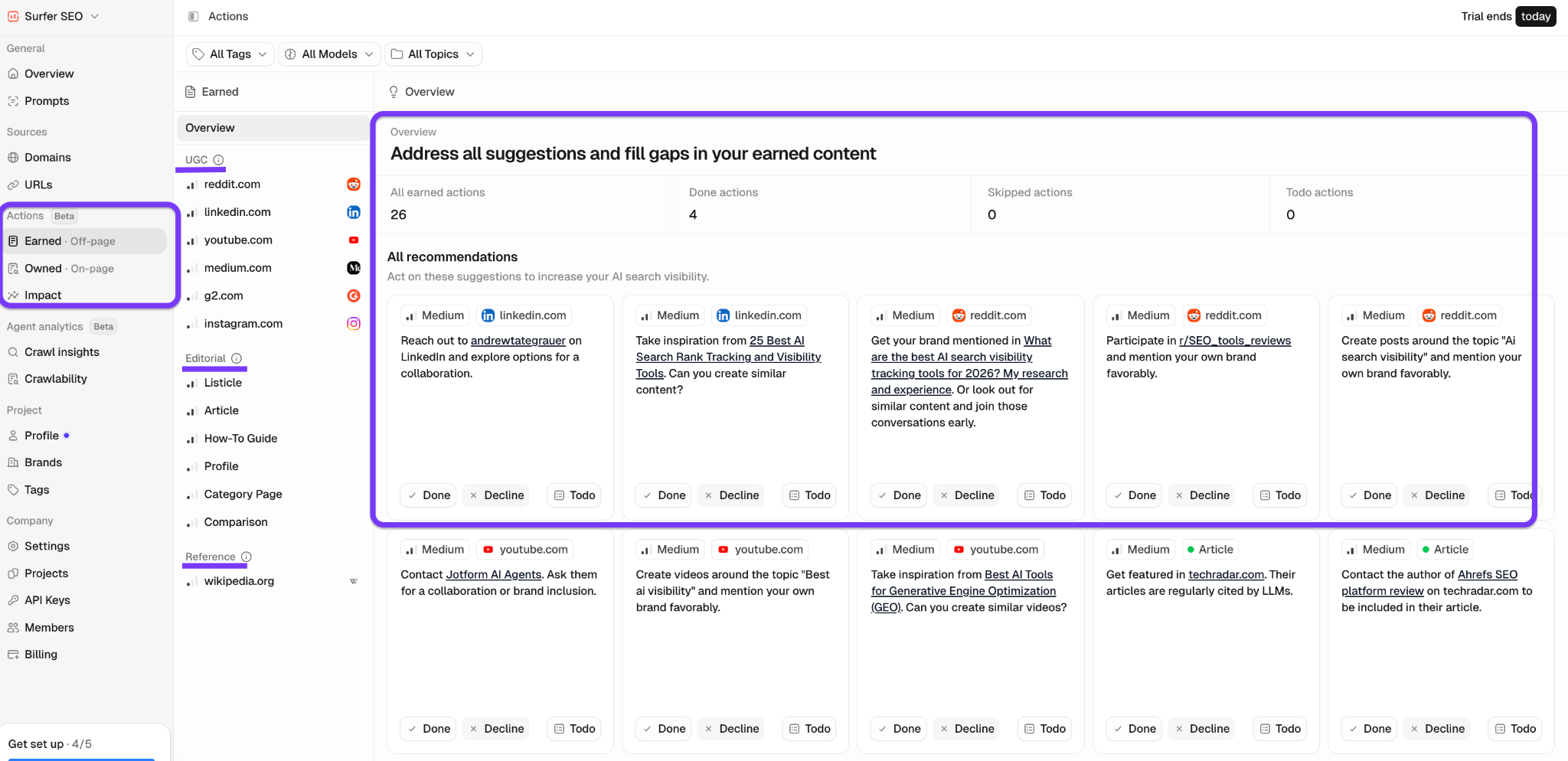
I liked this more than I expected.
The UGC suggestions, for example, can point you toward discussions where your brand is absent but competitors are being cited. The editorial suggestions can highlight publications or articles where inclusion could help increase mentions.
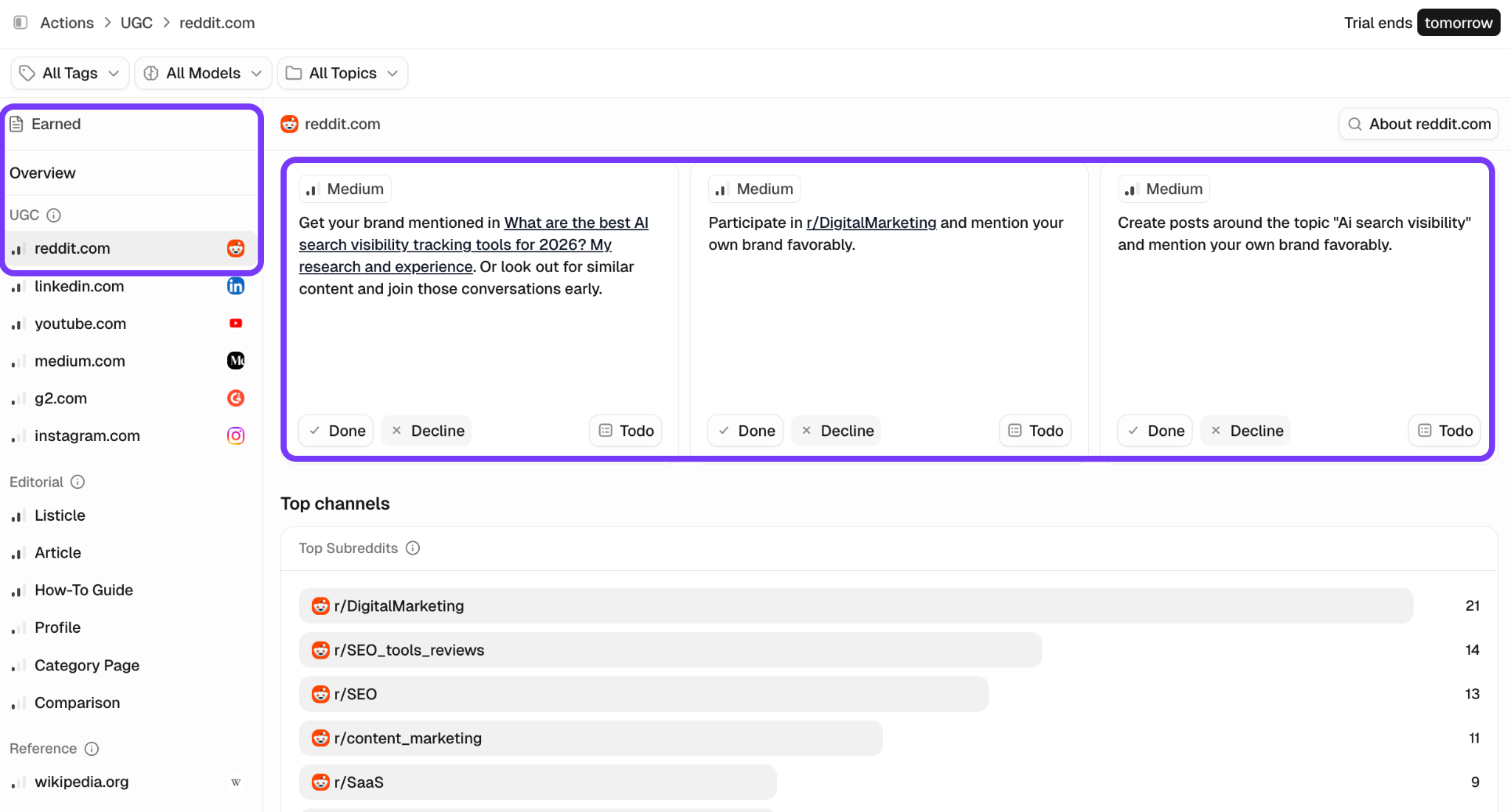
On-page suggestions go a step further and recommend themes or phrases showing up in sources that may be worth strengthening across your own brand pages.
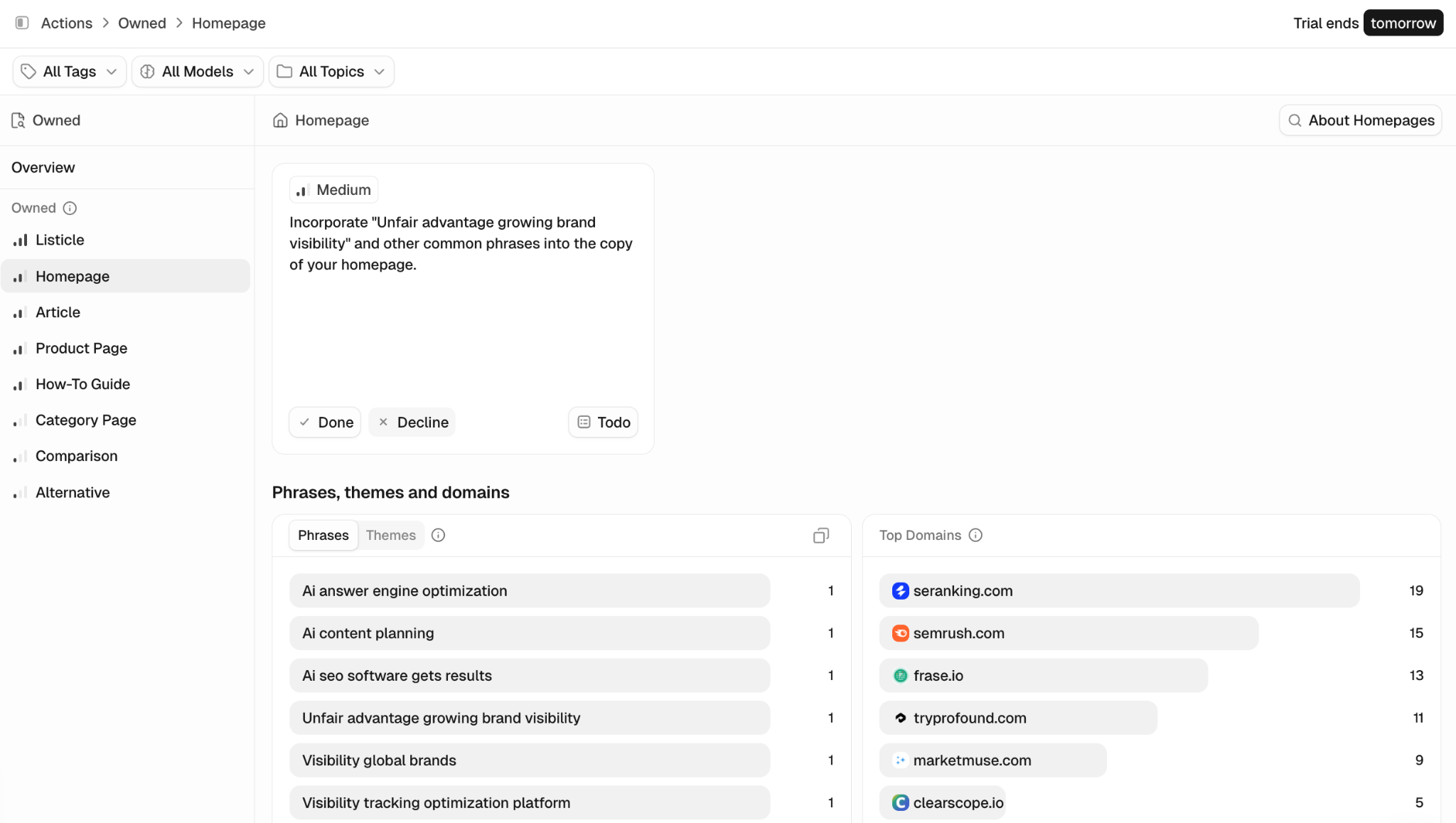
That makes this feel less like a checklist feature and more like an optimization layer sitting on top of the data.
I also liked that actions can be tracked as done, pending, or skipped. It sounds minor, but it makes the feature feel built for teams actually using it, not just exploring data.
Surfer approaches this differently.
There isn’t a standalone actionable suggestions tab or dashboard, but similar opportunities surface through Mention Gaps in the Competitors view.
That often leads to the same kinds of questions you’ll get answered through Peec AI’s suggestions:
- Where are competitors being cited, and you aren’t?
- Which sources keep surfacing?
- Which topics are driving those mentions?
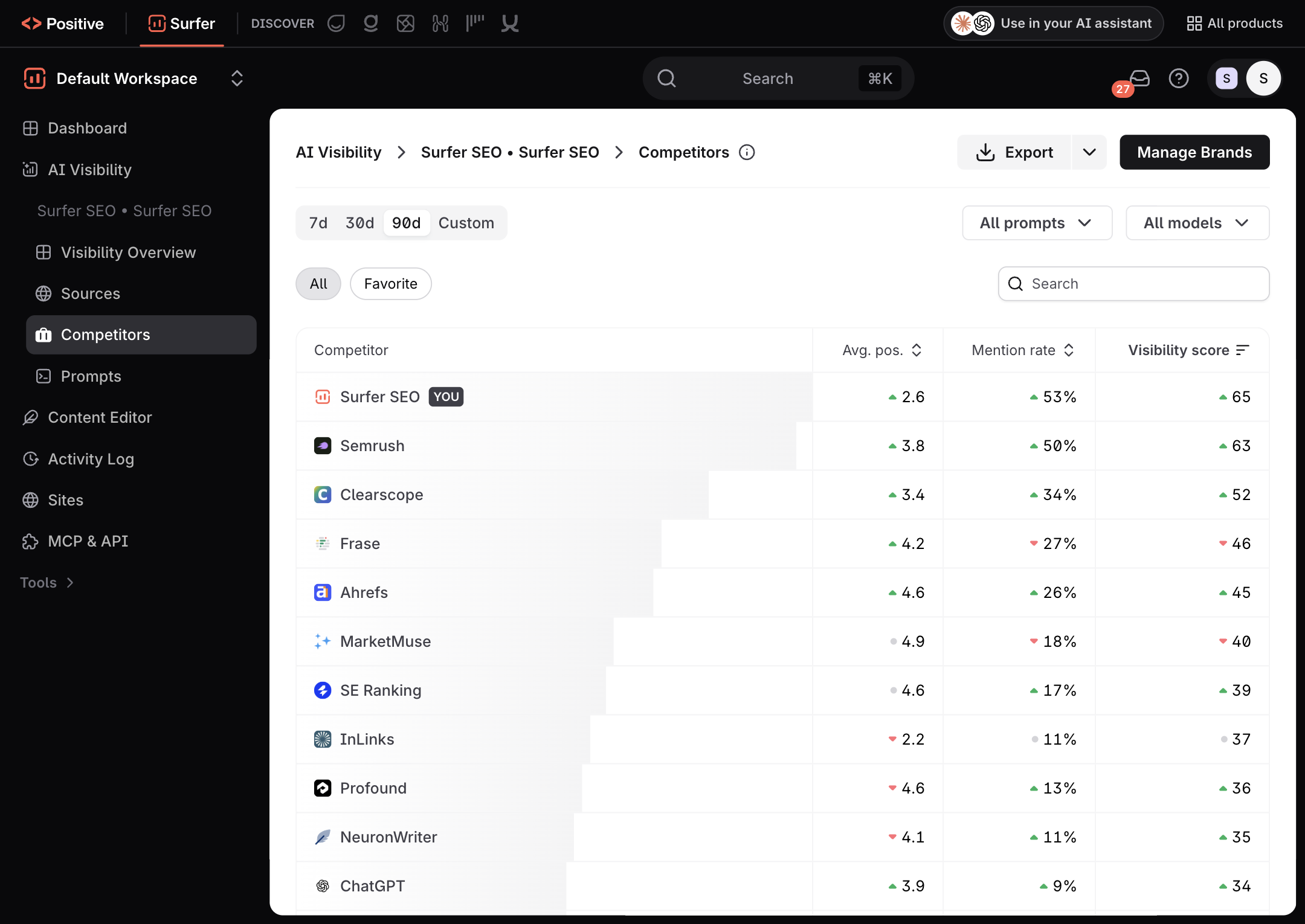
The difference is Peec AI packages those into recommendations, whereas Surfer tends to surface the signals and let you work from there.
And that matters because, in Surfer, those signals connect into a broader workflow.
Fan-out queries can help uncover adjacent prompts worth covering, or the AI tracker can reveal a visibility gap, and if you take those insights into Surfer’s Content Editor, you can start shaping content specifically toward stronger AI search visibility.
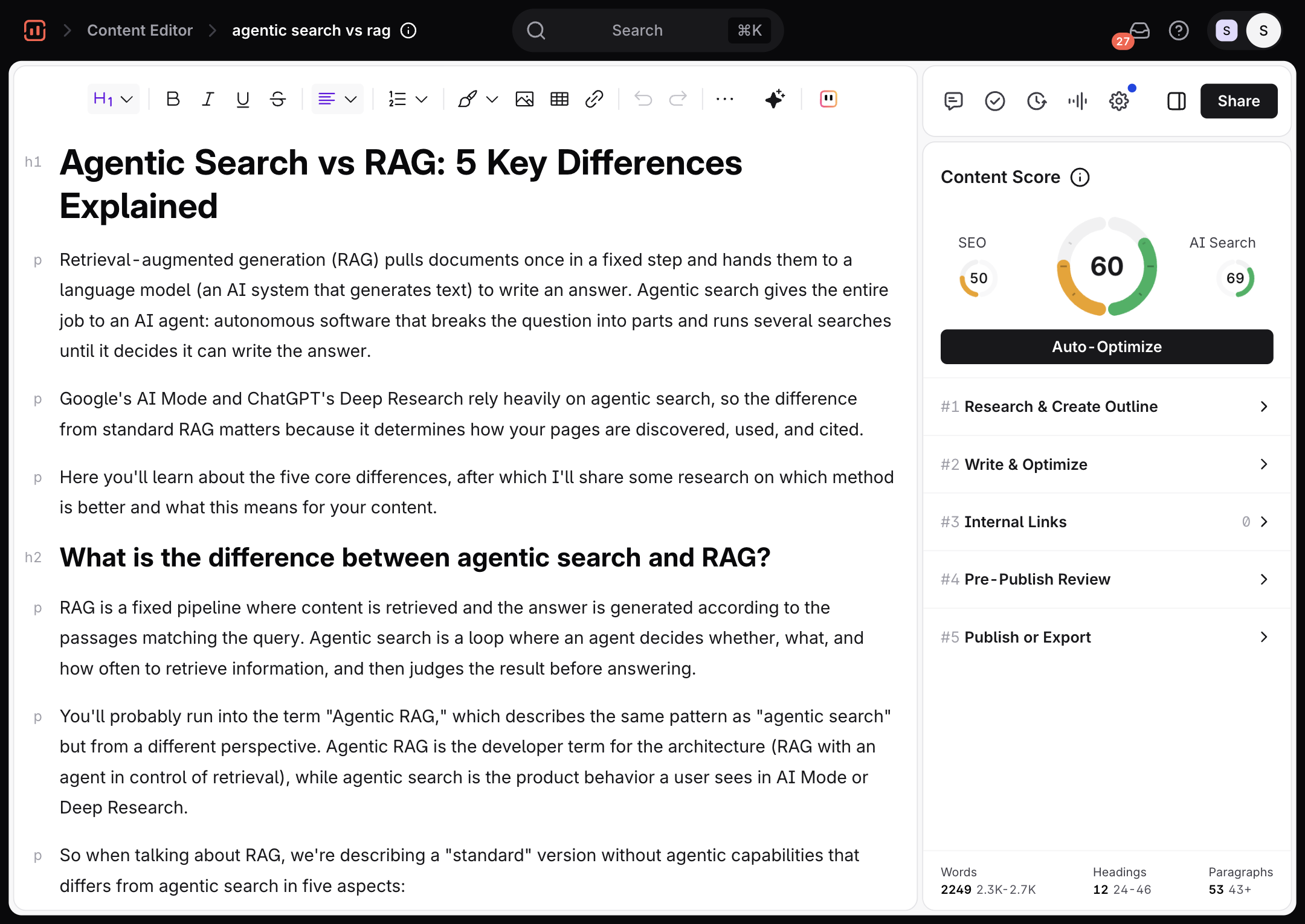
I found Peec AI stronger if you want more structured suggestions and deeper insights handed to you. But if you want those opportunities tied into content execution for your overall workflow and optimization, for brand performance, Surfer’s a great choice.
In short, they’re both solving the same problem from two different directions.
6. Agent analytics and crawl insights
Now here’s something different I came across while exploring Peec AI.
The platform goes beyond AI prompt and visibility monitoring by letting you see which AI crawlers can access your own site, where restrictions exist in robots.txt, and how competitor websites compare in this technical area.
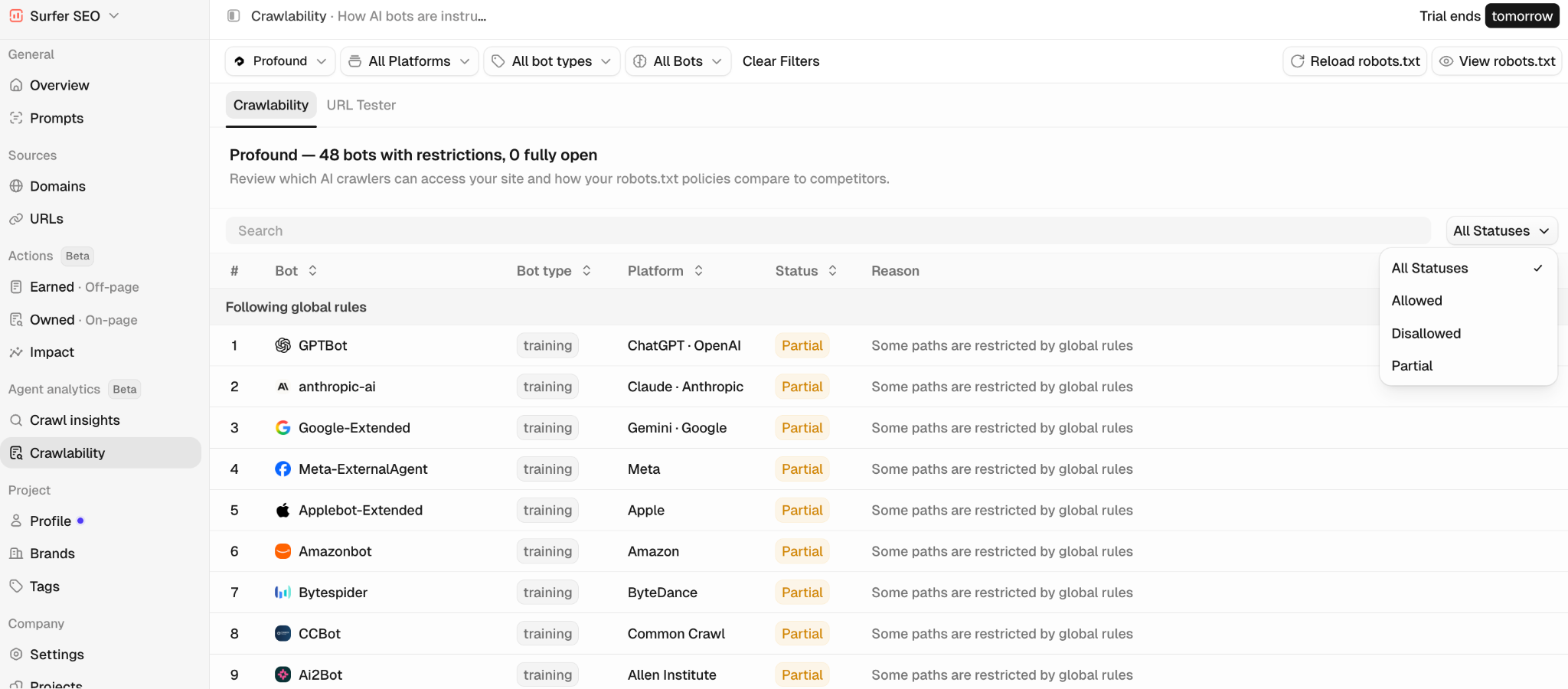
I like how this is more than a simple allow/block checker. The competitor comparison adds useful context, and the URL tester makes it practical to inspect exact URL access at the page level.
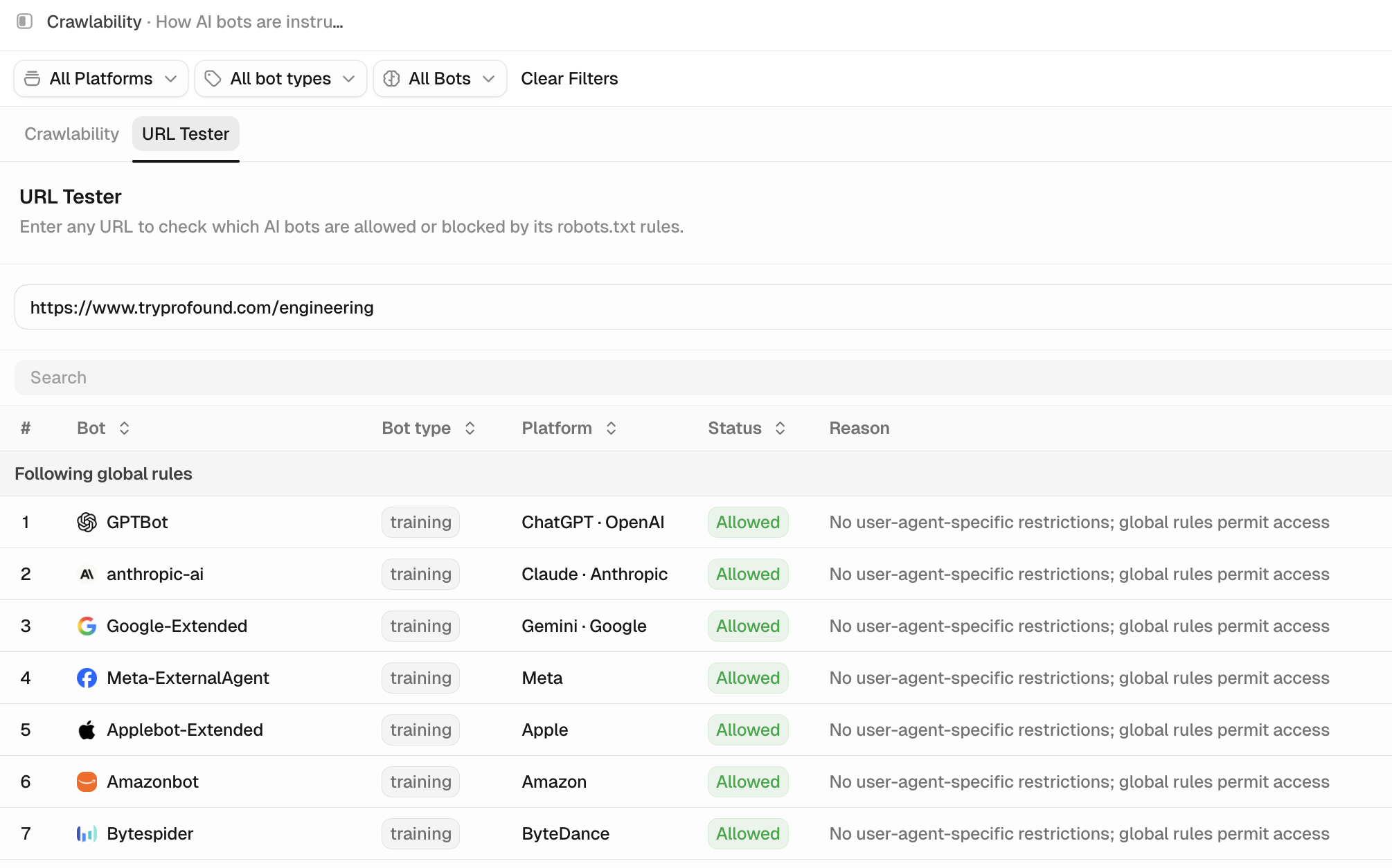
It won’t directly improve AI visibility, but it can help surface technical friction that may affect discoverability.
Peec AI also includes AI traffic and usage insights, which I found interesting, though I’d treat them as directional signals rather than hard attribution. This is still a very new space, and measurement around AI-driven traffic is far from settled.
Still, it’s a useful lens for looking beyond prompts and citations into how AI crawlers may be interacting with your site.
Some of this can also be explored outside the platform by analyzing server logs downloaded from your CDN, which is where this kind of bot activity is typically visible.
Overall, I see this as a thoughtful technical layer in the product. Maybe not a primary buying factor for most teams, but a useful feature if crawler access and emerging AI traffic signals matter to your strategy.
Comparing Peec AI vs. Surfer’s workflow for AI SEO content optimization
Peec AI is strong at surfacing opportunities. Its actionable suggestions through the Actions tab turn mention gaps into concrete suggestions, whether that’s getting cited on editorial sites, showing up in listicles, or finding opportunities through UGC platforms like Reddit and LinkedIn.
I like that it goes beyond flagging gaps and actually suggests ways to respond to them.
Surfer surfaces similar opportunities through Mention Gaps from competitor comparisons and source retrieval insights. But what stood out to me is how those insights tie directly into content optimization.
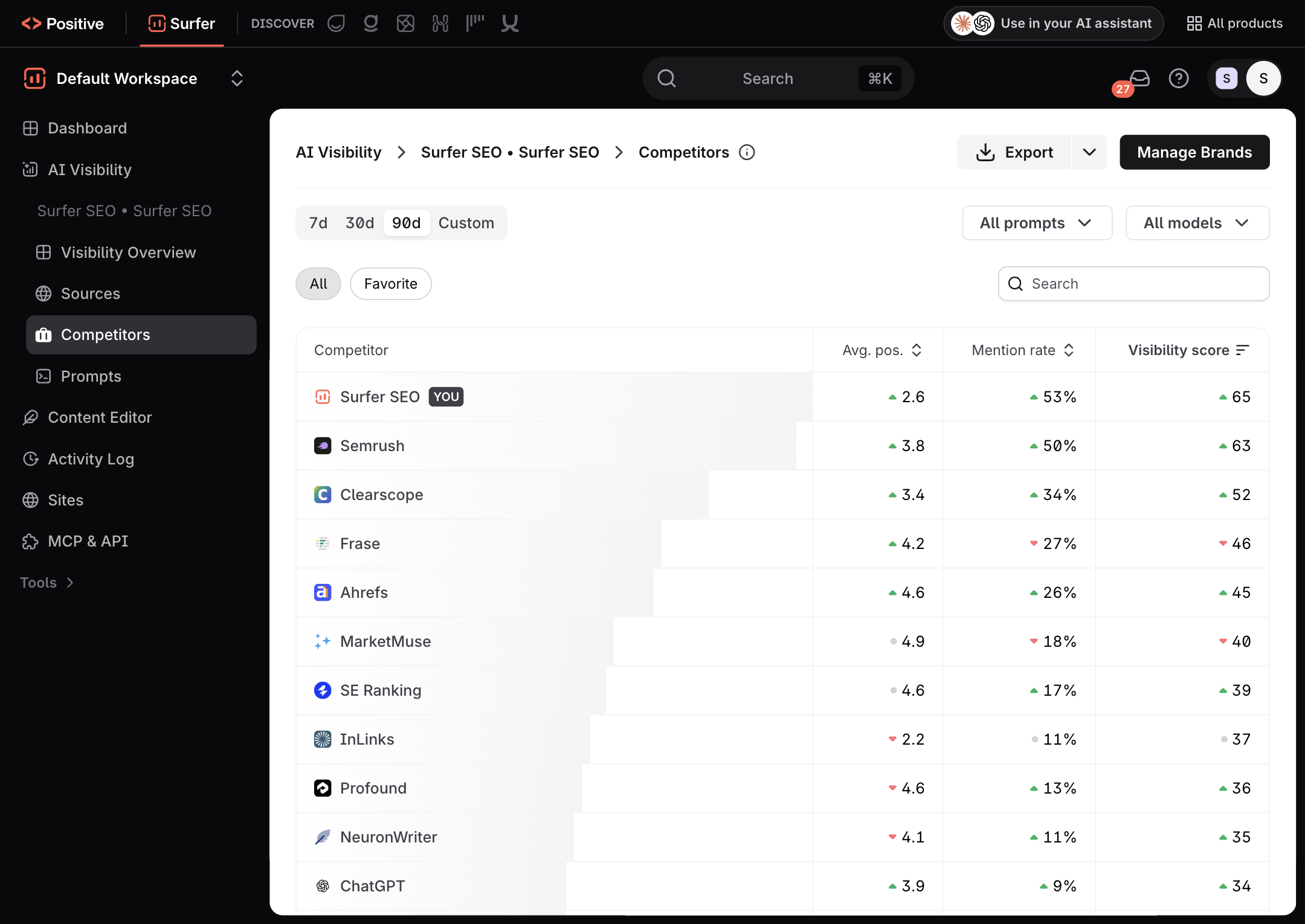
For example, you can spot a visibility gap with a competitor through the AI Tracker, use keyword research or topic clusters to explore what content could help close it, then move into the Content Editor to create or update that content.
Inside Surfer’s Content Editor, I love how you also get an AI search score, SEO score, and suggested facts to strengthen coverage for both traditional search and AI-generated answers.
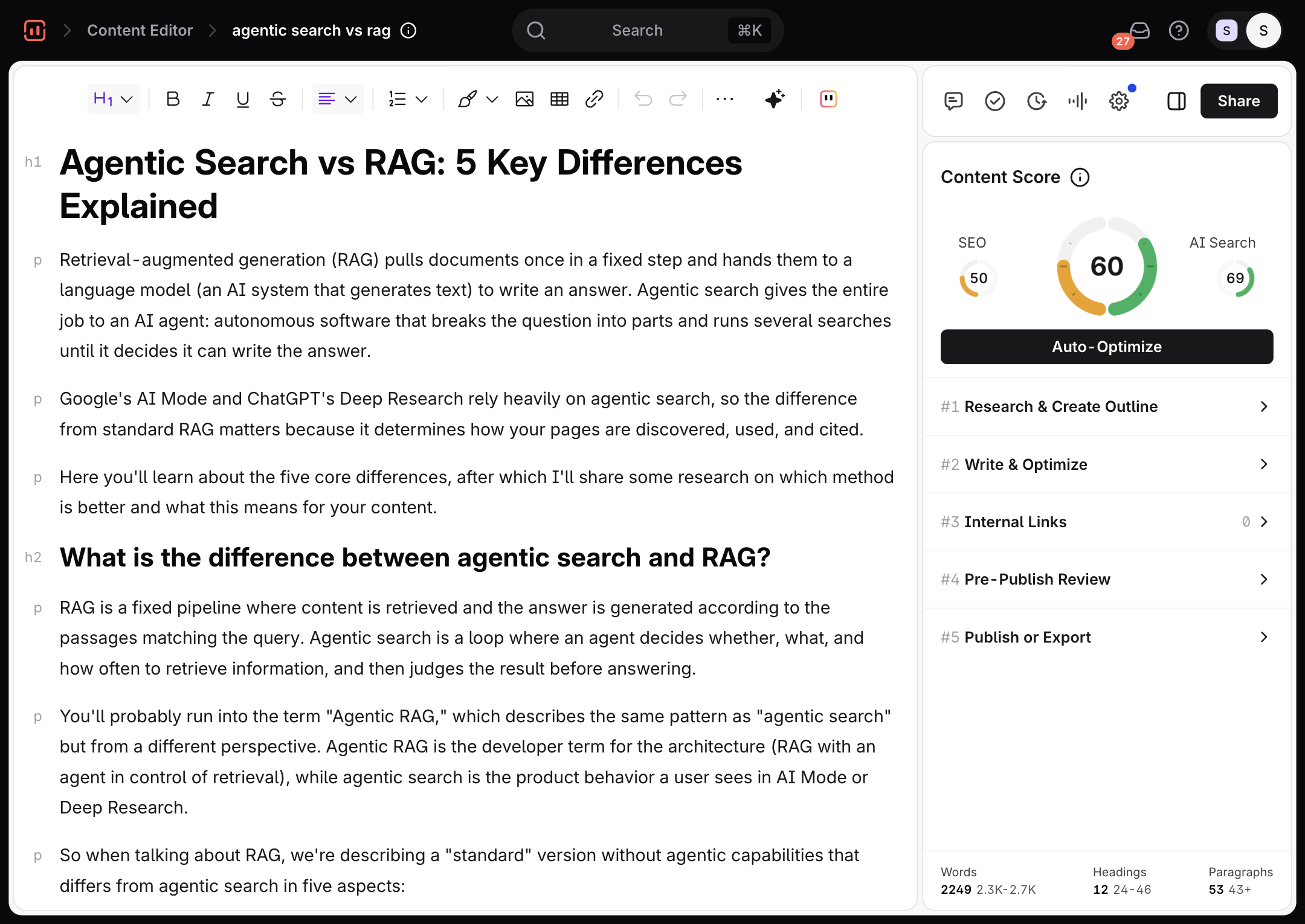
This integration is what makes the workflow feel a lot more different in practice. The research, optimization, and publishing steps sit much closer together and really feel like your content is aligning with “search everywhere optimization.”
As a content marketer, I found this to be a significant advantage because it reduces tool switching. Instead of using one platform to diagnose visibility issues and another to figure out how to improve the content itself, a lot of that happens in one place.
Here’s a simple example of what that workflow would look like:
- Find a visibility gap using the AI Tracker
- Explore related prompts or topic clusters relevant to that gap
- Dig deeper using Surfer’s Fanout Queries to identify related queries or topics
- Build or optimize a page in Content Editor based on what you’ve identified
- Monitor rankings and improve content for both SEO and AI search within the same workflow
Peec AI can absolutely help you uncover where gaps exist. In some areas, especially off-page and UGC opportunities, its suggestions are genuinely thoughtful.
But to me, Peec AI feels primarily built for measuring and tracking AI visibility.
Surfer leans more into optimization after the measurement, which is a different value.
That was probably the biggest distinction I noticed after testing both. Peec AI helps you understand where you stand and where opportunities may exist. Surfer is stronger when you want to take those insights and turn them into content changes that help fill those gaps.
Pricing comparisons
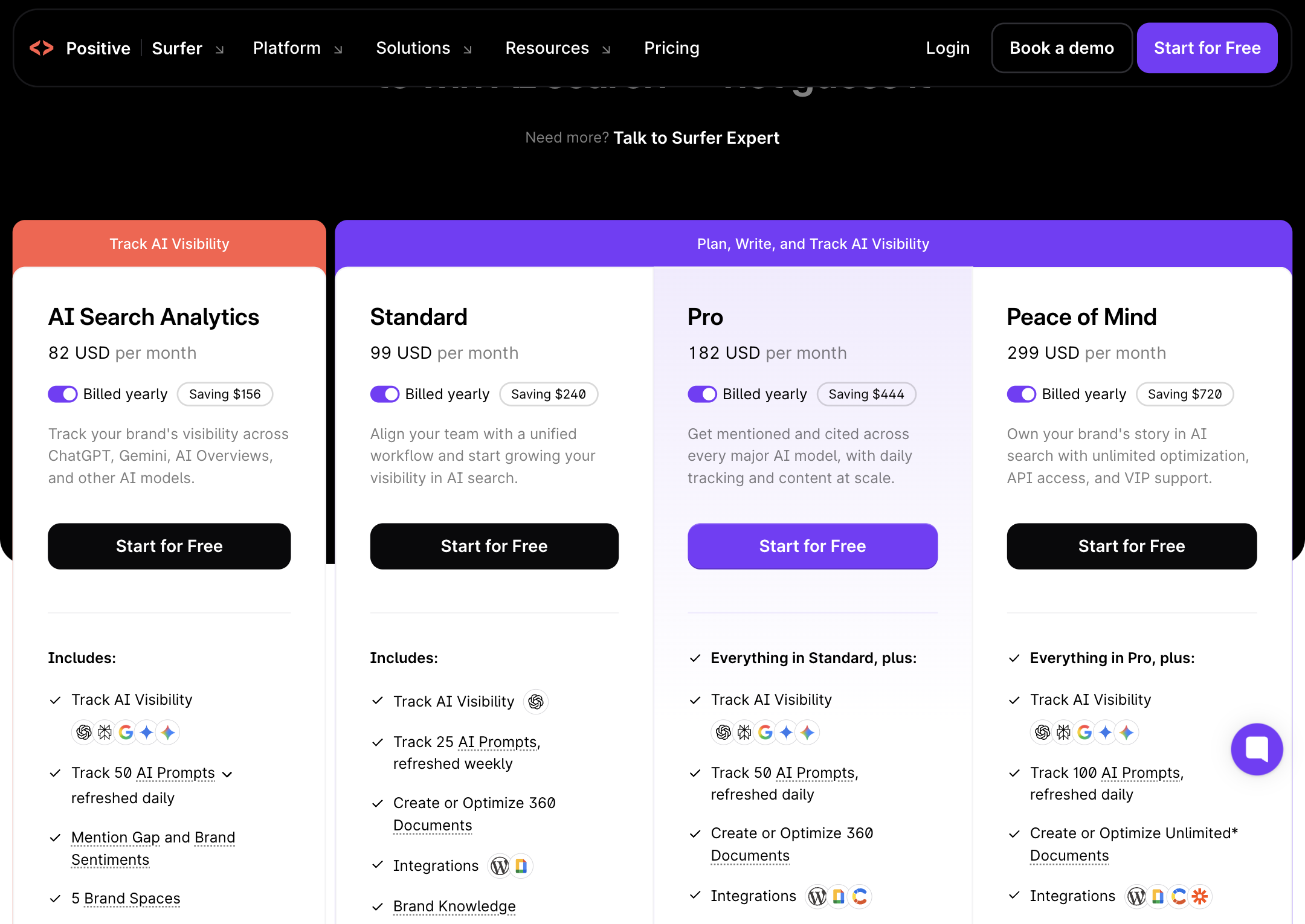
As of November 2026, Surfer’s Pro plan costs $182/month (billed annually) and includes 50 AI prompts refreshed daily, 360 content documents, 5 brand workspaces, data exports, integrations, and AI visibility tracking across five platforms, alongside Surfer’s broader SEO toolkit.
That means for one subscription, you’re getting AI visibility monitoring, keyword and topic research, content optimization, content auditing, internal linking, cannibalization reporting, and publishing integrations.
If you’re looking at AI search as part of a broader content and SEO workflow for brand visibility, that bundled value is hard to ignore.
Surfer also has a Peace of Mind plan that includes everything in the Pro plan, with additions like extra prompt tracking, unlimited brand workspaces, and more. There’s also an enterprise plan.
Peec AI cost and pricing:
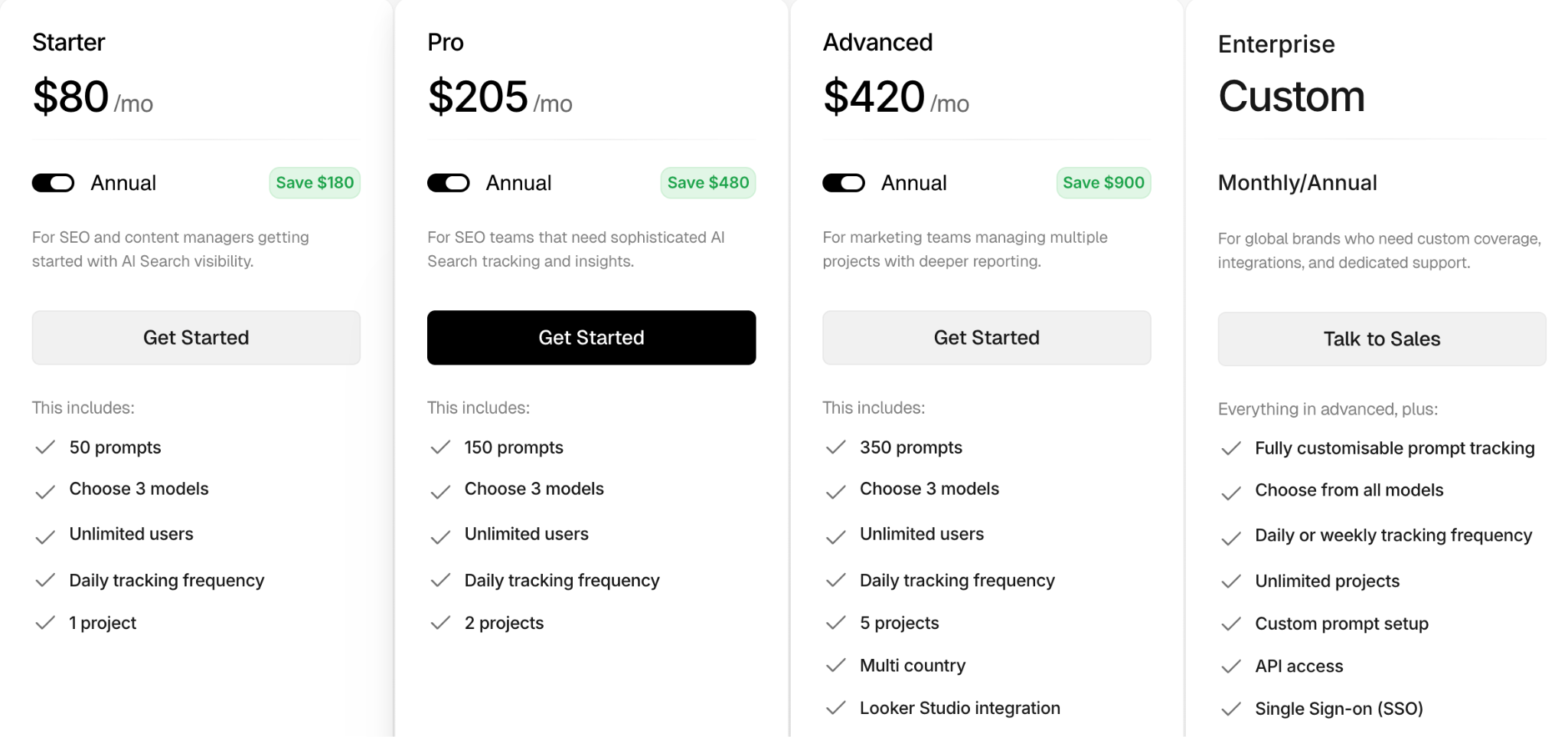
Peec AI’s closest comparable plan is the Pro plan at $245/month ($208/month billed annually), which includes 150 prompts, daily tracking, 2 projects, and support for 3 AI models, with unlimited users.
All Peec AI plans include unlimited seats, allowing teams to add as many users as needed without incurring additional costs, so Peec AI offers more tracking capacity at this tier.
But because it’s primarily built for AI search analytics and monitoring, you may still need a separate SEO and content optimization stack for research, writing, and implementation. That changes the cost equation a bit.
If your priority is dedicated AI visibility measurement, Peec AI’s pricing feels reasonable. But if you want tracking plus optimization and publishing in one workflow, Surfer packs in materially more functionality for a similar price point.
Which tool is the right fit for you?
Pick Peec AI if AI brand visibility monitoring is your main focus
Peec AI makes sense if your goal is going deep on AI visibility data—tracking prompts, studying citations, analyzing competitor mentions, and digging into how models surface brands.
I especially liked how much it surfaces around monitoring and gap discovery.
It feels best suited for marketing teams treating AEO or GEO as a dedicated discipline, or practitioners who want a purpose-built layer for measurement and reporting.
Just know there’s a bit more of a learning curve, especially if you’re newer to this space, and you’ll likely need other tools to turn those insights into content changes. While offering insights into brand visibility, I found Peec AI focuses less on deep optimization capabilities compared to competitors.
Pick Surfer if you want to optimize for both SEO and AI visibility
Surfer makes more sense if you don’t see AI visibility as separate from SEO, but as part of the same content strategy. That’s where I found it stronger.
You can identify visibility gaps in AI Tracker, research topics, and fan-out queries, optimize in Content Editor, and publish within the same workflow. So it’s not just helping you monitor whether you’re visible in AI search, but giving you a path to improve it.
From a marketing team perspective, that connected workflow is a big advantage.
You’re not stitching together research, optimization, and monitoring across multiple tools, and I found that especially useful if your goal is execution, not just analysis.
There’s also a practical budget angle here. If you want one platform that covers AI visibility while supporting broader content and SEO work, Surfer tends to stretch further without adding more tools to the stack.
Both are solid products, and honestly, I don’t think you can go wrong with either. It really comes down to whether you need measurement depth or optimization plus implementation.
If you want a platform built to help with both, Surfer is a solid starting point to see how it fits your workflow.
Note: Pricing and plan details in this Peec AI review were re-checked in November 2026; product UI screenshots reflect the tools at the time of writing.
What is the difference between Peec AI and Surfer?
Peec AI is primarily focused on AI visibility monitoring and measurement, helping teams track prompts, citations, share of voice and competitor presence across AI search platforms. Surfer includes AI visibility tracking too, but combines it with SEO research and content optimization, which makes it an end-to-end workflow for improving visibility, not just measuring it.
Is Peec AI or Surfer better for AI search optimization?
It depends on what you need. If your priority is deep monitoring and analytics around AI visibility, Peec AI may be a better fit. If you want to improve visibility through content optimization while also tracking performance, Surfer may be the stronger option because it combines both workflows in one platform.
Can AI visibility tools improve rankings in ChatGPT or Google AI Overviews?
Not directly. AI visibility tools don't boost rankings on their own. They show where your brand appears, where gaps exist, and which sources AI platforms cite. Improvement still comes from better content, stronger citations and stronger authority signals.
Do you need a separate AI visibility tool if you already have an SEO platform?
Not always. If your SEO platform already includes prompt monitoring, citation tracking and competitor visibility insights, a separate tool may be unnecessary. A dedicated AI visibility tool tends to make more sense for larger marketing teams treating AI search as a standalone growth channel.
How does Surfer help improve AI visibility compared to Peec AI?
Surfer connects tracking insights with SEO workflows like mention gap analysis, fan-out queries, topic clustering, content optimization and answer engine optimization. That makes it easier to act on visibility gaps instead of only identifying them, which is the main difference between the two tools.