Agentic search optimization means making your website easy for AI agents to find, understand, verify, and use. In practice, that means optimizing not just for people who browse search results, but for AI systems that can search your site, evaluate its information, and sometimes take action on a user’s behalf.
So the focus shifts from “Can I rank for this?” to “Can an AI agent actually use my site?” In short:
- Agentic search optimization is not agentic SEO: it optimizes your site for AI agents, rather than using agents to do SEO work.
- AI agents use your site in three ways. They retrieve information, verify it against other sources, and act on it, and acting is still the least reliable of the three.
- AI-referred traffic to U.S. retail sites converted 42% better than non-AI traffic in March 2026, but referral traffic is not proof that agents complete purchases.
- Seven steps cover the work, from measuring how much of a page a machine can read to making key actions completable.
- Agent-led checkout and transaction protocols are not worth building for yet.
- Measure readability, fan-out coverage, citations, agent-referred conversions and crawl-to-refer ratios together.
What is agentic search optimization and agentic SEO?
Agentic search optimization is structuring your site so autonomous AI agents can retrieve, verify, and act on it, rather than simply optimizing it for a person scanning a results page.
In practice, that can mean making important information easier to find, giving agents enough context to check what they find, and removing unnecessary friction when they need to use something on your site.
Keep in mind, there’s a difference between agentic SEO (or SEO agents) and agentic search optimization:
- Agentic SEO: You use AI agents to do SEO work, such as keyword research, content optimization, or site audits.
- Agentic search optimization: You optimize your website so AI agents can find, understand, verify, and use it.
In short, agentic SEO is about using AI or SEO agents to optimize your site and agentic search optimization is about optimizing your site for agents that crawl your pages. And this is exactly what this blog covers.
The idea sits alongside SEO, generative engine optimization (GEO), and answer engine optimization (AEO). Traditional SEO focuses heavily on helping your pages appear in search results, whereas GEO and AEO look at how AI systems find and use information when generating answers.
Agentic search optimization adds another layer: what happens when an AI system goes beyond generating an answer and actually interacts with your website?
An agent might search for information, compare several pages, check a claim against another source, and then use what it finds to answer a user or complete a task.
This is what agentic search is starting to look like.
And it changes what you need to think about when optimizing a website. A well ranking website is no longer enough if an AI system can’t find the information it needs, figure out whether the site is reliable, or use the page to get something done.
That includes newer search experiences such as AI Overviews, as well as AI agents that can interact with websites.
How do AI agents use your website?
AI agents can interact with your website in three broad ways:
- They can retrieve information
- Verify what they find
- And act on it
These are different jobs, and each comes with different evidence and optimization considerations.
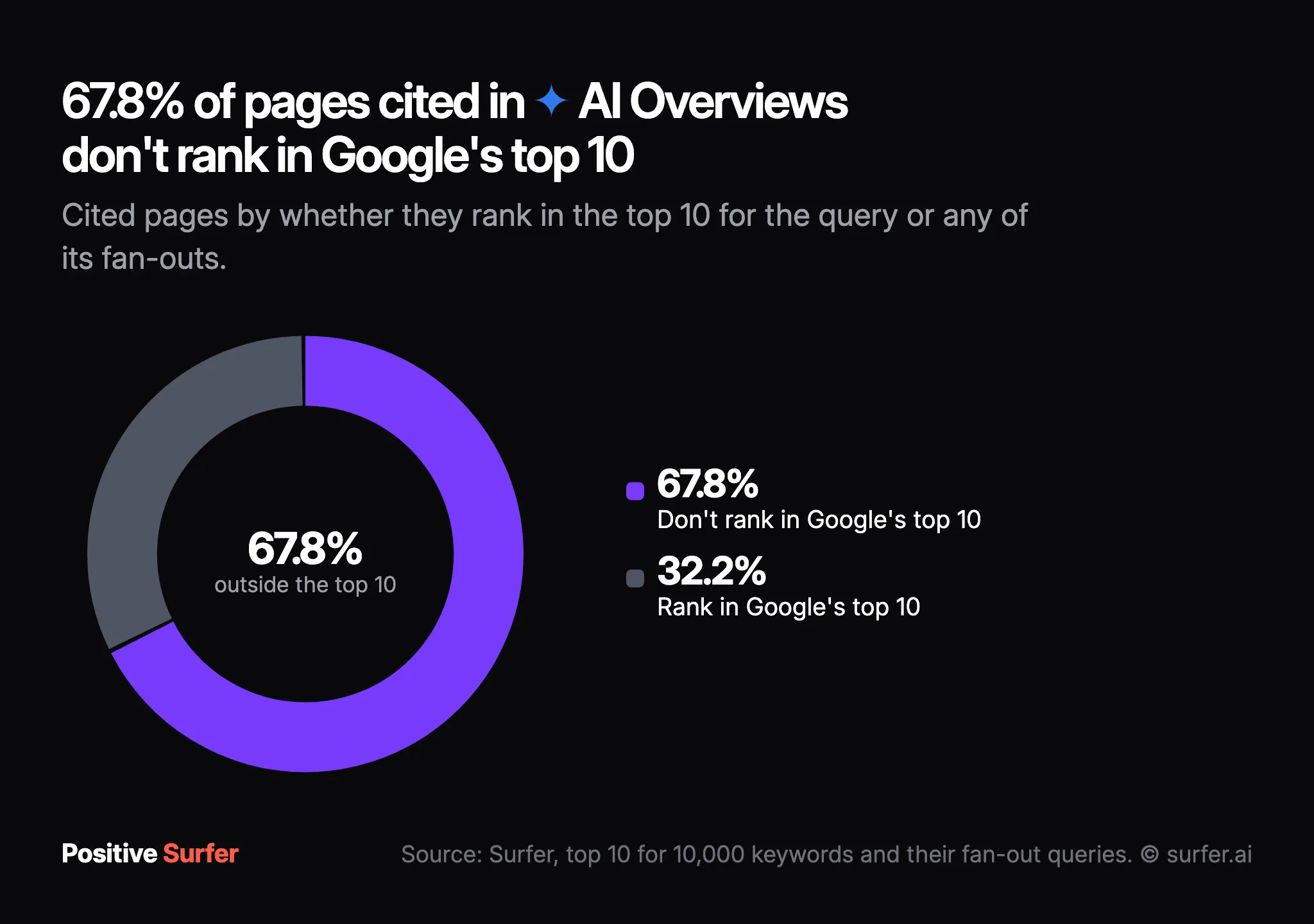
For example, a Surfer study found that 67.82% of sources cited in AI Overviews didn’t rank in Google’s top 10 for the query or any of its fan-out queries, so your usual rankings report won’t tell you the full story.
That’s why agentic search optimization isn’t just another SEO tactic. You need to think about what happens when an AI system reads your site, checks the information against other sources, and eventually tries to do something there.
Here's a break down of each of these jobs:
Retrieval: agents fan out one prompt into several searches
When an AI system receives a complex prompt, it may not run one search and just stop there.
It can break the prompt into smaller, related queries, search for each one, and use those results to build the final answer. A query fan-out is the set of these related search queries generated from an original prompt.
That means your page may need to show up for several related searches, not just the main keyword you optimized for. It changes how you approach keyword research and search optimization as the goal changes to providing broader coverage around the topic, not simply ranking for one head term.
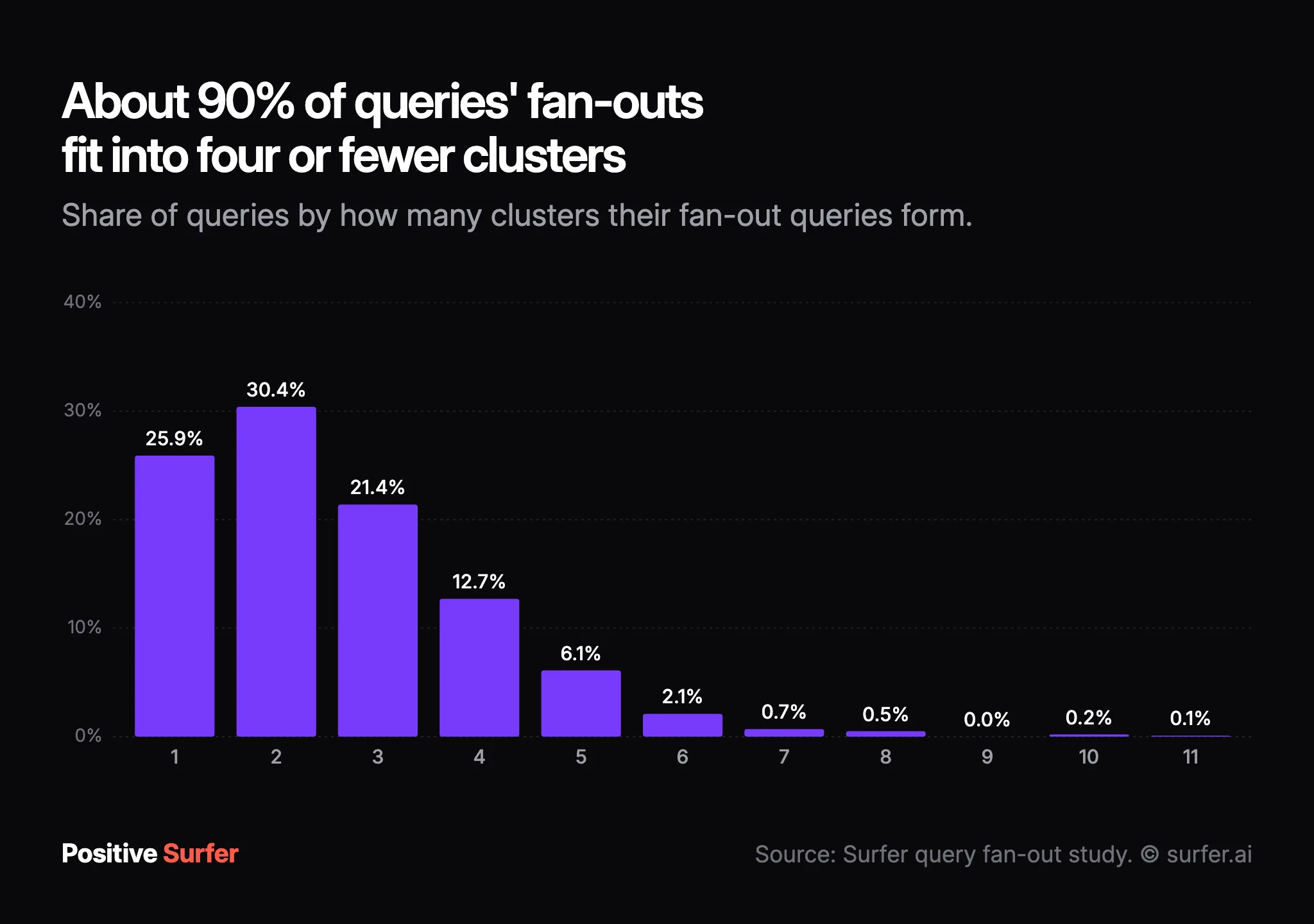
Surfer’s analysis of 1,600 runs of diverse keywords and prompts found that most queries triggered up to five fan-outs, with two to four being the usual range. Fan-outs weren’t generated for every query, and about 90% could be grouped into four or fewer clusters.
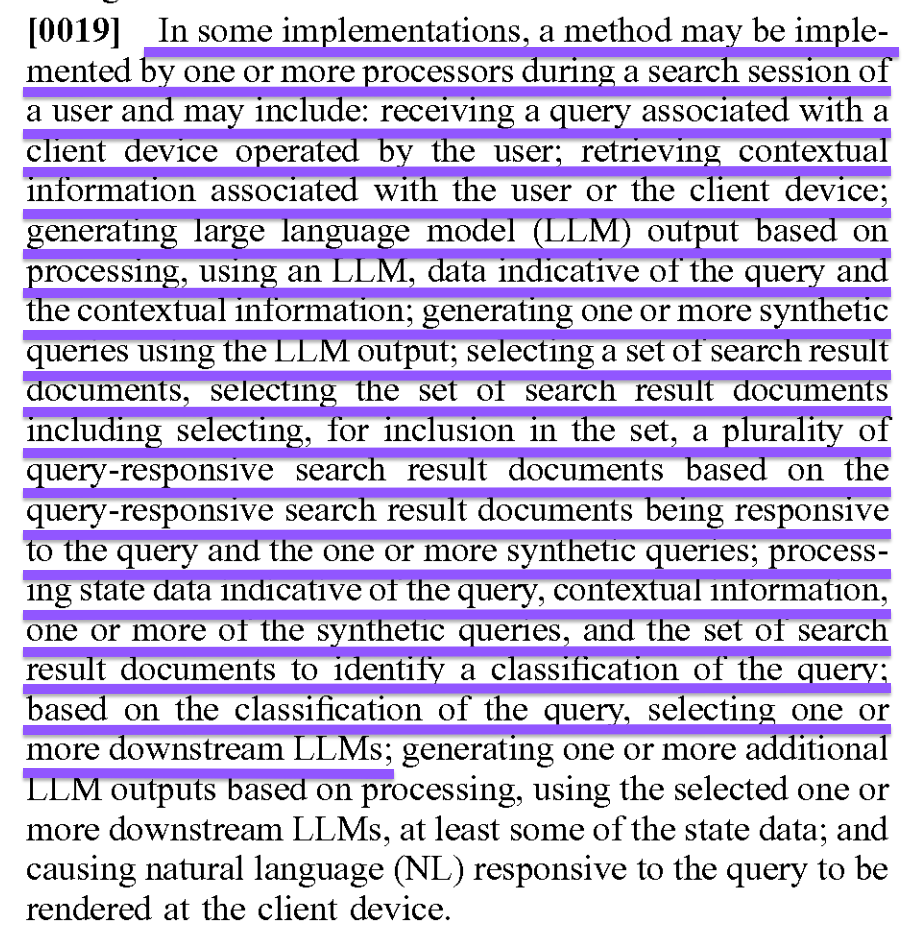
The idea also appears in Google’s own published patent application US20240289407A1, “Search with stateful chat.”
This is a published patent application, not a granted patent. The application describes a system that can maintain a user’s state across a search session, generate synthetic queries from the current query and context, retrieve results for those queries, and then use that state to select downstream generative models.
The application is fairly explicit about the mechanics.
In its description, Google says the user’s state can be stored as semantically rich embeddings, including an aggregate embedding built from the query, contextual information, synthetic queries, and search results. It then describes generating multiple synthetic search queries, including queries designed to drill down into a topic, and executing them to retrieve additional search results.
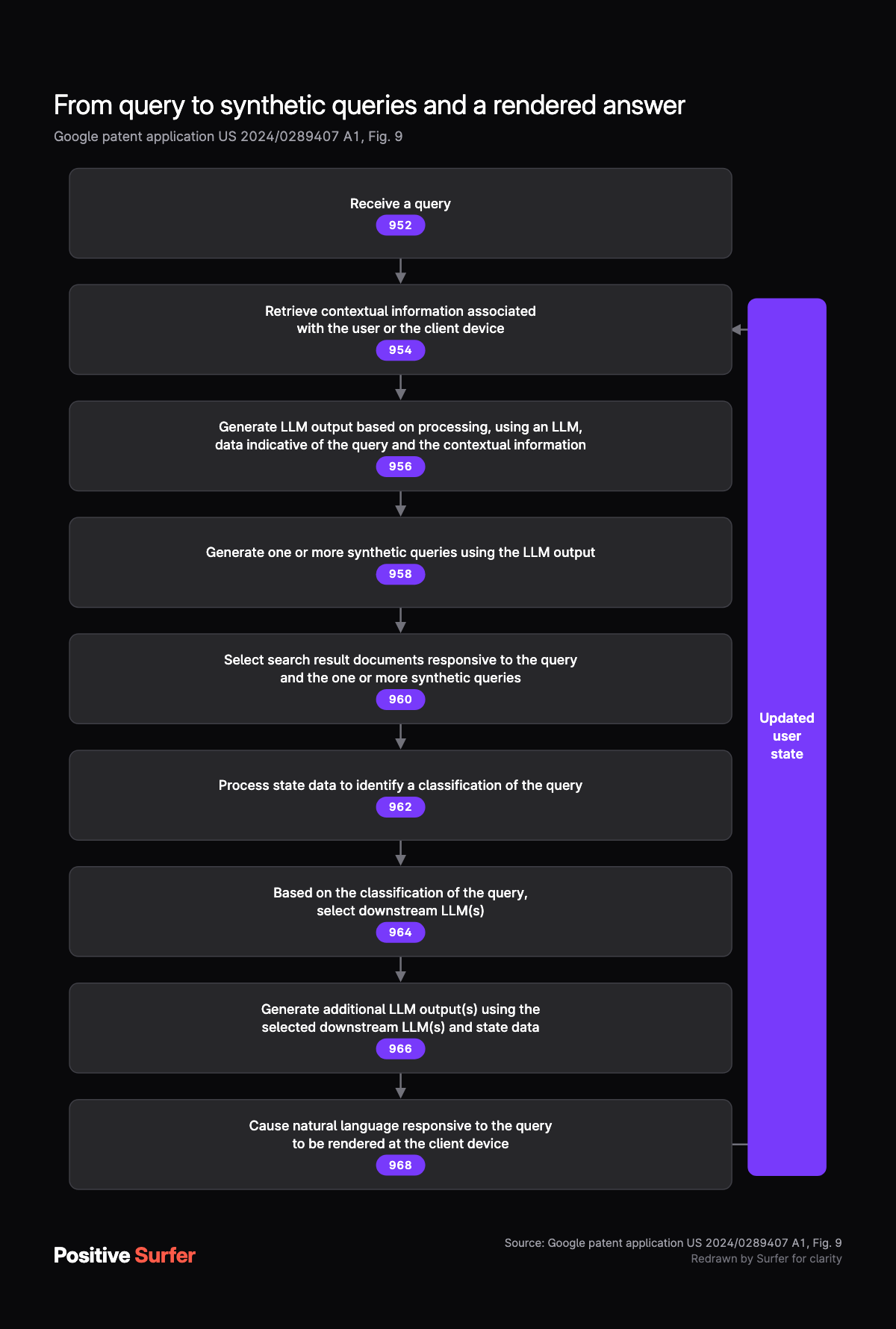
The flow is also shown visually in Figure 9 of the application, which moves from receiving a query to generating synthetic queries, selecting search result documents, and using that state to determine the next processing step.
So when you’re thinking about how to optimize content for agentic search, don’t stop at the query you find in a keyword research tool.
Look at the related questions, variations, and subtopics around it. Those are the searches an agent may use to find the information it needs, and covering them can give your content more opportunities to appear in the retrieval process.
Verification: agents cross-check a claim before they repeat it
Getting your page into an AI response is only part of the job. The information also needs to hold up when search engines check it against other sources.
An AI agent may compare what it finds on your page with information from other search results before using it in an answer or recommendation. So it helps to make important claims clear, specific, and easy to verify, rather than burying them in vague copy or unsupported statements.
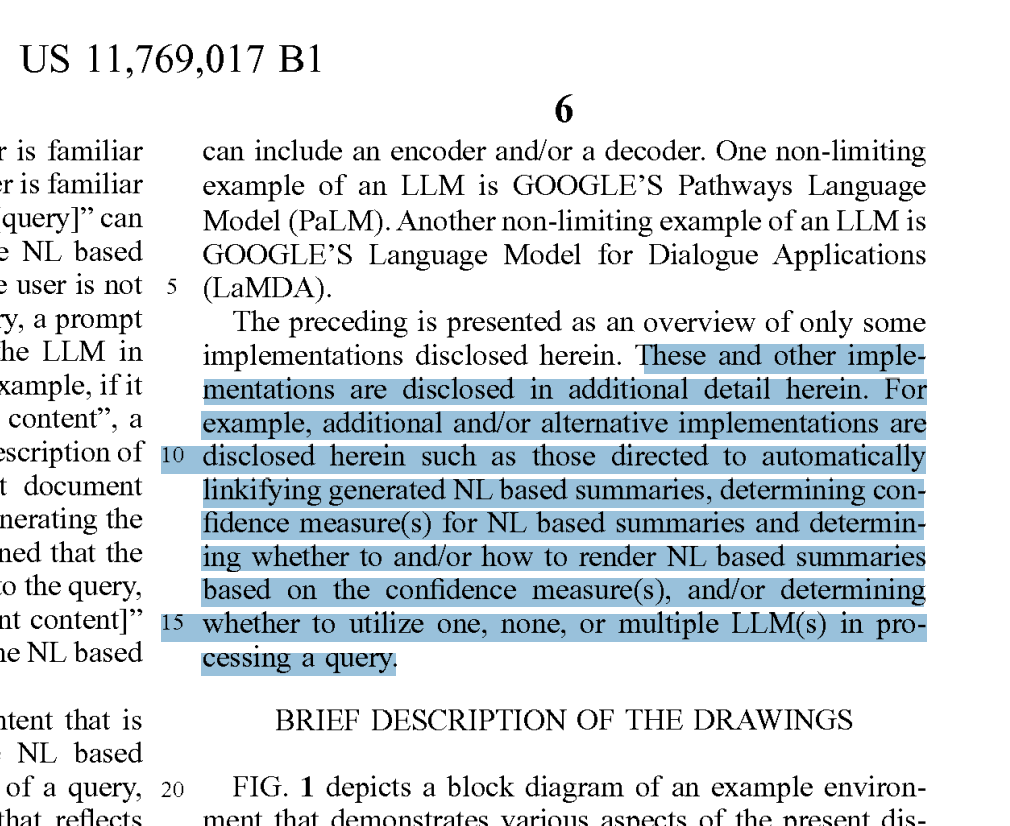
Google has described this kind of process in US11769017B1, “Generative summaries for search.”
This is a granted patent, issued to Google on September 26, 2023 that describes generating a summary from search result documents and then determining which documents verify particular portions of that summary. The system can link those portions back to the relevant documents and use confidence annotations when deciding how the summary should be presented.
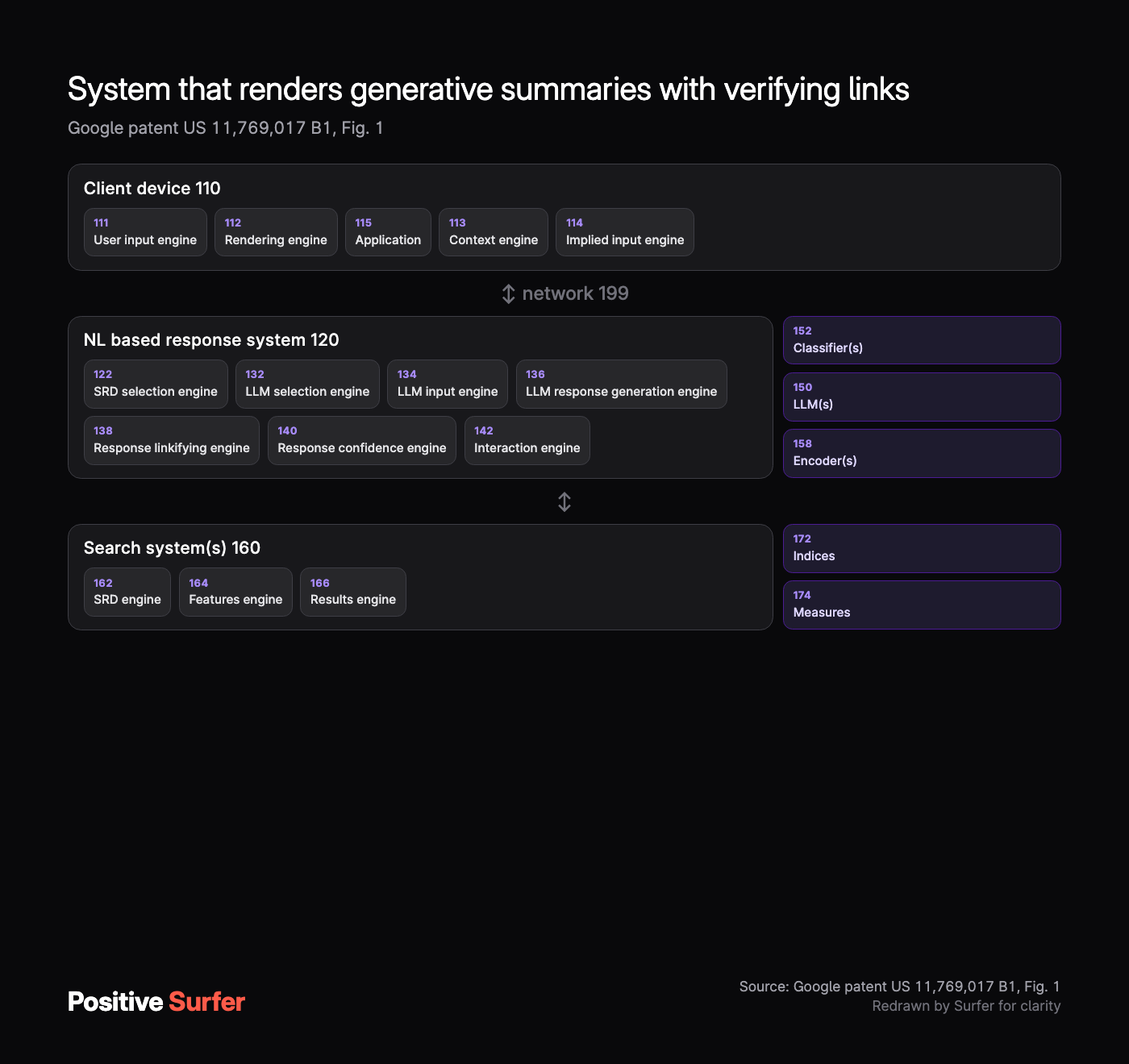
The workflow is visible in Figure 1 of the patent: after generating a natural-language summary, the system can render it with links to search result documents that verify portions of the summary, along with confidence annotations.
The system selects a portion of the summary, finding a candidate document, and checking whether that document verifies the claim before linkifying it.
For SEO specialists, this means that what other pages say about your brand can matter alongside what you say on your own website.
Surfer analyzed 289,105 URLs across 922 prompts to look at this relationship and found that the percentage of cited sources that mentioned a brand had a 0.41 Spearman correlation with how highly that brand was recommended in AI responses.
The prompts covered ChatGPT, AI Overviews, AI Mode, and Perplexity, with 26,573 total calls collected over seven days.
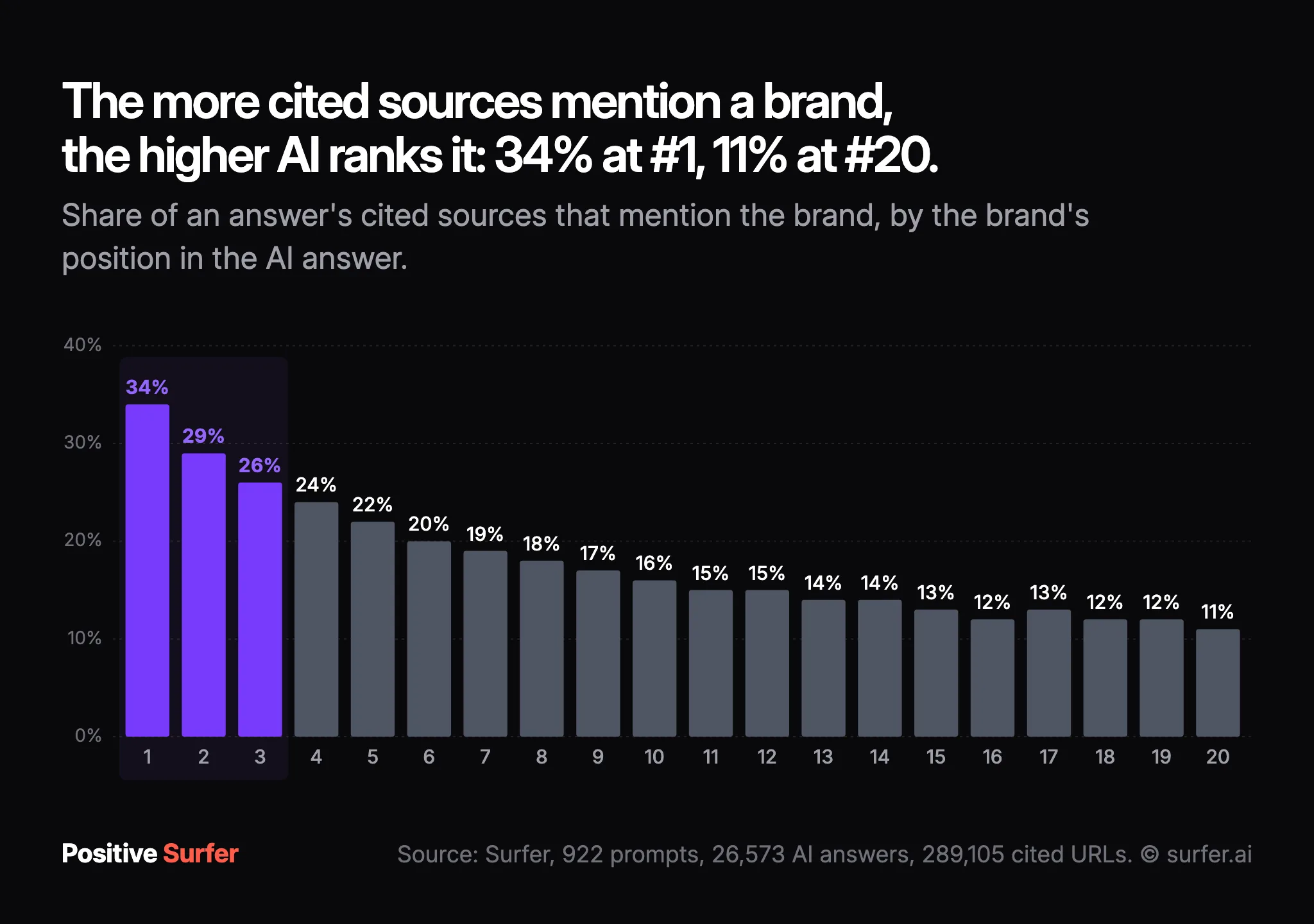
Keep in mind, this is just a correlation, not proof that getting mentioned on more third-party pages directly causes an AI system to recommend you more often. But it does point to the fact that AI recommendations aren’t based only on your own website.
If AI systems repeatedly find your brand mentioned on relevant, frequently cited pages, those mentions become part of the information available to them. That makes third-party coverage, backlinks, reviews, industry publications, and other relevant sources part of the broader picture of brand authority.
So verification isn’t just about making your own pages well structured. It’s also about making sure the information an AI agent interprets from your site lines up with what it can find elsewhere.
This means:
- Keeping important data consistent
- Correcting outdated claims
- Fixing broken links or contradictory information
- and building trust beyond your own landing pages
The important distinction here is that you can measure the sources an AI uses, but you can’t directly watch the model verify a claim in real time.
There’s no reliable desk-side test that shows exactly which checks happened behind an AI response or agent activity. The patent and the large-scale citation study give us evidence for the process without pretending we can observe every step an AI agent takes.
Action: agents try to complete a task on the page
An AI agent can retrieve a page, find an answer, or cite a source without changing anything. Completing a task is harder. It has to:
- Understand what the user wants
- Navigate the interface
- Choose the right buttons, links, or form fields
- Keep track of context across multiple steps
- Recover when something goes wrong
- Confirm that the task was actually completed
That could mean adding a product to a cart, changing an account setting, submitting a form, or completing a workflow across several pages. Every extra step gives the agent another chance to lose its place or stop before the task is finished.
The benchmark data shows how big this gap still is. Online-Mind2Web tests agents on 300 realistic tasks across 136 live websites. The original study found that:
- The strongest tested agent completed 61.3% of tasks
- Many of the other agents scored closer to 30%
- The tasks involve real web interfaces rather than static pages or cached snapshots
That makes the benchmark particularly relevant here. The agent isn't just finding an answer. It has to actually complete the requested workflow on the page.
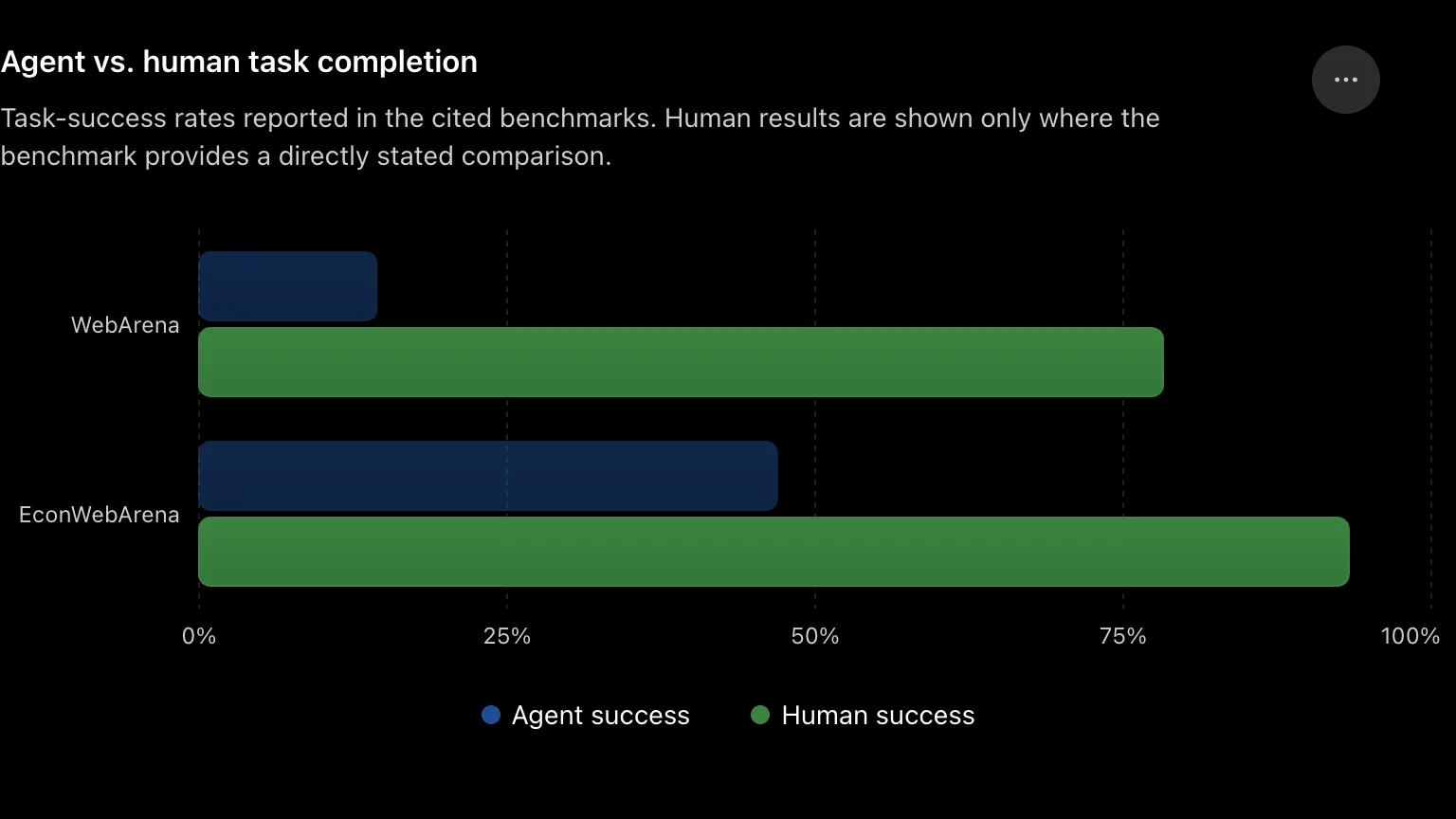
WebArena shows a similar gap in a more controlled environment. They tested 812 long-horizon web tasks across four domains: online shopping, forums, collaborative development, and business content management. It also includes tools like maps and calculators, plus knowledge resources like Wikipedia.
In the original WebArena paper the scores were:
- Best GPT-4-based baseline: 14.41%
- Human success rate: 78.24%
But these scores have improved since then.
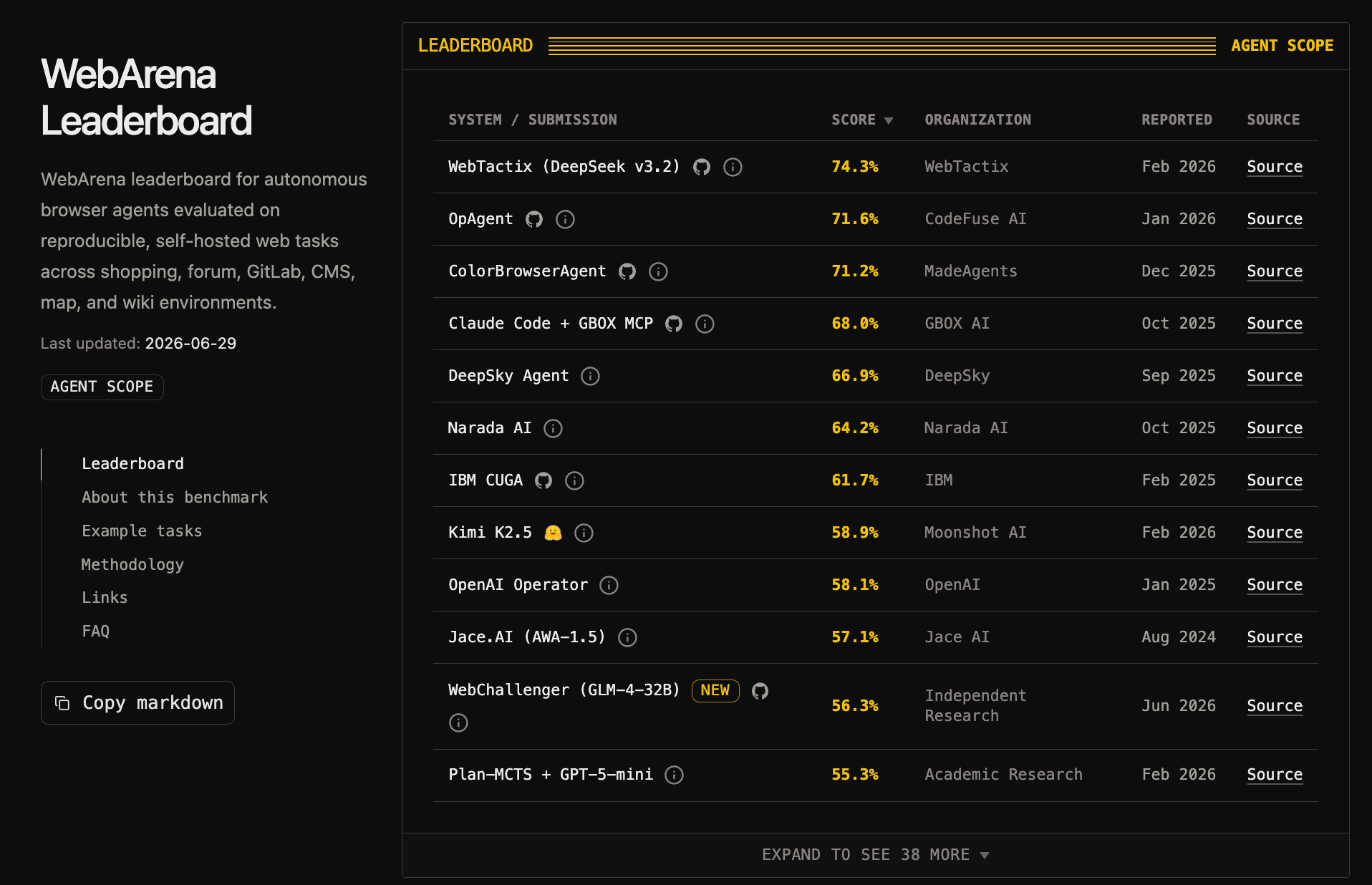
A WebArena leaderboard updated June 29, 2026 listed WebTactix using DeepSeek v3.2 at 74.3% on the full 812-task set. The next-best systems ranged from roughly 50% to the low 70s. These are scores for complete agent systems, rather than a raw model acting alone.
The gap also shows up in benchmarks that use live websites:
- EconWebArena: Across 360 tasks on 82 live websites, the best evaluated model achieved 46.9% task success, compared with 93.3% for humans.
- Odysseys: Across 200 long-horizon tasks on the live Internet, the strongest tested models achieved 44.5% success.
These benchmarks point to the same practical issue: reading a page is much easier than reliably completing a task on it.
This means, your SEO strategy shouldn’t only focus on whether agents read and find your content. You also need to make sure they can actually use the important parts of your website without getting stuck.
You don't need to predict every way an autonomous AI agent might use your website. Start by removing obvious friction from the workflows people already use:
- Give buttons, forms, menus, and calls to action clear labels.
- Make important actions easy to find without relying on ambiguous icons or purely visual cues.
- Keep booking, signup, checkout, contact, and account-management flows simple and predictable.
- Give forms clear labels, useful error messages, and obvious confirmation states.
- Avoid hiding important actions behind unnecessary pop-ups, overlays, or complicated interactions.
- Use accessible, semantic HTML so the structure of the page is clear beyond its visual design.
- Test important workflows after redesigns, CMS changes, or third-party script updates.
The point isn't that agentic AI can't use websites.
It's that task completion is still much less reliable than retrieval or citation, especially when a workflow is long, stateful, or involves several steps. For now, the practical approach is to make your key user journeys simple and predictable, rather than trying to optimize for an agent behavior you can't fully observe.
To see what this looks like in practice, I gave an agentic AI browser (Browser Use) a simple shopping task:
I’m going on a beach day trip. On Amazon.com, add these items to my cart: SPF 50 sunscreen, a beach towel, a waterproof phone pouch, a reusable water bottle that keeps liquids cold, and bright colored swim shorts. Keep the total under $150. Choose 4-star-and-above options, and don’t buy anything. Just add the items to the cart.
Browser Use's AI agent executed the task in 5 minutes and 11 seconds.
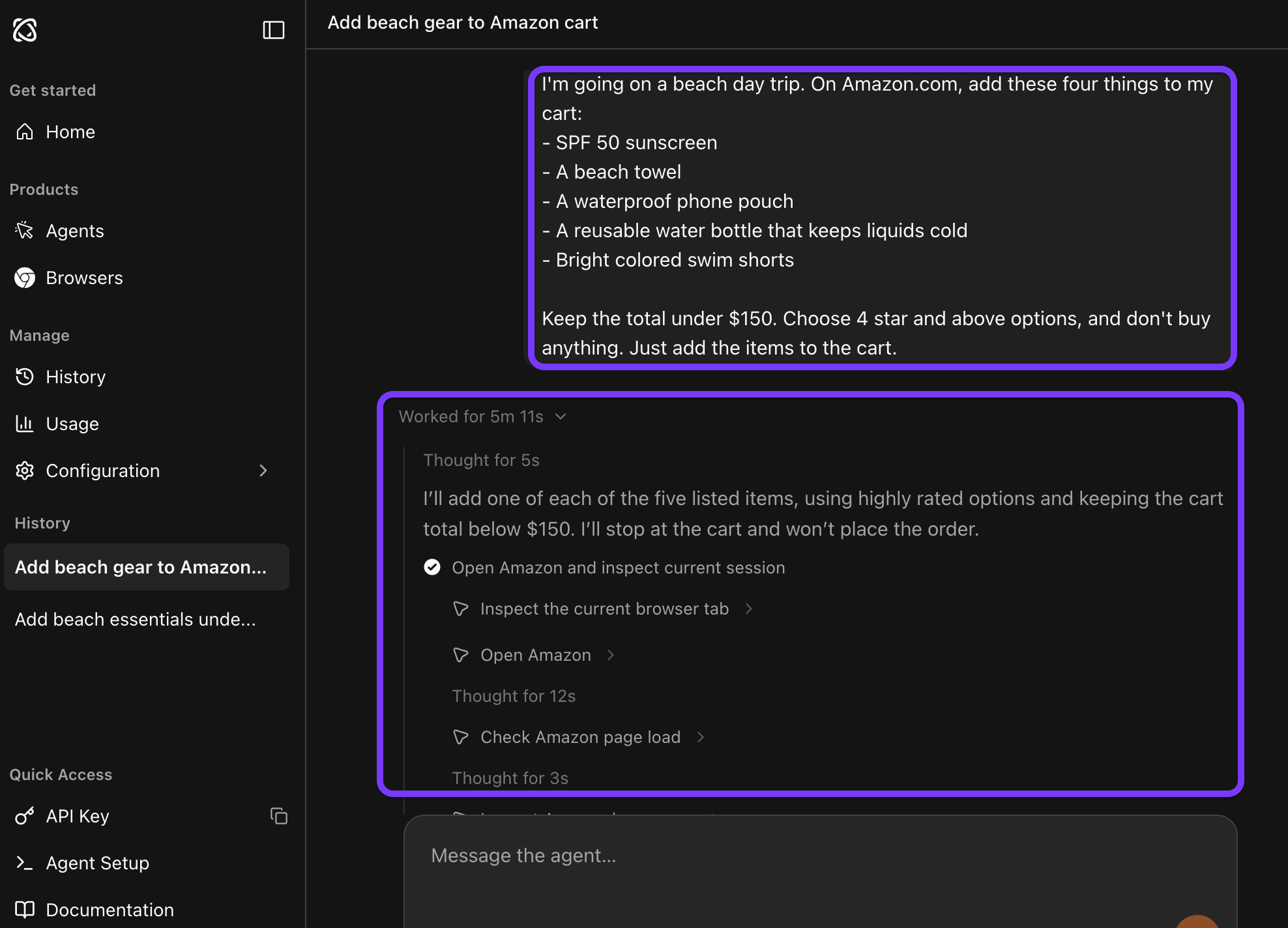
It added all the items to the cart:
- SPF 50 sunscreen
- Beach towel
- Waterproof phone pouch
- Insulated cold water bottle
- Red swim shorts, size Large
All items were rated 4.6 stars, and the final cart subtotal was $86.48, well below the $150 limit. No purchase was made.
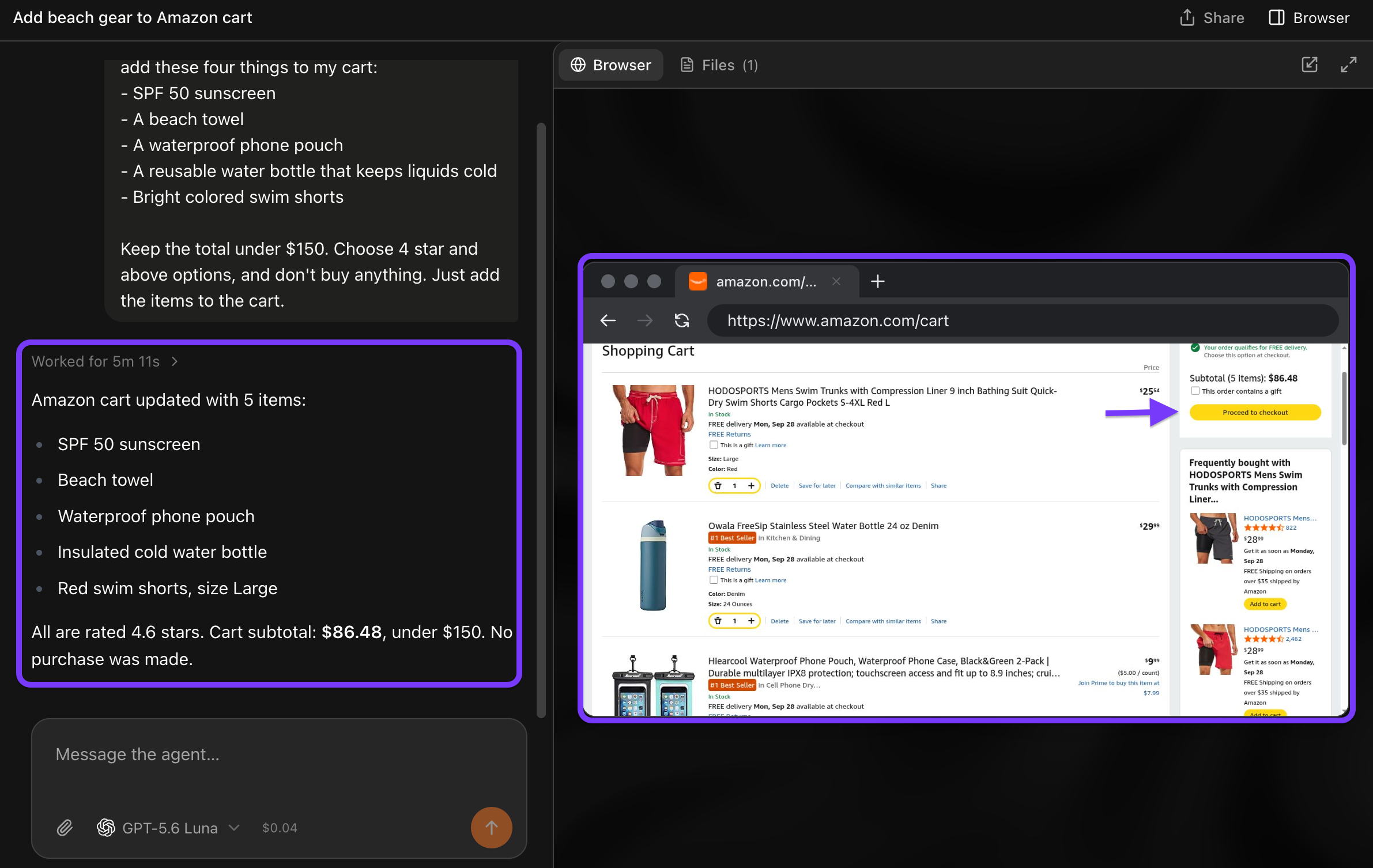
This is a useful example of what the action layer in agentic search looks like.
The agent searched the site, chose products based on the instructions, added them to the cart, and stopped at the requested point.
In this case, the workflow worked. That doesn't mean every website or task will be this easy. Longer workflows, unclear interfaces, forms, authentication, and other friction can still give an agent plenty of opportunities to get stuck.
For a successful task like this, I wouldn't make any traditional optimization based on this test alone. I'd test another important customer journey and look for the points where the agent needs help or stops.
Does agent traffic convert?
The short answer is yes, at least some AI-referred traffic is converting. But there’s an important distinction between traffic that an AI assistant sends to a website and an AI agent actually completing a task there.
Adobe’s 2026 Q2 AI Traffic Report shows how quickly AI-referred traffic is becoming commercially relevant. In March 2026, AI-referred traffic to U.S. retail sites converted 42% better than non-AI traffic. Just one year earlier, in March 2025, it converted 38% worse. That’s an 80-percentage-point swing in the relative conversion rate.
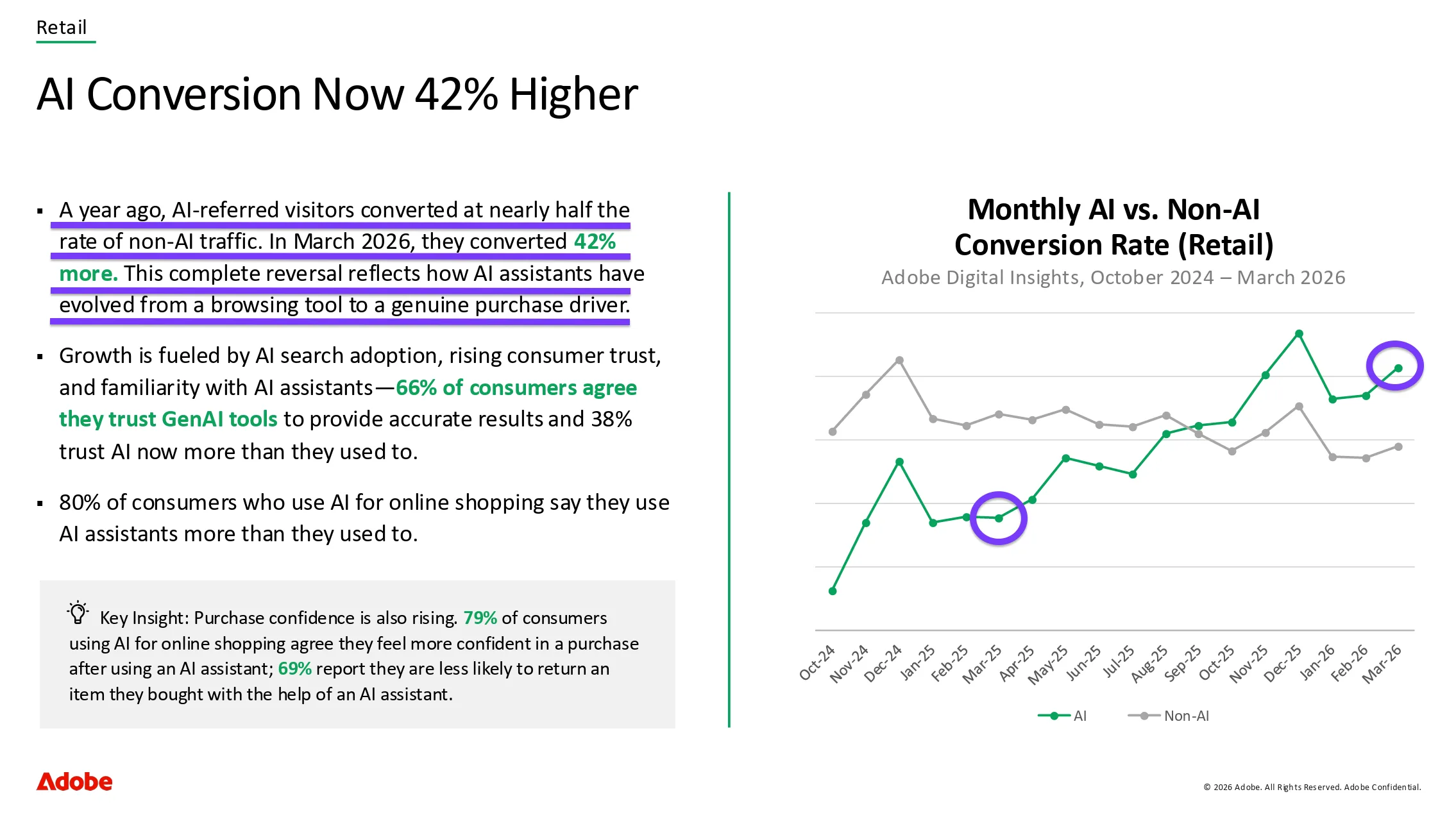
The same data also mentions that AI traffic to U.S. retail sites grew 393% year over year in Q1 2026, while AI-referred visitors in March had a 12% higher engagement rate, spent 48% longer on the site, and viewed 13% more pages per visit.
Adobe says its analysis is based on direct online transactions across more than 1 trillion visits to U.S. retail sites, alongside a survey of more than 5,000 U.S. respondents.
But there’s a big caveat: this is referral traffic data, not proof that AI agents can successfully complete purchases. Adobe is measuring people who arrived at retail sites from AI sources. That is different from an autonomous agent searching for a product, adding it to a cart, and checking out on the user's behalf.
Cloudflare’s data shows another reason not to treat AI crawling and referrals as the same thing.
In Cloudflare Radar’s crawl-to-refer view for the last 7 days (as of October 23rd), Perplexity recorded 3.8K:1, compared with OpenAI at 728.8:1. These figures measure aggregate HTML-page crawls per HTML-page referral, and they can change depending on the reporting window.
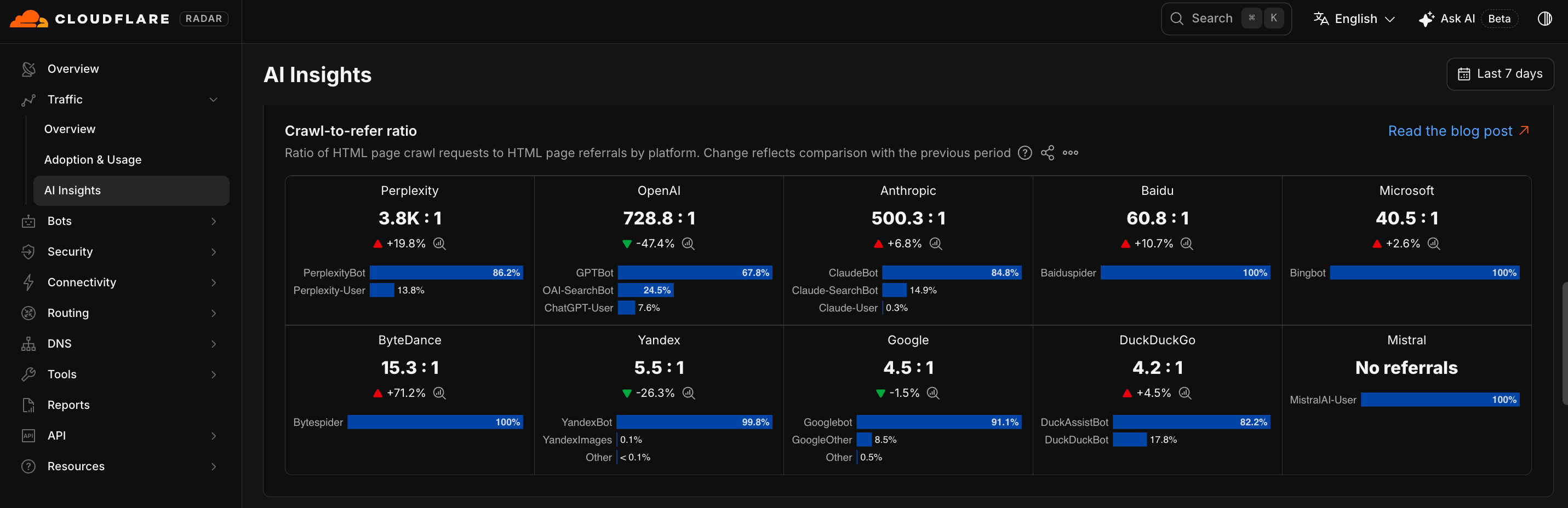
So a platform can crawl a large amount of content without necessarily sending the same volume of visitors back. That makes agent activity, referral traffic, and conversions three different things to measure.
There’s another interesting signal in Surfer’s analysis of 5 million AI citations. Across 20,000 prompts and roughly 5 million cited URLs, traditional link-based domain authority metrics showed correlations close to zero, with some slightly negative.
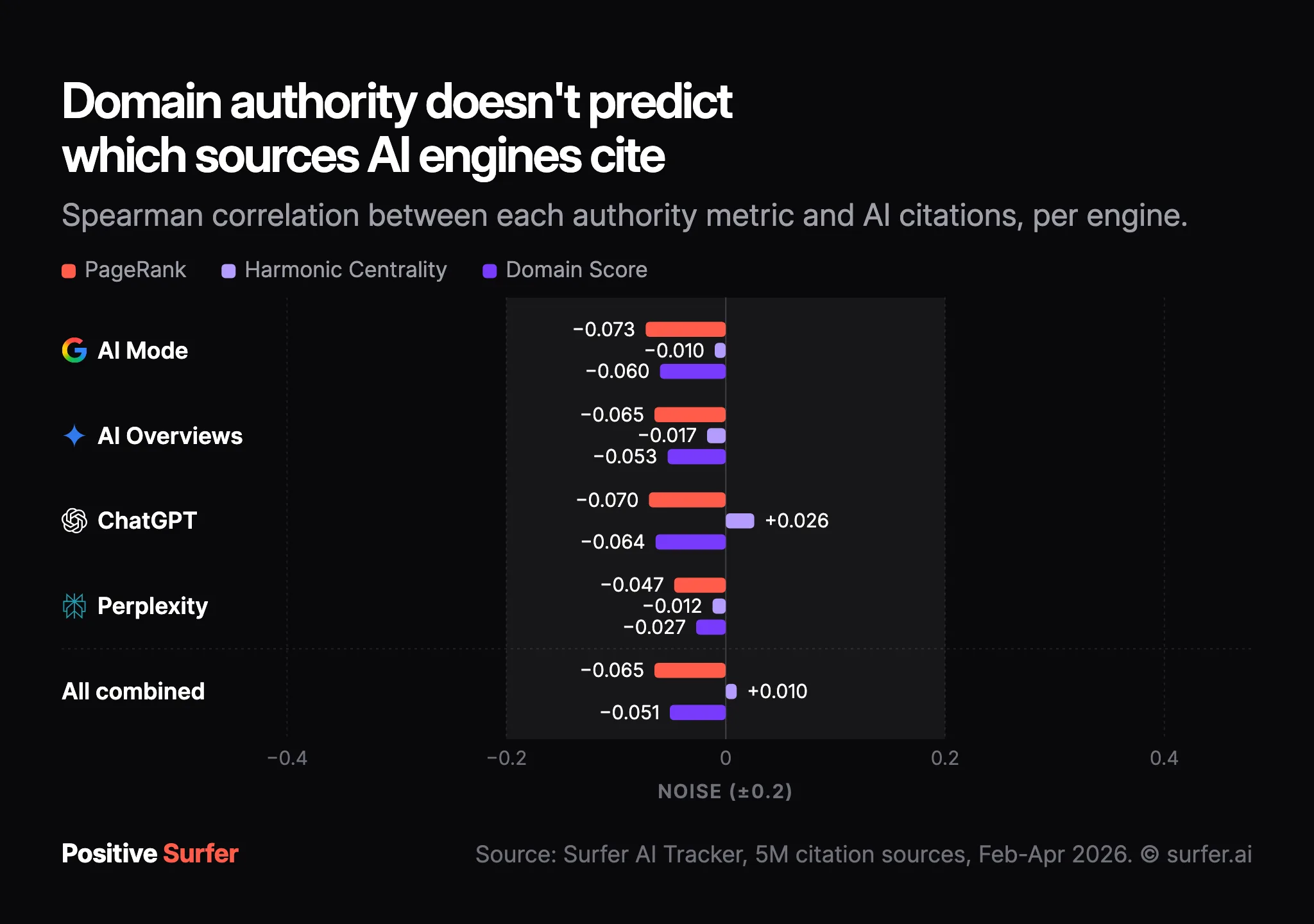
That doesn’t mean backlinks or authority no longer matter. It does suggest that traditional authority signals alone may not explain which pages AI systems choose to cite.
For agentic search optimization, that leaves more room for smaller sites to compete by making their content useful, specific, well structured, and easy for AI systems to understand.
How to optimize for agentic search in 7 steps
Agentic search optimization starts with understanding what AI agents can access on your site and then fixing the gaps that affect how they read, cite, and use your content. The process follows a deliberate order: measure first, fix what agents read, fix what agents can do, decide what is worth building, and then track the results.
Here are the seven steps:
- Measure how much of your page a machine can read.
- Cover the facts agents need.
- Rank for fan-out queries.
- Write passages agents can lift.
- Earn mentions on pages agents already cite.
- Publish key data in a machine-readable layer.
- Make key actions completable without a human-only interface.
1. Measure how much of your page a machine can read
Machine readability is how much of a webpage's content AI systems can access and interpret compared with what a human sees on the fully loaded page.
This is the best place to start because you can measure it on your own site in minutes. And the gap can be bigger than you might expect.
Adobe's AI Content Visibility Checker assigns each page a score out of 100% based on how much of its content is readable by machines. And in its analysis of U.S. retail sites, average scores were 75% for homepages, 74% for category pages, and 66% for individual product pages.
The range was also wide: the best-performing homepages scored 82.5%, while the lowest-performing ones scored just 54.2%.
That means a page can look complete to a human visitor while important parts of it remain inaccessible to AI systems. Adobe's checker is designed to show this difference by comparing an agent view with the fully loaded human view.
I also ran Adobe's AI Content Visibility Checker on two Surfer pages to see what an agent could actually access.
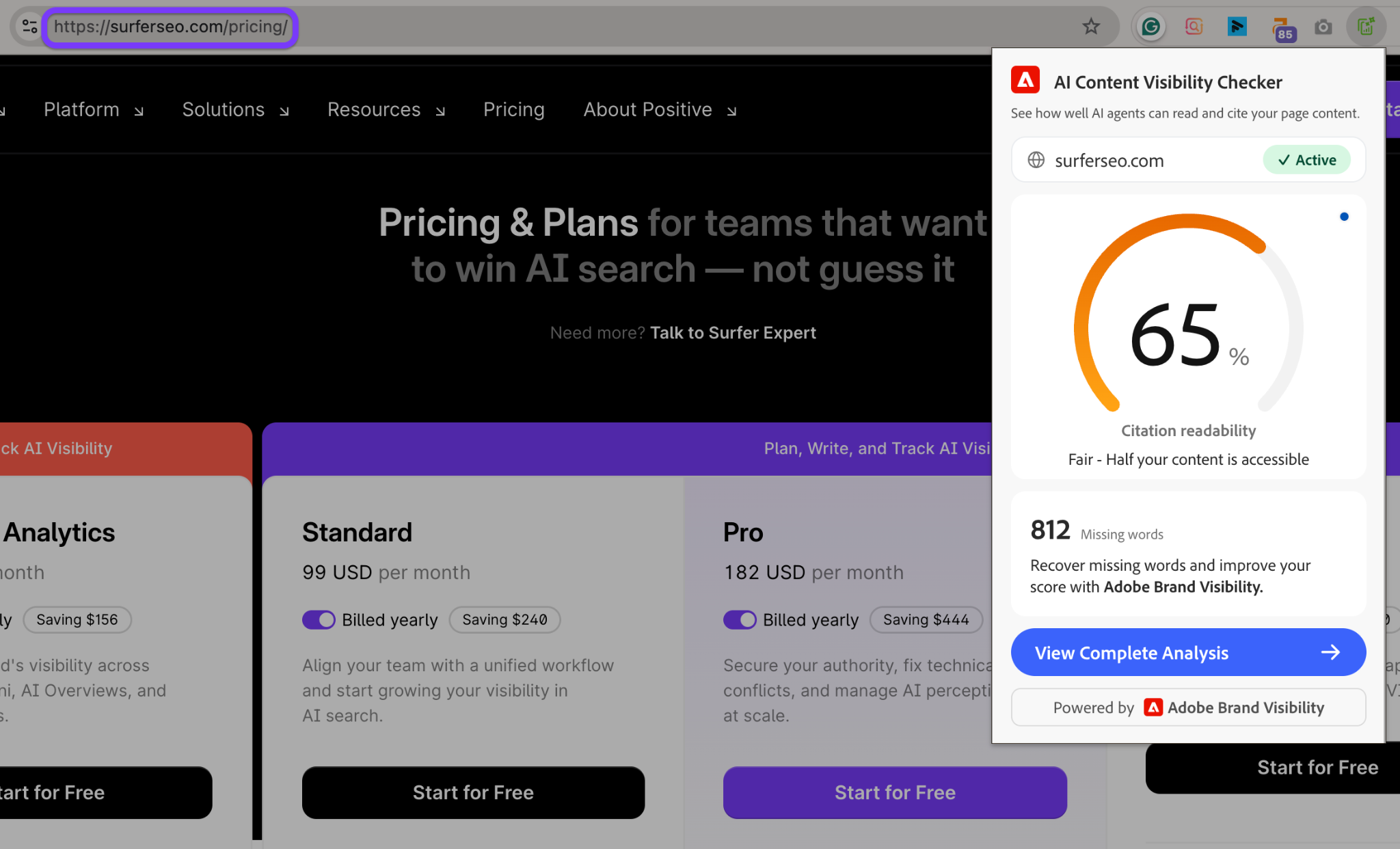
Surfer's pricing page scored 65% for citation readability, with 812 missing words. The checker marked it as "Fair" and showed that some content visible in the fully loaded page was not accessible to agents.
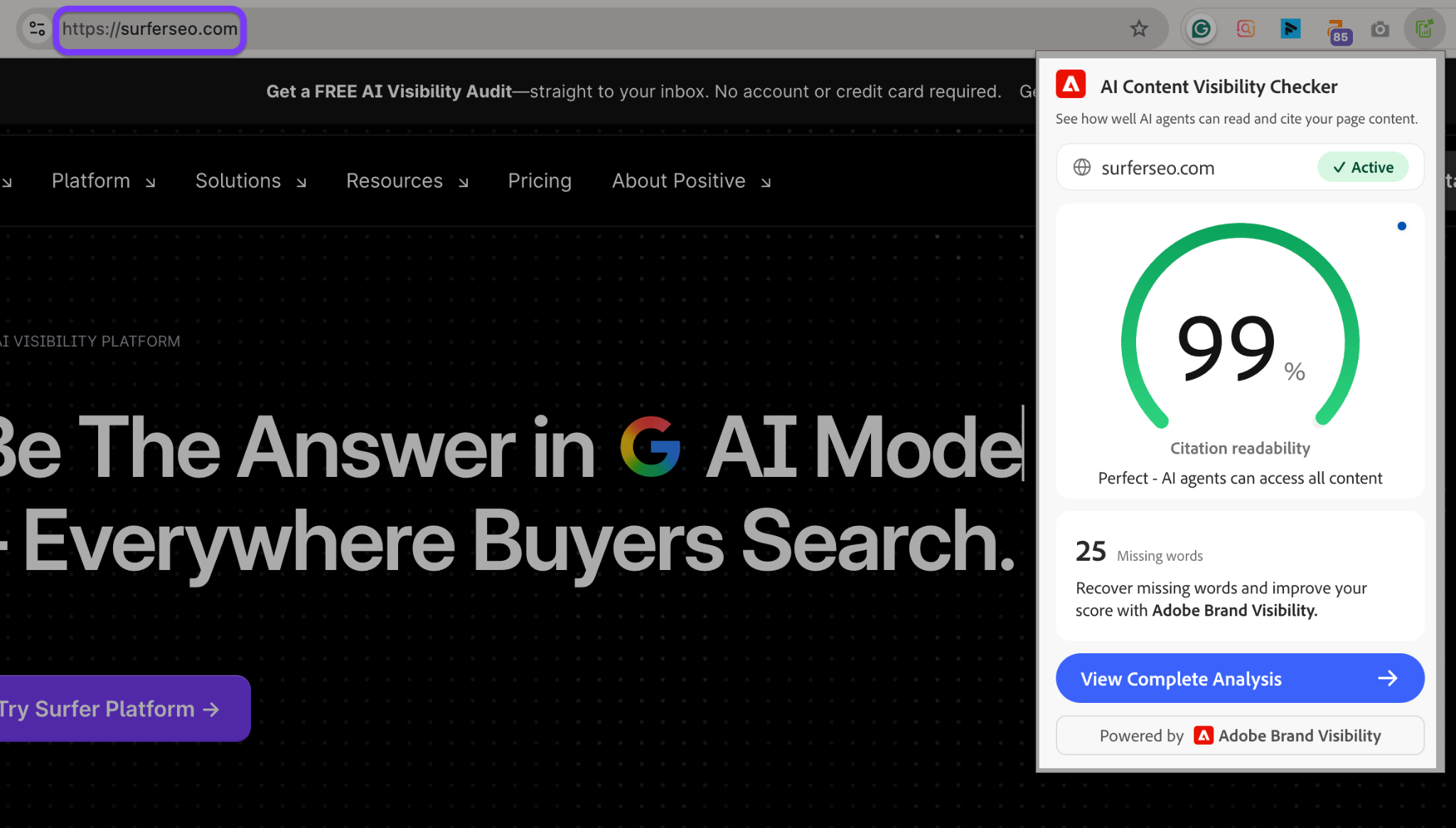
We then checked the Surfer homepage, which scored 99%, with only 25 missing words. The agent and human views were almost identical, and the checker classified the page as having "Perfect" citation readability.
That gives you a simple starting point for your own site: check your homepage and one important commercial page, such as a product or pricing page. Compare the scores, then look at what the agent view is actually missing.
If the score is low, don't immediately rewrite the page.
First identify what is being hidden. In our pricing-page test, for example, the next step would be to investigate the content that appears in the human view but not the agent view, then work with your development team to determine why it isn't being exposed.
The checker itself can help with this by showing the two versions side by side. Adobe's AI Checker explains that the tool analyzes what LLMs can and cannot read from a webpage:
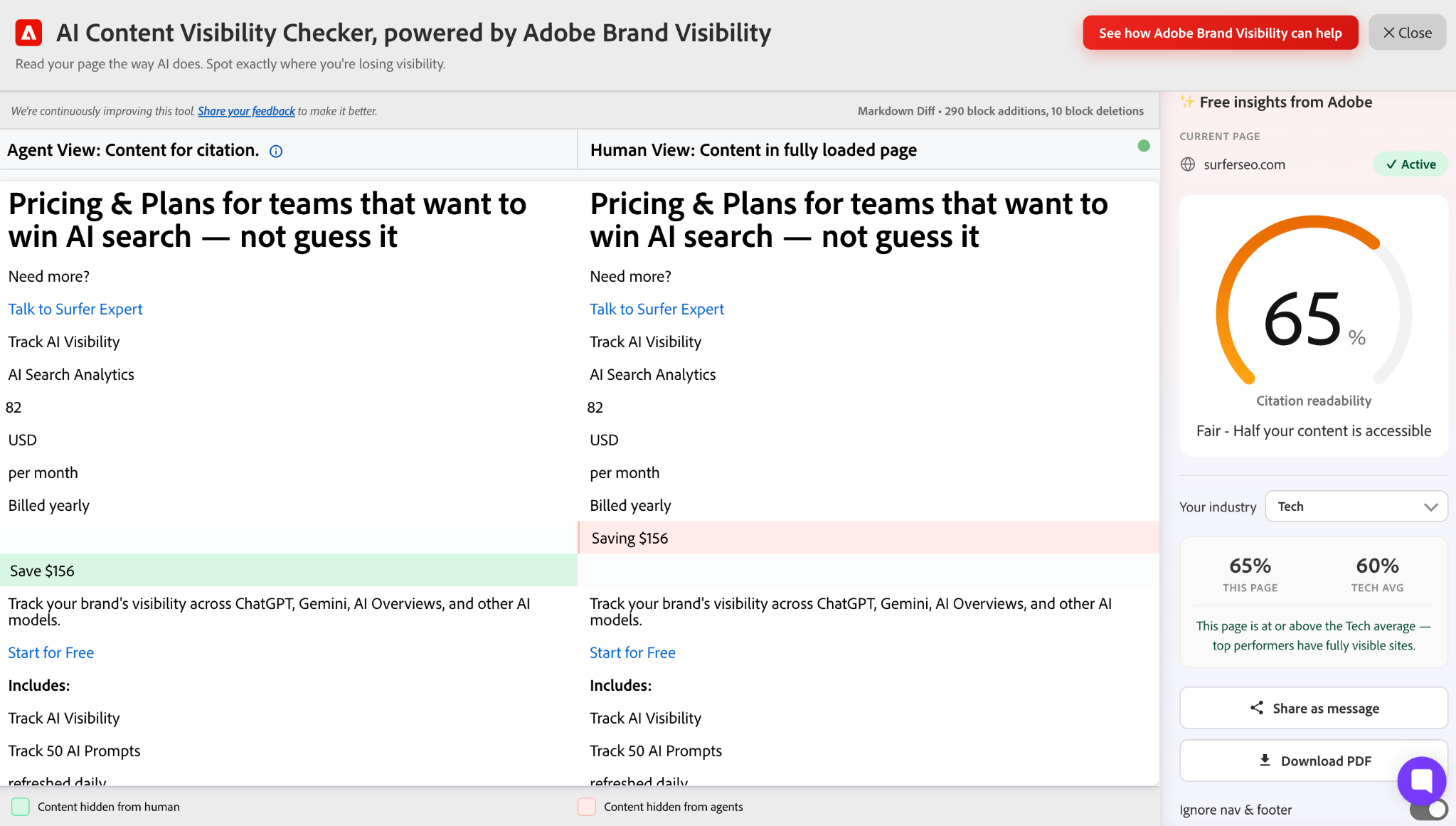
Your first change should be the biggest content gap you can see in the agent view, not a blanket rewrite of the page.
2. Cover the facts an agent needs to answer the whole question
AI agents need enough factual context to answer a question without filling in the gaps themselves. That means covering the fact set around a topic, not just the points your brand wants to highlight.
Surfer analyzed 57,253 pages and found that pages cited in Google AI Overviews had an average 31% fact coverage, compared with 24% for pages that weren't cited. The difference was even larger among frequently reused sources: core sources covered 42% of key facts, while pages that were never cited covered 23%.
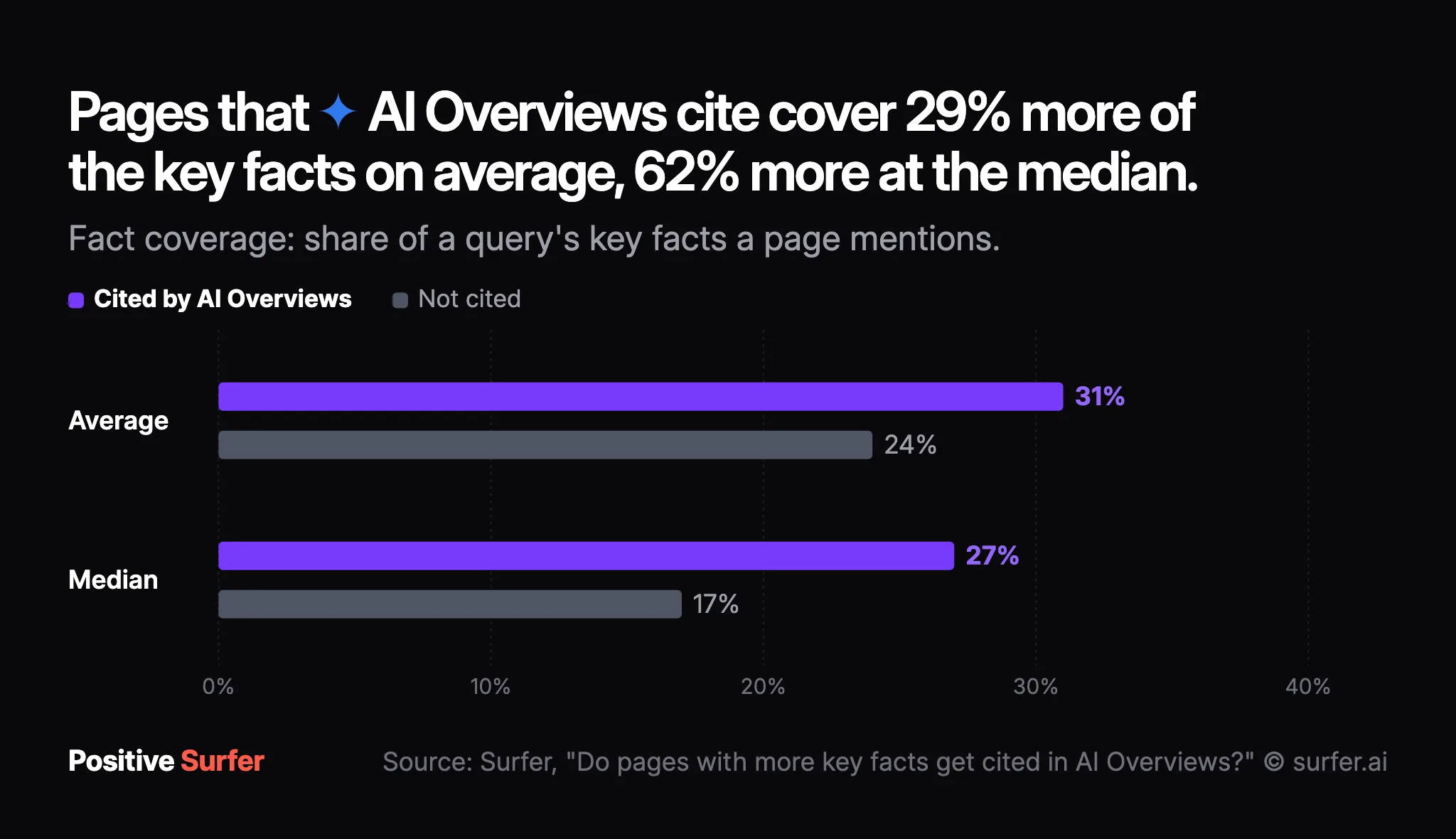
The goal isn't to make your content longer. It's to make it more complete.
Before writing or updating a page, build a fact set for the topic:
- Check the pages already being cited for your target query.
- Note the facts that appear across multiple sources.
- Look for specifications, limits, prices, conditions, requirements, comparisons, and exceptions.
- Add the information a reader would need to make sense of the answer, not just the benefits your own copy leads with.
- Make sure important claims are specific and verifiable.
For example, if you're writing about a product, don't stop at what it does. Cover the specifications, compatibility, limitations, pricing, use cases, and conditions that could change someone's decision.
Bee Pontoons is a great example of what this looks like in practice.
They launched their e-commerce site in February 2026 with zero domain authority, no backlinks, no existing content index, and no search history. And to gain citation authority in Google AI Overviews, the site targeted a narrow question, “how to stop bees drowning in bird bath,” and built a complete guide around it.
Instead of creating a product-focused post, the guide was built as a complete answer to the problem.
It covered why bees drown, bee-safety considerations, water-station features, and product options.
Each major section also opened with a 40–60 word standalone answer, giving AI search engines multiple self-contained passages to work with.
Within four months, the page earned three separate inline citations in a single Google AI Overview for the target query. The same content also appeared as a named product recommendation in ChatGPT and earned image and link citations in Perplexity.
And by August, four of the five cluster pages plus the pillar page had appeared in AI-driven Google surfaces.
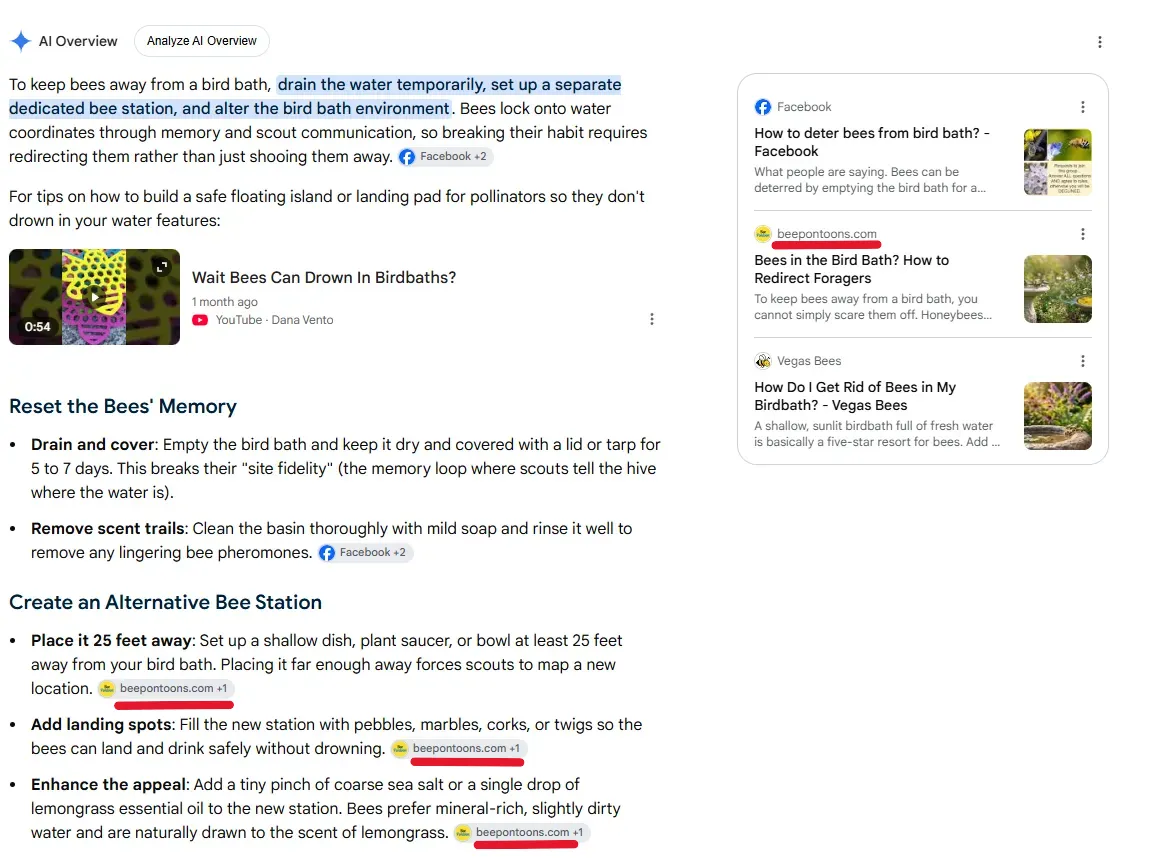
The case also included entity mapping and four types of schema markup and structured data, so it doesn't prove that fact coverage alone caused the citations. But what it does show is how a page can cover the full set of facts around a specific question instead of focusing only on what the brand wants to promote.
In other words, don't ask "What do I want to say about this topic?" Ask "What would an agent need to know to answer the entire question?"
3. Rank for the fan-out queries behind your head term
When an AI search engines answer a prompt, they can break that prompt into related search queries and use those results to build its answer. These fan-out queries can cover different angles, such as features, comparisons, use cases, or supporting questions.
Surfer analyzed 173,902 URLs and found that out of the cited pages that rank organically:
- 161% more likely to be cited: Pages ranking for both the main query and at least one fan-out query.
- 49% more likely to be cited: Pages ranking for fan-out queries only, compared with pages ranking for the main query only.
- 51.2% rank for both the main query and at least one fan-out query.
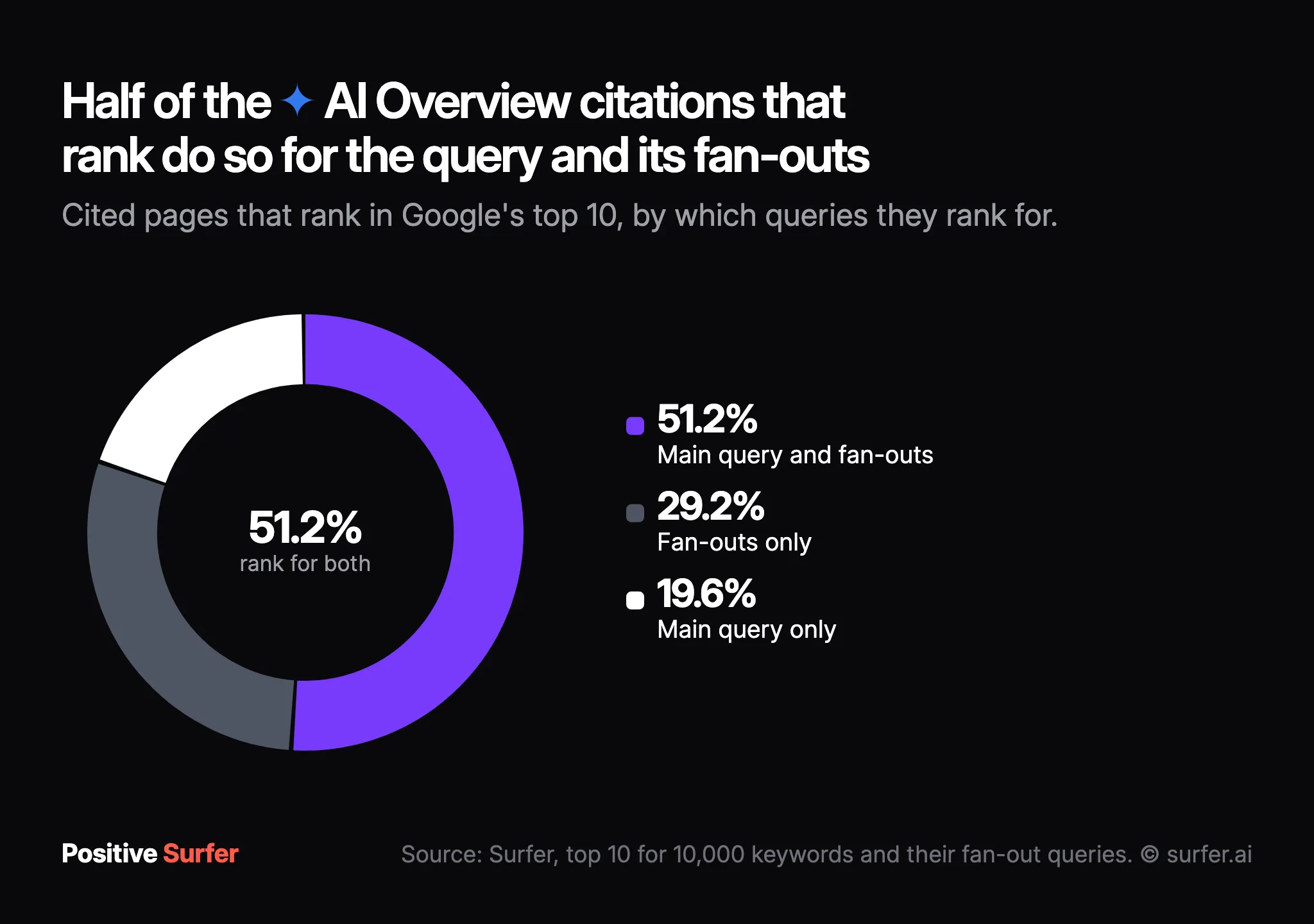
So, when you pick a head term, don't stop at the keyword itself. Think about user intent and the questions someone would ask around it. For example, for the keywords “best candidate sourcing tools,” those questions might include:
- What are the best tools for finding passive candidates?
- Which candidate sourcing tools work with LinkedIn?
- How much do candidate sourcing tools cost?
- What features should a candidate sourcing platform have?
These become your first fan-out set. You can then decide whether to cover them on the main page or create supporting content where a separate page makes more sense.
And you don't have to guess which related queries AI systems are researching. The Surfer AI Tracker Prompts report shows the prompts you track, with visibility score, mention rate, and average position for each one.
Use those prompts as research inputs: expand the ones that matter, review how models answer them, and map the related questions you still need to cover on your site.
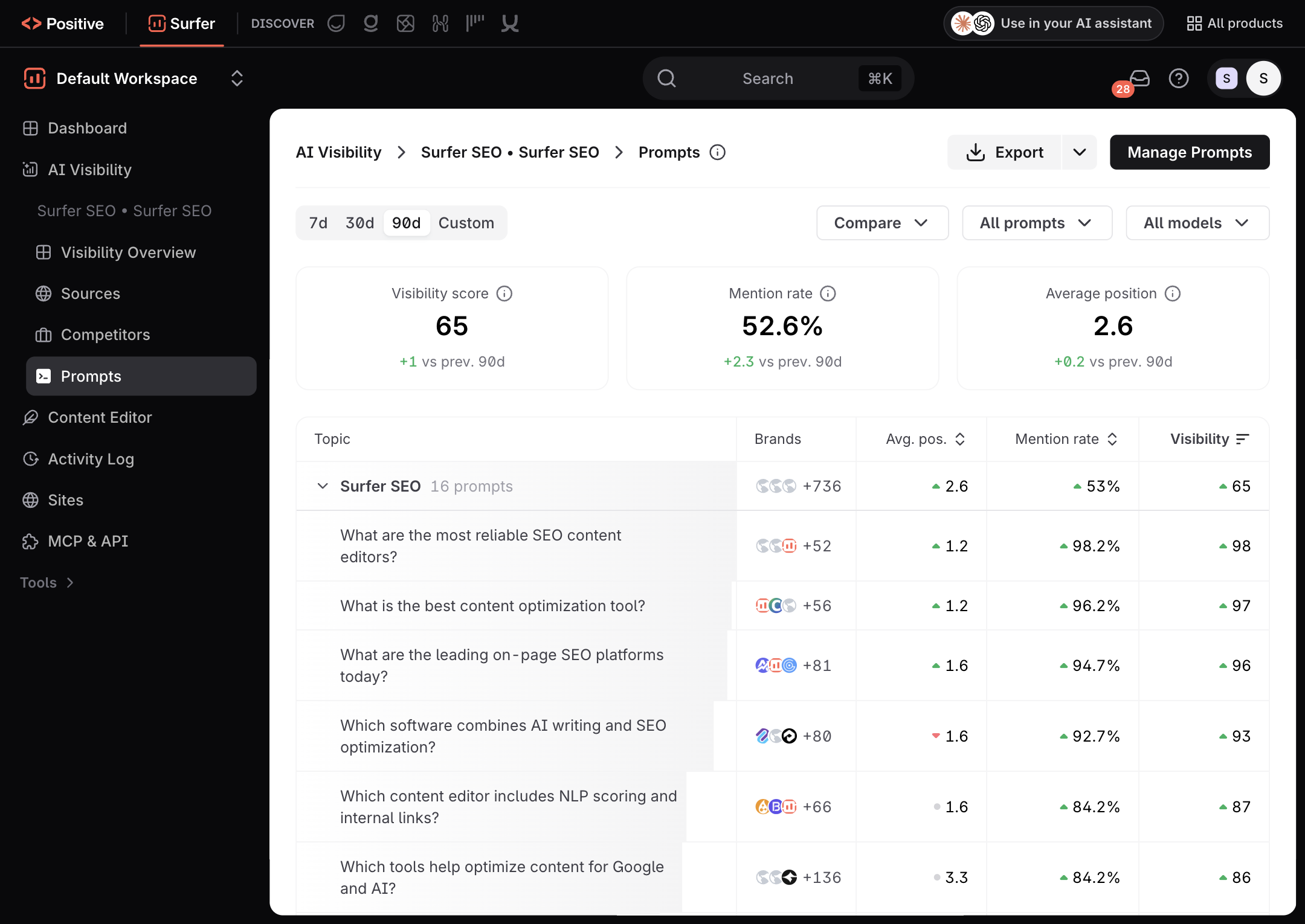
I like to use these queries or content clusters as research inputs to understand user intent, not a keywords to cram into one page.
Look for the topics and questions that keep coming up, then make sure your site has a useful answer for them. Surfer's research also found that fan-outs can vary between searches, so building broader topical coverage is more durable than trying to chase every individual query.
4. Write passages an agent can lift without editing
AI search engines can pull individual passages from a page to use in a generated answer. So when you have an important question to answer, make sure the answer is understandable even when it's isolated from the rest of the page.
You can optimize your answers by:
- Stating the claim first: Give the answer in the opening sentence.
- Adding the supporting context: Use the next two or three sentences to explain or qualify the claim.
- Removing dependencies on the surrounding text: Avoid phrases like “as mentioned above,” “this approach,” or “the method described earlier.”
- Be specific: A concrete fact or explanation is easier to extract than a vague statement.
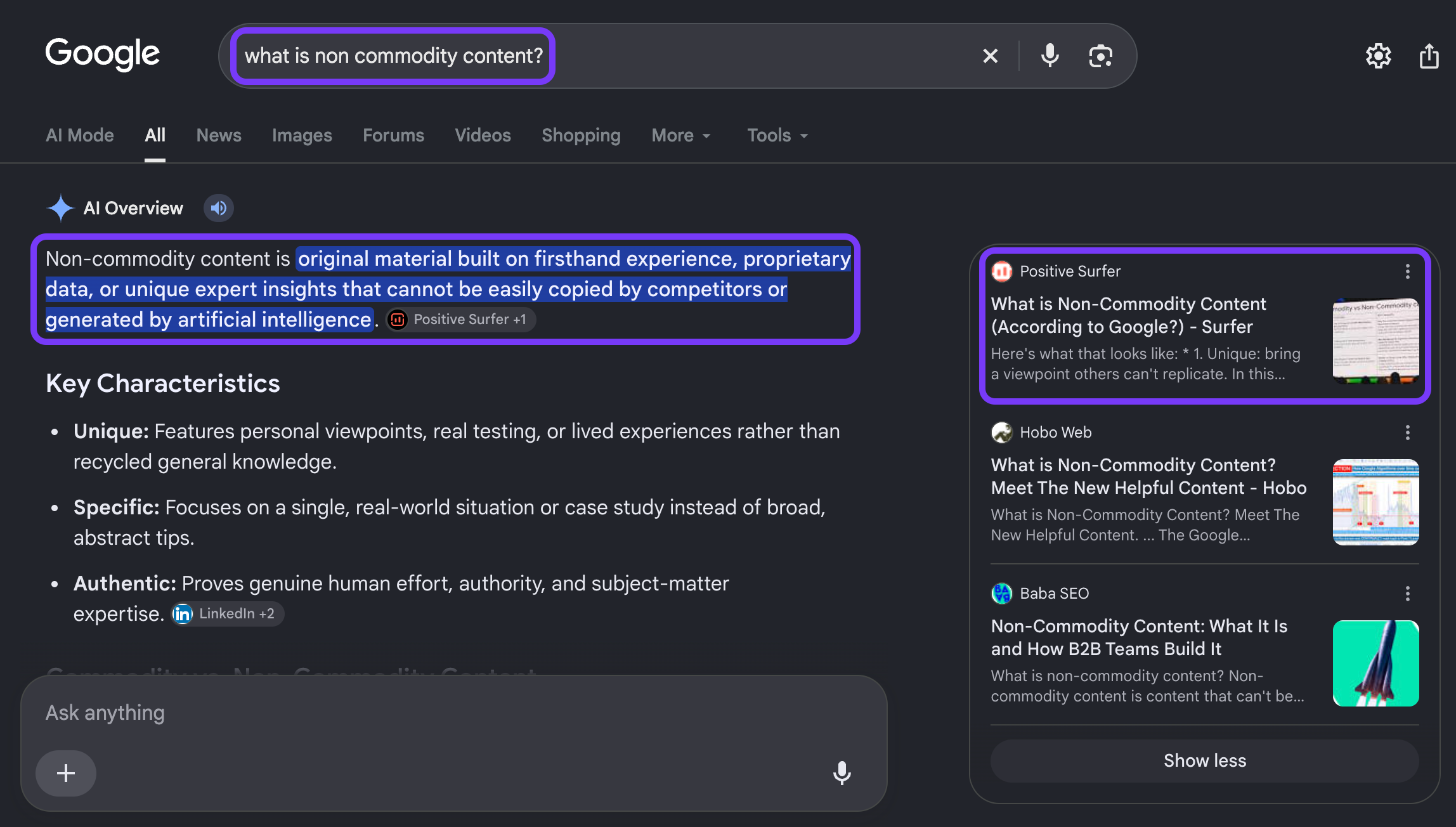
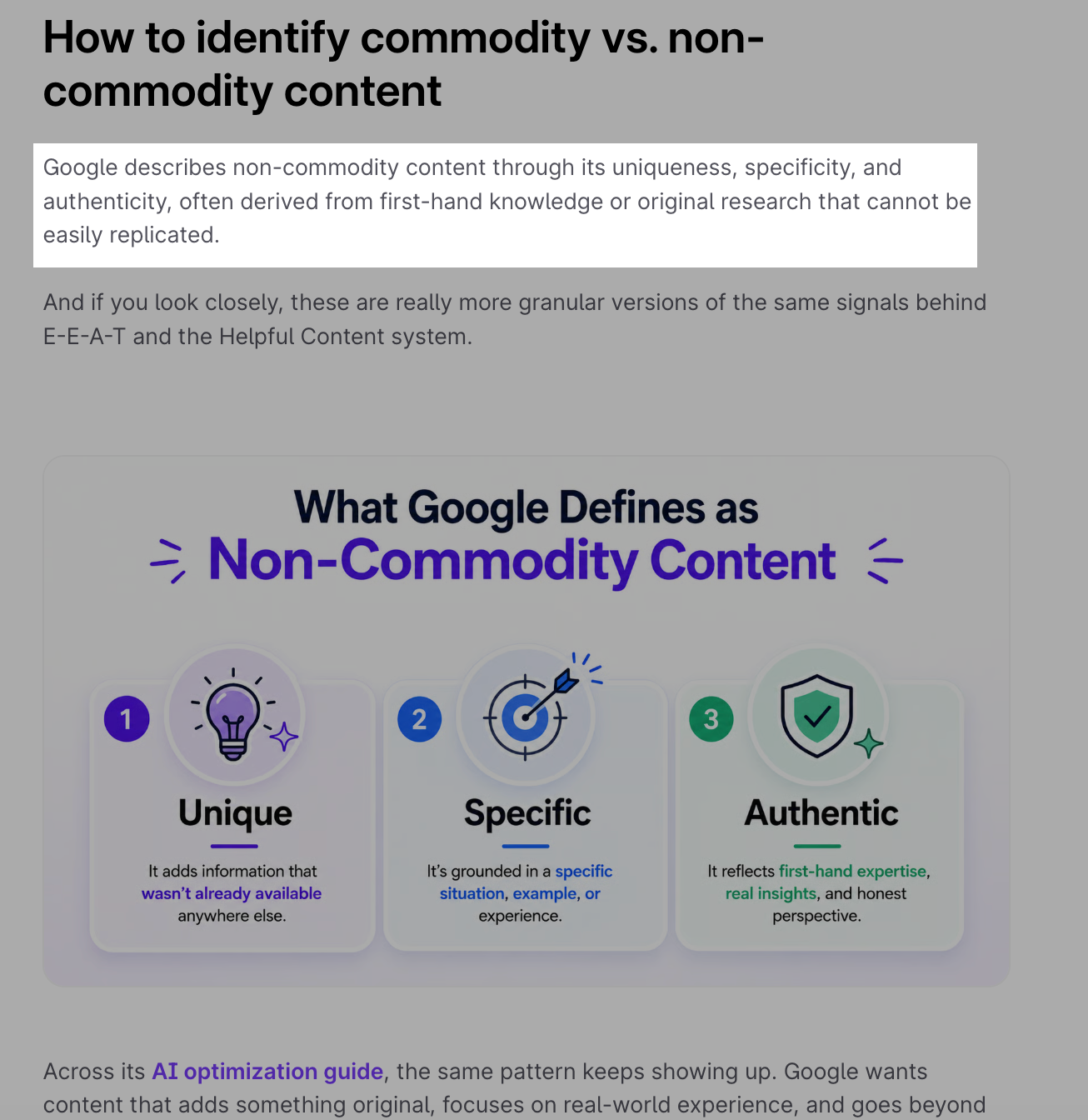
For example, Google's AI Overview for “what is non-commodity content?” pulls a definition from a Surfer blog that follows the same structure. The first sentence directly answers the question, then the passage explains what makes this type of content different. The source is also surfaced in the AI Overview's citation panel.
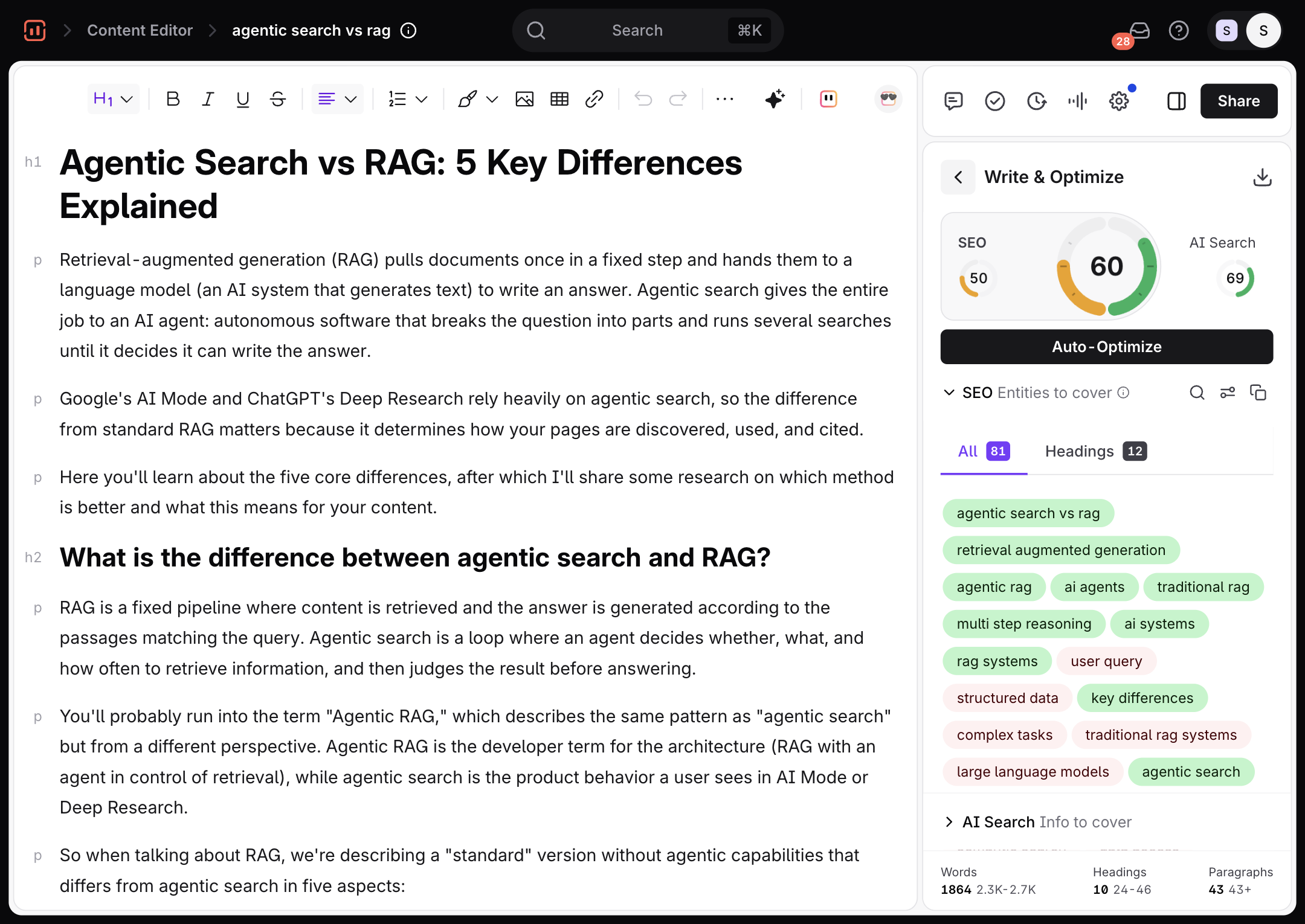
You can also refer to the Surfer Content Editor's AI Readability score and suggestions while writing.
It looks at how well your content works for AI-powered search, including whether it clearly answers the user's question and covers the relevant facts. Its AI Search score sits alongside SEO entities and AI Search Info to cover in the Write & Optimize panel, so you can see which facts and topics still need coverage while you write.
When reviewing your draft, focus on the passages that answer your most important questions. If one of them only makes sense after reading the paragraphs around it, rewrite it so the answer and its context are contained in the passage itself.
5. Earn mentions on the pages agents already cite
If AI agents repeatedly cite certain pages for your target topics, getting your brand mentioned on those pages can give them another piece of third-party evidence to work with. One Surfer study found a ~0.41 correlation between brand mentions on pages cited by AI and how often those brands were recommended.
The study looked at:
- 289,105 URLs
- 922 prompts
- ~0.41 correlation between cited-page brand mentions and recommendation frequency
Again, this is just one study, and the relationship is correlational, not causal. It doesn't show that earning a mention on a cited page will directly increase AI recommendations. Treat it as an early signal, not a settled rule.
For an agentic SEO strategy, start by finding the sources that already appear in AI answers for the topics you care about. Look across several relevant prompts, note which third-party pages come up repeatedly, and then identify where competitors are mentioned but your organization isn't.
Your first outreach list might include:
- Industry publications that already cover your category
- Comparison and "best tools" pages
- Relevant review sites
- Specialist blogs and resource pages
- High-authority publications covering your product or industry
Prioritize sources that are closely related to your topic and already show up in AI answers, rather than building a large list of unrelated websites, which can ultimately risk brand authority.
This is because AI agents need external evidence to function effectively when they research, compare options, and execute tasks for users. Your own website can explain what your business does, but independent sources can provide another layer of validation.
A B2B tech company's case study shows exactly how this kind of third-party visibility approach works.
The company started with zero AI visibility. When potential buyers asked AI assistants for solutions in its category, competitors appeared instead.
They then used ongoing prompt-gap analysis and digital PR to secure third-party editorial coverage.
Over three quarters, the company reported:
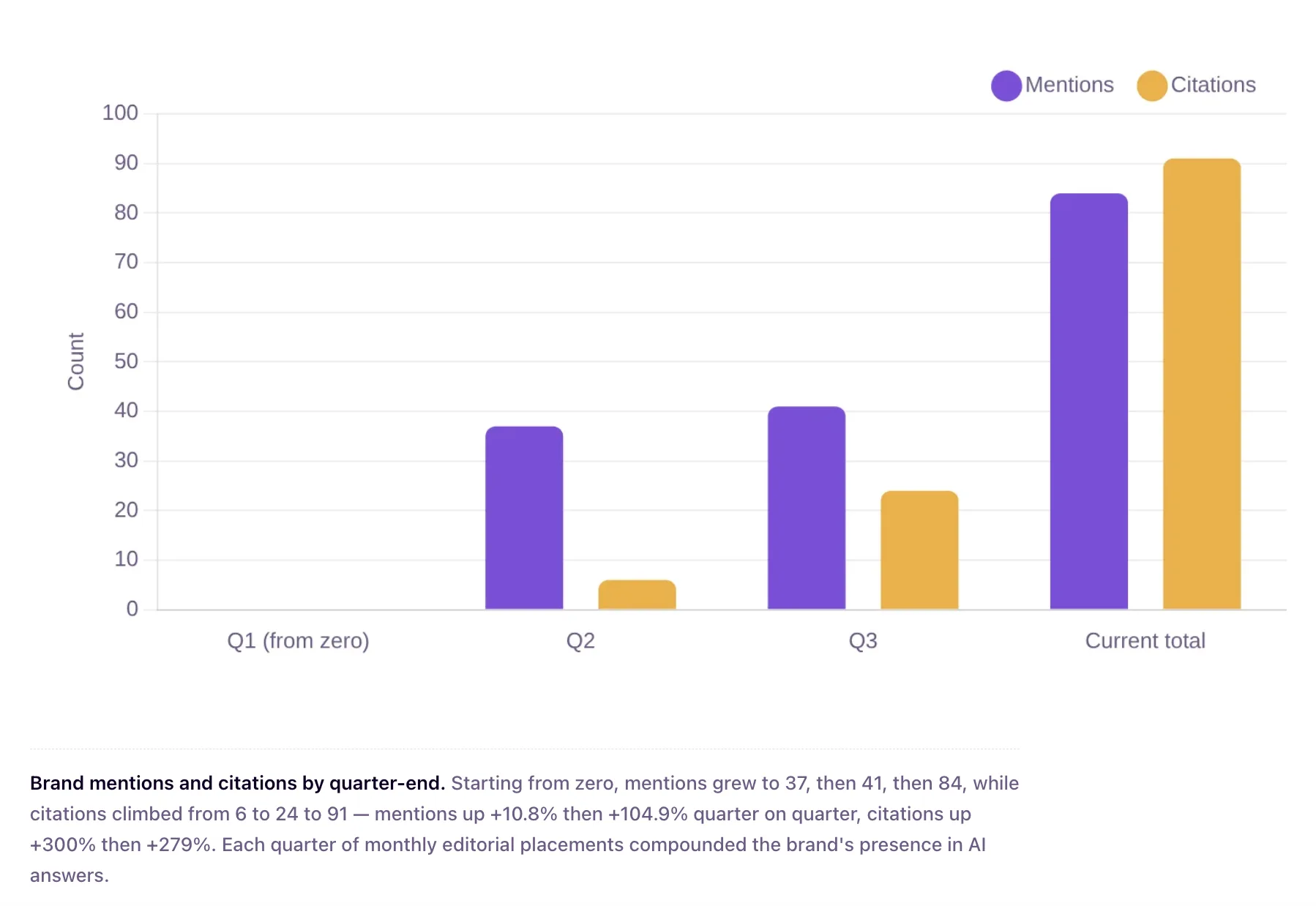
- Brand mentions: 0 → 37 → 41 → 84
- Brand citations: 0 → 6 → 24 → 91
- Editorial placements: 19 across 15 publications
- AI engines tracked: 5, including ChatGPT, Google AI, and Perplexity
The placements were on publications with an average domain rating of 78.5, with several above 90, ultimately becoming third-party evidence that AI engines used when recommending the company.
The result is interesting, but it comes with an important caveat: the case study doesn't identify which individual publications were already being cited for the company's target prompts, or which specific placement led to a particular recommendation.
Multiple things also happened during the campaign. So it shows that sustained third-party coverage coincided with growing AI visibility, not that outreach alone caused the increase.
That's particularly important in the early days of AI-generated content and AI search as SEO teams are still learning how agents evaluate sources, and sudden spikes in visibility don't necessarily tell you which tactic caused them.
Track your citations, mentions, and recommendations over time, but treat each result as evidence to investigate rather than a guaranteed formula.
6. Publish your key data in a machine-readable layer
Once you've fixed what agents can read, make the important information easy for them to interpret and compare. This is where structured data markup, consistent product and entity information, and server-rendered content matter.
Remember the machine-readability results from step 1: product pages had the lowest average score at 66% according to Adobe.
That's especially important for agentic SEO because product pages contain the details an agent needs to compare options, such as price, availability, specifications, features, and brand information. And structured data is what helps search engines understand and categorize content.
Start with the information that changes how someone would evaluate your product or business:
- Product schema: Mark up product details such as name, description, price, availability, brand, and other relevant attributes.
- Organization schema: Clearly connect your brand to its name, website, logo, and other consistent identity information.
- WebPage or Article schema: Help identify what a page is about and how it relates to the rest of your site.
You don't need to implement every schema type available. Pick the ones that describe the information your SEO agents need to understand, and keep that information consistent across your website and other sources.
Also check how your pages are rendered.
If important product details only appear after client-side JavaScript runs, an agent may not have access to the same information a human sees. Structured data can't compensate for content that doesn't exist in the initial page output.
For teams working on this now:
- Check your most important product or service pages
- Make sure the essential facts are present in the HTML
- Add the relevant schema markup
- And keep product and entity data consistent across the site
This is particularly useful for businesses and marketing agencies managing large numbers of SEO pages, where repetitive tasks can create inconsistencies.
7. Make your key actions completable without a human-only interface
If an AI agent is expected to book a demo, request a quote, or sign up on your site, it needs the ability to get through the same basic flow as a human visitor. Common blockers include content hidden behind extra clicks, modals that trap focus, buttons or fields without clear accessible names, and CAPTCHAs on public paths.
You don't need to build a special protocol integration for this. A simple browser-agent test can show whether an important action is actually usable by an agent.
For example, I asked an agentic AI browser (Browser Use) to fill out Surfer's book a demo form using test details and stop before submitting it.
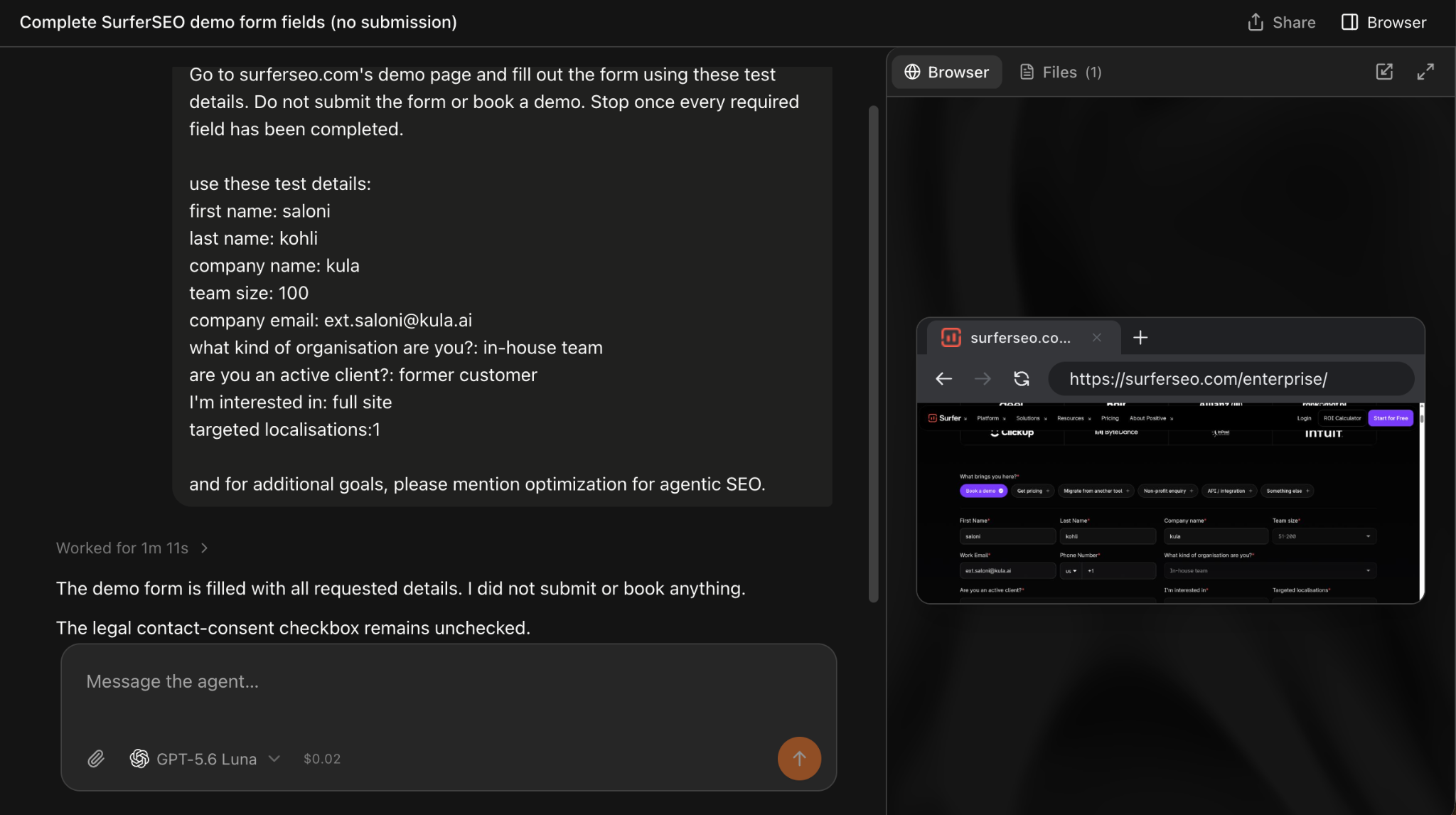
The agent completed the text fields and even worked through the form's dropdown selection controls, including:
- What kind of organisation are you?
- Are you an active client?
- I'm interested in
- Targeted localisations
It also filled in the additional information field without submitting the form.
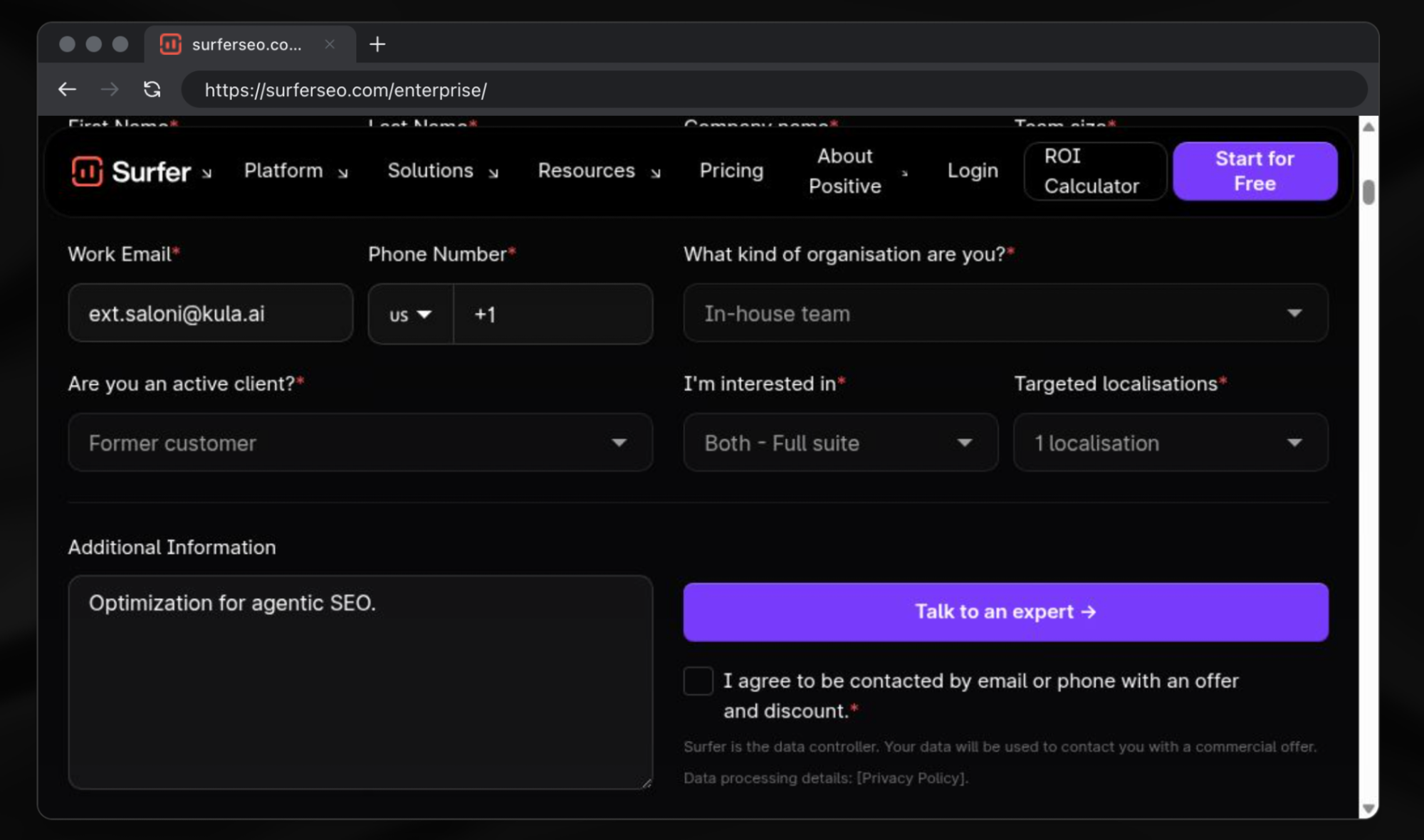
This kind of test gives teams a practical way to find interaction problems before they affect an agent trying to execute tasks on the site. Run it on one action that matters to your business and record exactly where the agent succeeds or stops.
The result can also point to accessibility, analytics, or security issues worth checking.
Protocol-level integrations are a separate consideration. For this step, focus on whether agents can actually use the customer-facing paths you already have.
Which agentic search optimization tactics are not worth doing yet?
Not every part of the agentic SEO stack needs your attention right now.
The clearest example is agent-led checkout. OpenAI launched Instant Checkout with U.S. Etsy sellers in September 2025 and pulled back on March 4, 2026.
Walmart found that purchases completed inside ChatGPT converted at roughly one-third the rate of users who clicked through to Walmart.com. OpenAI then shifted toward a discovery-first model, expanding the Agentic Commerce Protocol (ACP) so ChatGPT could help shoppers discover and compare products while routing transactions through third-party apps.
That makes protocol work a bigger commitment than it might first appear. Most businesses would need to consider how these standards fit together before investing development time in one, and the ecosystem is still evolving.
There's clear research showing that AI can help people discover products, but that doesn't mean businesses and SEO teams should rush to rebuild their checkout around agentic SEO.
The technology behind agent-led transactions is still changing, too.
ACP, AP2, UCP, MCP, and A2A all address different parts of how agents, businesses, and payment systems can interact. Some can also work together. For example, UCP is designed to work with AP2, A2A, and MCP rather than replace them.
This matters because supporting one protocol today may not be enough tomorrow, and there is not yet enough evidence to recommend that most businesses take on that implementation work as part of an agentic SEO strategy.
There's also a similar question around llms.txt.
Adoption evidence is still limited, so it makes more sense to keep an eye on how it develops than to make it a major part of your current AI search strategy.
For now, teams should focus on optimizing the parts of agentic search you can measure today, and watch the transaction layer as it develops. Use your audit, collect analytics, and research to decide when a new agent capability has enough evidence to justify the work for a revamped SEO strategy.
How to measure agentic search optimization
Since 67.82% of AI Overview citations didn't rank in Google's top 10 for the query or any of its fan-out queries, traditional rank tracking only shows part of the picture. A page can be missing from your usual SEO analytics reports and still be cited in an AI response.
Your dashboard should track the signals that traditional SEO tools miss:
Look at these measures together rather than relying on one number.
A strong machine-readability score tells you agents can access the page, while fan-out rankings and citation rates show whether they are actually finding and using it. Agent-referred sessions and conversion rates show what happens after that traffic reaches your site.
The crawl-to-refer ratio adds another useful layer. It shows how much HTML-page crawling a platform does for each HTML-page referral it sends, helping you understand whether increased agent activity is translating into visits.
Use these measures alongside your usual SEO reporting to see where agents are finding your site, what they use, and whether that activity is turning into visits and conversions. Rankings still matter, but they won't show whether AI systems are finding, citing, or sending traffic to your site.
What is the difference between agentic SEO and agentic search optimization?
Agentic SEO means using AI agents to do SEO work, such as keyword research, content optimization, or site audits. Agentic search optimization means optimizing your website so AI agents can find, understand, verify, and use it. The two sit alongside SEO, generative engine optimization and answer engine optimization.
Can AI agents complete tasks on websites reliably?
Not yet. On Online-Mind2Web, which tests 300 tasks across 136 live websites, the strongest tested agent completed 61.3% of tasks. On EconWebArena, the best model reached 46.9% task success, compared with 93.3% for humans. Reading a page is still much easier than completing a task on it.
Does AI-referred traffic convert?
Some of it does. Adobe found that in March 2026, AI-referred traffic to U.S. retail sites converted 42% better than non-AI traffic, after converting 38% worse a year earlier. That measures people arriving from AI sources, not autonomous agents completing purchases on their behalf.
Should you build for agent checkout protocols now?
Not for most businesses. OpenAI pulled back Instant Checkout in March 2026, and ACP, AP2, UCP, MCP and A2A each cover different parts of how agents and businesses interact while the ecosystem keeps changing. Optimize the parts of agentic search you can measure today and watch the transaction layer.
How do you measure agentic search optimization?
Track several signals together: machine-readability scores by page template, the share of fan-out queries you rank for, citation and mention rates per prompt, agent-referred sessions and conversions, and crawl-to-refer ratios by platform. Rank tracking alone misses many AI citations, because most cited pages do not rank in Google's top 10.